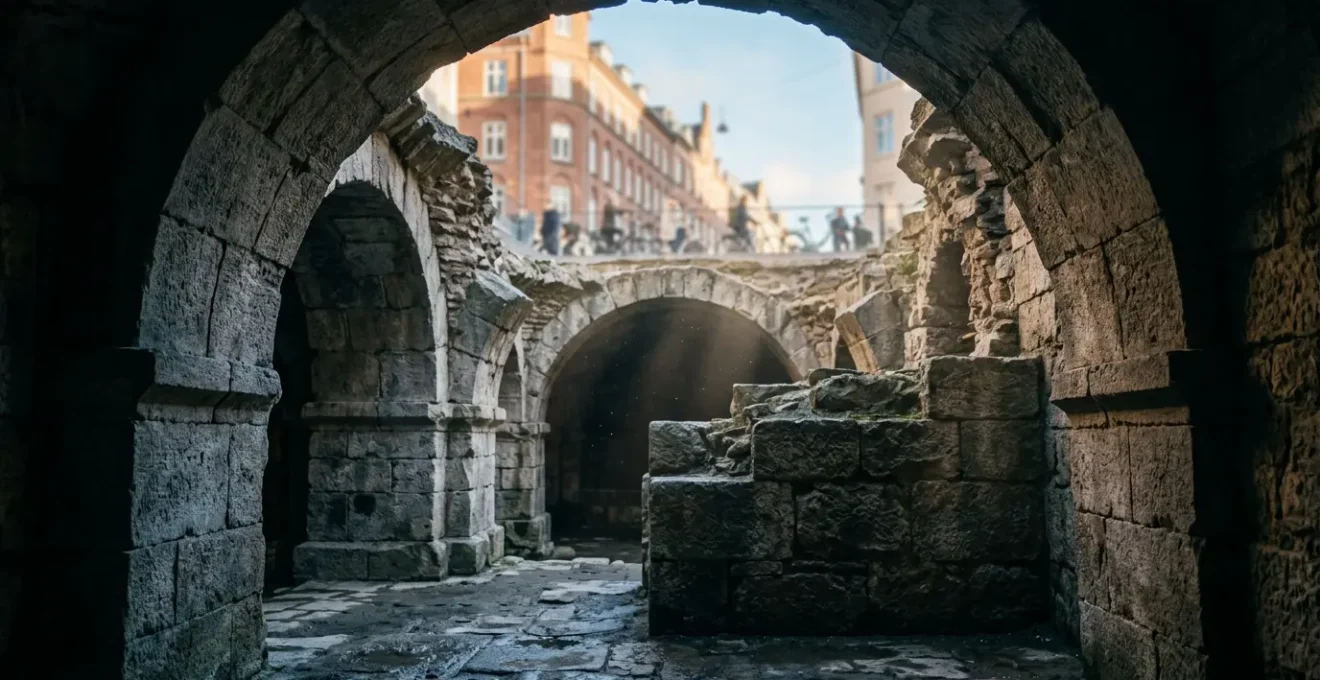
Most believe Copenhagen’s medieval past was erased by its great fires. The truth is more complex: it wasn’t lost, but buried. This guide reveals how to read the clues left behind by destruction and rebuilding. By understanding the forces of erasure—fire, faith, and royal power—you can uncover the authentic medieval city hidden in plain sight, from fire-resistant church walls and ghost-like street patterns to the very foundations of power built upon pagan relics.
Copenhagen presents a puzzle to the history lover. You arrive seeking the dark, winding alleys of a medieval port, only to find a city of elegant spires, broad squares, and harmonious Baroque facades. The great fires of 1728 and 1795 are the usual explanation, catastrophic events that wiped the slate clean. Standard guides point you towards the reconstructed landmarks, the polished surfaces of a city that rebuilt itself with ambition and order. They show you a beautiful city, but not necessarily the ancient one you came to find.
But what if the key to finding medieval Copenhagen isn’t looking for what survived, but understanding the very process of its disappearance? An urban archaeologist doesn’t just look at buildings; they read the scars, the layers, the “ghosts” in the city plan. The fires were not just an end, but a beginning—an opportunity for monarchs to impose a new, rational vision on the chaotic medieval core. The true medieval city is an urban palimpsest, a hidden layer that can still be traced if you know how to look.
This investigation will equip you with the tools for this unique form of discovery. We will descend into the city’s foundational ruins, perform architectural forensics on a church that refused to burn, and learn to walk the invisible medieval street grid. We will unpack not only the destructive force of fire but also the cultural and political erasures that came before and after. This is not a hunt for what’s left; it’s a guide to seeing what is hidden.
This guide provides a complete itinerary for your investigation. Follow the sections to uncover the evidence piece by piece, from the deepest ruins to the ideological battles that shaped the city’s very soul.
Summary: Uncovering Copenhagen’s Buried Medieval Core
- How to Visit the Bishop’s Castle Ruins Under Christiansborg Palace?
- Why Did St. Peter’s Church Survive When Other Medieval Buildings Didn’t?
- Can You Still Walk the Original Medieval Street Grid of 1400?
- The Fire of 1728: How Did It Erase 80% of the Medieval City?
- What Is the Most Efficient Walking Route for Medieval Sites?
- How to Explore 1000 Years of Royal History in a 3-Day Weekend?
- The Longest Inscription: Is the Glavendrup Stone Worth the Drive to Fyn?
- Beyond Jelling: Where to Find Runestones Hidden in Church Porches?
How to Visit the Bishop’s Castle Ruins Under Christiansborg Palace?
Your investigation begins at the absolute heart of power and the city’s deepest layer: the ruins beneath Christiansborg Palace. This is not just a basement; it is the archaeological bedrock of Copenhagen. Here lie the foundations of Bishop Absalon’s Castle, the fortress that started it all. Archaeological excavations confirmed that the ruins date back to 1167, marking the official birth of the city as a fortified center.
To visit is to descend through time. As you go underground, the first thing you notice is the sensory shift: the temperature drops, the air grows heavy with the smell of damp, ancient stone, and your footsteps echo in vaulted chambers. This is where the detective work starts. You are looking for the story told in the masonry. Your primary target is the gleaming white limestone curtain wall, built from stone hauled from Stevns Klint. This is the oldest part, the 12th-century fortress of Absalon. Contrast it with the broader, less refined foundations of the 14th-century Copenhagen Castle that were built around and over it.
Look for the details that bring the past to life. Seek out the preserved well made from hollowed oak trunks, a direct link to the daily lives of the castle’s first inhabitants. Notice the foundations of smaller houses built within the protective curtain wall. This wasn’t just a military fort; it was a self-contained community. Observing the half-centimeter joints in the original ashlar blocks reveals a level of craftsmanship that speaks to the immense resources and ambition behind the city’s founding. This subterranean world is the essential first chapter in Copenhagen’s story of burial and rediscovery.
Why Did St. Peter’s Church Survive When Other Medieval Buildings Didn’t?
After finding the city’s origin point, the next step is to understand survival. Why does one medieval structure stand today when so many others vanished? The answer lies in St. Peter’s Church (Sankt Petri Kirke) and provides a crucial lesson in architectural forensics. While the great fire of 1728 consumed its interior, the church’s essential structure endured, making it a key witness to the catastrophe.
Case Study: The Resilience of Gothic Brick
The survival of St. Peter’s Church is a textbook case of material advantage. Most of medieval Copenhagen was a tinderbox of densely packed, timber-framed houses. When the fire swept through, these structures were completely annihilated. St. Peter’s, however, was built in the mid-15th century using Gothic brick construction. During the fire, its roof and interior were gutted by the flames, but the outer brick walls remained standing. This structural integrity meant the church could be rebuilt by architect Johan Cornelius Krieger, while its timber-framed neighbors were reduced to ash. Its survival is direct physical evidence of how brick was far more fire-resistant than the wood that dominated medieval construction.
When you visit St. Peter’s, you are not just seeing an old building; you are seeing a survivor whose very walls tell a story of fire and resilience. Look closely at the masonry. The weathered, irregular surfaces are the skin of a building that withstood an inferno.
This visual evidence is crucial. Unlike the perfectly restored facades elsewhere, the aged bricks of St. Peter’s are a tangible connection to the pre-fire city. It stands as a testament not just to faith, but to the simple, robust engineering that allowed it to bridge the gap between the medieval world and the modern one. It is Copenhagen’s oldest operative church because its builders chose brick over wood, a decision that literally saved it from being wiped off the map.
Can You Still Walk the Original Medieval Street Grid of 1400?
While fires and rebuilding erased most of the medieval buildings, they could not completely erase the city’s footprint. The original street plan of 1400 is a form of ghost topography—an invisible framework that still dictates the flow of the modern city center. You can still walk it today, but you need to know the signs. The key is to look for organic, human-scaled patterns that contrast with the rigid, wide boulevards of the post-fire era.
Your primary targets are streets like Magstræde and Snaregade. Notice their gentle, natural curves. These are not the product of a planner’s ruler; they are the result of centuries of foot traffic and cart wheels following the path of least resistance. This organic shape is a hallmark of a pre-planned medieval layout. Compare their narrowness to the grander streets nearby. They were designed for a world without modern circulation, creating an intimate, almost claustrophobic feel that is authentically medieval. These streets are living artifacts of the city’s original scale.
The medieval heart of the city was its market, located at Gammeltorv and Nytorv (Old and New Squares). Though the surrounding buildings are post-fire reconstructions, the squares themselves occupy the same space where traders and citizens have gathered for over 800 years. Standing here, you are standing in the city’s medieval nucleus. To trace the city’s former boundaries, walk the paths of Ørstedsparken and the Botanical Gardens. These parks follow the “ghost” routes of the original defensive ramparts that once encircled the city, their gentle slopes hinting at the earthen walls that lay beneath. Finally, for a true subterranean experience, seek out the restaurants and shops in the Latin Quarter, many of which offer access to their authentic, vaulted medieval cellars—the deepest surviving layer of private architecture.
The Fire of 1728: How Did It Erase 80% of the Medieval City?
The Copenhagen Fire of 1728 was more than a tragedy; it was an urban extinction event. While the “80% erased” figure often cited is an informal combination of fire damage and subsequent rebuilding, the documented statistics are staggering enough. According to historical records, a devastating 47% of its medieval section was destroyed. The fire ultimately destroyed around 28% of the city’s properties overall, leaving 15,000 people—20% of the population—homeless. But how did it spread with such apocalyptic speed?
The answer lies in the very fabric of the medieval city. It was a dense network of narrow streets, packed with half-timbered houses whose upper floors often jettied out, nearly touching across the alleyways. This created a perfect fire-spreading environment. The narrow gaps between buildings acted as wind tunnels, fanning the flames and sending embers flying across rooftops. Once a fire took hold in this landscape, it was almost impossible to contain.
This urban density was the city’s fatal flaw. As the illustration shows, the close-set buildings and narrow passages created a natural funnel for both wind and fire. The lack of firebreaks, the timber construction, and a delayed, disorganized response created a perfect storm. The fire raged for three days, leaping from block to block, consuming the university library with its priceless manuscripts, several churches, and thousands of homes.
The blaze didn’t just destroy buildings; it incinerated the material culture of an entire era. It was this near-total destruction of the medieval core that gave planners a tabula rasa—a blank slate upon which to impose a new, more orderly, and less flammable city. The fire was the catalyst that allowed the transition from a chaotic medieval town to a planned Baroque capital.
What Is the Most Efficient Walking Route for Medieval Sites?
Armed with an understanding of the city’s foundations, its survivors, its layout, and its destruction, you can now embark on an efficient walking investigation. This route, which we’ll call “The Survivor’s Trail,” is designed chronologically and logically to connect the key pieces of evidence you’ve learned to look for. The entire trail covers a manageable 2.6 km (1.6 miles) and takes approximately 2 hours, making it a perfect half-day mission.
This is more than a sightseeing tour; it’s an active process of discovery. You will connect the dots between the city’s deepest foundations and its most resilient survivors, tracing the story of medieval Copenhagen on foot. The following checklist will guide your path from the epicenter of power outwards.
Your Action Plan: The Survivor’s Trail
- Start at the Foundation: Begin at the Christiansborg Palace Ruins. Access the underground entrance to stand on the ground of Bishop Absalon’s 1167 castle, the city’s birth certificate in stone.
- Walk to the Marketplace: Head north to Gammeltorv/Nytorv. Although the buildings are newer, you are standing in the physical space of the medieval market, the city’s historic commercial and social heart.
- Find the Church Monastery Roots: Continue to the Church of the Holy Ghost (Helligåndskirken). While rebuilt, it sits on the site of a 13th-century monastery, representing the powerful religious presence in the medieval city.
- Discover a Hidden Square: Detour to Gråbrødretorv (Greyfriars Square). This cozy square, with history dating to a 13th-century Franciscan friary, preserves the intimate scale of the old city.
- End with the Ultimate Survivor: Finish your walk at St. Peter’s Church (Sankt Petri Kirke). As the oldest operative church, its fire-resistant 15th-century brick walls make it the ultimate symbol of medieval endurance.
By following this route, you are actively reconstructing the medieval city’s narrative. Each stop is a piece of the puzzle, and the walk itself, through streets that follow ancient paths, connects them into a coherent story. You will end your journey with a profound sense of the city’s layered history, having seen not just what is there, but also what is not.
How to Explore 1000 Years of Royal History in a 3-Day Weekend?
The erasure of medieval Copenhagen wasn’t just an accident of fire; it was intertwined with 1,000 years of shifting royal power. To understand this, you can structure a 3-day exploration focused on how successive royal visions deliberately superseded the past. This itinerary frames history as a series of erasures, where each new era of power sought to build its legacy on top of the old one.
Day 1: The Medieval Foundation and its Christian Authority. Start your weekend as you started this investigation: at the Christiansborg Palace ruins, the 1167 seat of Bishop Absalon’s power. This represents the shift from Viking chieftains to a Christian kingdom cementing its authority in stone. Follow this with a visit to the National Museum’s Middle Ages exhibition to contextualize the era, and end at St. Peter’s Church. This first day establishes the medieval world that would later be overwritten.
Day 2: The Renaissance Erasure of Medievalism. The second day focuses on the ambition of Christian IV. Visit his masterpiece, Rosenborg Castle (1606-1624), a symbol of Renaissance wealth and sophistication. Then walk to the nearby Børsen (Stock Exchange, 1619-1640). These grand, geometric buildings were a conscious break from the medieval past. They represent a new royal vision that valued modern, planned urbanism over the organic, chaotic layout of the old city. This was a deliberate act of architectural and ideological replacement.
Day 3: Absolute Power and the Post-Fire Baroque Order. The final day explores how the monarchy capitalized on the fires. Tour the Royal Reception Rooms at the current Christiansborg Palace (rebuilt 1907-1928) and then visit Amalienborg Palace, constructed in the 1750s on land cleared after the 1728 fire. The fires of 1728 and 1795 gave the absolute monarchy the perfect opportunity to impose orderly, magnificent Baroque and Rococo grandeur on the ruins. This was the final act of erasure, replacing the last vestiges of the medieval world with a city that reflected absolute power and rational design.
Key Takeaways
- Copenhagen’s medieval history is not gone but hidden, accessible through an “urban archaeologist” mindset that focuses on erasure and survival.
- The city’s original layout can still be traced in the curved, narrow streets like Magstræde, while parks often follow the “ghost” lines of old ramparts.
- The 1728 fire was so destructive due to dense, timber-framed housing, creating wind tunnels that turned the city into a tinderbox. Brick buildings like St. Peter’s Church survived where wood burned.
The Longest Inscription: Is the Glavendrup Stone Worth the Drive to Fyn?
To fully grasp the medieval world, we must first understand the world it replaced. A drive to the island of Fyn to see the Glavendrup Stone is more than a side trip; it’s a journey into the prequel of Copenhagen’s story. This runestone, bearing the longest inscription in Denmark, is a powerful monument to the pre-Christian, clan-based Viking society that dominated just before cities like Copenhagen were founded.
Case Study: The Glavendrup Stone as a Symbol of Transition
The Glavendrup stone embodies the pagan world that was systematically replaced by the Christian order. Its inscription is not about a king or a god, but about a woman named Ragnhild who raised the stone to honor her late husband, a chieftain and priest (“goði”). It speaks of honor, family lineage, and the warrior elite. It even includes a curse against anyone who would dare to move or damage it. This worldview—focused on personal honor, clan loyalty, and a pagan priesthood—is the polar opposite of the centrally governed, Christian-led civilization that Bishop Absalon would found. Understanding the Glavendrup stone is essential to grasping what a radical transformation the creation of a fortified, church-led medieval city truly represented.
The Danish Middle Ages are officially defined as the period from around the year 1000, when Denmark became a Christian kingdom, until 1536 and the Lutheran Reformation. The Glavendrup stone, from the early 10th century, is a voice from the final moments before that transformation. It represents the old power structure that the new Christian kings and bishops had to overcome and absorb.
So, is it worth the drive? For the urban archaeologist, absolutely. It provides the essential context for everything you see in Copenhagen. It is the baseline against which the entire medieval project of city-building, religious conversion, and centralized power was defined. It is the ghost of the culture that had to be buried for medieval Copenhagen to be born.
Beyond Jelling: Where to Find Runestones Hidden in Church Porches?
You don’t always need to drive to Fyn to witness the clash between the Viking and Christian worlds. The most powerful evidence of this cultural supersession is found much closer, hidden in plain sight within the walls of early medieval churches. The practice of incorporating pagan Viking runestones directly into church masonry was a profound statement of conquest and continuity.
This act was both practical and symbolic. In the 11th to 13th centuries, as the new Christian order asserted itself, builders used these large, readily available stones as foundation material. But the symbolism was far more potent: they were literally building the house of their new God upon the sacred relics of the old pagan world. It was a physical demonstration that the old power was now subservient to the new. This practice was common in the regions around Copenhagen as Bishop Absalon and his contemporaries consolidated Christian rule.
While no such examples exist within Copenhagen’s city limits (as it was founded after this transitional period was largely complete), the closest and best examples can be found in the Roskilde area, approximately 30 km west of the capital. Several village churches there contain runestones embedded in their porches and walls. These stones, with their runic inscriptions honoring Viking chieftains, are now framed by the architecture of the faith that replaced their culture. They are the immediate “prequel” to Copenhagen’s 1167 founding, visual proof of the ideological battle that had to be won before a city like Copenhagen could be built.
This phenomenon completes our investigation. It reveals that the first act of “erasure” in Copenhagen’s history was not fire, but a deliberate religious and cultural conversion. The medieval city was built on a foundation not just of stone, but of a conquered and assimilated pagan past.
Now, your investigation is complete. You have the tools and the itinerary to look past the polished facades and see the layers of history buried beneath. It’s time to stop being a tourist and start being an urban archaeologist. Begin your walk, follow the clues, and uncover the medieval city that is waiting to be found.