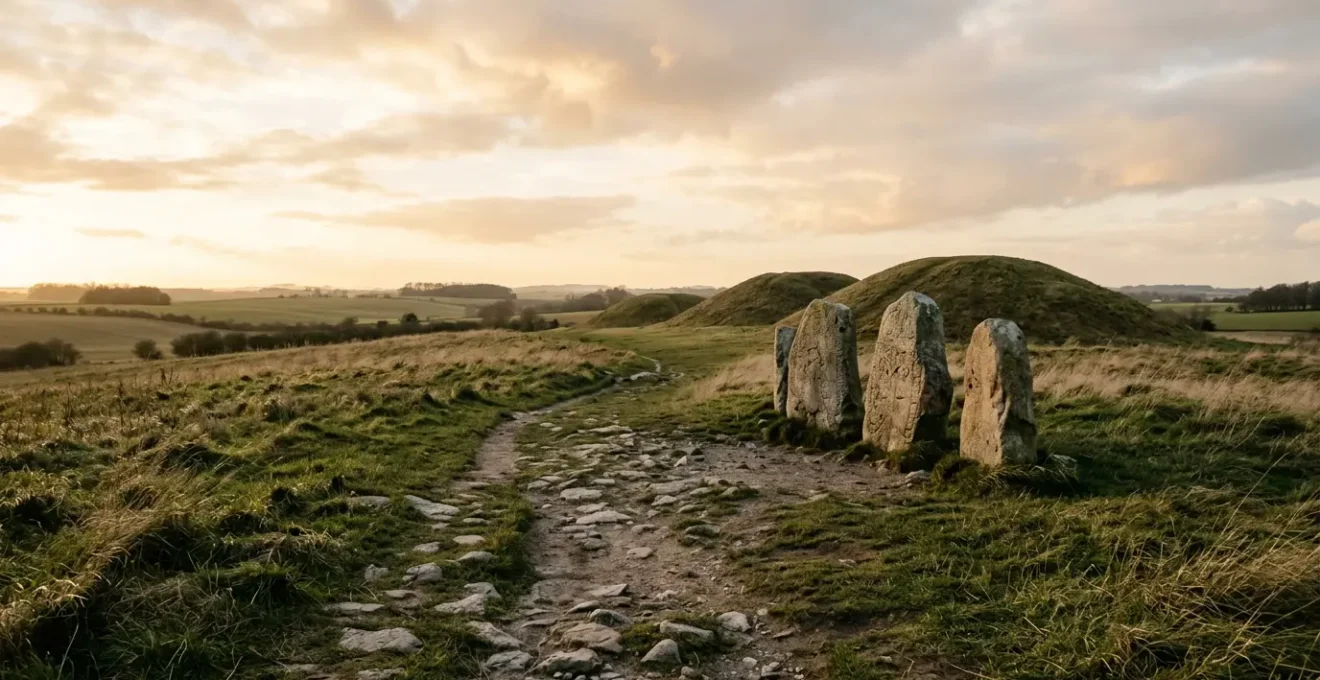
The popular image of Vikings is largely a 19th-century invention; the historical reality found in Denmark, revealed by the archaeological record, is far more fascinating.
- The Viking Age was a concise historical period (c. 800-1050 AD) that concluded not in defeat, but with the formation of a centralized Christian state.
- The vast majority of its people were farmers and traders, not just warriors, living within a complex, three-tiered society.
Recommendation: Visit key sites like Roskilde and Jelling not to find movie clichés, but to witness the authentic engineering, art, and political foundations of a nation.
The very word “Viking” conjures a powerful, almost mythical image: savage warriors with horned helmets, sailing dragon-prowed longships, bent on plunder and destruction. This Hollywood-fueled vision is what many visitors expect to find in Denmark. They search for the brutal, the chaotic, the legendary. As an archaeologist, however, I invite you to look deeper. The stories we unearth from the soil and decipher from runestones tell a different, more complex, and ultimately more compelling tale. The popular narrative often overlooks the societal structure, the technological innovation, and the political maneuvering that truly defined the era.
The real quest for a history buff isn’t to chase romanticized fictions, but to understand the historical context. What if the most defining feature of the Vikings wasn’t their ferocity, but their skill as farmers, traders, and state-builders? This guide is designed to act as your archaeological toolkit. We will sift through the layers of myth to reveal the historical reality. We will debunk the most persistent clichés, guide you to the Danish sites where the authentic Viking Age is palpable, and explore how this period culminated in the very birth of the nation of Denmark.
To help you navigate this journey from myth to archaeological fact, this article is structured to answer the most pressing questions. We will explore the true timeline of the Viking Age, compare the country’s most important museums, and uncover the reality of daily life, before culminating at the site where Denmark’s identity was literally carved in stone.
Summary: Viking Myths vs. Reality: What Will You Actually Find in Denmark?
- Why Is the Viking Age Shorter Than Most People Think?
- National Museum vs. Roskilde: Which Viking Collection Is Better for You?
- Farmers or Warriors: Who Were the Real Inhabitants of Viking Denmark?
- Plastic Helmets with Horns: The Souvenir Mistake No Dane Would Buy
- How to Research Your Danish Roots While Visiting the Country?
- How to Experience Viking Traditions Alive in Modern Denmark?
- Harald Bluetooth’s Boast: What Does the Big Jelling Stone Actually Say?
- How to Understand the Birth of Denmark at the Jelling Monuments?
Why Is the Viking Age Shorter Than Most People Think?
One of the most common misconceptions is that the “Viking Age” was a long, amorphous era of barbarian dominance. The archaeological and historical record, however, defines it as a remarkably specific and relatively brief period. Most scholars and institutions agree that the Viking Age in Denmark covers the period from around 800 until 1050 AD. This wasn’t an eternity of raids, but a distinct 250-year chapter of profound social, political, and technological transformation in Scandinavia.
So, why did it end? It wasn’t because the Vikings were simply defeated in battle. Rather, the age ended because its own internal evolution made the classic “Viking” way of life obsolete. The primary driver was state formation. Charismatic chieftains and kings began consolidating power, creating larger, more organized kingdoms. This shift is a core element of the historical context often missed. Instead of small, independent bands of warriors, powerful rulers began to command formal armies and navies.
This process of centralization fundamentally changed the social and military structure. As the Encyclopedia Britannica notes in its analysis of the era:
The centralization of temporal power also contributed significantly to the decline of the Vikings. Canute the Great, for example, gathered relatively large armies under his control rather than allowing small warrior bands to join him at will—as was the Viking tradition.
– Britannica Encyclopedia, Denmark – Viking, Scandinavia, Jutland
The end of the Viking Age was therefore not a collapse, but a graduation. The decentralized, seafaring chieftaincies evolved into a structured, Christianized kingdom, laying the groundwork for the modern nation of Denmark. The Viking became a Dane.
National Museum vs. Roskilde: Which Viking Collection Is Better for You?
Once you understand the context, the next question is: where do you see the evidence? In Denmark, two institutions offer world-class but fundamentally different windows into the Viking Age: the National Museum in Copenhagen and the Viking Ship Museum in Roskilde. Choosing between them depends entirely on what you, as a history buff, want to experience.
The National Museum of Denmark, located in the heart of Copenhagen, is the nation’s premier institution for cultural history. Here, the Viking Age is presented as one crucial chapter in the long, sweeping story of Denmark. You will find an unparalleled collection of artifacts: exquisite jewelry, fearsome weapons, everyday tools, and iconic runestones. It is the place for context, where you can see the objects that defined life, death, and belief.
The Viking Ship Museum in Roskilde, a short train ride away, offers something else entirely: immersion and experimental archaeology. Its centerpiece is the five original, 1000-year-old Viking ships salvaged from the fjord. But the museum’s mission goes beyond preservation. In its harbor, you can see and even sail in full-scale, seaworthy reconstructions built using authentic Viking Age techniques. It is an experience focused on maritime engineering, craftsmanship, and the raw reality of seafaring life.
This table breaks down the choice to help you decide where to invest your time:
| Aspect | National Museum (Copenhagen) | Viking Ship Museum (Roskilde) |
|---|---|---|
| Location | Heart of Copenhagen city center | Roskilde, 25-35 min train from Copenhagen |
| Focus | Viking artifacts: jewelry, weapons, tools, runestones | Five original Viking ships, shipbuilding, maritime archaeology |
| Experience Type | Traditional artifact-centric exhibition | Experimental archaeology with hands-on activities |
| Time Needed | 2.5-3 hours (flexible half-day) | Full day recommended (includes harbor exploration) |
| Best For | Context-seekers wanting Vikings in Denmark’s broader history | Experience-seekers fascinated by maritime engineering |
| Unique Feature | Comprehensive cultural history collection | Only place to see 1000-year-old ships AND full-scale reconstructions |
The image below captures the essence of Roskilde’s mission: bringing the past to life not just through display, but through tangible reconstruction, allowing us to see a longship as its builders and crew did—a masterpiece of naval technology afloat on the water.
Ultimately, the ideal visit includes both. But if you must choose, ask yourself: do you want to see the treasures a Viking held, or do you want to stand on the deck of the ship that carried them?
Farmers or Warriors: Who Were the Real Inhabitants of Viking Denmark?
The image of the axe-wielding warrior is so pervasive that it has almost completely eclipsed the historical reality of Viking society. While raiding and warfare were certainly part of the culture, they were the occupation of a small, specialized minority. The archaeological and historical evidence is unequivocal: most Vikings were farmers, fishermen, craftsmen, and traders. The backbone of the society was not the longship, but the longhouse and the cultivated field.
Viking Age Denmark was primarily an agrarian society. The majority of the population lived on farms, their lives governed by the seasons. They grew crops like barley, oats, and rye, and raised cattle, sheep, and pigs. This focus on agriculture is what sustained the population and provided the economic foundation for the more famous seafaring expeditions. The warrior who went raiding in the summer often returned to be a farmer in the autumn. This duality is essential to understanding their world.
Viking society was not an egalitarian band of pirates; it was a highly stratified, three-class system. Understanding this hierarchy is key to moving beyond the warrior caricature:
- Karls: These were the freemen, the landowners, and the farmers. They formed the vast majority of the population and were the bedrock of the economy. A Karl could own his own farm, bear arms to defend his land, and participate in the local assembly (the Ting).
- Jarls: The aristocracy or nobility. These were wealthy chieftains and lords who commanded loyalty from a retinue of warriors and controlled large estates. Their role was to provide protection and maintain order, often in exchange for taxes or service.
- Thralls: This was the lowest class, composed of slaves. Thralls were typically captives from raids or individuals born into slavery or sold into it to pay debts. They performed the hardest labor on farms and in households and were a significant, though often overlooked, part of the Viking Age economy.
This social structure reveals a society far more complex than simple myth suggests. It was a world of laws, social obligations, and deep connections to the land, where the fate of most people was tied to the harvest, not the sword.
Plastic Helmets with Horns: The Souvenir Mistake No Dane Would Buy
Let us address the elephant in the room—or rather, the horns on the helmet. No piece of Viking mythology is more iconic or more completely wrong. As an archaeologist, I can state this with absolute certainty. Quoting my colleague Ingrid Ystgaard from NTNU University Museum, in a report for Science Norway: “No, helmets from the Viking Age with horns on them have never been found.” The few authentic Viking helmets that have been unearthed, like the famous Gjermundbu helmet from Norway, are simple, practical skullcaps of iron, sometimes with a spectacle-like face guard. They were designed for protection, not theatricality.
So where did this pervasive myth come from? The blame lies not in the Dark Ages, but in the 19th-century opera. The horned helmet made its grand debut in the 1876 premiere of Richard Wagner’s epic opera cycle, Der Ring des Nibelungen. The costume designer, Carl Emil Doepler, created the horned headwear for the villainous characters to give them a fierce, barbaric appearance on stage. The image was so powerful that it stuck, becoming inextricably linked with Vikings in the popular imagination, despite having no basis in the archaeological record.
To truly connect with the Viking aesthetic, one must look past this operatic fiction and toward the authentic craftsmanship recovered from the ground. The real artistry of the Vikings is found in the intricate metalwork of their jewelry, the complex carvings on their runestones, and the elegant lines of their ships. Theirs was a sophisticated design language of interwoven animals, geometric patterns, and powerful symbols.
When you see a piece of genuine Viking art, like the detailed brooch above, you are looking at their true aesthetic. It is an art of complexity, symbolism, and masterful skill—a world away from the crude, horned caricature. Buying a plastic helmet is buying a piece of 19th-century German opera costume; discovering a piece of intricate knotwork is connecting with the actual Viking Age.
How to Research Your Danish Roots While Visiting the Country?
For many visitors of Scandinavian descent, a trip to Denmark is also a personal pilgrimage—a desire to connect with ancestral roots that may stretch back to the Viking Age. While the idea of tracing your lineage to a famous figure like Ragnar Lothbrok is a compelling fantasy, the historical and genealogical reality requires a more grounded approach. The lack of written records like birth certificates or comprehensive censuses from that era makes direct lineage tracing virtually impossible. However, you can absolutely connect with your Danish heritage in a meaningful and historically sound way.
Connecting with your ancestry is about understanding the world your forebears lived in, not just finding a name in a book. It’s about walking the land they farmed, seeing the harbors they sailed from, and engaging with the cultural DNA they left behind. A visit to the National Archives (Rigsarkivet) or regional archives can help you trace your family back through church records, often to the 17th or 18th centuries, placing them in a specific parish and region of Denmark. This gives you a tangible place to visit—a real ancestral home.
If you’re serious about this genealogical quest during your visit, a structured approach is essential. The following plan helps manage expectations while providing concrete steps for a rewarding journey into your past.
Your Action Plan: Tracing Danish Ancestry
- Set Realistic Expectations: Acknowledge that tracing a documented line to a specific, named Viking Age individual (pre-1000 AD) is not feasible due to the lack of written records. Your goal is to connect with the geography and history of your more recent, documented ancestors.
- Visit the National Archives (Rigsarkivet): Head to the archives in Copenhagen or a regional center. Here you can access church records (kirkebøger) and census data that often date back to the 17th century, which are the primary tools for Danish genealogy.
- Identify and Visit Your Ancestral Region: Once you’ve identified a town or parish, plan a visit. Walk through the local churchyard, explore the landscape, and visit the local museum. This provides a powerful, physical connection to your family’s past.
- Consider DNA Testing for Context: A DNA test can reveal your percentage of “Scandinavian” ancestry, linking your deep origins to the region. Understand this as geographical heritage, not a direct link to a specific Viking. It confirms your roots are in the right soil.
- Explore Modern Scientific Projects: For a deeper understanding of genetic heritage, look into academic initiatives like the ‘Viking DNA Project’. These projects provide expert, contemporary perspectives on how ancient populations have shaped the modern gene pool.
This approach transforms the search from a hunt for a single famous ancestor into a richer exploration of the society, land, and history that shaped your family for centuries.
How to Experience Viking Traditions Alive in Modern Denmark?
The legacy of the Vikings isn’t confined to museums and archaeological sites; it’s a living heritage woven into the fabric of modern Denmark. While you won’t see longships in every harbor, the traditions, values, and language of the Viking Age persist in subtle but profound ways. Experiencing this “invisible” heritage is one of the most rewarding aspects of a visit for a true history enthusiast.
The most direct and unavoidable connection is the Danish language itself. Modern Danish is a North Germanic language that evolved directly from the Old Norse spoken by the Vikings. While the alphabets have changed, countless words, grammatical structures, and especially place names (towns ending in -by, -torp, or -lev) are direct linguistic fossils from that era. Every time you read a sign or hear a conversation, you are encountering the echo of an ancient tongue.
Beyond language, a key Viking Age concept that arguably shaped modern Danish society is the “Ting”. The Ting was a governing assembly of the free men of a community. It was a place for law-making, settling disputes, and making major political decisions. This institution represented a foundational belief in communal governance and the rule of law over the rule of brute force. As one historical analysis points out:
The concept of the ‘Ting’ (a local assembly of free men) can be seen as an early root of Denmark’s strong democratic and egalitarian traditions.
– Encyclopedia.com Historical Analysis, Pre-Viking and Viking Age Denmark Social Structures
This tradition of consensus-building and social responsibility is a cornerstone of contemporary Danish culture. Other living traditions include the celebration of Midsummer (Sankthans), which has pre-Christian roots, and a deep cultural connection to the sea and seafaring. By observing modern Danish society through this historical lens, you begin to see the Viking Age not as a finished chapter, but as the foundational text of a continuous story.
Harald Bluetooth’s Boast: What Does the Big Jelling Stone Actually Say?
In the small town of Jelling in Jutland stands Denmark’s most important monument: a massive, three-sided runestone. It is often called “Denmark’s birth certificate,” and for good reason. The stone was erected around 965 AD by King Harald Bluetooth, and its inscription is not a myth or a saga, but a bold and calculated political declaration. It is a boast that announces the creation of a new kind of kingdom.
The inscription, carved in the runic alphabet of the time, makes three distinct claims. As the official Danish tourism guide, VisitDenmark, succinctly puts it, this national birth certificate claims that he united Denmark and brought Christianity to the new kingdom. The full text, spread across its three faces, reads (in translation): “King Haraldr ordered this monument made in memory of Gormr, his father, and in memory of Thyrvé, his mother; that Haraldr who won for himself all of Denmark and Norway and made the Danes Christian.”
This was a masterpiece of political communication. Each claim was designed to legitimize his rule and announce a radical break with the past. Let’s break down the boast from an archaeological and historical perspective:
- “Won for himself all of Denmark”: This was the declaration of state formation. Harald was claiming to have subdued the petty chieftains and regional jarls, uniting disparate territories under a single, centralized royal authority for the first time. He was no longer just a king *in* Denmark; he was the king *of* Denmark.
- “and Norway”: This was a statement of military power and imperial ambition, projecting his strength beyond Denmark’s borders and positioning himself as a dominant Scandinavian ruler.
- “and made the Danes Christian”: This was the most revolutionary claim. By officially adopting Christianity as the state religion, Harald was aligning his new kingdom with the powerful Christian empires of mainland Europe, particularly the Holy Roman Empire to the south. It was a strategic move to modernize his kingdom, consolidate his power through the church’s administrative structure, and gain international legitimacy.
The Jelling Stone is not just a memorial; it is a press release carved in granite. It marks the moment the Viking chieftain became the European king, and the moment Denmark officially entered the stage as a unified, Christian nation.
Key Takeaways
- The Viking Age was a distinct, 250-year period of transformation (c. 800-1050 AD) that ended with the formation of a centralized Danish state.
- Authentic Viking society was primarily agrarian and socially complex, a reality best explored through artifacts at the National Museum and experimental archaeology at Roskilde.
- The most iconic Viking “myths,” like horned helmets, are 19th-century fictions; the true legacy lies in sophisticated craftsmanship, language, and foundational democratic concepts like the ‘Ting’.
How to Understand the Birth of Denmark at the Jelling Monuments?
The Jelling Monuments complex—a UNESCO World Heritage site—is more than just the location of Harald Bluetooth’s famous stone. It is a complete, symbolic landscape that physically represents Denmark’s transition from paganism to Christianity and from a collection of chieftaincies to a unified kingdom. To stand at Jelling is to stand at the epicenter of this national birth. The site includes two massive burial mounds, two runestones, and a church, each element telling a part of the story.
The sheer scale of the site is breathtaking, intended to project immense power. The mounds are some of the largest in the Nordic world, and the entire royal complex was once enclosed by a vast, 1.5-kilometer-long palisade. The construction of the Jelling monuments in the mid-10th century was a statement of unparalleled royal authority, making them some of the most striking examples of Nordic culture from the entire Viking Age.
The true genius of Jelling is how its components create a physical timeline of cultural and religious change. An archaeological analysis of the site reveals a clear narrative progression:
The northern burial mound (pagan tradition), the runestones (transitional phase blending Norse and Christian elements), and the church (the triumph of the new religion) physically represent the end of one era and the beginning of another.
– Archaeological Analysis, Jelling Monuments Cultural Timeline Study
First, you have the massive north mound, a purely pagan burial monument built by Harald’s father, Gorm the Old. Then come the runestones, which act as a bridge: Gorm’s smaller stone uses traditional Norse runes to honor his wife, while Harald’s larger stone uses the same script but introduces a carving of the crucified Christ—a perfect symbol of transition. Finally, you have the stone church, built by Harald on the site, cementing the triumph of the new faith and the new world order. Visiting Jelling is to walk through this very transition, step by step.
Go beyond the Hollywood clichés. When you visit Denmark, seek out the authentic archaeological record. Stand on the harbor at Roskilde and marvel at the engineering of the longships. Walk the grounds of Jelling and feel the weight of a kingdom being born. This is where you will find the real Vikings—not as one-dimensional warriors, but as the complex and innovative people who laid the foundations of a nation. Your journey into Denmark’s past will be infinitely richer for it.