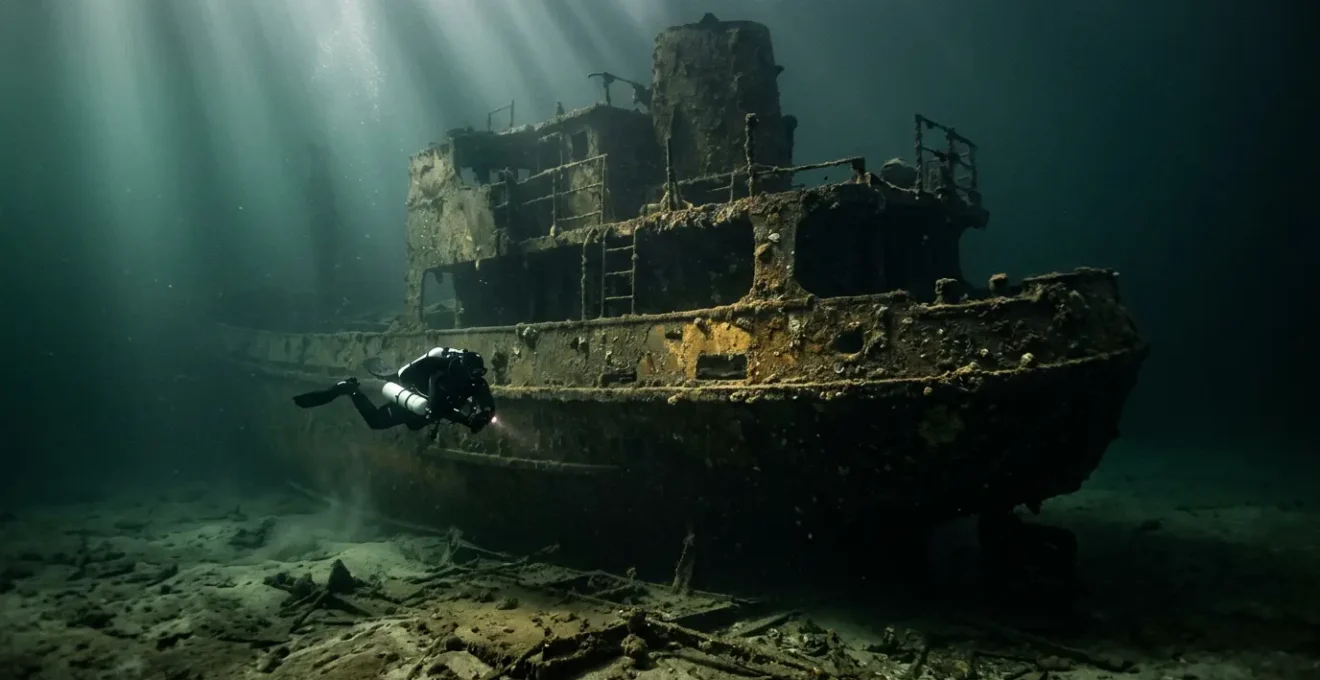
Diving the wrecks of the Øresund is not an expedition to a site, but a pilgrimage to an underwater archive where history is suspended in time.
- The Baltic’s unique, low-salinity water creates an unparalleled environment for preserving wooden shipwrecks, offering a window into centuries past.
- Approaching these sites requires a blend of advanced technical skill, an ethical mindset for visiting historical graves, and specialized cold-water equipment.
Recommendation: Begin your journey on a purpose-sunk training wreck like the M/F Ærøsund to master buoyancy and cold-water procedures before attempting to commune with the more fragile historical sites.
The narrow strait separating Denmark and Sweden, the Øresund, is more than a vital shipping lane; it is a submerged museum. For centuries, its seabed has collected the silent stories of naval battles, merchant trade, and maritime mishaps. For the wreck diver, these cold, dark waters offer an experience that transcends mere recreation. It is a dialogue with the past, a chance to witness history not in a glass case, but in its raw, final resting place. Yet, many divers are drawn by simple lists of sites, equipped only with basic cold-water advice.
This approach misses the essence of the Øresund. The true key to unlocking these underwater secrets lies not in just knowing *where* the wrecks are, but in understanding *why* they exist here in such a remarkable state, and *how* to approach them with the reverence they command. This is not simply about managing a dry suit or choosing a torch; it is about adopting the mindset of a maritime archaeologist, where every piece of rusted metal and waterlogged timber is a word in a sentence, a chapter in a much larger story.
This guide moves beyond a simple catalog of GPS coordinates. We will explore the solemn rules governing war graves, delve into the unique science of Baltic preservation, and outline the rigorous training required. We will treat these wrecks not as destinations, but as the fragile aqueous archive they truly are, guiding you on how to read their stories responsibly.
This article provides a framework for the thinking diver, exploring the ethical considerations, scientific marvels, and technical preparations necessary to truly appreciate the submerged heritage of the Øresund. The following sections will guide you through this unique underwater world.
Summary: A Diver’s Guide to the Underwater Heritage of the Øresund
- War Graves at Sea: What Are the Rules for Diving on WWII Wrecks?
- Preserved by the Baltic: Why Do Wooden Ships Survive Longer Here?
- The Ærøsund: Is This Purpose-Sunk Wreck Good for Beginners?
- Penetration Diving: Do You Need Special Training for Danish Wrecks?
- Backscatter: How to Shoot Wrecks in Low-Vis Baltic Water?
- Thick Undergarments: How Much Extra Weight Do You Need for a Dry Suit?
- Why Is the Ocean Central to Every Aspect of Danish Heritage?
- Dry Suit Diving: How to Prepare for Your First Cold Water Dive?
War Graves at Sea: What Are the Rules for Diving on WWII Wrecks?
Before any fin touches the water, the first principle of diving on historical wrecks, particularly those from conflicts like WWII, is one of profound respect. These are not adventure parks; they are cemeteries. Many nations have enacted laws to protect these sites as the final resting places of sailors and military personnel. The spirit of these laws, even when diving in international or less-regulated waters, should guide every action. The governing ethos is one of observation, not interaction. These sites are hallowed ground, saturated with the memory of human loss.
The legal framework often sets a clear boundary. The United Kingdom’s legislation is a benchmark for this ethical approach, establishing a standard that many responsible dive communities adopt worldwide. As a core guideline states, even for sites that are not officially designated as protected zones:
Divers may visit the site, but the rule is look, don’t touch and don’t penetrate.
– UK Protection of Military Remains Act 1986, Wikipedia – Protection of Military Remains Act 1986
This means no artifact collection, no disturbing the structure, and certainly no taking of “souvenirs.” A diver’s role is to be a silent, respectful witness. To descend upon a war grave is to enter a place of memorial. The goal is not to conquer the wreck, but to honour the memory encapsulated within its steel hull. Every dive plan should begin with historical research to understand the vessel’s story and the fate of its crew, transforming the dive from a recreational pursuit into a meaningful act of remembrance.
Preserved by the Baltic: Why Do Wooden Ships Survive Longer Here?
The Øresund and the greater Baltic Sea are home to a ghost fleet of astonishingly well-preserved wooden wrecks, some dating back to the medieval period. This is not by chance but by chemistry. The secret to this remarkable preservation lies in the unique properties of the Baltic water itself, a phenomenon that has turned the seabed into a near-perfect museum for maritime history. The primary factor is the water’s low salinity, which creates an environment hostile to the most destructive marine organisms.
The main culprit in the destruction of wooden ships in most of the world’s oceans is the naval shipworm, Teredo navalis. Despite its name, it is not a worm but a species of saltwater clam notorious for boring through submerged wood. It reduces historic hulls to pulp in a matter of decades. However, this voracious organism cannot survive in brackish water. The unique preservation of wrecks in this region is due to its 0.3% to 0.9% salinity level, a threshold that inhibits the shipworm’s life cycle. This “Baltic Anomaly” is the reason archaeologists can study Viking longships and Hanseatic cogs that would have long since vanished anywhere else.
This image shows the intricate texture of marine wood, highlighting the kind of cellular structure that is destroyed by shipworms in saltier waters but remains intact in the Baltic’s protective embrace.
In addition to low salinity, the Baltic’s cold temperatures slow down the chemical and biological decay processes. The relative darkness at depth and occasional low-oxygen (anoxic) conditions on the seabed further contribute to creating a stable, low-energy environment where wrecks can rest, undisturbed, for centuries. This makes every dive an potential encounter with history in its most authentic state.
The Ærøsund: Is This Purpose-Sunk Wreck Good for Beginners?
While the Øresund is famed for its fragile, ancient wrecks, it also provides a perfect modern classroom. For divers looking to build the skills and confidence necessary for cold-water wreck exploration, the M/F Ærøsund is an unparalleled training ground. Unlike historical wrecks, this former car ferry was not a victim of storm or conflict; it was intentionally and meticulously prepared to be a safe, accessible, and environmentally sound artificial reef and dive site. For a newcomer to Danish diving, it is the ideal first chapter.
Sunk in 2014, the Ærøsund rests upright in just 19 meters of water, with its highest point, the funnel, reaching up to 6 meters from the surface. This shallow depth makes it accessible for divers with an Open Water certification and allows for longer, safer bottom times. Before its sinking, the vessel was stripped of any potential hazards. This process involved removing over 100 tonnes of hazardous material and equipment, ensuring the site was clean. It was then stabilized with 300 tonnes of sand ballast to guarantee it would remain stable and upright on the seabed, providing a predictable environment for divers.
Case Study: M/F Ærøsund as a Progressive Training Platform
The M/F Ærøsund ferry was purpose-sunk in 2014 off Denmark’s South Funen coastline at 19 meters depth specifically as a diver training facility. The preparation process involved removing over 100 tonnes of material and cutting large entry/exit points into the deck, sides, and bulkheads while removing selected stairs and walls to create safe swim-throughs. Over 300 tonnes of sand ballast was added to stabilize the vessel upright. The wreck’s intact structure, shallow depth (funnel at just 6m), and engineered safety features make it ideal for practicing core wreck skills including buoyancy control, line-laying, and navigation in a controlled environment with minimal current and good visibility from the surface.
Most importantly, large openings were cut into its hull and decks, creating clear, light-filled swim-throughs instead of dark, tight corridors. This allows divers to experience the feeling of being inside a wreck without the risks associated with true penetration. Practicing buoyancy control, finning techniques, and navigation on the Ærøsund builds the foundational skills essential for later approaching more challenging and historically significant sites.
Penetration Diving: Do You Need Special Training for Danish Wrecks?
The allure of a shipwreck is often the mystery of its hidden interior. The desire to glide down a sunken corridor or peer into a ship’s bridge is powerful. However, transitioning from observing a wreck’s exterior to entering its confines is one of the most significant and dangerous steps a diver can take. In the challenging conditions of the Baltic, this decision requires more than just courage; it demands specific, rigorous training, specialized equipment, and an unwavering adherence to safety protocols. Penetration is not exploration; it is a technical procedure.
A standard recreational “wreck diver” certification is merely an introduction. It teaches how to safely navigate the exterior of a wreck and, at most, venture into areas where an exit and natural light are always clearly visible. True penetration—entering the overhead environment where you cannot make a direct vertical ascent to the surface—is the domain of technical diving. This requires certifications in overhead environments, such as Advanced Wreck, Technical Wreck, or Cave Diving. These courses teach the non-negotiable skills: laying guidelines, advanced gas management like the “Rule of Thirds,” and emergency procedures for zero-visibility silt-out situations.
The table below outlines the critical differences in training levels. It is not a ladder to be climbed for status, but a guide to understanding the skills required for different types of engagement with a wreck. Moving from one level to the next without formal training is a gamble with the highest stakes.
| Certification Level | Penetration Allowed | Depth Limit | Key Skills Taught |
|---|---|---|---|
| Basic Wreck Diver (PADI/SSI/SDI) | External only OR limited light zone | Recreational limits (30-40m) | Hazard identification, external navigation, basic line awareness |
| Advanced/Extended Range Wreck | Daylight zone with multiple exits | Up to 40m | Guideline deployment, gas management, limited penetration techniques |
| Technical Wreck Diver | Full penetration beyond daylight zone | Beyond 40m with deco | Complex navigation, zero-visibility protocols, advanced gas management, emergency procedures |
| Cave Diving Cross-Training | Complex overhead environments | Variable | Considered gold standard for wreck penetration – develops overhead environment mindset and skills that transfer from rock to rust |
Go/No-Go Wreck Penetration Decision Framework
- Structural Assessment: Is the wreck intact with reinforced entry points and multiple large exits, or is it heavily deteriorated with collapse-prone corridors and restricted passages?
- Environmental Conditions: Evaluate current, surge, visibility, and depth. Can you navigate safely if visibility drops to zero from silt-out?
- Training Verification: Do you hold overhead environment certification (Extended Range Wreck, Cave, or Technical Wreck)? Entry-level wreck courses only cover external exploration.
- Gas Management: Have you calculated gas supply using the Rule of Thirds for overhead environments? Do you have redundant air supply and sufficient reserves for cold water?
- Team Cohesion: Is every team member trained to the same standard with aligned gear configuration, procedures, and communication methods? If in doubt, stay out.
Backscatter: How to Shoot Wrecks in Low-Vis Baltic Water?
Photographing shipwrecks in the Øresund presents a unique paradox. The very conditions that preserve these historical treasures—cold, dark, and often particle-filled water—are the greatest enemies of the underwater photographer. The instinct to light up the whole scene with powerful strobes is a recipe for failure. In the low-visibility (low-vis) environment of the Baltic, this approach only illuminates the floating particles between the lens and the subject, creating a blizzard of white specks known as backscatter. Capturing compelling images here is not about overpowering the darkness, but about working with it.
The solution is counter-intuitive: get closer and think smaller. Forget the grand, sweeping shots of an entire ship. That is the domain of professional survey teams with specialized equipment. The art of low-vis wreck photography is the art of the macro and the semi-macro. It is about isolating a single, evocative detail—a brass porthole, a section of railing draped in seaweed, the texture of a ship’s bell colonized by marine life. This approach dramatically reduces the amount of water (and thus, particles) between the lens and the subject.
This image of a weathered artifact is a perfect example of the macro approach, focusing on texture and history rather than a wide, ambient-light scene.
Technically, this means using long strobe arms to position your lights far from the camera body and at an angle to the subject. This technique, called side-lighting, illuminates the subject without lighting up the column of water directly in front of the lens. Use a macro or short-focal-length lens, and control your buoyancy meticulously to get within inches of your subject without touching the wreck or stirring up silt. The goal is to create a small, perfectly lit scene within a vast sea of darkness, letting the negative space hint at the scale and mystery of the whole.
Thick Undergarments: How Much Extra Weight Do You Need for a Dry Suit?
Diving in the Øresund is dry suit diving. With water temperatures that can hover in the single digits Celsius even in summer, thermal protection is not just about comfort; it is a critical piece of safety equipment. However, the warmth provided by a dry suit and its thick undergarments comes at a cost: massive buoyancy. The air trapped in the fibers of a 400g undersuit and within the suit itself creates significant lift. Counteracting this requires a carefully calculated amount of weight, a variable that mystifies many new cold-water divers. There is no single magic number; the correct amount of weight depends on a system of interconnected factors.
The primary variables are the suit material, undergarment thickness, and cylinder type. A trilaminate suit has very little inherent buoyancy, whereas a neoprene suit is itself buoyant. A thick 400g+ undersuit traps far more air and requires more weight to compensate than a thin 200g one. Furthermore, a steel cylinder is negatively buoyant and helps you sink, while an aluminum cylinder becomes positively buoyant as it empties, requiring even more lead to offset it at the end of a dive.
The following table provides a starting point for estimating the additional weight needed compared to a standard wetsuit dive. These are approximations; the only way to be certain is to perform a proper weight check in shallow water with nearly empty cylinders, fully kitted in the gear you will use for the dive. Salinity is also a key factor; the brackish water of the Øresund is less dense than the full-salinity North Sea, requiring slightly less weight.
| Dry Suit Type | Undergarment Thickness | Cylinder Material | Approximate Additional Weight | Notes |
|---|---|---|---|---|
| Trilaminate | Thin (200g) | Steel | +2-4 kg (4-9 lbs) | Minimal buoyancy from suit material |
| Trilaminate | Thick (400g) | Steel | +4-6 kg (9-13 lbs) | Air volume in undergarment requires offset |
| Neoprene (compressed) | Integrated insulation | Steel | +3-5 kg (7-11 lbs) | Suit itself provides buoyancy at depth |
| Trilaminate | Thick (400g) | Aluminum | +7-9 kg (15-20 lbs) | Must compensate for positively buoyant cylinder |
| Salinity adjustment: Add 1-2 kg (2-4 lbs) when moving from brackish Baltic (Øresund) to full salinity North Sea | ||||
Why Is the Ocean Central to Every Aspect of Danish Heritage?
To understand the sheer density of shipwrecks in the Øresund, one must look beyond individual maritime incidents and see the water itself as the heart of Danish identity. For millennia, the sea has not been a barrier for Denmark, but its primary highway, its source of wealth, and its strategic battlefield. Every Dane lives within 50 kilometers of the coast. This intimate, and often fraught, relationship with the ocean is written across every era of the nation’s history, and the seabed is the final page of many of those chapters.
From the Viking Age, when longships radiated out to trade and raid, to the Hanseatic League’s lucrative trade routes that crisscrossed the Baltic, the Øresund has been a chokepoint of immense strategic and economic importance. Control of this strait meant control over the flow of goods like grain, timber, and salt, making it a focal point for taxation, diplomacy, and naval conflict. This long history of intense maritime traffic naturally led to a high number of shipwrecks, caused by storms, navigational errors, and warfare. A recent announcement from marine archaeologists from the Viking Ship Museum confirmed a wreck with a 28-meter length and 9-meter width, making it the largest medieval cog ever documented, a testament to the scale of trade in the era.
This deep connection means the wrecks are viewed not as isolated accidents but as tangible links to the nation’s past. They are physical evidence of the stories, struggles, and ambitions that shaped the kingdom. A maritime archaeologist’s perspective frames this perfectly:
The wrecks in the Sound [are] not as isolated accidents, but as physical chapters in Denmark’s history book.
– Maritime archaeology perspective, The Scuba News – Medieval Cog Discovery in Øresund
Diving here is, therefore, an immersion into the very soul of Danish heritage. Each wreck, whether a humble fishing boat or a mighty warship, is a piece of a national narrative defined by the constant, powerful presence of the sea.
Key takeaways
- Ethical Approach: Wrecks, especially war graves, are memorials. The guiding principle is “look, don’t touch” to honour the memory of those lost.
- The Baltic Anomaly: The unique low-salinity, cold, and dark water of the Baltic Sea prevents the destructive naval shipworm (Teredo navalis) from surviving, leading to unparalleled preservation of wooden wrecks.
- Progressive Training: Start with controlled environments like the purpose-sunk M/F Ærøsund to master cold-water skills before attempting to dive on fragile and more dangerous historical sites.
Dry Suit Diving: How to Prepare for Your First Cold Water Dive?
The decision to explore the submerged heritage of the Øresund is the beginning of a new chapter in a diver’s journey. But the transition to the cold, dark waters of the north is as much a mental challenge as it is a physical one. Preparation is everything. Your first cold water dive in a dry suit should not be on a challenging historical wreck; it should be a dedicated session in a calm, shallow environment with a single objective: mastering the equipment and your own psychological response to the cold. The dive itself is the final step in a long sequence of preparation.
The first shock is not the water temperature itself—a good dry suit and undergarments will protect you—but the sheer task loading. You are managing a new buoyancy device (the suit), potentially thicker gloves that reduce dexterity, and the psychological stress of a new environment. The key is to build muscle memory on land. Before the dive, walk through every skill: connecting and disconnecting your inflator hose, managing valve shutdowns, and practicing emergency procedures. This “dirt diving” reduces cognitive load in the water, freeing up mental bandwidth to simply be present and aware.
This moment of focused preparation, of communing with your equipment before entering the water, is a ritual that separates the prepared diver from the merely eager one.
A conservative dive plan is essential. Your first outing should be short, shallow, and focused. Plan for no more than 15 meters in depth and a bottom time of 25-30 minutes. Dedicate the first five minutes of the dive at a shallow depth (around 5 meters) to simply hovering, practicing inflating and deflating the suit in small increments to achieve neutral buoyancy. This is not wasted time; it is the most important part of the dive. Only when you feel calm, controlled, and comfortable should you proceed with the rest of the plan. This methodical approach transforms fear of the unknown into respect for the environment.
Your journey into the Øresund’s aqueous archive begins not with a giant stride, but with meticulous preparation, a deep respect for history, and the humility to learn the unique skills these waters demand. Begin that journey today by researching a qualified local dive operator who specializes in cold-water and wreck-diving instruction.