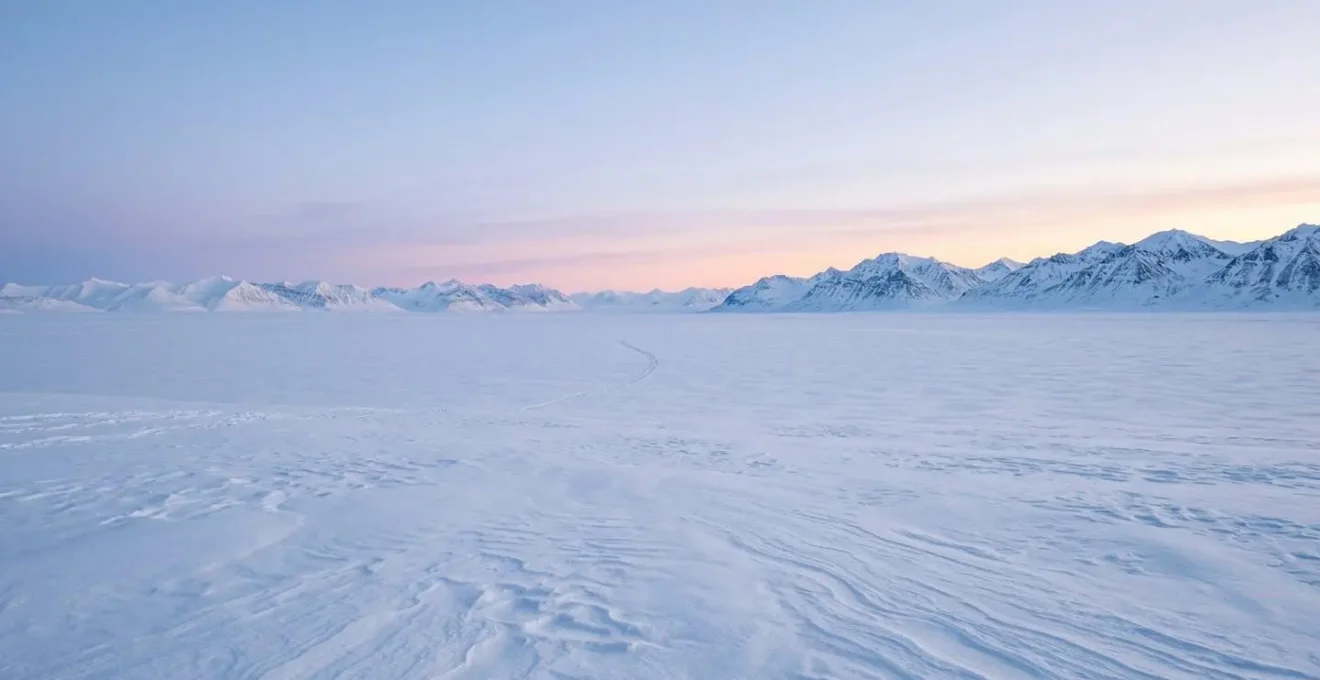
For the stressed urban mind, the Arctic promise of quiet is often misunderstood as mere emptiness. This guide reframes that notion, revealing that true silence is a rich, sensory environment that demands psychological attunement. It’s not about escaping noise, but about learning the language of the wilderness—a process of sensory recalibration that moves you from enduring solitude to finding profound mental clarity within it.
In the digital clamor of modern life, the mind rarely rests. We are saturated with notifications, background noise, and a relentless flow of information. The allure of a “silence retreat” is a direct response to this sensory overload—a deep-seated need to turn down the volume. Many imagine a simple absence of sound, a void. Yet, the Arctic wilderness offers something far more profound and challenging.
The common approach is to focus on gear and survival, on the cold and the physical dangers. But what if the greatest challenge isn’t the external environment, but the internal one? When the distractions are stripped away, the inner monologue can become deafening. True mastery of the Arctic quiet isn’t about simply enduring it. It is about a fundamental sensory recalibration, learning to listen not to the absence of sound, but to the subtle, complex acoustic ecology of the ice, wind, and snow.
This guide moves beyond a simple packing list. We will explore the psychological tools and practical knowledge needed to engage with the Arctic on its own terms. We’ll delve into the nuances of travel, shelter, and perception, framing the journey as an active meditation. The goal is to transform the wilderness from a place you survive into a space you can truly inhabit, allowing the profound quiet to reshape your awareness and bring clarity.
Summary: Silence Retreats: How to Find Absolute Quiet in the Arctic Wilderness?
- Snowshoes vs Skis: Which Is Better for Exploring Deep Powder Silence?
- Igloo or Quinzee: Can You Really Sleep Warm Inside a Snow Mound?
- Satellite Phones: Do You Need One for a Solo Arctic Trek?
- Singing Ice: Why Do Frozen Lakes Make Strange Laser Sounds?
- Whiteout Conditions: What to Do When You Lose All Visual Reference?
- The 37-Hour Work Week: How Do Danes Actually Get Things Done?
- Solo vs Guided: Should You Attempt a Night Hike in Mols Bjerge Alone?
- How Does Urban Design Influence the ‘Danish Art of Living’?
Snowshoes vs Skis: Which Is Better for Exploring Deep Powder Silence?
The way you move through the snow is the first line of your dialogue with the wilderness. It dictates your rhythm, your focus, and the very sounds you contribute to the landscape. Choosing between snowshoes and skis is not just a technical decision; it’s a choice about the nature of your meditative journey. Each has a distinct acoustic signature and encourages a different state of mind.
Snowshoes ground you. Their deliberate, rhythmic “crunch and pack” sound connects you to the earth with every step. The motion is akin to a walking meditation—slower, more strength-based, and inviting frequent pauses for observation. As Jonathan Wiesel, a renowned expert interviewed by Outside Magazine, famously put it, “If you can walk, you can snowshoe,” highlighting their immediate accessibility. This makes them ideal for those who wish to explore intricate terrain, stop to study animal tracks, or simply feel a profound sense of stability and connection to the frozen ground.
Skis, on the other hand, invite a state of flow. The “glide and swish” is a quieter, more fluid rhythm that can lull the mind into a state of sustained focus. It’s a faster way to travel, demanding cardiovascular effort but rewarding you with a sense of floating over the landscape. While they require more practice, skis offer superior performance in deep powder, allowing you to cover more ground and immerse yourself in the vastness of the scenery. The choice, therefore, depends on your intention: the grounded, observant deliberation of snowshoeing or the flowing, rhythmic meditation of skiing.
This table breaks down the practical considerations that stem from these two different approaches to movement and silence, based on an in-depth comparison of backcountry travel methods.
| Criterion | Snowshoes | Skis (Touring/AT) |
|---|---|---|
| Learning Curve | Minimal – functional within 10 steps | Requires practice and skiing experience |
| Deep Powder Performance | Traditional models offer better flotation; modern compact models sink more | Longer surface area provides superior weight displacement in deep snow |
| Acoustic Signature | ‘Crunch and pack’ – deliberate, grounded rhythm | ‘Glide and swish’ – rhythmic, meditative soundscape |
| Physical Demand | High-stepping motion; slower, strength-based; allows frequent observation stops | Sustained cardiovascular effort; promotes flow state; faster travel |
| Steep Terrain | Direct ascent possible with modern crampons | Requires switchbacking on steep slopes |
| Survival Versatility | Can be used as shovel for snow pits or stove platform | Can serve as splint, anchor, or signaling device |
| Noise Level | Wood models are silent; metal frames are never quiet | Quieter gliding motion on packed surfaces |
Igloo or Quinzee: Can You Really Sleep Warm Inside a Snow Mound?
The idea of sleeping in a shelter made of snow seems, to the uninitiated, like a form of self-inflicted punishment. Yet, it is one of the most profound lessons the Arctic teaches: the element that creates the cold can also be your greatest source of warmth and security. The quinzee, a shelter built by hollowing out a large pile of consolidated snow, is a masterpiece of thermal engineering. It is not just a shelter; it is a womb-like refuge that insulates you from the world.
The physics are elegantly simple. Snow is composed of intricate ice crystals with vast amounts of trapped air. This air is a poor conductor of heat, making snow a surprisingly effective insulator. A well-built quinzee can be remarkably warm. In fact, research on snow shelter thermal performance shows the interior temperature can be 60 to 70 degrees Fahrenheit warmer than the outside air, maintained purely by your body heat and a small candle.
But the true magic of the quinzee goes beyond thermal comfort. It is an acoustic sanctuary. The same properties that trap heat also absorb sound, creating an almost absolute silence. As the survival experts at WillowHaven Outdoor note, “It also works as a soundproof room – you could scream in there and people can’t hear you outside.” This profound quiet allows the mind to settle in a way that no tent can replicate. The soft, diffused blue light filtering through the snow walls creates an ethereal, calming atmosphere. To spend a night in a quinzee is to experience a deep, primal sense of security, utterly disconnected from the wind and the world outside.
Satellite Phones: Do You Need One for a Solo Arctic Trek?
For the purist seeking absolute disconnection, carrying a communication device can feel like a compromise. The satellite phone in your pack represents a tether to the world you’re trying to leave behind. However, from a wilderness therapy perspective, this tool is not about preventing solitude; it’s about enabling it safely. The paradox is that having a reliable emergency lifeline allows you to commit more fully to the experience of being alone, reducing the background hum of survival anxiety.
In the polar regions, not all satellite networks are created equal. The Iridium network, with its 66 active low-Earth orbit satellites, provides 100% global coverage, making it the only truly dependable option at extreme latitudes. As the Explorersweb Equipment Review Team states, “If you’re traveling to the ends of the Earth — literally — you only have one option for sat phone coverage and that’s Iridium.” This reliability is the foundation of your psychological safety net.
The key is not the device itself, but the protocol you establish for its use. It should be seen as a piece of survival equipment, like a first-aid kit, not a convenience. Creating intentional friction between you and the device is crucial to preserving your immersion. The goal is to carry the means for rescue without sacrificing the feeling of self-reliance. This requires discipline and a clear, pre-defined plan.
Your Action Plan: Communication Protocol for Maintaining Solitude
- Pre-trip agreement: Establish strict communication rules before departure (e.g., ‘Check-in every 72 hours only’ or ‘Life-threatening emergencies exclusively’).
- Choose appropriate device tier: A PLB (one-way beacon), satellite messenger (limited pre-set messages), or full sat phone based on your risk tolerance vs. solitude goals.
- Physical separation: Store the device in a sealed pack compartment, not on your body, to create intentional friction between impulse and action.
- Message templates: If using a messenger, pre-write only essential status updates (‘Safe, continuing as planned’) to minimize communication time.
- Emergency-only mindset: The device exists for survival, not for relieving boredom or loneliness. This is a mental commitment you must make before you go.
Singing Ice: Why Do Frozen Lakes Make Strange Laser Sounds?
The Arctic soundscape is not one of silence, but of strange and beautiful noises. Among the most haunting is the “singing” of a frozen lake. When conditions are right, the ice emits a symphony of eerie pings, whistles, and zaps reminiscent of science fiction sound effects. This phenomenon is a powerful reminder that the wilderness is a living, breathing entity, communicating in a language of physics.
The Viral Discovery of Arctic Ice Acoustics
This otherworldly sound was brought to global attention by Cory Williams, who moved to Alaska and documented the phenomenon. His viral video of skipping rocks on a frozen lake, which produced a cascade of ‘pew-pew’ sounds, garnered over 11 million views. As detailed in an NPR report on his discovery, Williams later found the lake making these sounds on its own, driven by natural temperature changes. His experience beautifully illustrates how the ice acts as both a natural instrument and a sensitive gauge of environmental conditions.
The science behind this acoustic magic is fascinating. The sounds are caused by thermal stress. As the air temperature changes, the vast sheet of ice expands or contracts, creating cracks. These cracks release energy in the form of sound waves. The unique, high-pitched tones are a result of dispersion; different frequencies of sound travel through the ice at different speeds. The higher frequencies travel faster, reaching your ear first as a “ping,” followed by the lower frequencies as a trailing “zap.”
What you are hearing is the sound of tension and release, the acoustic manifestation of the lake adjusting to its environment. As some research on cryoacoustic physics reveals, these bending waves travel through the ice at incredible speeds, radiating sound continuously. To stand on a singing lake is to be in the presence of a vast, natural synthesizer, a direct and audible expression of the forces of nature. It’s an experience that fundamentally shifts one’s perception of “quiet.”
Whiteout Conditions: What to Do When You Lose All Visual Reference?
A whiteout is perhaps the most disorienting experience the Arctic has to offer. It’s not just a storm; it’s the dissolution of the world. The sky and snow-covered ground blend into a single, uniform field of white, erasing the horizon and robbing you of all sense of scale, direction, and even balance. In this moment, the external world ceases to offer reliable information. Your survival depends entirely on your internal resources.
The primary danger is not just getting lost, but the profound psychological impact. The loss of visual reference can induce a powerful form of vertigo and trigger a primal panic. Your brain, starved of the spatial cues it relies on, can begin to create its own, leading to disorientation and poor decision-making. This is the ultimate test of self-reliance, where the mantra “trust your compass, not your instincts” becomes a lifeline. The urge to “walk it off” or to believe you can see a landmark just ahead is a dangerous illusion.
In a whiteout, the first and most critical action is to stop. Movement without reference is gambling. The safest course is to create a reference point. This can mean building a snow wall, deploying your tent, or digging a trench. You create a small, knowable universe in the midst of the infinite, featureless void. This act of creating shelter is as much for your psychological stability as it is for your physical protection. It is a declaration of control in an uncontrollable situation. As the REI Expert Advice Team wisely cautions, “Traveling alone in the winter backcountry is a high-risk endeavor,” and this scenario is the pinnacle of that risk.
The most important tool in a whiteout is not on your gear list; it is a calm and disciplined mind. You must sit with the uncertainty, manage the rising tide of anxiety, and wait. The whiteout teaches the hardest lesson of the wilderness: sometimes, the most courageous and effective action is to do nothing at all.
The 37-Hour Work Week: How Do Danes Actually Get Things Done?
In the urban world, we measure productivity in hours worked against a clock. In the Arctic, the clock is the sun, and the “work week” is a cycle of tasks dictated by temperature and daylight. There’s a concept we can borrow from the efficient Danish mindset and apply here: the “Arctic Work Week” is not about working less, but about working with absolute intention. Every calorie expended must have a purpose, as wasted energy is a direct threat to survival.
The “work” of an Arctic retreat includes a steady rhythm of essential tasks: melting snow for water, preparing food, checking gear, maintaining your shelter, and navigating. These are not chores to be rushed through; they are rituals that ground you in the reality of your environment. An inefficient process, like repeatedly searching for a misplaced item in a disorganized pack, doesn’t just waste time; it drains precious body heat and mental energy. The Danish principle of *arbejdsglæde* (joy at work) finds a parallel here: there is a deep satisfaction in a task done smoothly and efficiently, in the hiss of a well-primed stove or the clean cut of a snow block.
Mastering this rhythm of efficiency is what creates the space for silence. By systematizing your survival tasks—having a designated place for everything, performing tasks in a logical sequence—you free up mental bandwidth. The mind, no longer consumed by the logistics of staying warm and fed, is liberated to observe, reflect, and sink into the profound quiet. The goal is to get the “work” done with such practiced ease that it becomes a form of moving meditation, a backdrop to the real work of the retreat: internal exploration.
The 37-hour week is a metaphor for a finite budget of energy and daylight. By “balancing the books” with ruthless efficiency, you create the surplus of time and peace of mind that you came to the Arctic to find. It’s the ultimate lesson in minimalist productivity.
Solo vs Guided: Should You Attempt a Night Hike in Mols Bjerge Alone?
We can transpose the question from the hills of Mols Bjerge to the vast expanse of the Arctic tundra: should you venture into the polar night alone? Hiking at night in the Arctic is a fundamentally different experience, one that amplifies both the risks and the rewards of your journey. The choice between a solo and a guided night excursion is a choice between two distinct psychological landscapes.
To walk alone under the aurora or a canopy of stars so bright they seem to touch the snow is to experience a sense of awe that is almost overwhelming. With no one else to validate the experience, it becomes intensely personal. Your senses, already heightened by the cold and dark, go into overdrive. Every crunch of your boots, every whisper of wind, every distant call of an arctic fox becomes a significant event. This is the path of maximum sensory immersion. It is also the path of maximum responsibility. There is no one to second-guess your navigation, no one to share the watch, no one to calm your nerves if the shadows begin to play tricks on your mind.
A guided night hike offers a different kind of magic: the magic of shared wonder and interpreted knowledge. A guide can point out constellations invisible from the city, explain the behavior of nocturnal animals, and read the subtle language of the snow in the moonlight. There is a profound comfort and safety in this shared experience. It allows you to relax and absorb the beauty without the constant low-level hum of self-preservation. The silence is still present, but it is a communal silence, punctuated by the quiet wisdom of an expert who knows and loves this environment.
Neither path is inherently better. The choice depends on your goal. Are you seeking the raw, unfiltered confrontation with the self that only true solitude can provide? Or are you seeking a deeper understanding of the environment, facilitated by an expert guide who can act as your interpreter of the night? Both are valid paths to the heart of the Arctic.
Key takeaways
- True silence is not an absence of sound but a rich acoustic environment to be learned.
- Psychological preparation and establishing mental protocols are more crucial than gear alone.
- The key to comfort is trusting in the counter-intuitive principles of nature, like the insulating power of snow.
How Does Urban Design Influence the ‘Danish Art of Living’?
Just as urban design shapes the flow of life and social interaction in a city, your “camp design” in the wilderness dictates your psychological state. We can adapt the Danish concept of *hygge*—the art of creating cozy, comfortable, and convivial environments—into an “Arctic Art of Living.” How you arrange your temporary home in the snow is a direct expression of your mindset and has a profound impact on your ability to find peace.
A well-designed camp is more than just a place to sleep; it is a micro-haven of order and safety in a vast and chaotic landscape. This means thinking beyond just pitching a tent. Where do you place your snow walls to provide the most effective windbreak? How do you orient your tent door relative to the rising sun and the prevailing winds? Where do you build your kitchen area to be both safe from fire and sheltered for cooking?
Each of these decisions contributes to an overall sense of control and well-being. A messy, disorganized camp creates mental static, a low-level anxiety that gnaws at the edges of your tranquility. A thoughtfully designed camp, where everything has its place and every structure has its purpose, fosters a sense of calm and security. It becomes an extension of your own organized mind. Creating a small, level platform for your stove or carving a bench out of a snowdrift are not frivolous acts; they are ways of claiming the space and making it your own.
This “Arctic hygge” is about finding comfort and contentment in the harshest of conditions. It’s the feeling of sipping hot tea in a tent that is quiet and stable while a blizzard rages outside. It is the deep satisfaction that comes from creating a small pocket of warmth, light, and order with your own two hands. It proves that the art of living well is not dependent on external conditions, but on the intention and care you bring to creating your immediate environment.
The true journey into Arctic silence is an inner one. The wilderness is merely the catalyst, the perfect mirror that strips away the noise and shows you what remains. The first step is not to book a flight to the far north, but to begin practicing the art of listening—to the quiet moments in your own life. Start there, and the path to the Arctic will find you.