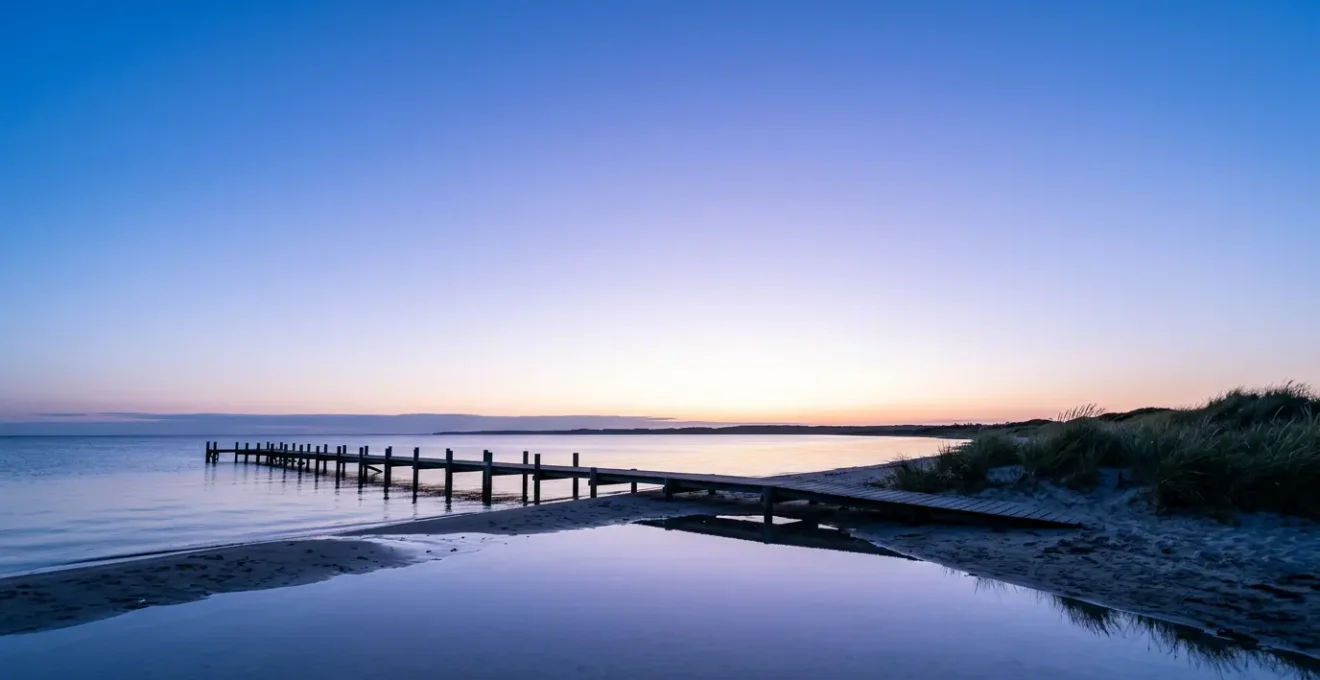
Denmark does not have a true ‘Midnight Sun’; it experiences ‘White Nights’ (Lyse Nætter), where the sun dips just below the horizon, creating perpetual twilight that dramatically affects your body clock.
- Constant daylight suppresses melatonin, the sleep hormone, leading to increased energy but potential sleep disruption.
- The extended ‘blue’ and ‘golden’ hours are caused by the shallow angle of the sun, scattering light through more atmosphere.
Recommendation: To fully enjoy the Danish summer, don’t just endure the light—manage it by creating an artificial night, sticking to a sleep schedule, and embracing the unique late-night activities it enables.
Many travelers arrive in Denmark during summer expecting the famed “Midnight Sun” they’ve heard about in stories of Scandinavia. They anticipate a sun that never sets, hanging low on the horizon at midnight. However, the reality in Denmark is something different, yet equally mesmerizing: the Lyse Nætter, or “White Nights.” This is not a mere semantic difference. Unlike northern Norway, where the sun remains visible for 24 hours, Denmark’s unique geographical position means the sun dips just below the horizon, bathing the country in a luminous, never-ending twilight that can feel both energizing and deeply disorienting.
The common advice is often practical but shallow: “pack an eye mask” or “enjoy the long days.” But these tips don’t address the fundamental biological question: why do you feel so wired, and how can you manage your internal clock when the external cues have vanished? The key isn’t to simply block out the light, but to understand its profound effect on your circadian rhythm. This isn’t just a travel experience; it’s a biological one. By grasping the science behind the constant glow—from melatonin suppression to the physics of the blue hour—you can move from being a passive observer to an active participant, truly harnessing the magic of the Danish summer.
This guide unpacks the science behind Denmark’s unique summer light. We’ll explore why sleep can be challenging, what makes the twilight so dramatic, and how you can adapt your own biology to thrive during the white nights, transforming confusion into a deep appreciation for this remarkable natural phenomenon.
Summary: Midnight Sun vs White Nights in Denmark
- Blackout Curtains: How to Ensure Quality Sleep During White Nights?
- Golf at Midnight: What Activities Can You Do at 11 PM in Summer?
- Golden Hour: Does the Sunset Light Really Last for 3 Hours?
- Melatonin Suppression: Why Do You Feel So Energetic in Scandinavian Summers?
- Bonfires at Twilight: Why Does the Midsummer Fire Look So Dramatic?
- Sankt Hans Aften: How to Join the Midsummer Bonfire Rituals?
- The Blue Hour: Why Is Twilight So Long and Blue in Scandinavia?
- The Black Sun: How to Witness the Starling Murmuration in Tønder?
Blackout Curtains: How to Ensure Quality Sleep During White Nights?
During Denmark’s white nights, the most significant challenge for any traveler is sleep. The persistent twilight tricks your brain into thinking it’s still daytime, disrupting the production of melatonin, the hormone that regulates your sleep-wake cycle. Your internal clock, or circadian rhythm, relies heavily on the clear distinction between light and dark. When that distinction vanishes, so does the body’s natural signal to wind down. This is why simply feeling tired isn’t enough; you must create an artificial night to cue your brain for rest.
While blackout curtains are the most famous tool, they are part of a larger strategy of “sleep hygiene” essential for high-latitude summers. The goal is to control your environment to send unambiguous signals to your brain. This involves not just blocking light but also managing temperature and routine. A cooler room temperature mimics the natural drop in body temperature that accompanies sleep onset, further reinforcing the signal to rest. A consistent pre-sleep routine—reading a book, avoiding screens, gentle stretching—acts as a powerful psychological trigger, telling your body that despite the light outside, sleep is imminent.
Ultimately, managing sleep during the white nights is an act of deliberate biological regulation. You are consciously taking over the environmental cues that are normally automatic. Mastering this allows you to enjoy the energetic days without paying the price of sleep deprivation.
Action Plan: Optimizing Your Sleep Environment for White Nights
- Install blackout curtains to block external light and create complete darkness in your bedroom.
- Establish a consistent bedtime routine to signal ‘night’ to your brain despite continuous daylight.
- Cool your room temperature slightly, as cooler environments facilitate better sleep quality.
- Use eye masks if blackout curtains are unavailable or for travel situations.
- Maintain regular sleep-wake schedules aligned with your internal clock rather than external light cues.
Golf at Midnight: What Activities Can You Do at 11 PM in Summer?
The extended daylight of a Danish summer redefines the concept of a “day.” At the peak of summer, around the solstice, Denmark can experience up to 17.5 hours of daylight, and the darkness that follows is merely a deep twilight. This effectively erases the normal curfew on outdoor activities, opening up a world of possibilities that feel wonderfully surreal. It’s a time when the rhythm of life shifts, and the evening is not an end but a new beginning.
This perpetual light encourages Danes and visitors alike to extend their activities late into the “night.” Evening swims at the harbor baths in Copenhagen, late-night picnics in city parks, or even a round of golf on a coastal course at 10 PM are not uncommon. The energy is palpable; cafes and bars spill out onto the streets, and the atmosphere is one of a gentle, prolonged celebration. Kayaking through the canals as the city lights begin to twinkle against a deep blue, not black, sky is a quintessential Danish summer experience. The extended “golden” and “blue” hours provide a magical, soft light perfect for photography and simply soaking in the atmosphere.
This unique environment invites a shift in mindset. Instead of winding down as the clock strikes 9 PM, you can plan an entire second-act for your evening. It’s an opportunity to see the country in a different light—literally.
As you can see, activities like kayaking take on a completely different character in the twilight. The water reflects the lingering colors of the sky, creating a serene and almost magical setting that is impossible to experience at any other time of year. This isn’t just about doing things late; it’s about experiencing them in an entirely new context defined by the unique quality of the light.
Golden Hour: Does the Sunset Light Really Last for 3 Hours?
The “golden hour” in Denmark during summer is a phenomenon that stretches the definition of an “hour.” While not literally three hours long, the period of soft, warm light associated with sunset and sunrise is dramatically extended. This is a direct result of Denmark’s high latitude. The sun sets and rises at a very shallow angle to the horizon, meaning its journey through the atmospheric layer that creates these beautiful light effects takes much longer than in regions closer to the equator. Instead of a fleeting moment, it becomes a prolonged spectacle.
This extended period is technically a combination of the golden hour and the subsequent civil and nautical twilights. As photographer Adrien Mauduit, who documents this phenomenon, explains, the unique conditions are tied directly to geography:
At a latitude of 56-57 degrees North, like Denmark, the sun never goes down below the astronomical twilight/dawn during late spring and summer days (late April until early August), making the nights brighter and brighter towards the summer solstice.
– Adrien Mauduit, EarthSky
This means that true darkness never arrives. After the sun dips below the horizon, the sky remains illuminated by sunlight scattering in the upper atmosphere. According to scientific data on twilight duration, this period of astronomical twilight can last for up to two hours after sunset, providing a persistent, ethereal glow that photographers and nature lovers cherish. The light is soft, diffused, and changes in hue from gold to pink to a deep, lingering blue.
So, while the “golden” part might be closer to an hour, the entire process of the sun setting and the light fading into a bright twilight can indeed feel like a three-hour event. It’s a slow, graceful transition that offers ample time to enjoy the dramatic coastal landscapes or urban architecture bathed in this magical, slow-motion sunset.
Melatonin Suppression: Why Do You Feel So Energetic in Scandinavian Summers?
That feeling of boundless energy you experience during a Danish summer, the urge to stay out late and wake up early, isn’t just psychological excitement—it’s a powerful biological response. The primary driver is melatonin suppression. Melatonin is the “hormone of darkness,” produced by your pineal gland in response to fading light. It’s the key that unlocks sleepiness and prepares your body for rest. When your eyes are exposed to light, especially the blue wavelengths prevalent in daylight, melatonin production is halted.
During the white nights, your eyes perceive light from early morning until late at night. This constant light exposure sends a continuous “daytime” signal to your brain’s master clock, the suprachiasmatic nucleus (SCN). The SCN, in turn, instructs the pineal gland to drastically reduce or stop melatonin production. The biological impact is significant; clinical research reveals a 73.7% median melatonin suppression during all-night light exposure. Without the sleep-inducing effects of melatonin, you feel more alert, awake, and energetic, even when you should be winding down.
This hormonal state is a double-edged sword. On one hand, it fuels the festive, energetic atmosphere of the Danish summer, allowing you to pack more into your days. On the other, it can lead to a significant “sleep debt” if not managed carefully. Your body still needs rest, even if it’s not sending strong signals to get it. This is why a disciplined approach to sleep, such as creating an artificial dark environment, is so crucial. You are essentially overriding the powerful, natural (but in this case, unhelpful) stimulus of constant light to allow your natural sleep processes to take over.
Bonfires at Twilight: Why Does the Midsummer Fire Look So Dramatic?
A bonfire lit on a beach during the Danish midsummer festival of Sankt Hans Aften has a unique and dramatic visual quality. The flames don’t dance against a backdrop of inky blackness, but rather against a canvas of deep, luminous blue and orange twilight. This contrast is what makes the scene so memorable and visually arresting. The fire appears richer and more vibrant precisely because the sky is not completely dark.
The science behind this lies in the concept of astronomical twilight. During the summer solstice period in Denmark, the sun never dips far enough below the horizon to allow for true night. As noted by observers of this phenomenon, the specific angle is key.
The sun is just 12° below the horizon and that makes the sky from St Petersburg (well known for its white nights) to Scotland to Canada provide those white skies.
– Inge E. Knudsen, Snap Shots on Medium
This residual light in the sky creates a low-contrast environment. The warm, intense light of the bonfire (around 1500-2000 Kelvin) stands out dramatically against the cool, ambient light of the twilight sky (around 10,000-15,000 Kelvin). Your eyes perceive this color temperature difference with heightened intensity. The orange flames seem to “pop” against the blue backdrop, an effect that would be lost in the stark, high-contrast environment of a truly dark night. The smoke from the fire catches this ambient twilight, glowing and adding to the ethereal atmosphere.
Furthermore, the long, slow sunset means this perfect lighting condition lasts for an extended period, allowing ample time for festivities. The bonfire isn’t just a source of light in the darkness; it becomes a dynamic interplay of warm and cool light, a centerpiece in a natural theater of color that defines the white nights experience.
Sankt Hans Aften: How to Join the Midsummer Bonfire Rituals?
Sankt Hans Aften (Saint John’s Eve) is Denmark’s quintessential midsummer celebration, a cherished ritual that marks the longest day of the year. While the summer solstice itself can vary by a day or two, this Danish tradition marks the June 23rd annual celebration date with a nationwide series of bonfires, songs, and communal gatherings. For a traveler, participating in Sankt Hans Aften is an opportunity to connect with a deep-seated part of Danish culture. It’s a tradition rooted in ancient folk beliefs about warding off evil spirits, which has evolved into a modern celebration of light, community, and the peak of summer.
The heart of the celebration is the bonfire, or *bål*, often built on beaches, in parks, or by lakes. Traditionally, an effigy of a witch is placed atop the bonfire, which is set alight as twilight deepens. This is accompanied by speeches and, most importantly, the singing of the “Midsommervisen” (Midsummer Song). Even if you don’t speak Danish, the atmosphere is powerful and inclusive. It’s a moment of shared experience, watching the flames leap against the bright night sky.
To join in, you don’t need a formal invitation. These are public events. For an authentic experience, consider heading to a smaller coastal town or a local park rather than the largest city gatherings. Here, the atmosphere is often more intimate and traditional. It’s a moment to observe the Danish concept of *hygge* on a grand, communal scale.
Checklist: Your Etiquette Guide for Sankt Hans Aften
- Do: Bring a blanket and snacks to share with fellow attendees at the bonfire gathering.
- Don’t: Stand too close to the bonfire, as flames can be large and unpredictable.
- Do: Learn the chorus of ‘Midsommervisen’ (the traditional midsummer song) beforehand to join in.
- Do: Expect speeches in Danish and embrace the atmosphere even without understanding every word.
- Do: Arrive early to secure a good viewing spot as celebrations are popular.
- Do: Seek out smaller coastal village celebrations for more authentic, intimate experiences.
The Blue Hour: Why Is Twilight So Long and Blue in Scandinavia?
The “blue hour” is that fleeting period of twilight after sunset when the sky is filled with a deep, saturated blue. In Denmark, this hour is not so fleeting. Like the golden hour, it is dramatically extended, providing a long, meditative period of cool-colored light. Danes have a specific term for this entire bright night phenomenon, which is central to their summer experience. As photographer Adrien Mauduit notes:
Danish people call it Lyse nætter, literally meaning bright nights. This natural phenomenon occurs when the sun does not go lower than 18 degrees under the horizon as seen from Denmark.
– Adrien Mauduit, EarthSky
This “18 degrees” threshold is the limit of astronomical twilight. As long as the sun is higher than this, its light continues to scatter in the upper atmosphere and illuminate the sky. The deep blue color is a matter of physics, specifically a process called Rayleigh scattering.
During twilight, the sun is below the horizon, so its direct light cannot reach you. Only the light that is scattered by the atmosphere does. Because the light has to travel through a much thicker layer of the Earth’s atmosphere to reach you, most of the longer wavelengths (like reds and yellows) are filtered out. The shorter, blue wavelengths are scattered more effectively, and this is the light that dominates the sky, painting it in shades of deep blue and violet.
The Physics of an Extended Blue Hour
The blue hour phenomenon occurs due to Rayleigh scattering: when the sun is positioned below the horizon, its light passes through a longer path of atmosphere. This extended atmospheric path scatters shorter wavelengths (blue light) more effectively than longer wavelengths (red/orange), creating the characteristic deep blue tint that defines twilight in high-latitude regions like Denmark. Because of the shallow angle of the sun’s descent, the time it spends in this optimal position for blue light scattering is significantly prolonged compared to lower latitudes.
This long, slow descent into a blue that never fully gives way to black is the essence of the Danish white night. It’s a time of quiet and beauty, offering a completely different mood from the energetic brightness of the day.
Key Takeaways
- Denmark experiences “White Nights” (Lyse Nætter), not a true 24-hour “Midnight Sun,” due to its latitude where the sun dips just below the horizon.
- The constant daylight suppresses the sleep hormone melatonin, causing heightened energy but requiring deliberate sleep management like using blackout curtains.
- Unique light phenomena like the extended golden and blue hours are caused by the sun’s shallow angle, which is also responsible for the dramatic appearance of midsummer bonfires against the twilight sky.
The Black Sun: How to Witness the Starling Murmuration in Tønder?
While the white nights define the Danish summer, they also create an environment where some celestial phenomena are hidden. As one local observer notes, the perpetual twilight makes true stargazing nearly impossible: “Throughout most of June and July here in northern Denmark the ‘white nights’ adorn the sky, a beautiful sight although they make it next to impossible to gaze at the stars.” However, Denmark offers another breathtaking spectacle of the sky, one that is not about celestial light but about life: the “Sort Sol,” or Black Sun.
The Black Sun is not an astronomical event but a natural one. It refers to the incredible murmurations of European starlings. In the spring and autumn, particularly in March/April and September/October, hundreds of thousands of these birds gather in the marshlands of southwestern Jutland, near the town of Tønder and the Wadden Sea National Park. Just after sunset, they take to the sky in massive, swirling flocks, creating intricate, flowing patterns that can seem to obscure the fading light—hence the name “Black Sun.”
To witness this event, timing is everything. It occurs outside the peak summer season of the white nights. The best way to experience it is to join a guided tour, as local experts know the starlings’ preferred roosting spots, which can change daily. The birds perform their aerial ballet for about 20 minutes before settling down for the night, creating a mesmerizing and unforgettable natural wonder. It stands as a powerful counterpoint to the summer’s endless light—a spectacle of darkness and movement that showcases another facet of Denmark’s rich natural heritage.
Now that you understand the science and rhythm of Denmark’s unique light phenomena, from the white nights of summer to the black sun of autumn, the next logical step is to experience it for yourself. Plan your visit to align with these incredible natural spectacles.