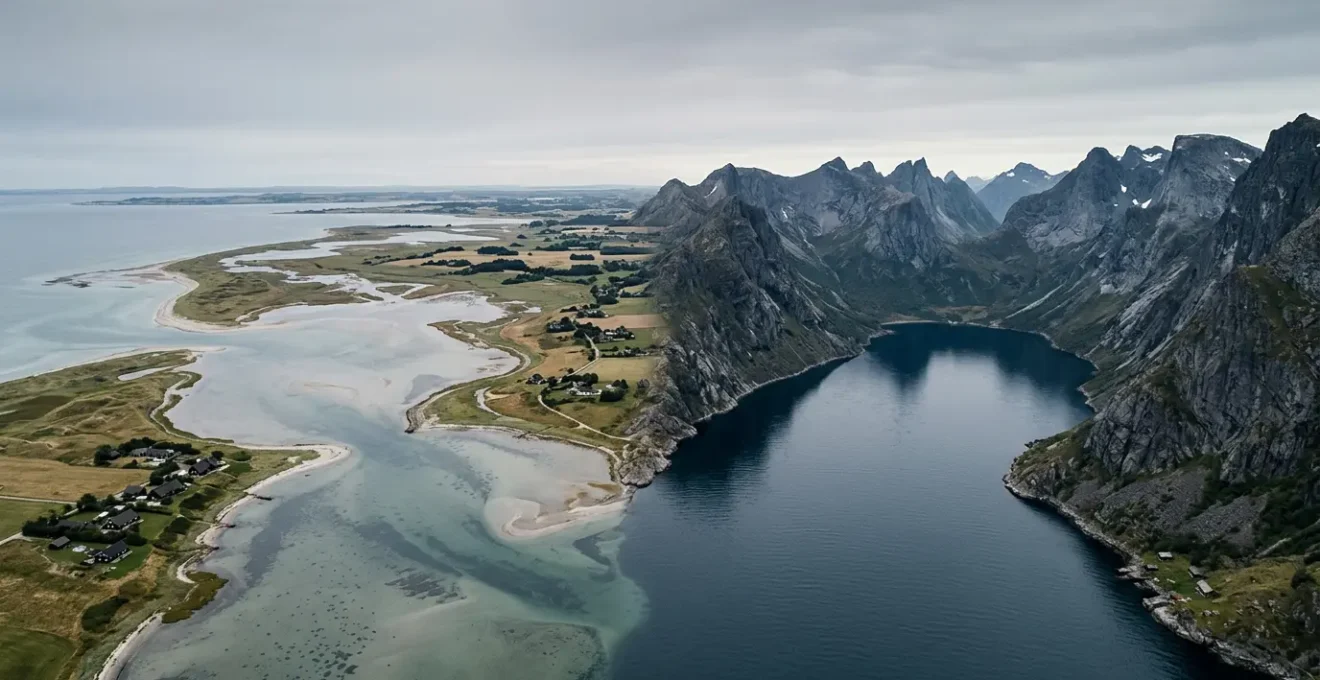
The critical mistake is comparing Danish and Norwegian fjords by scale; they are fundamentally different landscapes offering distinct experiences.
- Danish “fjords” are shallow, brackish coastal inlets shaped by sea-level rise, fostering rich ecosystems and accessible recreation like cycling and kayaking.
- Norwegian fjords are deep, dramatic U-shaped valleys carved by glaciers, defined by towering cliffs and monumental scale.
Recommendation: Approach Denmark’s coastlines not as a “lesser Norway” but as an intimate, living landscape to be explored at water level, where history and nature intertwine.
When you hear the word “fjord,” your mind likely conjures images of towering, sheer cliffs plunging into deep, dark blue water—the dramatic landscapes of Norway’s western coast. So, when you see places like Limfjord or Roskilde Fjord on a map of Denmark, a flat, low-lying country, it’s natural to question the comparison. Are they truly fjords? The simple answer is yes, but they belong to a completely different category of coastal feature. To compare a Danish fjord to Geiranger is like comparing a meandering river to a thundering waterfall; both are water, but their character, origin, and the way you experience them are worlds apart.
Many guides might simply list activities, but this misses the fundamental point. The key to appreciating Denmark’s coastline is to manage expectations and understand the unique geography that has shaped its history, culture, and ecosystems. The defining feature of a Danish fjord is not vertical drama, but horizontal expanse and shallow, life-giving waters. This distinction isn’t just academic; it dictates everything from the design of Viking ships centuries ago to the world-class sea trout fishing and cycling routes available today. This guide moves beyond the simple comparison of scale to explore the unique character of Denmark’s coastal inlets, revealing why their subtle beauty offers a profound connection to nature and history that Norway’s grandeur cannot replicate.
This article will guide you through the defining experiences of Danish fjords, from their historical significance to their rich biodiversity and recreational opportunities. By understanding their unique identity, you can better appreciate these remarkable landscapes.
Summary: Understanding the Unique Character of Danish Fjords
- Viking Ships waters: Is Roskilde Fjord the Best Place for Historical Paddling?
- Sea Trout Hunting: Why Are Danish Fjords World-Class for Anglers?
- Oyster Safari: When Is the Best Time to Harvest in the Limfjord?
- Fjord Path: Can You Cycle the Entire Ringkøbing Fjord in a Day?
- Vejlerne: Why Is the Limfjord Area a Mecca for Birdwatchers?
- Seals and Porpoises: Where Are You Most Likely to See Them from a Kayak?
- Seatrout Fishing: Do You Need a License to Cast from the Shore?
- Where to Find the Most Photogenic Coastlines in Denmark?
Viking Ships waters: Is Roskilde Fjord the Best Place for Historical Paddling?
While Norway’s fjords were formidable barriers and highways for oceanic voyages, Denmark’s shallow inlets like Roskilde Fjord served a different purpose: they were the heart of a maritime trade and defense network. This is the perfect place to understand the concept of a living landscape, where geography directly shaped history. The shallow, protected waters were ideal for the Vikings’ versatile ships, which needed to navigate both open seas and inland waterways. Paddling a kayak here is not just a recreational activity; it’s a journey through time, gliding over the very same channels used for commerce, transport, and defense over a millennium ago.
The Skuldelev Ships: A Fjord-Based Defense Strategy
Around 1070 AD, a fascinating act of strategic defense took place. To protect the vital trading hub of Roskilde from sea-based attacks, the Vikings deliberately sank five of their own ships in a narrow channel of the fjord. This underwater blockade, known as the Skuldelev ships, reveals how ship design was tailored to the Danish landscape. The excavated vessels range from the Skuldelev 3, a small coastal trader with a shallow 0.9m draught perfect for Danish inlets, to the Skuldelev 2, a 30-meter oceanic longship built for raiding. This archaeological evidence demonstrates that the fjord’s geography fostered a unique maritime culture focused on commerce and coastal control, a stark contrast to the deep-water needs of Norwegian seafaring.
The Viking Ship Museum in Roskilde brings this history to life, housing the original ships and building faithful reconstructions using ancient techniques. Seeing these vessels, you understand that their design is a direct response to the environment. Paddling alongside these replicas on the fjord, you gain a tactile sense of this history.
The reflection of a hand-hewn oak hull in the calm water, with your own paddle dipping into the same surface, creates an unparalleled connection to the past. The fjord is not a static backdrop but the central character in the story of the Vikings. Therefore, for anyone interested in history, Roskilde Fjord is arguably the most profound place in Scandinavia to experience the Viking Age from the water’s surface.
Sea Trout Hunting: Why Are Danish Fjords World-Class for Anglers?
The same geographic features that make Danish fjords less dramatic than Norway’s—their shallowness, gentle currents, and brackish water—create a paradise for one of Europe’s most prized sport fish: the sea trout. These inlets are essentially vast, nutrient-rich estuaries, where freshwater from streams and rivers mixes with saltwater from the sea. This unique brackish ecosystem is an all-you-can-eat buffet for the shrimp, sand eels, and small fish that sea trout prey on. Unlike the deep, cold, and predominantly saltwater environment of Norwegian fjords, Danish fjords offer the perfect habitat for trout to feed and grow large before returning to their home rivers to spawn.
The sheer accessibility of these fishing grounds is another key factor. With over 8,000 kilometers of coastline, much of it consisting of gently sloping shores, anglers can easily wade and cast from the bank. This style of fishing provides an intimate connection to the environment that is impossible from a boat in a deep Norwegian fjord. You are standing in the trout’s habitat, reading the subtle currents and observing the life around you. The FlyFish Circle guide rightly notes, “The nutrient-rich waters and favorable climate create the perfect habitat for these elusive fish.” It’s this combination of rich feeding grounds and accessibility that makes Denmark a world-class destination.
Furthermore, Denmark has invested heavily in conservation and fishery management. Proceeds from the mandatory national fishing license are used to fund smolt release programs and habitat restoration projects. This ensures that the sea trout populations remain healthy and sustainable for future generations. For an angler, this means the dream of catching a large, silver “overspringer” (a trout that has skipped a spawning run to feed for an extra year) is a very real possibility. It’s a challenging but rewarding pursuit, set against a backdrop of subtle coastal beauty.
Oyster Safari: When Is the Best Time to Harvest in the Limfjord?
The Limfjord, Denmark’s largest fjord system, offers another unique culinary adventure born from its specific geography: the oyster safari. The best time to harvest oysters here is during the “R” months—from September through April. During these colder months, the oysters are at their prime, firm and flavorful, and the risk of harmful algal blooms is at its lowest. Wading into the shallow, calm waters of the Limfjord in waterproof waders to pick your own oysters is a uniquely Danish experience, blending foraging with a deep connection to the coastal environment.
Interestingly, the star of the show is an invasive species. The native European flat oyster has been largely outcompeted by the Pacific oyster, which spread to the Limfjord from farms in southern Europe. Initially viewed as an ecological threat, this hardy species has now become a celebrated gourmet resource. It forms dense reefs in the shallow waters, making it easy for foragers to collect them by hand at low tide. This story is a fascinating example of ecological change, where a potential problem has been turned into a sustainable culinary opportunity, balancing conservation needs with the management of an invasive population.
An “oyster safari” is more than just gathering food; it’s a lesson in marine biology and local ecology. Guided tours, popular in the region, will teach you how to identify the right oysters, shuck them correctly on the spot, and understand their role in the fjord’s ecosystem. Standing in the crisp air, with the vast, calm expanse of the Limfjord around you, and tasting a freshly shucked oyster—salty, fresh, and complex—is to taste the very essence of the place. It’s an experience of intimate scale, impossible in the deep waters of a Norwegian fjord, that highlights the productive, life-giving nature of these shallow inlets.
Fjord Path: Can You Cycle the Entire Ringkøbing Fjord in a Day?
Yes, not only is it possible, but cycling the path around Ringkøbing Fjord is one of the best ways to understand the character of the Danish coast. The experience perfectly encapsulates the “horizontal” nature of the landscape. The official Fjord Path (Fjordstien) is a dedicated 100 km route that encircles the entire fjord, and for a reasonably fit cyclist, completing it in a single day is a popular and achievable challenge. Unlike the mountainous terrain surrounding Norwegian fjords, which is suited for hardcore hiking, the Danish landscape is defined by its gentle, rolling topography, making it ideal for cycling.
The route takes you through an incredibly diverse range of scenery, all connected by the constant presence of the water. You’ll pedal through charming harbor towns like Hvide Sande and Ringkøbing, across protected nature reserves teeming with birdlife, through fragrant pine forests, and alongside vast stretches of marsh reeds. The path is mostly flat and well-maintained, allowing you to focus on the expansive views and the changing light on the water rather than a grueling physical effort. It’s a meditative experience, where the rhythm of your pedaling syncs with the gentle lapping of the waves.
This accessibility is a key point of difference. While a Norwegian fjord inspires awe and a sense of human smallness against monumental nature, a Danish fjord invites participation. You are not just observing the landscape from a ferry deck; you are moving through it, feeling the sea breeze, smelling the salt air, and stopping whenever a view catches your eye. Cycling the Fjord Path reveals the subtle beauty of the Danish coast—a beauty found in the vastness of the sky, the dance of light on the water, and the feeling of being an integral part of the landscape, not just a spectator.
Vejlerne: Why Is the Limfjord Area a Mecca for Birdwatchers?
The Limfjord area, particularly the nature reserve of Vejlerne, is a European birdwatching mecca for a simple reason: its geography creates a perfect, large-scale service station for migratory birds. Vejlerne, Northern Europe’s largest bird sanctuary, consists of vast, shallow lakes, extensive reedbeds, and coastal meadows. This mosaic of wetland habitats, formed by a failed 19th-century land reclamation project, provides an ideal environment for breeding, resting, and feeding. The shallow waters are crucial, offering easy access to food for a huge variety of waders, ducks, geese, and spoonbills.
Unlike the deep, steep-sided Norwegian fjords, which offer limited shallow feeding grounds, the broad, low-lying landscape around the Limfjord is a massive larder. Millions of birds use the East Atlantic Flyway, a migratory superhighway stretching from the Arctic to Africa, and Vejlerne is one of their most important stops. Here, they can rest and refuel in relative safety. The reserve’s management focuses on maintaining these habitats, for instance, by controlling water levels and using cattle grazing to keep meadows open, ensuring the area remains attractive to its avian visitors.
For a visitor, the experience is breathtaking. From strategically placed observation towers and hides, you can witness incredible spectacles: thousands of geese taking flight at dawn, the elegant dance of courting cranes in spring, or the sight of a sea eagle soaring overhead. The sheer numbers and diversity of species are staggering. This abundance is a direct consequence of the subtle topography of the Danish fjord landscape. It’s another example of how the lack of dramatic cliffs and deep water gives rise to a different kind of natural wonder—one of immense biological richness and dynamic, vibrant life. For a nature lover, the sights and sounds of Vejlerne are as awe-inspiring as any Norwegian cliff face.
Seals and Porpoises: Where Are You Most Likely to See Them from a Kayak?
While both Danish and Norwegian fjords are home to marine mammals, the experience of seeing them from a kayak is profoundly different due to the fundamental geology of these landscapes. The key difference lies in depth. For instance, Sognefjorden, Norway’s deepest fjord, plunges to 1,308 meters below sea level. In stark contrast, Danish fjords are typically only a few meters deep. This incredible shallowness is what makes kayaking in Denmark such an intimate wildlife experience.
In the Danish fjords, particularly in protected areas like the Wadden Sea National Park or parts of the Limfjord, you have a high chance of encountering harbor seals and grey seals. They often haul out on sandbanks (sandrevler) that become exposed at low tide. From a kayak, you can quietly approach these colonies, keeping a respectful distance, and observe them resting, interacting, and slipping into the water. Because the water is shallow, you can often see them swimming beneath you. The most common cetacean, the harbor porpoise, also frequents these inlets to feed. While shy, their small dorsal fins are a common sight as they surface for air. The intimate scale of the environment means you are sharing their space at their level.
In a deep Norwegian fjord, seeing a porpoise or a seal is also possible, but the context is entirely different. You are a tiny speck on a vast, deep body of water, and the animal is a fleeting presence against a backdrop of immense cliffs. In Denmark, the landscape is your partner in the encounter. You might follow a channel through a reed bed and surprise a seal, or paddle over a clear, sandy bottom where you can see crabs scuttling. It is this closeness and the ability to see and understand the entire habitat—from the seabed to the surface—that makes wildlife encounters from a kayak in Danish fjords so uniquely personal and memorable.
Seatrout Fishing: Do You Need a License to Cast from the Shore?
Yes, obtaining a license is a legal requirement for any angler wishing to fish in Denmark, and this rule is a cornerstone of the country’s successful fishery management. It reflects a culture of shared responsibility for maintaining the natural resources that make the fjords so special. The process is straightforward and the investment directly benefits the ecosystem you are enjoying. Understanding these regulations is the first step to a successful and responsible fishing trip.
The license, known as the “fisketegn,” is mandatory for anyone aged between 18 and 65. The funds generated are not a tax but are reinvested into the fishery through research, habitat improvement, and the release of juvenile trout. This system ensures the long-term health and sustainability of the world-class sea trout population. As outlined in the comprehensive guide from Denmark’s official sea trout resource, there are also specific rules regarding minimum sizes and conservation zones that every angler must know and respect.
These regulations are not just bureaucratic hurdles; they are an integral part of the Danish approach to nature. They foster a sense of stewardship among anglers and ensure that the pursuit of a silver sea trout can be enjoyed for generations to come. The checklist below provides the essential points you need to know before you cast a line from the shores of a Danish fjord.
Action Plan: Your Danish Fishing License Checklist
- Confirm Requirement: If you are aged 18-65, a national angling license (fisketegn) is mandatory for all forms of sport fishing in Denmark.
- Purchase Your License: The easiest way is to buy it online at the official www.fisketegn.dk website. Ensure you carry proof of purchase (digital or print) at all times while fishing.
- Understand Minimum Sizes: The general minimum size for sea trout is 40 cm, but be aware of local exceptions, such as the 45 cm minimum in Odense Fjord. Always carry a measuring tape.
- Respect Seasonal Restrictions: From November 16 to January 16, all colored (spawning) sea trout must be released immediately. Only silvery fish with loose scales may be kept.
- Check Conservation Zones: Fishing is strictly prohibited within a 500-meter radius of river and stream estuaries to protect migrating spawners. Always consult an up-to-date map of these zones (fredningszoner) at www.fredning.fd.dk before your trip.
Key Takeaways
- Geological Distinction: Danish fjords are shallow, glacially-formed coastal inlets, while Norwegian fjords are exceptionally deep, U-shaped glacial troughs. This is the primary difference that shapes all others.
- Character and Experience: Denmark offers an intimate, accessible landscape defined by rich biodiversity and human history. Norway provides a monumental, dramatic landscape that inspires awe.
- Mode of Interaction: The best way to experience a Danish fjord is through active participation at water level—cycling, kayaking, wading, and fishing—to appreciate its subtle, living character.
Where to Find the Most Photogenic Coastlines in Denmark?
After exploring the differences, it becomes clear that searching for “photogenic” coastlines in Denmark requires a shift in perspective. You won’t find the epic, mountainous backdrops of Geiranger or Nærøyfjord. Instead, the photographic beauty of the Danish coast lies in its subtlety, light, and life. The most compelling images are not of monumental scale, but of intimate moments where water, land, and sky interact in delicate ways. The most photogenic coastlines are those where you can capture the unique character of this low-lying landscape.
For capturing history, the calm waters of Roskilde Fjord at sunrise, with the silhouette of a Viking ship reconstruction against a soft sky, are unbeatable. For capturing the essence of coastal life and recreation, the area around Ringkøbing Fjord offers endless opportunities: the clean graphic lines of a cyclist on the Fjord Path, the textures of windswept reeds, or the colorful fishing boats in Hvide Sande harbor. For raw, untamed nature, the vast wetlands of Vejlerne in the Limfjord provide a stage for dramatic scenes of birdlife, especially during the “black sun” murmurations of starlings or the arrival of thousands of geese.
The key to successful photography here is to focus on the details and the quality of light. The long Nordic summer evenings and the crisp, low light of winter create magical conditions. Look for reflections in the still, shallow water, the texture of the sand on a deserted beach, the gentle curve of the coastline disappearing into the mist, or the graphic shape of a seal on a distant sandbank. The beauty is horizontal, not vertical. It’s found in the expansive sky, the subtle color palettes, and the sense of peace and tranquility that these accessible, human-scaled landscapes provide.
The best way to discover these photogenic coastlines is to immerse yourself in them. Choose your adventure—whether by paddle, pedal, or foot—and let the subtle charm of Denmark’s living landscape reveal itself to you.