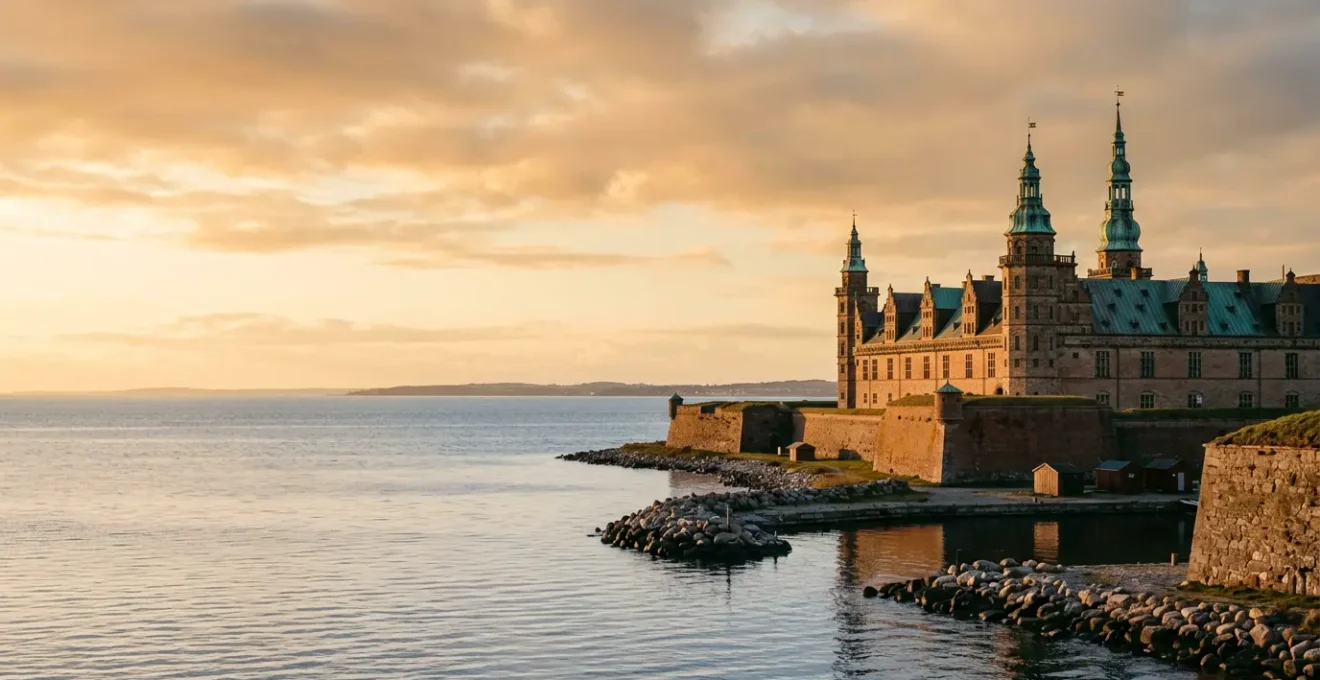
Choosing between Kronborg and Frederiksborg is less about the destination and more about the story you wish to experience.
- Kronborg Castle offers dramatic, literary immersion with its stark fortress walls pounded by the sea winds of Elsinore.
- Frederiksborg Castle provides opulent, art-filled splendor, set like a fairytale palace on a lake with magnificent Baroque gardens.
Recommendation: Use this historian’s guide to match your travel persona—dramatic pilgrim or art connoisseur—to the right castle, and choreograph a day trip that transcends mere sightseeing.
For any lover of architecture or literature visiting Copenhagen, the question inevitably arises: which castle deserves your precious day-trip time? The choice is often presented as a simple binary: Kronborg, the formidable sea-swept fortress of Shakespeare’s Hamlet, or Frederiksborg, the opulent “Versailles of the North,” home to the Museum of National History. This decision pits dramatic, windswept tragedy against gilded, palatial grandeur. Most guides will tell you Kronborg is for the literary pilgrim and Frederiksborg for the art historian, that both are easy trips, and that the Copenhagen Card is your best friend. While true, this advice barely scratches the surface.
But what if the choice wasn’t about picking one over the other, but about consciously choreographing a narrative experience? The true art of the Danish castle day trip lies not in the destination, but in the design of the journey itself. This guide moves beyond the brochure descriptions to offer a historian’s perspective on how to strategically plan your visit. We will dissect the atmospheric immersion of each site, untangle the logistical strategy required to see them, and evaluate the experiential return on your investment of time and attention. By understanding the architectural dialogue between these two titans of the Danish Renaissance, you can craft a day that resonates with your own personal story.
This article provides a detailed comparison to help you make an informed choice, with practical advice on transportation, timing, and avoiding common pitfalls. Explore the sections below to master the art of the Danish castle day trip.
Summary: A Strategic Comparison of Denmark’s Renaissance Masterpieces
- Kronborg vs. Frederiksborg: Hamlet’s Fortress or the Museum of National History?
- The Coast Line: How to Reach Elsinore by Train with Great Views?
- Hamlet Live: Is the Interactive Theater at Kronborg Worth It?
- Baroque Gardens: When Are the Hedges at Frederiksborg Perfectly Trimmed?
- Scaffolding Risks: How to Check if the Spire Is Covered Before You Go?
- How to Explore 1000 Years of Royal History in a 3-Day Weekend?
- Is the Amalienborg Museum Worth the Ticket Price for Non-Royalists?
- Hamlet Live: Is the Interactive Theater at Kronborg Worth the Extra Cost?
Kronborg vs. Frederiksborg: Hamlet’s Fortress or the Museum of National History?
At the heart of your decision lies a fundamental difference in character. Kronborg Castle is an exercise in dramatic, military Renaissance architecture. Its stark walls, battered by the winds of the Øresund Strait, command a strategic position that once controlled all trade into the Baltic Sea. Its atmosphere is one of power, salt, and literary ghosts. To walk its ramparts is to feel the weight of history and fiction intertwined. In contrast, Frederiksborg Castle is a symphony of opulent Dutch Renaissance splendor. Built across three lake islands, its copper spires, ornate interiors, and sprawling Baroque gardens were designed not for war, but for royal representation. It is a palace meant to overwhelm the senses with beauty and wealth, housing Denmark’s Museum of National History within its gilded halls.
The choice is not merely between military and palatial, but between two distinct narratives. Do you seek the moody, contemplative experience of a Shakespearean tragedy, set against a backdrop of cannons and coastal fog? Or do you prefer to be dazzled by artistic mastery, wandering through rooms overflowing with portraiture, tapestries, and decorative arts? The following table breaks down the core differences to help you choreograph your ideal day.
| Criteria | Kronborg Castle | Frederiksborg Castle |
|---|---|---|
| Atmosphere | Dramatic coastal fortress with wind, sea, and stark Renaissance military architecture | Opulent palace on lake islands with Baroque gardens and ornate interiors |
| Best For | Literary pilgrims (Hamlet connection), dramatic coastal views, atmospheric experience | Art lovers, photography, ornate interiors, museum collections |
| Time Needed | 1-2 hours for main visit | 3-5 hours including gardens |
| Entrance Fee | 125 DKK adults (free with Copenhagen Card) | 75 DKK adults (free with Copenhagen Card) |
| Travel Time from Copenhagen | 40-45 minutes by train | 40-42 minutes by train |
| Key Features | UNESCO site, casemates, Hamlet performances, coastal ramparts | Museum of National History, Baroque gardens, Chapel, lake setting |
| Rainy Day Option | Good – indoor casemates and halls | Excellent – extensive indoor museum |
For the ambitious traveler, visiting both in a single day is a logistical feat. It requires an early start and precise timing, particularly for the once-per-hour 930R train connecting Hillerød (Frederiksborg) and Helsingør (Kronborg). A successful dual-castle day involves leaving Copenhagen by 8:30 AM, dedicating the morning to Frederiksborg’s extensive grounds, and catching the 12:57 PM train to arrive at Kronborg for an afternoon of coastal exploration. This packed itinerary leaves little room for error and transforms the day into a high-paced challenge rather than a leisurely immersion.
The Coast Line: How to Reach Elsinore by Train with Great Views?
The journey to Kronborg Castle in Helsingør is an integral part of the experience, a prelude that sets a majestic tone. The most scenic route is via the Kystbanen, or “Coastal Line,” a railway that hugs the shoreline of the Øresund Strait. To maximize this experience, the single most important piece of advice is this: when traveling northbound from Copenhagen, secure a seat on the right side of the train. This east-facing position provides uninterrupted vistas of the Danish coast, quaint seaside towns, and the distant silhouette of Sweden across the water. The journey itself becomes a moment of contemplative travel, far removed from a standard commute.
As confirmed by the official Kronborg Castle visitor information, the journey is as efficient as it is beautiful, with trains departing roughly every 20 minutes and a travel time of 40-45 minutes. This frequency allows for flexibility and spontaneity. The Coastal Line is more than just a transport link; it’s a thread connecting some of North Zealand’s greatest cultural treasures. Strategically, you can combine your visit to Kronborg with a stop at the Louisiana Museum of Modern Art in Humlebæk or the Karen Blixen Museum in Rungsted Kyst, as both are served by the same line. For those attempting the ambitious two-castle day, the key is the 930R ring train connecting Hillerød to Helsingør, a crucial shortcut that saves over an hour by avoiding a return to Copenhagen.
Hamlet Live: Is the Interactive Theater at Kronborg Worth It?
The “Hamlet Live” experience transforms a visit to Kronborg from a historical tour into an immersive piece of living theatre, but its value is entirely dependent on your goals for the day. This is not a formal, seated performance. Instead, it consists of short, powerful scenes from Shakespeare’s play enacted by actors in various rooms and courtyards throughout the castle. Between these pop-up performances, the characters—Hamlet, Ophelia, Claudius—wander the grounds in character, allowing for spontaneous and often engaging interactions with visitors. This format brilliantly uses the castle’s authentic, atmospheric setting as its stage, breathing life into the cold stone walls.
For literature enthusiasts and theater lovers, the experience is absolutely worth it. It provides a unique, dynamic way to connect with the play in its spiritual home. The actors use an accessible form of English, and their physical performances often convey the story’s emotion beyond the dialogue, making it enjoyable even for non-native speakers or those less familiar with the text. However, there is a significant trade-off: the investment of time. To follow the narrative as it unfolds throughout the day, a typical 1.5-hour visit can easily extend to 3-4 hours. This makes it nearly impossible to also visit Frederiksborg on the same day without feeling rushed. Therefore, choosing to engage with “Hamlet Live” is, in essence, a choice to dedicate your entire day trip to the full Kronborg immersion.
Baroque Gardens: When Are the Hedges at Frederiksborg Perfectly Trimmed?
The gardens of Frederiksborg Castle are a masterpiece of horticultural architecture, a living sculpture that changes dramatically with the seasons. For the visitor seeking that perfect, symmetrical photograph of the Baroque garden, timing is everything. The period of peak precision is from late May to June. During these weeks, the boxwood hedges have received their primary trim for the season, and the intricate royal monograms of past monarchs (Frederik IV, Christian VI, and others) are at their most sharply defined against the gravel paths. This is when the garden’s geometric perfection, a core tenet of Baroque design asserting human control over nature, is on full display.
The garden’s spectacle is further enhanced by its grand cascade and fountains. According to Visit North Zealand’s official information, the water features are active daily from May 1st until mid-October, bringing sound and movement to the landscape. While summer offers the full sensory experience, autumn provides a different kind of beauty, with rich foliage colors in the adjoining Romantic landscape garden offering a softer, more naturalistic counterpoint to the Baroque’s rigid structure. For photographers, the best vantage point to capture the garden’s symmetry is not from the ground, but from the upper floors of the castle museum, looking down upon the parterre. This elevated perspective reveals the full scale and mathematical elegance of the design, creating an unforgettable image of palatial grandeur.
Scaffolding Risks: How to Check if the Spire Is Covered Before You Go?
There are few travel disappointments as acute as arriving at a historic monument, camera in hand, only to find its iconic facade obscured by a web of scaffolding. Both Kronborg and Frederiksborg are centuries-old structures that undergo regular, necessary restoration. For an architecture lover or photographer, this can ruin a long-planned visit. Fortunately, you can move beyond hope and employ a pre-visit verification strategy to mitigate this risk. The key is to triangulate information from several modern sources just before your trip.
Your first and most reliable step is to check the official websites, specifically the “Plan Your Visit” or “News” sections, for any announcements about major restoration work. However, not all projects are widely publicized. This is where real-time, user-generated content becomes invaluable. A few days before you go, search Instagram for the hashtags #kronborgslot and #frederiksborgslot, filtering by “Recent.” This will show you photos taken by visitors within the last few hours or days, providing a current, unfiltered view of the castle’s condition. Similarly, checking the newest reviews on Google Maps or TripAdvisor can be highly revealing, as visitors frequently comment on (and complain about) unexpected scaffolding. This simple intelligence gathering can save you from significant disappointment and allow you to adjust your plans accordingly.
Your Pre-Visit Scaffolding Verification Plan
- Official Channels: Regularly check the ‘Plan Your Visit’ pages on the official Kronborg (kronborg.dk) and Frederiksborg (frederiksborg.dk) websites for restoration news.
- Social Media Reconnaissance: Search Instagram hashtags (#kronborgslot, #frederiksborgslot) and filter by ‘Recent’ to see photos from the last 7 days.
- Review Mining: Scan the ‘Newest’ reviews on Google Maps and TripAdvisor; visitors often post real-time updates and photos of construction work.
- Direct Contact: For definitive confirmation, email the castle’s visitor services directly. Contact details are available on their websites.
- Contingency Planning: If scaffolding is present, pre-plan an alternative photographic focus, such as interior details, garden views, or dramatic close-ups of unaffected architectural elements.
Should you arrive to find scaffolding, all is not lost. Reframe your photographic approach. At Kronborg, focus on the dramatic sea-level views from the ramparts. At Frederiksborg, use the lake to your advantage by shooting from the opposite shore to capture reflections that may obscure the construction work.
How to Explore 1000 Years of Royal History in a 3-Day Weekend?
A day trip to Kronborg and Frederiksborg can be beautifully contextualized within a longer, 3-day immersion into Denmark’s rich royal past. By choreographing your weekend, you can trace a compelling narrative from the Viking Age to the modern monarchy. This itinerary structure transforms a series of individual site visits into a cohesive historical journey through time. The most logical approach is to explore this history chronologically, creating a powerful storytelling arc across your three days.
Day 1: Viking Kings & Cathedral Tombs. Begin your journey in Roskilde (a 30-minute train ride from Copenhagen). Here, you start at the beginning. Visit the Viking Ship Museum to understand the maritime foundations of Danish power, then proceed to the magnificent Roskilde Cathedral, a UNESCO World Heritage site. This is the royal burial church of Denmark, holding the tombs of 39 kings and queens, a physical timeline of the monarchy stretching back a millennium.
Day 2: Renaissance Power & Drama. With the medieval foundation set, you can now appreciate the explosive power and wealth of the Renaissance. This is the day for your grand castle tour. Take the morning train to Hillerød to explore Frederiksborg’s opulent halls and gardens. In the afternoon, journey to Helsingør to experience the formidable military might and literary resonance of Kronborg. This day encapsulates the peak of Denmark’s influence in the 16th and 17th centuries.
Day 3: Rococo Palaces & Crown Jewels. Conclude your weekend in central Copenhagen by focusing on the 18th century to the present. Start at Rosenborg Castle to gaze upon the dazzling Crown Jewels. Then, walk to Amalienborg Palace, the elegant Rococo residence of the current royal family, and witness the Changing of the Guard at noon. This day brings the story into the modern era. To facilitate such a packed itinerary, the Copenhagen Card is invaluable. As detailed on Visit Copenhagen’s official transport guide, the card includes unlimited public transport across all necessary zones and free entry to all the mentioned sites, including Kronborg, Frederiksborg, Rosenborg, Amalienborg, and Roskilde Cathedral.
Is the Amalienborg Museum Worth the Ticket Price for Non-Royalists?
For the traveler whose interests lean more toward social history or design than royal lineage, the Amalienborg Museum presents a surprisingly compelling case. The key to appreciating its value lies in understanding its unique position in Copenhagen’s royal landscape. It offers a fundamentally different experience than the monumental fortresses of Kronborg or Frederiksborg. If the day-trip castles represent “monumental history,” Amalienborg offers a rare glimpse into “lived-in history.”
Where Kronborg and Frederiksborg showcase the grand, often impersonal, power of the 16th and 17th centuries, Amalienborg opens the door to the private world of the monarchy from the 19th century to the near-present. Visitors walk through the intimate studies, drawing rooms, and private chambers of recent kings and queens, preserved as they were left. The focus shifts from military might to the subtleties of daily royal life, decorative arts, and the evolution of Danish design. It provides a relatable, human-scale counterpoint to the awe-inspiring but distant grandeur of the Renaissance castles.
Case Study: Lived-in History vs. Monumental History
Amalienborg offers a fundamentally different experience from Kronborg and Frederiksborg: it presents ‘lived-in history’ rather than ‘monumental history.’ Where the day-trip castles showcase vast Renaissance halls and dramatic fortifications from the 1500s-1600s, Amalienborg reveals intimate 19th-20th century royal apartments with exquisite Rococo interiors, Fabergé eggs, and Danish design craftsmanship. For visitors interested in social history and decorative arts rather than military might, Amalienborg provides relatable insights into how a functioning modern monarchy lives. The museum ticket often includes discounted or combined access to Rosenborg Castle, creating a ‘Royal Copenhagen Day’ pairing that covers both baroque opulence and contemporary royal life.
Furthermore, much of the Amalienborg experience is free. You can freely walk the magnificent octagonal palace square, admire the four identical Rococo facades, and witness the pageantry of the Changing of the Guard ceremony daily at noon. You can even tell if the Queen is in residence by looking for the royal standard flying above Christian IX’s Palace. For those who do choose to buy a ticket, it often provides combined or discounted entry to Rosenborg Castle, allowing for a value-packed “Royal Copenhagen Day.”
Key takeaways
- Frame your choice strategically: Kronborg delivers a dramatic, literary atmosphere, while Frederiksborg offers opulent, art-focused splendor.
- The journey is part of the experience; on the Coastal Line train to Kronborg, always sit on the right-hand side for spectacular sea views.
- The “Hamlet Live” immersive theater is a major time commitment; engaging with it means dedicating your entire day to Kronborg.
- To see both castles in one day, you must master a tight logistical schedule centered on the once-per-hour 930R train between Hillerød and Helsingør.
Hamlet Live: Is the Interactive Theater at Kronborg Worth the Extra Cost?
A common question for budget-conscious travelers is whether the “Hamlet Live” experience at Kronborg requires an additional, expensive ticket. The answer provides a crucial insight into planning your visit: for the daytime interactive performances, there is no extra cost. The “Hamlet Live” pop-up scenes that run throughout the day from June to August are included with the standard castle admission ticket. This makes the value proposition excellent from a purely financial standpoint; you are getting a live theatrical experience for the price of a museum entry.
The “extra cost” confusion arises from the separate, large-scale Shakespeare Festival that takes place on select evenings in August. These are formal, ticketed productions on a stage built over the moat, with prices that, based on 2023-2024 pricing information, can range from 240 to 460 DKK. This is a premium theatrical event, distinct from the inclusive daytime performances. Therefore, the real “cost” of enjoying the daytime “Hamlet Live” is not monetary, but temporal. As discussed, the 3-4 hours required to see the full cycle of scenes makes it your primary activity for the day.
The cost-benefit analysis then becomes one of opportunity cost. Is the immersive Shakespearean experience more valuable to you than the opportunity to also see Frederiksborg’s art and gardens? For a family with teenagers studying literature, the answer is likely yes. For an art historian with limited time, the answer may be no. For those on the fence, a free alternative exists: download key scenes from the play and read them aloud yourself in the castle’s courtyards. This allows for a personal moment of literary connection without the significant time commitment of the official performance.
Now, armed with a historian’s strategic insight, you are prepared to move beyond a simple tourist visit. You can choreograph a day trip to Denmark’s great castles that is not just seen, but felt and experienced—a narrative of your own design. Evaluate your priorities, plan your logistics, and embark on your perfect Danish Renaissance adventure.
Frequently Asked Questions About Hamlet Live and Castle Visits
What is the format of Hamlet Live at Kronborg?
Hamlet Live consists of multiple short scenes enacted in different rooms throughout the castle every half hour. Actors perform excerpts from Hamlet, sometimes sticking to the script, other times directly engaging visitors. Between scenes, characters wander the castle in costume, allowing spontaneous interactions.
Should I pre-book tickets or buy on arrival?
Pre-booking online is essential during peak season (June-August) to avoid multi-hour queues, especially when cruise ships dock in Copenhagen. The Copenhagen Card provides skip-the-line access and includes both castle entries plus unlimited train travel, offering significant value for a multi-castle day trip.
What should I do if I arrive and find scaffolding on the castle?
Reframe your photography approach: focus on interior details, close-up architectural elements, or dramatic perspectives that exclude the affected areas. At Kronborg, emphasize the coastal ramparts and sea-level views; at Frederiksborg, concentrate on the Baroque gardens from the opposite lake shore for unobstructed castle reflections.