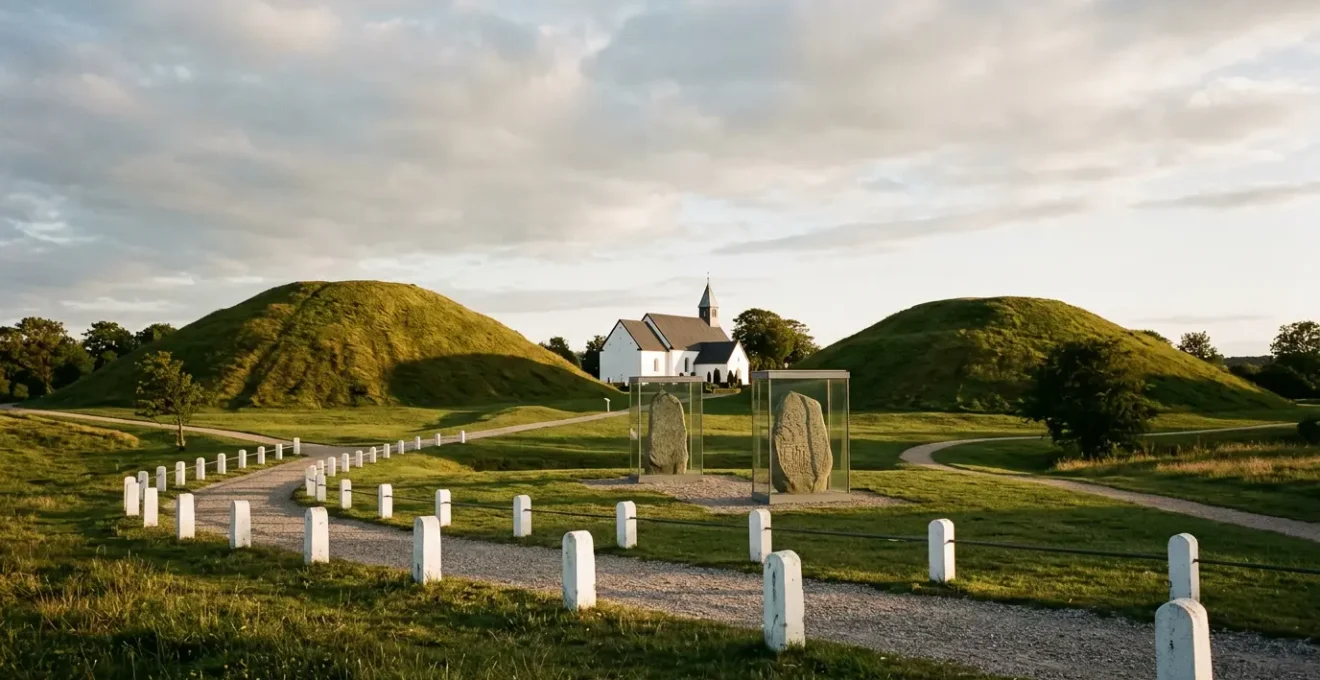
The Jelling Monuments are not a static ‘birth certificate’ but the active landscape where the story of Denmark’s reinvention was physically written, overwritten, and buried.
- The site must be read as a strategic space, where Viking power was converted into Christian kingship through acts of masterful propaganda and symbolic overwriting.
- Understanding the narrative requires visiting the Kongernes Jelling visitor center first; it provides the “Viking-Vision Goggles” needed to see the full story.
Recommendation: Approach Jelling not as a collection of ancient objects, but as a single, powerful narrative of transformation that begins in the museum and culminates at the stones and mounds.
To stand on the green lawns of Jelling, flanked by two monumental burial mounds and two exquisitely carved stones, is to stand at the very heart of Danish identity. For centuries, this place has been called “Denmark’s Birth Certificate,” a simple, powerful metaphor for a profound historical moment. As a steward of this UNESCO World Heritage site, I can assure you that this description, while evocative, only scratches the surface. It suggests a single, static event, a document signed and filed away in history.
The reality is infinitely more dramatic and complex. The common approach is to see the mounds, read the plaque by the stones, and leave, having ticked a historical box. But what if the key to understanding Jelling is not to see it as a document, but as a manuscript? A landscape of power where one story was violently erased and another, even more ambitious, was carved in its place. This is not just the story of Denmark’s birth, but of its strategic and spiritual reinvention.
This guide is designed to help you read that manuscript. We will decode the propaganda on Harald Bluetooth’s great stone, visualize the fortress that once stood here, and uncover the dramatic family secret buried within the mounds. By following this path, you will see Jelling not just as a place where Denmark was born, but as the very ground where its future was forged.
This article will guide you through the layers of meaning embedded in the Jelling landscape, from the grand pronouncements of its kings to the hidden details that reveal the true story of a nation in transition. Explore the sections below to fully appreciate this monumental site.
Summary: Decoding the Layers of Power at the Jelling Monuments
- Harald Bluetooth’s Boast: What Does the Big Jelling Stone Actually Say?
- Legoland to Vikings: How to Combine Jelling with a Family Trip?
- The Massive Ship Setting: How to Visualize the Lost Viking Fortress?
- Why You Should Never Skip the Visitor Center Before the Stones?
- North or South Mound: Which One Did Gorm the Old Build?
- Viking Myths vs. Reality: What Will You Actually Find in Denmark?
- Memorials or Property Deeds: Why Did Vikings Raise Stones?
- Beyond Jelling: Where to Find Runestones Hidden in Church Porches?
Harald Bluetooth’s Boast: What Does the Big Jelling Stone Actually Say?
The great Jelling Stone, often called the jewel of the site, is far more than a memorial. It is a masterful piece of medieval propaganda, a three-sided declaration of power that fundamentally rewrote Danish identity. To understand it, one must read its three faces as a cohesive political statement. One side honors Harald’s parents, Gorm and Thyra, establishing his legitimate lineage. Another features a magnificent lion-and-serpent battle, symbolizing his temporal power and control over a fierce kingdom. But the third and most revolutionary side is the key to his entire project.
This face contains the earliest known depiction of Christ in all of Scandinavia, carved around 965 AD, according to the National Museum of Denmark. With this image, Harald does something audacious: he claims Christ, and therefore the God of the powerful continental empires, as his own. The inscription boldly states that he “made the Danes Christian.” This was not a humble announcement of personal faith; it was a public broadcast of a new national brand, aligning Denmark with the future of Europe and consolidating his rule under a single, unifying ideology. While the original stone is now protected behind glass, an exact replica stands outside, allowing you to trace the intricate lines of this 1000-year-old declaration of a new era.
The stone’s sophisticated Mammen-style art is not merely decorative; it is a testament to the high culture of the Viking age. The flowing, interlaced patterns demonstrate a level of craftsmanship and aesthetic vision that rivals any in Europe at the time. This was not a primitive culture, but one capable of producing enduring symbols of power. This stone wasn’t just a claim; it was the physical proof of the ambition and capability of the king who commissioned it, a permanent boast carved for eternity.
Legoland to Vikings: How to Combine Jelling with a Family Trip?
While Jelling speaks to the grand narrative of a nation, it is also a remarkably accessible and engaging destination for visitors of all ages, making it a perfect historical counterpoint to a family trip to nearby Legoland. The vast open green space between the mounds is ideal for children to run and play, connecting with history in a physical, energetic way. The site’s popularity is undeniable, with more than 150,000 annual visitors making the pilgrimage, many of them families discovering history together.
The key to a successful family visit is to frame it as an adventure. The landscape itself is a playground of history, but the true magic for younger visitors lies in the interactive challenges that bring the Viking Age to life. Instead of a dry history lesson, you can present the site as a series of quests. This approach transforms passive viewing into an active treasure hunt, allowing children to discover the symbols, stories, and scale of Jelling at their own pace. The Kongernes Jelling visitor center is specifically designed with this in mind, offering numerous interactive exhibits that captivate young minds.
Your Jelling Viking Challenge for Kids
- Find the serpent fighting the lion on the great runestone: look carefully at the second side of Harald’s stone for the intertwined beast battle scene.
- Race to the top of both burial mounds: the northern and southern mounds are both 10 meters high with 70-meter diameters, perfect for a friendly competition.
- Hunt for your name in runes at Kongernes Jelling visitor center: the interactive exhibition lets kids discover how their names would be written in Viking runes.
- Use the digital binoculars on the rooftop terrace to see how Jelling looked 1000 years ago: travel back in time without leaving the present.
- Experience the virtual fire in the longhouse exhibit and listen to animated Viking battle stories that bring history to life.
By combining the physical exploration of the outdoor monuments with the digital and tactile experiences inside the visitor center, Jelling becomes more than just a historical site. It becomes a place of discovery, where the legends of the Vikings feel immediate and exciting. It’s an opportunity to show that history is not just in books, but is a living story etched into the landscape itself.
The Massive Ship Setting: How to Visualize the Lost Viking Fortress?
To stand at Jelling today is to experience a serene, park-like landscape. But a thousand years ago, this was the heart of a formidable, bustling royal complex. The true scale of this ambition is one of the hardest things to grasp, but it is made visible by a simple, powerful intervention: the white concrete posts that mark the perimeter of the lost world. These posts outline both a massive palisade and an even older, monumental stone ship setting.
Before Harald’s fortress, the site was dominated by a colossal stone ship, a quintessential Viking funerary monument. This was later superseded by Harald’s even grander vision: a huge, diamond-shaped palisade fortress. The scale is staggering. The original ship setting was a remarkable 356 meters long, the largest ever found. The palisade that replaced and enclosed the area was defended by a wall perhaps four meters high and enclosed an area equivalent to twenty football pitches. This was not a humble village; it was the Washington D.C. of its day, a statement of absolute power designed to intimidate and impress.
The white posts that stand today are not a reconstruction but a visualization. They are sentinels of memory, allowing your mind’s eye to rebuild the towering wooden walls. As you walk the perimeter, you begin to feel the sheer size of the enclosure. You can see how the mounds and the church were deliberately brought within this new, defended, and sacred space. This wasn’t just defense; it was architectural storytelling. Harald was creating a new center of the world, a landscape of power that physically contained both the ancestral past (the mounds) and the Christian future (the church) within his royal domain.
Why You Should Never Skip the Visitor Center Before the Stones?
A visit to Jelling that begins with the outdoor monuments is a visit half-lived. To truly understand the narrative of power and transformation, it is absolutely essential to start your journey at the Kongernes Jelling visitor center. It is here that you acquire the “Viking-Vision Goggles” necessary to decode the landscape. Best of all, this world-class experience is completely free to enter, removing any barrier to this crucial first step.
Without the context provided by the center, the mounds are simply large hills and the stones are weathered grey granite. They are impressive, but mute. The visitor center gives them a voice. Through stunning interactive technology, you witness the world as the Vikings saw it. You see the great Jelling stone not as it is now, but as it was then: painted in a riot of vivid, glorious colors, a beacon of power visible from afar. You see the different phases of construction, understanding how the site evolved from pagan burial ground to royal Christian complex. A visit of just two to three hours, split between the center and the grounds, is enough to transform your entire perception of the site.
Case Study: The “Viking-Vision Goggles” Effect
The Kongernes Jelling museum provides a transformative pre-visit experience. Its exhibits function as essential “Viking-Vision Goggles,” equipping visitors with the context to see the outdoor monuments come alive. Visitors who skip the center see only weathered grey stones; those who visit first can visualize the original brightly-painted monuments, the bustling royal fortress, and the profound religious transformation the site represents. The center’s cutting-edge displays, like the virtual fire in the longhouse and the black-and-white animations, provide historical context that is both visually striking and deeply informative, making the subsequent walk through the grounds a journey of recognition rather than confusion.
Think of the visitor center as the key to a locked story. It doesn’t just present facts; it builds a world. By experiencing the digital reconstructions and animated stories, you arm yourself with knowledge. When you finally step outside and stand before the real monuments, you are no longer a passive observer. You are an informed witness, capable of reading the layers of meaning in the stones and seeing the ghosts of the great palisade rise from the grass.
North or South Mound: Which One Did Gorm the Old Build?
The two great mounds dominate the Jelling skyline, but they tell very different stories. The southern mound is an enigma; built around 970 AD, it contains no burial and its exact purpose remains a mystery. The northern mound, however, is the scene of one of Danish history’s most compelling dramas. This is the mound built by King Gorm the Old, the last pagan king of Denmark, as his final resting place around 958 AD. But when archaeologists finally entered its great wooden burial chamber, they found it empty.
This empty tomb is not a riddle, but the answer to a profound question about Denmark’s transformation. The solution reveals a dramatic act of symbolic overwriting by Gorm’s son, the newly Christian King Harald Bluetooth. In a move of staggering political and religious genius, Harald had his pagan father’s remains exhumed from the ancestral mound. He then reburied Gorm within the new wooden church he had constructed between the two mounds. This act physically and symbolically forced the old pagan king—and the entire ancestral tradition he represented—to submit to the new Christian order, even in death.
The story comes full circle with modern archaeology. In 1978, the scattered remains of a man were discovered beneath the floor of the current stone church (built on the site of Harald’s original wooden one). Analysis confirmed they belonged to Gorm the Old. In the year 2000, Gorm was formally re-interred in a marked spot within the church chancel. Today, you can stand upon the empty pagan mound, look down at the church, and then enter it to stand over the final resting place of the king. In that short walk, you traverse the entire physical conversion of a kingdom, a journey from paganism to Christianity compressed into a few hundred meters.
Viking Myths vs. Reality: What Will You Actually Find in Denmark?
The popular image of Vikings as horned-helmeted barbarians is a persistent myth. The reality, as witnessed at Jelling, is one of a highly sophisticated, strategic, and politically savvy culture. Jelling was not merely a Viking graveyard; it was a multi-purpose royal complex that functioned as a seat of power, a religious center, a defended residence, and a family memorial. It was, in effect, the capital of a kingdom undergoing a profound rebranding.
The monuments themselves are the best evidence against the “brutish pagan” stereotype. The Jelling Stone, with its complex theology, high-level artistry, and strategic messaging, demonstrates a culture with a deep awareness of the broader European political landscape. Harald’s actions were not those of a simple warlord, but of a nation-builder using every tool at his disposal—art, architecture, religion, and military might—to forge a new identity for his people. The idea that conversion to Christianity was a single, clean event is also debunked by the site itself.
The very landscape of Jelling reveals a messy, decades-long transition. You can see the pagan burial mounds existing side-by-side with the Christian runestone and church. This physical layout shows a period where the two belief systems coexisted, with the new Christian order slowly but surely absorbing and overwriting the old pagan traditions. Understanding this allows you to see the site not as a static museum piece, but as the dynamic stage for a cultural and religious struggle. The following table helps clarify these distinctions:
| Common Myth | Historical Reality at Jelling | Evidence |
|---|---|---|
| Jelling is just a Viking graveyard | Multi-purpose royal complex: power statement, religious center, defended residence, family memorial | UNESCO designation cites it as equivalent to ‘Washington D.C. of its day’ – the seat of Danish kingship |
| Vikings were simply brutish pagans | Highly sophisticated culture with complex theology, political strategy, and European awareness | The Jelling Stone demonstrates high-level artistry, theological understanding, and strategic political messaging comparable to modern branding |
| Conversion to Christianity was a single event | Messy, decades-long transition with paganism and Christianity coexisting | Physical site shows pagan mounds (Gorm’s burial) and Christian monuments (Harald’s stone and church) existing side-by-side before Christianity absorbed pagan traditions |
What you will find in Denmark, and especially at Jelling, is the compelling, nuanced truth: a people at a crossroads, led by visionary rulers who understood that to build a nation, you must first tell its story in stone.
Memorials or Property Deeds: Why Did Vikings Raise Stones?
The Jelling Stones are the most famous runestones in the world, but they are the apex of a tradition that spanned centuries and covered all of Scandinavia. To see them as simple gravestones is to miss their primary function. Viking runestones were active instruments of power, public declarations that served a multitude of purposes, much like legal documents, press releases, and billboards all rolled into one.
As the academic consensus summarized on runestone research pages notes:
The main purpose of a runestone was to mark territory, to explain inheritance, to boast about constructions, to bring glory to dead kinsmen and to tell of important events.
– Runestone research consensus, Wikipedia: Runestone article – academic synthesis
This understanding transforms how we view them. A runestone claiming “Ulf and his sons own this land” is a property deed. One stating “Sven financed this bridge” is a public works announcement and a boast of wealth. A stone reading “Tola raised this stone for her son, who died in England” is both a memorial and a status symbol, broadcasting the family’s participation in prestigious and profitable long-distance raiding. They were a way for a largely non-literate society to make permanent, public claims on status, property, and legacy.
The scale of this practice was immense. While Norway has around 50 and Denmark has about 250 known runestones, Sweden has a staggering number, estimated between 1,700 and 2,500. This shows a culture deeply invested in this form of public communication. Harald Bluetooth’s Jelling Stone was so effective because he was using a familiar medium—the runestone—but amplifying its message to an unprecedented, national scale. He took a local tradition of family honor and property claims and turned it into a tool for forging a kingdom and declaring its place on the world stage.
Key Takeaways
- Jelling is not a static site but a “landscape of power,” a physical narrative of Denmark’s strategic reinvention from a pagan to a Christian kingdom.
- Harald Bluetooth’s great runestone was a masterful act of “medieval propaganda,” using familiar Viking art to declare a revolutionary new political and religious identity.
- The story of Gorm the Old’s reburial is the site’s central drama, a literal “forced conversion in death” that embodies the symbolic overwriting of the past.
Beyond Jelling: Where to Find Runestones Hidden in Church Porches?
The powerful narrative of symbolic overwriting, so dramatically displayed at Jelling with Gorm’s reburial, was not an isolated event. It became a blueprint, repeated in hundreds of local communities across Scandinavia as Christianity solidified its hold. The most tangible evidence of this process can be found in a fascinating phenomenon: runestones deliberately repurposed as building materials for the very churches that replaced their belief system. This practice was not about convenience; it was about architectural subjugation.
As new stone churches were built in the 11th and 12th centuries, pagan memorial stones were taken from their prominent positions in the landscape and built into the foundations, walls, and thresholds of the new structures. This act transformed the old power—the stone honoring a Norse ancestor—into the literal foundation of the new power, the Church. It was a powerful, physical statement that Christian authority now stood upon the subjugated traditions of the past. Paradoxically, this act of domination is also what preserved many of these stones, protecting them from the elements while keeping them in plain sight for those who know where to look.
This “recycled history” can be found all over Scandinavia. An observant visitor to a medieval Danish, Swedish, or Norwegian church might spot a flash of intricate carving or a line of runes on a foundation stone. These are not decorative fancies; they are captured relics of a vanquished world. The treasure hunt for runestones extends far beyond Jelling, with notable examples found in many places:
- In Denmark, the church on the island of Bornholm, Ny Larsker, houses a magnificent runestone from c. 1100 AD right inside the church porch.
- Across the water in Sweden, the area around Uppsala Cathedral is rich with runestones, and many churches on the island of Gotland feature stunning picture stones.
- Even the Isle of Man boasts over 200 decorated stones in its churchyards, showing a unique fusion of Norse and Celtic traditions.
By seeking out these hidden stones, the modern pilgrim can trace the echoes of Jelling’s grand drama. Each stone embedded in a church wall tells the same story: the story of a new order being built, quite literally, upon the remnants of the old.
Your pilgrimage into the heart of the Viking Age does not have to end here. Use this newfound understanding to explore the countless other sites where the story of the North is written in stone, and continue to read the grand, living manuscript of Scandinavian history.