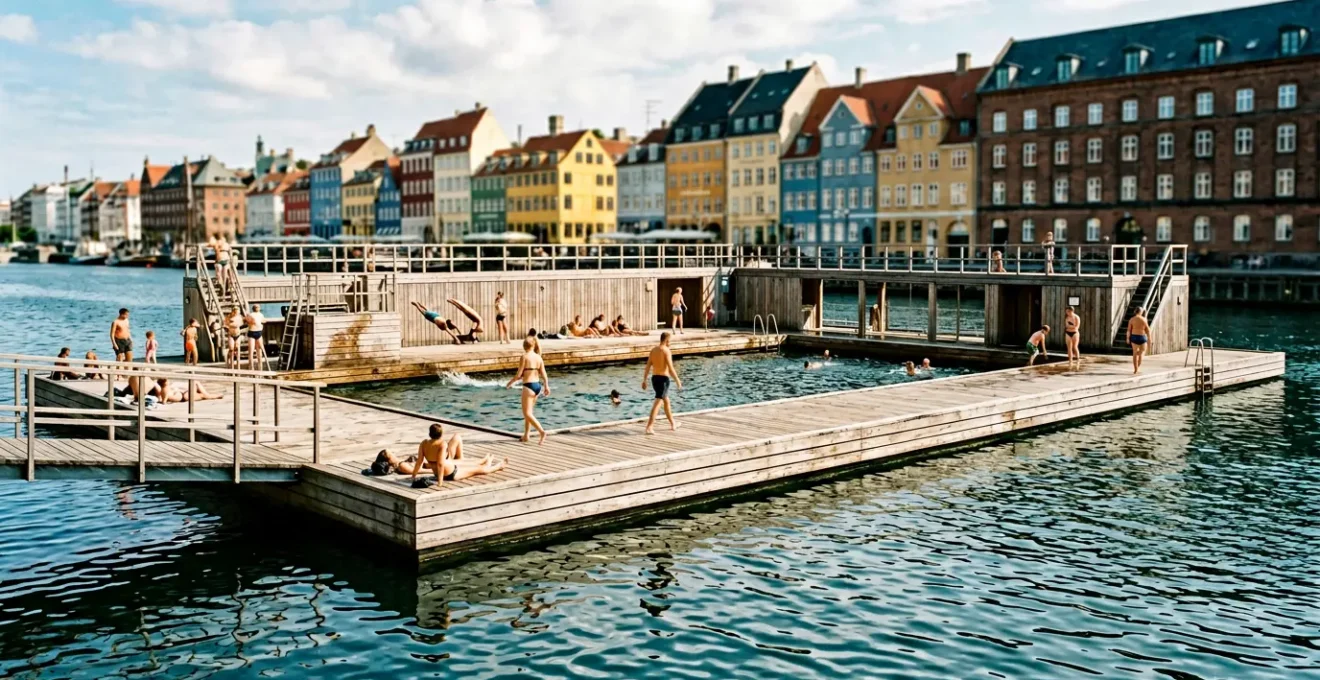
Choosing between Islands Brygge and Sandkaj is about more than swimming; it’s about picking your social scene for the day.
- Islands Brygge is the classic, high-energy choice with lifeguards and dedicated family pools, perfect for people-watching.
- Sandkaj offers a modern, more relaxed neighborhood vibe with nearby cafés but no lifeguards, best for a quieter dip.
Recommendation: For a full-on family day or a bustling social scene, pick Islands Brygge. For a stylish plunge and a beer on the dock, Sandkaj is your spot.
That first blast of summer heat hits Copenhagen, and a single thought ripples through the city: the harbor. You see, here, we don’t just look at our water; we live in it. The question isn’t *if* you’ll swim, but *where*. Any travel guide can give you a list of locations, but they miss the most important part. As a local swimmer and lifeguard, I can tell you that picking a harbor bath is less about geography and more about social chemistry. It’s a vibe check.
You’re trying to choose between the two heavyweights: the iconic Islands Brygge and the chic Sandkaj in Nordhavn. One is a sprawling aquatic playground, the other a sleek, modern boardwalk. They both offer crystal-clear, refreshing water, but they serve up completely different experiences. Forget just finding a place to cool off. The real key is understanding the unwritten rules, the social scenes, and the unique character of each spot to find where you truly belong.
This isn’t just another list. This is your insider’s guide. We’ll dive into why the water is so clean you could (almost) drink it, what’s up with the strict no-jumping rules, and how to picnic like a true Copenhagener. By the end, you won’t just pick a place to swim; you’ll have found your perfect summer tribe.
This guide will walk you through everything you need to know, from the high-tech systems keeping the water clean to the social etiquette on the docks. Use the summary below to jump to the sections that interest you most.
Summary: A Deep Dive into Copenhagen’s Harbor Life
- How Does Copenhagen Keep the Harbor Water Clean Enough to Drink?
- Winter Dipping Zones: Where to Find a Sauna After a Cold Plunge?
- Which Harbor Bath Has the Safest Shallow Pools for Toddlers?
- No Diving Signs: Why Are the Lifeguards So Strict About Jumping?
- Picnic Etiquette: Can You Drink Beer on the Wooden Docks?
- Why Can You Swim in Copenhagen’s Harbor When Other Cities Are Polluted?
- City vs. Coast: Is Urban Kayaking Harder Than Sea Kayaking?
- How to Kayak in Denmark: From City Canals to Open Sea?
How Does Copenhagen Keep the Harbor Water Clean Enough to Drink?
The first thing that shocks visitors is the very idea of swimming in a major city’s harbor. The secret? It’s not magic; it’s a masterpiece of engineering born from a history of crisis. Copenhagen has invested billions in a dual-purpose system that handles both everyday wastewater and the increasing threat of extreme rainfall. After a catastrophic cloudburst in 2011 resulted in what some records estimate as €1.6 billion in damages from a single storm, the city went all-in on a forward-thinking plan.
The core of this is the “Cloudburst Management Plan.” Think of it as a city-sized sponge. It combines massive underground tunnels with green surface solutions like parks designed to absorb water. These tunnels are the real heroes; during heavy rain, they act as massive storage tanks, holding onto storm runoff and sewage overflow. This prevents the polluted mixture from ever reaching the harbor, keeping it separate until the treatment plants can catch up. It’s a proactive separation of rainwater and sewage that most cities only dream of.
On top of this physical infrastructure, there’s a digital guardian. An advanced forecasting system constantly monitors the water. As the European Environment Agency notes, “The forecast system is designed to predict the concentration of E. coli and enterococci…based on different types of input data and models.” This means that on the rare occasion water quality dips, authorities know immediately and can raise the red flags. It’s this combination of heavy infrastructure and smart technology that makes your swim not just pleasant, but incredibly safe.
Winter Dipping Zones: Where to Find a Sauna After a Cold Plunge?
If you think harbor swimming is just a summer fling for Copenhageners, you’d be mistaken. When the temperatures drop, a whole new culture emerges: winter bathing. This isn’t just a quirky hobby for a few brave souls; it’s a massive, organized movement. The national association for winter bathers boasts over 70,000 members in 184 clubs, and the scene in Copenhagen is thriving. The invigorating shock of the cold water followed by the intense, rewarding warmth of a sauna is a ritual cherished for its health benefits and social connection.
During winter, many prime spots like the main area at Islands Brygge become members-only to manage access to club saunas. However, the city ensures public access remains. You can always find a spot for a cold plunge at designated zones like Sandkaj, La Banchina, and Kalvebod Bølge. At Islands Brygge, a specific area of the dock remains open to everyone. The real question is, where’s the post-dip sauna? La Banchina has a bookable public sauna right on-site, a perfect combination. Over at Sandkaj in Nordhavn, you’ll find Sauna Nor and the floating Copenwater sauna, though these often require reservations or memberships.
For the uninitiated, the key is to be prepared. This is a quick, purposeful act. You get in, you get out, and you get to the warmth. The community vibe is strong, filled with mutual respect and encouragement. You don’t need to be a Viking to try it, but you’ll certainly feel like one afterward. Just remember to check access rules and book saunas in advance, as they are incredibly popular.
Which Harbor Bath Has the Safest Shallow Pools for Toddlers?
When you’ve got little ones in tow, the “vibe” you’re looking for is spelled S-A-F-E-T-Y. From a lifeguard’s perspective, this is where Islands Brygge unequivocally shines. It was designed from the ground up as a family destination. Sandkaj is fantastic, but it’s more of a boardwalk for all ages, while Brygge is a dedicated aquatic park. The key difference lies in the purpose-built infrastructure for children.
Islands Brygge features two dedicated children’s pools, one of which has a very shallow depth of just 30 cm. This is perfect for toddlers to splash around in safely without parents having a constant panic attack. Crucially, Islands Brygge is staffed by lifeguards from June to August. Having that professional set of eyes on the water adds a massive layer of peace of mind that you simply don’t get at Sandkaj, which is an unsupervised swimming zone. In the event of any issue, even a temporary dip in water quality, the protocol is clear. As Visit Copenhagen states, “a red flag is raised, and swimming is prohibited.” This formal system is a parent’s best friend.
The comparison below breaks it down, but the story is clear: for families with small children, Islands Brygge is the more structured and secure environment.
| Feature | Islands Brygge Harbour Bath | Sandkaj Bathing Area (Nordhavn) |
|---|---|---|
| Shallowest Pool Depth | 30 cm (children’s pool) | Adjustable 60-120 cm (dipping zone) |
| Number of Children’s Pools | 2 dedicated children’s pools | 1 compact 4x6m pool |
| Lifeguard Presence | Yes (June 1 – August 31, 10:00-18:00) | No lifeguards – swim at own risk |
| Facilities | Public toilets, small showerheads, large grassy area | Public toilets, changing rooms |
| Nearby Playground | Havneparken park adjacent | Nordhavn urban quarter (limited green space) |
| Shade Availability | Grassy lawn area for picnics | Boardwalk with cafés nearby |
| Overall Vibe | Busy family hub, community atmosphere | Quieter, modern neighborhood beach vibe |
No Diving Signs: Why Are the Lifeguards So Strict About Jumping?
From my lifeguard tower, the “no jumping” rule is the one I have to enforce the most, and it’s the one that causes the most grumbling. I get it. You see a beautiful stretch of water on a hot day, and your first instinct is to run and jump. But in a busy urban harbor, a spontaneous leap can be genuinely dangerous. With around 2 million people using the harbor annually, including thousands of swimmers, paddlers, and boaters, strict rules are what keep the fun from turning into chaos.
The primary reason is simple: variable and unseen depths. The harbor is a working waterway. Away from the designated pools, depths can change unexpectedly. More importantly, there can be submerged objects. Copenhagen is constantly under construction, and while the water is clean, the harbor floor isn’t always perfectly clear. We enforce the rule to prevent a fun jump from ending with a serious injury on an unseen hazard.
This isn’t about killing joy; it’s about channeling it safely. The design of Islands Brygge is a perfect example. It’s not “no diving” everywhere; it’s “no diving *here*.” The facility includes a dedicated diving area with springboards at 1, 3, and 5 meters high, positioned over a pool that is a safe 7 meters deep. This is engineered safety. It provides a controlled environment for thrill-seekers while protecting everyone else in the shallower swimming areas. So when a lifeguard tells you not to jump from the edge, they’re not being a killjoy; they’re directing you to the place designed specifically for that exhilarating plunge.
Picnic Etiquette: Can You Drink Beer on the Wooden Docks?
Absolutely, yes! Grabbing a six-pack of cans and heading to the docks is a quintessential Copenhagen summer experience. It’s part of the vibe. The wooden decks of Islands Brygge and Sandkaj aren’t just entry points to the water; they are the city’s shared front porch. On a sunny day, they transform into a vibrant mosaic of towels, books, and picnics. But enjoying this freedom comes with a set of unwritten rules—a sort of aquatic social contract.
The most important principle is a Danish concept called ‘tak for lån’, which means “thanks for borrowing.” You’re borrowing this public space, so your duty is to leave it as good as or better than you found it. This means meticulously cleaning up after yourself. No one wants to swim through floating picnic debris. Another key rule: no glass. This is a big one for safety. Broken glass on a wooden dock where everyone is walking barefoot is a nightmare. Always bring cans or pour your drinks into reusable containers.
Being a good dock-side citizen also means being spatially aware. On a crowded day, don’t spread your belongings out like you own the place. Be mindful of music volume. The goal is a collective, relaxed atmosphere, not a private party. Following these simple etiquette points ensures the docks remain a welcoming and safe space for everyone.
Your Dockside Picnic Checklist
- Check the Flag: Before you even settle, check the flag (green means good to go!) or use the ‘Badevand’ app for real-time water quality.
- Pack Smart: Bring snacks and drinks in non-glass containers (cans are king). Remember reef-safe sunscreen to protect your skin and the water.
- Practice ‘Tak for Lån’: Bring a small bag for your trash and clean up your entire area meticulously before you leave.
- Mind Your Space: On busy days, keep your footprint small. Be considerate with music volume to maintain the chill, communal vibe.
- Stay Safe: Never mix heavy drinking with swimming. Enjoy a beer on the dock, but wait until you’re done swimming for the day.
Why Can You Swim in Copenhagen’s Harbor When Other Cities Are Polluted?
The clean water in Copenhagen’s harbor isn’t a happy accident; it’s the result of a deliberate, decades-long political and financial commitment. While other cities were turning their backs on their industrial waterfronts, Copenhagen decided to reclaim its heart. This transformation story began in the 1990s with a bold vision and a massive investment in modernizing the city’s sewer system and expanding wastewater treatment plants.
A huge milestone came in 1999, when the EU officially declared the harbor water safe for bathing. This was the green light. The first public harbor bath at Islands Brygge opened in 2002, serving as a powerful symbol of this new era. It was a declaration that the harbor was no longer a polluted sewer but a recreational oasis for the people. This was a radical shift, turning a previously neglected industrial zone into a prime public space.
The key to sustaining this success has been the relentless effort to separate sewage from the harbor. As Danish environmental experts at State of Green explain, the city has “built rainwater reservoirs and reservoir conduits, which can store wastewater until there is space again in the sewage system.” This has allowed them to close down 55 obsolete overflow channels that once dumped raw sewage directly into the water during heavy rain. It’s this long-term thinking and sustained investment that sets Copenhagen apart. Other cities have polluted harbors because, for decades, they used them as a convenient dumping ground. Copenhagen chose a different, more difficult, and ultimately more rewarding path.
City vs. Coast: Is Urban Kayaking Harder Than Sea Kayaking?
It’s not harder, just different. Think of it like driving in a bustling city versus on an open country road. Sea kayaking is a battle against the elements: wind, waves, and currents. Your primary focus is on nature. Urban kayaking in Copenhagen’s harbor is a dance of social navigation. You’re dealing with a different set of obstacles: tour boats, other kayakers, swimmers, and the occasional stand-up paddleboarder. The harbor’s recreational infrastructure is extensive, supporting over 6,000 members in kayaking and rowing clubs alone.
The challenge in the city is situational awareness. You need to understand the “rules of the road” on the water, know where you can and cannot paddle, and always be on the lookout for others. The water might be calm, but the environment is dynamic and dense with activity. In contrast, the open sea can be physically more demanding and requires a deeper knowledge of weather patterns and self-rescue techniques, but you often have vast stretches of water to yourself.
The rise of stand-up paddleboarding (SUP) highlights this trend. When it became legal to SUP throughout the inner harbor in 2021, it added another layer to the social fabric of the waterways. Paddling through the canals is less about an intense workout and more about seeing the city from a new perspective, gliding past landmarks and navigating alongside fellow water-lovers. It’s an accessible, social way to engage with the harbor’s unique environment, requiring more social grace than brute force.
Key Takeaways
- Vibe is Everything: Choose Islands Brygge for a bustling, family-friendly scene and Sandkaj for a chic, relaxed neighborhood feel.
- Safety by Design: Copenhagen’s harbor isn’t just clean, it’s engineered for safety with designated diving zones, lifeguard-staffed areas, and real-time water monitoring.
- Live Like a Local: Embrace the ‘tak for lån’ (thanks for borrowing) mentality—pack out what you pack in, ditch the glass bottles, and enjoy a beer on the docks responsibly.
How to Kayak in Denmark: From City Canals to Open Sea?
Whether you’re a seasoned paddler or a complete novice, Denmark offers incredible kayaking opportunities, but the most uniquely Copenhagen experience is right in the city center. You don’t need to own equipment or even have experience to get on the water. The city’s ethos of accessibility and environmentalism has created fantastic opportunities for everyone to participate.
You can find numerous rental companies along the canals, but one initiative perfectly captures the spirit of the city: GreenKayak. This non-profit offers you a free two-hour kayak rental. The only price of admission? You agree to paddle around and collect any trash you find, reporting back with the amount you gathered. It’s a brilliant, socially-conscious program that turns a recreational activity into a direct contribution to the harbor’s cleanliness.
Case Study: The GreenKayak Initiative
The GreenKayak program is the ultimate embodiment of Copenhagen’s environmental ethos. By offering free rentals in exchange for litter collection, it removes the financial barrier to entry while actively engaging the public in harbor maintenance. As noted by Copenhagen’s official tourism guides, the program is a leading example of how the city combines recreation with civic responsibility, allowing tourists and locals alike to become active stewards of the environment they’re enjoying. Paddling becomes an act of citizenship.
This approach transforms you from a passive tourist into an active participant in the city’s life. It’s the perfect starting point. Once you have a feel for the city canals, you can then graduate to guided tours or venture further out to explore the beautiful Danish coastline. But starting with a GreenKayak is more than just a paddle; it’s an initiation into the values that make Copenhagen’s harbor so special.
Ready to dive into the Copenhagen spirit? Start by exploring the canals with a purpose. Find a GreenKayak rental, grab a paddle, and become part of the story that keeps this harbor one of the most beautiful and usable in the world.