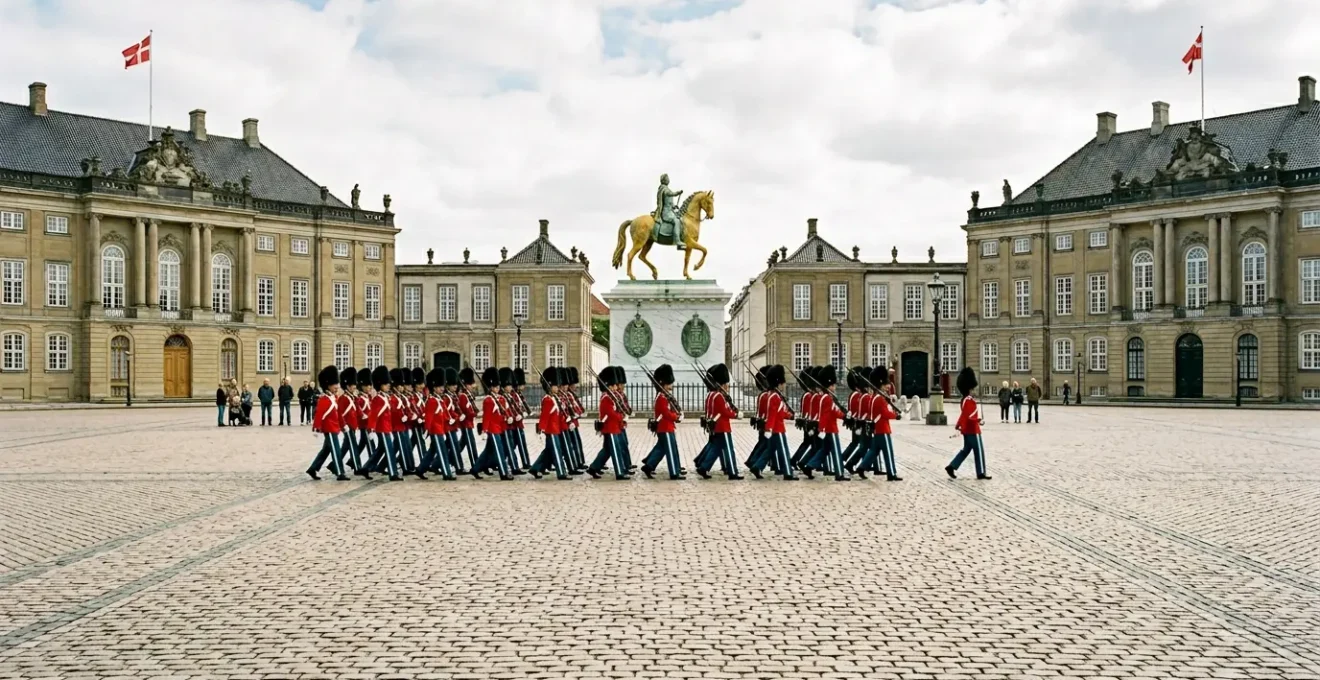
Understanding Amalienborg’s “living protocol” is the key to transforming a simple visit into a meaningful royal experience.
- The type of guard ceremony, including its music, directly reveals which member of the Royal Family is in residence.
- Your distance from the guards is a non-negotiable sign of respect, governed by a strict, escalating protocol.
Recommendation: Look for the royal flags and listen for the music—these are your primary royal cues to the palace’s daily life.
The vast, cobbled square of Amalienborg Palace, with its four identical Rococo palaces and the stoic Royal Life Guards in their bearskin caps, presents a formidable and impressive sight. For many visitors, the goal is simple: get a great photo of the iconic Changing of the Guard ceremony. Everyone knows it happens at high noon, a piece of clockwork tourism that draws crowds daily. But what most people miss is the rich, silent language being spoken all around them—a living protocol that dictates the rhythm of this royal residence.
As a former palace guide, the first thing I always stressed is that Amalienborg is not merely a museum or a historic site; it is a working home. The true experience lies not just in watching the spectacle, but in learning to read the subtle royal cues that tell the story of the day. Is the King at home? Is a foreign head of state visiting? The answers are all there in plain sight, if you know where to look. The key is to shift your mindset from that of a passive tourist to an informed observer.
But if the real magic is in these details, the biggest mistake is failing to understand the ceremonial boundaries that protect this unique environment. This guide is designed to move you beyond the surface. We will decipher the palace’s layout, decode the different guard ceremonies, and explain the unwritten rules of conduct. By the end, you will not only witness the royal life at Amalienborg, but you will understand its language, ensuring a visit that is both memorable and deeply respectful.
This article provides a structured path to becoming an informed observer at Amalienborg and other royal sites. The following sections break down everything you need to know, from identifying the correct palace to understanding the nuances of royal traditions across Denmark.
Summary: A Guide to Experiencing Denmark’s Royal Heart
- Which of the Four Amalienborg Palaces Can You Actually Enter?
- Changing of the Guard: Is the Noon Ceremony Always the Same?
- The Mistake of Standing Too Close to a Guard on Duty
- Is the Amalienborg Museum Worth the Ticket Price for Non-Royalists?
- How to Combine Amalienborg with a Walk to the Little Mermaid?
- How to Explore 1000 Years of Royal History in a 3-Day Weekend?
- When Does the Spire Master Fire the Cannons at Kronborg?
- Hamlet Live: Is the Interactive Theater at Kronborg Worth the Extra Cost?
Which of the Four Amalienborg Palaces Can You Actually Enter?
The first step to navigating Amalienborg like an insider is understanding that the four uniform palaces are not interchangeable. They form an octagonal courtyard, but each serves a distinct function within the living monarchy. Knowing which is which is fundamental to respecting the living protocol of the space. Only one is consistently open to the public, while others are private royal homes or used for official state functions.
Here is the definitive guide to identifying each palace and its purpose:
- Christian VIII’s Palace (Northwest): This is your primary destination. It houses the Amalienborg Museum, offering a journey through the private rooms of monarchs from 1863 to 1947. The entrance is through the gate closest to Frederiksgade. For those wondering about its quality, the museum holds a high visitor rating of 4.2 out of 5 stars, confirming its value.
- Christian IX’s Palace (South): This is the official residence of Her Majesty Queen Margrethe II. It is strictly closed to the public. The most important royal cue is the flag: when the swallow-tailed royal flag is flying from its roof, the Queen is in residence.
- Frederik VIII’s Palace (East): Home to His Majesty King Frederik X, Her Majesty Queen Mary, and their children. This palace is also a private residence and closed to the public. Look for the King’s flag to know if the monarch is at home.
- Christian VII’s Palace (West): This is the official guest and representation palace, used for royal events and to host dignitaries. It is generally closed, but offers a rare opportunity: occasional guided tours are available during the summer months (typically July-September). You must check the official schedule and book in advance.
By distinguishing between these palaces, you immediately elevate your understanding from a simple tourist to someone who grasps the layout of a functioning royal complex.
Changing of the Guard: Is the Noon Ceremony Always the Same?
A common assumption is that the Changing of the Guard at 12:00 noon is a single, unchanging performance. This is incorrect. The ceremony’s scale, music, and pageantry are deliberate royal cues that communicate precisely who is residing in the palace and in what capacity. Recognizing these variations is the key to truly understanding the spectacle before you. There are three distinct types of guard changes, each with its own name and significance.
The stoic guard at his post embodies this tradition. His formal presence is a constant, but the ceremony around him is dynamic and full of meaning.
As the table below illustrates, paying attention to the music and the size of the parade allows you to decode the day’s royal status instantly. The difference between a silent march and a full band with fifes and trumpets is not arbitrary; it is a public announcement.
| Ceremony Type | When It Occurs | Size & Music | What to Look For |
|---|---|---|---|
| King’s Guard (Kongevagt) | When HM King Frederik is in residence at Christian IX’s Palace | Full parade with Royal Life Guards Music Band (flutes, drums, trumpets, fifes), Commander + 36 guards + Second-in-Command | Royal flag flying on palace roof, full musical accompaniment, largest ceremony |
| Lieutenant’s Guard (Løjtnantsvagt) | When Crown Prince, Queen Mary, Queen Margrethe, Prince Joachim, or Princess Benedikte act as regent | Medium-sized parade with flutes and drums only | Regent’s flag flying, partial musical accompaniment |
| Palace Guard (Palævagt) | When palace is unoccupied or Crown Prince/Prince Joachim present but not as regent | Guards march without music – smallest ceremony | Split flag displayed (indicates no royal family member in residence), silent march |
The Mistake of Standing Too Close to a Guard on Duty
Of all the unwritten rules at Amalienborg, this is the most critical: respect the ceremonial boundaries of the Royal Life Guards. While they are a magnificent sight, they are not performers or photo props. They are active-duty soldiers charged with the protection of the Royal Family. Getting too close is not just poor etiquette; it will trigger a clear and escalating response protocol. The guards begin their march from Rosenborg Castle, and according to the official schedule, are departing Rosenborg Castle at 11:27 AM daily, arriving for a precisely timed duty you must not interrupt.
A common mistake I have seen countless times is a tourist stepping into the guard’s patrol line for a selfie, only to be met with a firm and startling reaction. To avoid this embarrassment and show proper respect, it is essential to understand the formal protocol they are trained to follow. Think of it as a three-step system designed to maintain a secure perimeter.
Your Action Plan: Understanding the Guard Response Protocol
- Step 1 – Verbal Warning: If you cross into their patrol zone or get too close, the guard will first issue a sharp, clear verbal command in Danish or English to move back. This is your one and only polite request.
- Step 2 – Physical Gesture: Ignoring the verbal warning prompts a non-threatening but unmistakable physical action. The guard will make a deliberate movement with their rifle, such as stomping its butt on the ground, to reinforce the boundary. This is not an act of aggression, but a final, serious warning.
- Step 3 – Detainment: Continued violation after both warnings is taken as a potential security threat. The guard is authorized to detain you, and security personnel will intervene until the authorities arrive. This is a rare but serious outcome.
- Safe Viewing Rule: The simplest way to stay safe is to position yourself at least 1.5 meters away from the palace walls and never, ever sit on the steps of the palaces. Use the designated green viewing areas if marked.
- Photo Technique: To capture those impressive close-up shots, use a zoom or telephoto lens from a respectful distance. This allows you to get your photo without breaching the crucial ceremonial boundaries.
Understanding this protocol is the single most important piece of knowledge for any visitor. It ensures your safety, the guards’ ability to perform their duties, and the preservation of the formal atmosphere.
Is the Amalienborg Museum Worth the Ticket Price for Non-Royalists?
With an admission fee that currently costs DKK 95 for adults (students and children have reduced or free entry), many visitors wonder if the Amalienborg Museum is a worthwhile expense, especially if they aren’t die-hard monarchy fans. The answer depends entirely on your interests. The museum is not a gallery of crowns and grand battles; it is an intimate glimpse into the personal lives and tastes of the Danish royal family over 150 years, preserved as if they just stepped out.
To decide if it’s right for you, consider what the museum offers through different lenses:
- For Interior Design Aficionados: The museum is a time capsule of evolving royal taste, from the heavy, ornate Victorian style of Queen Louise’s private salon to more modern aesthetics. You can trace 150 years of decorative arts and royal living.
- For Fans of “The Crown” or “Downton Abbey”: This is where the museum truly shines. The study of Christian X and the dining room of Queen Alexandrine are preserved exactly as they were upon their deaths. You see their personal photographs, books, and belongings, telling intimate family stories that a history book cannot.
- For History Buffs: The artifacts trace the Danish monarchy’s vast European connections. Christian IX and Queen Louise were famously known as the “in-laws of Europe,” with their children ascending to the thrones of England, Greece, and Russia.
- For Lovers of Art and Luxury: The Fabergé Chamber is a highlight, showcasing breathtaking Russian jewelry and objets d’art from 1860-1917, including imperial gifts that highlight the close ties between the Danish and Russian courts.
- For Architecture Enthusiasts: While the rooms are the main focus, the magnificent Gala Hall, designed by Nicolai Abildgaard with sculptures by the famed Bertel Thorvaldsen, is a stunning example of late 18th-century neoclassical design that is still used for royal receptions.
In essence, if you appreciate history told through personal objects, design, and family narratives, the museum is an absolute must-see. If you are looking only for grand military history or crown jewels (which are housed at Rosenborg Castle), you might choose to focus your time elsewhere.
How to Combine Amalienborg with a Walk to the Little Mermaid?
After the structured formality of the Amalienborg Palace square and the Changing of the Guard, a walk along the waterfront provides the perfect contrast. The route to The Little Mermaid is short, scenic, and packed with interesting stops, effectively creating a “Royal Mile” that connects the heart of the monarchy to Copenhagen’s most famous icon. This leisurely 15-20 minute stroll is an ideal way to decompress and see more of the city’s harbor-front beauty.
The journey begins at the Amalie Garden (Amaliehaven), a modern green space that beautifully frames the view of the Opera House across the water. It serves as a symbolic transition from the historic royal quarter to the contemporary city.
Here is a simple, step-by-step itinerary to guide your walk:
- Stop 1 – Amalie Garden (Amaliehaven): As you exit the palace square towards the harbor, you’ll immediately enter this modern garden. Opened in 1983, it’s the perfect spot to capture a stunning photo of the Copenhagen Opera House. It’s only a 2-minute walk from the palace.
- Stop 2 – St. Alban’s Church: Continue north along the waterfront promenade to find this beautiful English Gothic church, often called “The English Church.” Its distinctive architecture and peaceful grounds offer a quiet moment of reflection. This is about a 5-minute walk from the garden.
- Stop 3 – The Gefion Fountain: A few minutes further along the Langelinie promenade, you’ll encounter this powerful fountain. It depicts the Norse goddess Gefion with her four oxen sons, illustrating the mythical legend of how the island of Zealand (where Copenhagen sits) was created.
- Stop 4 – The Little Mermaid: A final 3-minute walk brings you to Edvard Eriksen’s world-famous statue. The entire walk is approximately 1.5 km (0.9 miles) and is a highlight for any visitor.
For a slightly longer but more historic detour, consider cutting through the Kastellet, a well-preserved star-shaped fortress dating back to 1662, after passing the Gefion Fountain. Its ramparts, windmill, and green paths offer a beautiful alternative route away from the main crowds.
How to Explore 1000 Years of Royal History in a 3-Day Weekend?
While Amalienborg is the living heart of the Danish monarchy, it’s just one chapter in a much larger story. With Copenhagen’s popularity soaring—evidenced by over 11.1 million overnight stays recorded in 2024—having a smart itinerary is crucial to making the most of a short trip. To truly grasp the 1,000-year royal narrative, you can connect several key sites in and around the city over a long weekend, tracing the monarchy’s evolution from medieval fortress kings to the modern, approachable institution of today.
This chronological itinerary is designed to build a cohesive story, allowing you to see how power, architecture, and royal traditions have shifted through the centuries.
- Day 1 – Medieval Fortress Kings & Royal Legacies: Start with the raw power of the Middle Ages. In the morning, take a 45-minute train ride to Helsingør to explore Kronborg Castle, the formidable UNESCO site immortalized as Elsinore in Shakespeare’s Hamlet. In the afternoon, travel to nearby Roskilde (30 min from Copenhagen) to visit Roskilde Cathedral, the final resting place for over 40 Danish kings and queens dating back to the 1200s.
- Day 2 – Renaissance Splendor & Absolute Power: This day is about the lavishness of the Renaissance. Spend the morning at Frederiksborg Castle in Hillerød (40 min by train), a breathtaking palace that now houses the Museum of National History. In the afternoon, return to Copenhagen and visit Rosenborg Castle, Christian IV’s 1606 pleasure palace, where the dazzling Danish Crown Jewels are kept secure in the treasury.
- Day 3 – The Modern, Approachable Monarchy: Bring the story into the present day. Start your morning at Amalienborg Palace and Museum to see the current royal residence and watch the guard ceremony at noon. In the afternoon, explore Christiansborg Palace, the seat of the Danish Parliament, which also houses the Royal Reception Rooms used for official functions. Here, you complete the royal narrative, connecting the jewels you saw at Rosenborg to the monarch who lives at Amalienborg and the state functions at Christiansborg.
By following this path, you don’t just visit castles; you follow the thread of Danish history, making each site more meaningful than the last.
When Does the Spire Master Fire the Cannons at Kronborg?
A persistent myth surrounding Kronborg Castle is that its cannons are fired daily as a tourist attraction. This is a common misconception that can lead to disappointment. The powerful cannon salutes from the castle’s flag bastion are not a daily spectacle; they are reserved exclusively for official Royal Gun Salutes on days of national or royal significance. Understanding this distinction is key to setting the right expectations for your visit to this historic fortress.
So, what constitutes a “saluting day”? These are specific, predetermined dates in the national calendar. Salutes are typically fired to mark events such as the reigning monarch’s birthday, Constitution Day (June 5th), the birth of a new member of the royal family, or major state visits by foreign heads of state. The only reliable way to know if a salute is scheduled is to check the official calendar on the Royal House website (kongehuset.dk) before your trip. This is the definitive source for the current year’s saluting days.
If you are at the castle and wondering if an unscheduled salute might occur, look to the flag bastion. The presence of the Dannebrog (the Flag of Denmark) on a day that is not a standard flag day can be a real-time indicator that a special event is planned. However, this is not a guarantee. Instead of hoping for cannon fire, it is far better to focus on the guaranteed drama the castle offers: ‘Hamlet Live’. This series of interactive theatrical performances brings Shakespeare’s tragedy to life throughout the very chambers where the story is set, providing a dynamic and engaging experience every day.
Key Takeaways
- The type of guard ceremony at Amalienborg (King’s, Lieutenant’s, or Palace Guard) is a direct signal of who is in residence.
- Maintain a respectful distance of at least 1.5 meters from the guards; they follow a strict, escalating response protocol if you get too close.
- Plan your visit by connecting royal sites like Amalienborg, Rosenborg, and Kronborg to follow the full “royal narrative” of the Danish monarchy.
Hamlet Live: Is the Interactive Theater at Kronborg Worth the Extra Cost?
Since cannon fire is a rare event, many visitors to Kronborg Castle are faced with a choice: explore the magnificent UNESCO World Heritage site on their own, or pay extra for a ticket that includes ‘Hamlet Live’. This interactive theater experience, where professional actors perform key scenes from Shakespeare’s play in the castle’s rooms and courtyards, is a unique offering. Whether it’s “worth it” depends entirely on what kind of visitor you are and what you hope to get from your experience.
The value of Hamlet Live can be broken down by visitor type:
- It’s worth it if: You enjoy immersive, theatrical experiences. The castle itself becomes the stage, and you follow characters like Hamlet, Ophelia, and Claudius as the tragedy unfolds around you, bringing the cold stone walls to life.
- It’s worth it if: You appreciate “edutainment” and are visiting with teenagers or young adults. The interactive storytelling transforms a potentially dry historical tour into an engaging, story-driven adventure that connects literature, history, and architecture.
- It’s worth it if: You want a truly unique cultural experience. This is the only place in the world where you can see Shakespeare’s drama performed in the very castle that inspired it, offering unparalleled context and atmosphere.
- Maybe skip it if: You are on a very tight budget and prefer a self-guided pace, reading the information panels and using your own imagination to picture the castle’s past.
- Maybe skip it if: You are a Shakespeare purist or have seen many professional productions of Hamlet. Your primary interest might be the castle’s military history and Renaissance architecture, rather than its literary connection.
When considering the cost, it’s helpful to compare it not to a standard museum entry, but to the price of a traditional theater ticket. Here, the world’s most famous castle is your set, offering a memorable experience that justifies the additional expense for the right audience.
Now that you are equipped with an insider’s understanding of royal protocol, you can plan a visit that is not only enjoyable but also deeply respectful. By observing the royal cues and appreciating the living history around you, you move beyond simple sightseeing to truly connect with the heart of the Danish monarchy.
Frequently Asked Questions about How to witness the Royal Life at Amalienborg Without Breaking Protocol?
Are the cannons at Kronborg Castle fired daily for tourists?
No, this is a common misconception. The cannons are not a daily tourist attraction. They are fired exclusively for official Royal Gun Salutes on specific commemorative days of national or royal significance.
What are Denmark’s official Royal Saluting Days when cannons might be fired?
Salutes occur on days such as: The reigning monarch’s birthday, Constitution Day (June 5), births of royal family members, significant royal anniversaries, and state visits by foreign heads of state. Check the official Royal House calendar (kongehuset.dk) before your visit for the current year’s saluting days.
How can I tell if a gun salute will happen on the day I visit?
Look for the Dannebrog (Flag of Denmark) flying on the castle’s flag bastion. The presence of the flag on a non-standard day is the single best real-time indicator that a salute may occur. However, this is not guaranteed, so checking the official calendar in advance is recommended.
What should I watch instead if there’s no cannon firing during my visit?
Kronborg offers ‘Hamlet Live’ interactive theater performances where professional actors bring Shakespeare’s story to life throughout the castle chambers. This daily spectacle provides guaranteed entertainment and brings the castle’s dramatic history to life even without cannon fire.