In summary:
- Walking Copenhagen’s cobblestones is less about endurance and more about strategy; understanding the ‘why’ behind the streets is key.
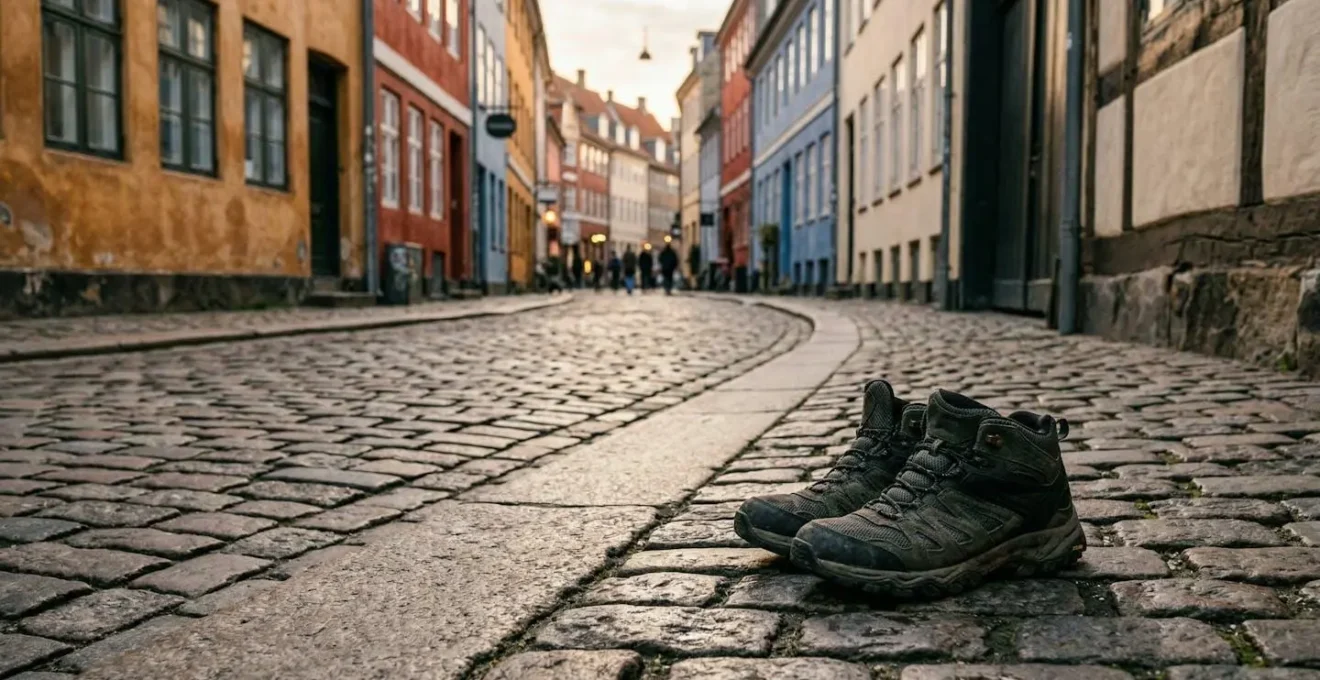
- Footwear choice is a science: focus on cushioning, support, and thick, slip-resistant soles over just “comfort.”
- Accessibility is surprisingly well-integrated, with features like smooth pavement strips for wheels.
- Timing is everything. To avoid delivery trucks and crowds, the early morning or late afternoon are your golden hours.
- The city’s medieval past is hiding in plain sight—in the street grid itself, not just the buildings.
Ah, Copenhagen’s Old City. It conjures images of colourful townhouses, ancient spires, and winding, romantic streets. And then there’s the reality: cobblestones. They are the city’s charming, historic, ankle-twisting, luggage-wheel-destroying, podiatrist-funding signature feature. Every travel blog offers the same groundbreaking advice: “wear comfortable shoes.” A trained hamster could tell you that. What they don’t tell you is how to truly outsmart a street surface designed in the Middle Ages and fundamentally at odds with modern ankles, stroller wheels, and the concept of rolling luggage.
The secret isn’t just about what’s on your feet; it’s about what’s in your head. It’s about understanding the subtle engineering of the streets, the specific anatomy of a “cobblestone-proof” shoe, and the rhythm of the city. Forget mere survival. This is about mastery. But if the real key wasn’t just enduring the bumps, but rather learning to read the city’s historical pavement like a local? What if you could navigate these ancient pathways with the grace of a Dane on a bicycle, even with a suitcase in tow?
This guide provides that insider knowledge. We’ll move beyond the platitudes and dive into the practical physics of footwear, the best-kept secrets for accessibility, and a bit of urban archaeology. We will dissect the best times to walk, the most photogenic (and walkable) streets, and how to spot the authentic medieval city hiding beneath centuries of history. Prepare to transform your painful trek into a masterful exploration.
To help you navigate this unique urban landscape, this article breaks down the essential strategies. From historical context to practical hacks, here’s everything you need to know to conquer Copenhagen’s Old City on foot.
Table of Contents: A Savvy Walker’s Guide to Copenhagen’s Old City
- Why Does Copenhagen Keep Cobblestones Despite Accessibility Issues?
- Sneakers or Boots: Which Footwear Survives a Week on Danish Cobbles?
- Magstræde or Snaregade: Which Old Street Offers the Best Photo Op?
- How to Navigate the Latin Quarter with a Stroller or Wheelchair?
- When Is the Best Time to Walk the Old City Streets to Avoid Delivery Trucks?
- Can You Still Walk the Original Medieval Street Grid of 1400?
- Why Are the Houses in Nyhavn Painted Different Colors?
- Where to Find the Last Traces of Medieval Copenhagen After the Fires?
Why Does Copenhagen Keep Cobblestones Despite Accessibility Issues?
First, let’s address the elephant in the room. Why, in a country obsessed with functional design and progressive thinking, do we cling to these lumpy, bumpy relics? The answer is a classic Danish balancing act: heritage versus practicality. These cobblestones aren’t just pavement; they’re a protected, physical link to the city’s medieval and Renaissance past. Tearing them up would be like ripping pages out of a history book. They force a slower pace, reminding everyone that they are walking through a living museum.
But this city isn’t just a museum. Copenhagen takes its accessibility seriously, leading to some clever, almost hidden, compromises. Look closely at the sidewalks in the Old Town. Instead of a full-scale replacement, the city has integrated modern solutions right into the historic fabric. For instance, two parallel smooth pavement strips run along many Copenhagen cobblestone sidewalks, creating a smoother path for wheelchairs, strollers, and beleaguered luggage wheels. It’s a beautifully pragmatic solution: preserving the aesthetic of the whole while ensuring the function of the part.
This approach maintains the street’s historical character, which is crucial for tourism and local identity, while acknowledging that people in the 21st century have places to be and don’t want to sprain an ankle getting there. It’s a testament to the idea that preservation doesn’t have to mean stagnation. The city is constantly finding creative ways to embed modern needs within its ancient framework, a philosophy you’ll see time and again as you explore.
Sneakers or Boots: Which Footwear Survives a Week on Danish Cobbles?
Now for the million-kroner question. The generic advice to “wear comfortable shoes” is infuriatingly vague. Your comfiest slippers are not the answer here. Battling cobblestones is a matter of engineering, not just softness. The ideal shoe is less of a pillow and more of a personal suspension system. Think of it as footwear forensics: we’re looking for specific features that counteract the physics of uneven stone.
The primary enemy is high-frequency vibration and unpredictable impact. Your shoe must be designed to absorb and diffuse that energy before it travels up your shins and into your soul. A thin, flat-soled fashion sneaker is the equivalent of bringing a butter knife to a sword fight. You need a thick, cushioned midsole, preferably made of EVA foam or a similar shock-absorbing material. This is your first line of defense. The second is a sturdy, slip-resistant outsole. Cobbles can be slick, especially after a classic Danish shower, so good traction is non-negotiable.
To truly understand the anatomy of a cobblestone-conquering shoe, let’s break down the essential components.
As you can see, the magic happens at the point of impact. A well-designed sole deforms slightly to absorb the shock, protecting your joints. So, between sneakers and boots, the winner is whichever has the superior sole technology. A high-quality trail running shoe often beats a stylish but flat-soled leather boot. Conversely, a sturdy hiking boot with a cushioned, high-traction sole will outperform a flimsy lifestyle sneaker every time. Don’t choose a category; choose the technology.
Your Checklist for Cobblestone-Ready Shoes
- Cushioning and support: Look for shoes with ample cushioning in the midsole and heel to absorb impact, plus good arch support to reduce foot fatigue.
- Sturdy and slip-resistant soles: Choose shoes with rubber or non-slip soles that provide excellent traction on uneven surfaces.
- Closed-toe design: Opt for closed-toe shoes to protect your feet from stubbing them on uneven stones.
- Lightweight and flexible: Select shoes that are lightweight and flexible enough to promote natural foot movement.
- Durable construction: Choose shoes made from durable materials that can withstand the repetitive impact of walking on cobblestones.
Magstræde or Snaregade: Which Old Street Offers the Best Photo Op?
Once your feet are properly equipped, it’s time to hunt for those iconic Copenhagen photos. In the Old City, two streets consistently battle for the title of “most picturesque”: Magstræde and its neighbour, Snaregade. As a guide, I’m constantly asked which is better. The truth is, they offer different photographic personalities. As Wikipedia contributors note, Snaregade and Magstræde are two of the oldest streets in the Old Town of Copenhagen, and crucially, they are among the few that still feature their original cobbling. This authenticity is their shared foundation.
Snaregade and Magstræde are two of the oldest streets in the Old Town of Copenhagen, Denmark. The streets are among the few streets in the Old Town of Copenhagen which still feature their original cobbling.
– Wikipedia contributors, Wikipedia – Magstræde
Snaregade is the quieter, more understated sibling. It’s incredibly narrow and feels more like a secret passageway. It offers a sense of intimacy and discovery, perfect for portraits or shots that emphasize the tight, historic architecture. However, for that one epic, sweeping shot that screams “Old Copenhagen,” Magstræde has a distinct architectural advantage.
Case Study: Magstræde’s Photographic S-Curve
Magstræde, with history dating back to the 1520s, isn’t a straight line. It has a gentle, elegant “S” curve. For photographers, this is a compositional gift. This curve creates natural leading lines that draw the viewer’s eye through the frame, past the vibrant, colourful facades of the 17th-century buildings. It allows you to capture depth, texture, and a dynamic sense of movement in a single shot. The street’s slight bend means you can frame your shot so the road disappears into the distance, adding a touch of mystery and making the scene feel more expansive than it is.
So, the verdict? For a quiet, moody shot that feels like a hidden discovery, head to Snaregade. But for the quintessential, postcard-perfect photograph that captures the grandeur and winding charm of old Copenhagen, Magstræde’s S-curve is unbeatable. Go in the early morning or late afternoon for the best light, when the sun illuminates the colourful building fronts and creates long, dramatic shadows on the ancient cobblestones.
How to Navigate the Latin Quarter with a Stroller or Wheelchair?
The Latin Quarter, with its buzzing atmosphere and historic university buildings, is a must-see. It’s also a nexus of narrow streets and, you guessed it, more cobblestones. For anyone navigating with a stroller or wheelchair, it can seem daunting. But again, this is where you outsmart the city, not just endure it. The key is a combination of modern technology and old-fashioned strategic planning.
First, abandon any notion of using a standard, flimsy umbrella stroller with tiny plastic wheels. That’s a recipe for disaster. The wheels will get caught in every crevice, and the vibrations will be unbearable for the passenger. You need wheels that can handle the terrain. Many local shops offer rentals of strollers with larger, air-filled tires, similar to a jogging stroller. These are absolute game-changers, gliding over the bumps rather than fighting them. For wheelchair users, knowing the city’s built-in aids is crucial. Those smooth granite strips we talked about are your best friends.
Beyond equipment, your smartphone is your most powerful tool. Before you even leave your hotel, use Google Maps in Street View mode. It’s like a reconnaissance mission. You can digitally “walk” your route to identify potential obstacles, check for smooth pavement strips, and see if a cafe entrance has a step. This simple act of pre-planning can save you immense frustration. Combining the right gear with digital foresight turns a potential struggle into a smooth adventure.
Your Action Plan: Accessibility Hacks for Copenhagen’s Cobbles
- Use Google Maps Street View beforehand: When planning a trip, use street view to see if a building entrance is accessible and to evaluate if an area has cobblestones you can handle.
- Target the smooth pavement strips: There are two strips of smooth pavement along many Copenhagen sidewalks. Depending on the width of your chair or stroller, they may line up with your wheels perfectly.
- Rent strollers with larger air-filled tires: For navigating cobblestones more easily, consider renting strollers with larger, air-filled tires from local shops.
- Time your visit strategically: Visit accessible destinations like museums during off-peak hours when crowds are smaller and maneuvering is easier.
When Is the Best Time to Walk the Old City Streets to Avoid Delivery Trucks?
There are two major obstacles to a peaceful stroll through Copenhagen’s Old City: the crowds of fellow tourists and the army of delivery trucks that service the shops and cafes. While you can’t get rid of other people, you can absolutely avoid the vehicle traffic with some simple timing. The most charming pedestrian streets, or *gågader*, are not vehicle-free 24/7. They have a specific window for commercial activity.
As a general rule, the city comes to life with deliveries very early in the morning. Based on Copenhagen tour operator observations, most pedestrianized streets open for deliveries typically from 6:00 AM to 10:00 AM. During this period, the narrow streets can feel more like a warehouse loading dock than a historic wonderland, with vans and small trucks maneuvering precariously close to ancient doorways. It’s noisy, chaotic, and frankly, it ruins the magic.
Therefore, the golden rule for the strategic walker is this: avoid the Old City’s main arteries before 10:00 AM if you’re seeking tranquility and good photo opportunities. The sweet spot is either the “post-delivery peace” between 10:00 AM and lunchtime, or the “golden hour” in the late afternoon when the light is beautiful and the day-trippers have started to thin out. If you’re an early riser, use that 6:00-10:00 AM window to explore the waterfront or parks, and then move into the Old Town once the trucks have cleared out. Walking Copenhagen is like a performance; you just need to know the schedule to get the best seats.
Can You Still Walk the Original Medieval Street Grid of 1400?
This is a question for the true urban archaeologist. Visitors often assume that because the buildings are from the 17th or 18th century, the entire layout is more recent. But here lies one of Copenhagen’s most remarkable secrets: while massive fires in the 1700s wiped out most of the medieval *buildings*, they couldn’t destroy the *streets* themselves. When the city rebuilt, they largely followed the existing, ancient property lines and pathways.
So, the answer is a resounding yes. When you walk down a crooked lane like Magstræde, you are treading a path laid out centuries ago. The fundamental street pattern of the inner city is remarkably intact from the medieval period. This is confirmed by walking tours that focus on the area; for example, the medieval district’s crooked cobblestone streets still follow the original layout. The slight curves, the narrow passages, the odd angles—these aren’t random. They are the fossilized footprints of a city that grew organically long before the invention of the urban planning grid.
Urban Archaeology: Reading the Layers
While the year 1400 is a good benchmark, the city was constantly evolving. We know, for instance, that Magstræde was formally created in the 1520s when the coastline was moved. This tells us the grid wasn’t static but was actively shaped during that period. So while you may not be on a “1400” specific street, you are absolutely walking on a layout that is fundamentally medieval. The experience is one of walking through time; the street plan is the original 13th-16th century manuscript, and the buildings are simply newer illustrations drawn on top of it.
This is what makes walking here so special. You’re not just looking at old houses; you’re physically moving through the same space, along the same routes, as merchants, craftsmen, and royals did over 500 years ago. Every turn in the road is a whisper from the past.
Why Are the Houses in Nyhavn Painted Different Colors?
Ah, Nyhavn. The jewel in Copenhagen’s crown and the undisputed king of Instagram. Everyone knows the view, but few ask the practical question: why the riot of colour? The modern, cynical answer is “for the tourists,” and while their preservation is certainly good for business now, the tradition is rooted in gritty, maritime history, not a marketing meeting.
The most popular—and frankly, most romantic—theory is beautifully simple. Nyhavn was a bustling, chaotic port filled with sailors, merchants, and a healthy number of bars (or “bodegas”). After a long voyage and a few celebratory drinks, finding your way home down a uniform street could be a challenge. The solution? Paint your house a colour that’s impossible to miss. A sailor could simply be told, “You live in the bright yellow one,” and even in a boozy haze, could stumble his way to the correct door. It was a low-tech navigation system for a rowdy neighbourhood.
Another practical factor was economics. In the 17th and 18th centuries, certain paint pigments were cheaper than others. Red and yellow ochres, derived from natural earth clays, were often more affordable and readily available. So, the colour of your house might have said less about your personal taste and more about your budget. The vibrant palette we see today is a curated and protected version of this practical past. The city now has regulations to maintain this iconic, colourful facade, ensuring the legacy of those pragmatic sailors and frugal homeowners lives on.
Key takeaways
- Outsmart the cobblestones with strategy: Use smooth pavement strips, time your walks to avoid delivery trucks (10 AM onwards), and use Street View to plan routes.
- Footwear is about engineering, not just comfort: Prioritize thick, cushioned soles, good arch support, and slip-resistant tread to absorb impact.
- The city’s history is under your feet: The street grid in the Old City is genuinely medieval, even if the buildings are more recent reconstructions.
Where to Find the Last Traces of Medieval Copenhagen After the Fires?
Now that you’re an expert on navigating the city’s terrain, it’s time for the final challenge: a historical treasure hunt. The Great Fires of 1728 and 1795 were devastating, but they weren’t absolute. Tucked away within the rebuilt city are surviving fragments and “ghosts” of the true medieval Copenhagen. You just need to know how to look. This is the ultimate act of urban archaeology—reading the subtle clues in the brickwork and foundations.
Your best hunting ground is, once again, the area around Magstræde and Snaregade. While most buildings here are from the Rococo or Neoclassical periods post-fire, some incorporate older elements or are rare survivors. The key is to look for inconsistencies: a change in brick colour or style low on a wall, a stone foundation that seems older than the building above it, or a structure that sits at a slightly different angle from its neighbours. These are the architectural scars that tell a story.
To guide your forensic investigation, here are some specific clues to look for as you wander. Think of it as a checklist for spotting medieval survivors in the wild.
- Look for pre-1728 fire buildings: Building No. 20 in Magstræde is a famous example, dating from the time before the fire of 1728 and showcasing more authentic, less ornate construction.
- Identify Rococo-era reconstruction: The Schäffer House (No. 6 Magstræde), built in 1733-34, is a prime example of post-fire rebuilding. Its rich interior Rococo decorations are so significant they are now displayed in the National Museum.
- Search for repurposed medieval structures: Former warehouses and breweries from the late 1700s often incorporated the original, robust medieval foundations and cellars that survived the fires.
- Examine building materials and techniques: Look for shifts in brickwork, exposed stone foundations visible through basement windows, and abrupt changes in architectural style that indicate an older core within a later reconstruction.
By training your eye to spot these details, you’re no longer just a tourist looking at pretty buildings. You become a detective, piecing together the fragmented story of a city that refused to be erased. It’s the most rewarding way to experience Copenhagen’s deep history.
Now that you’re armed with this insider knowledge, it’s time to chart your own course. Go forth, conquer Copenhagen’s charming streets, and walk them not as a visitor to be intimidated, but as a savvy local in the know.