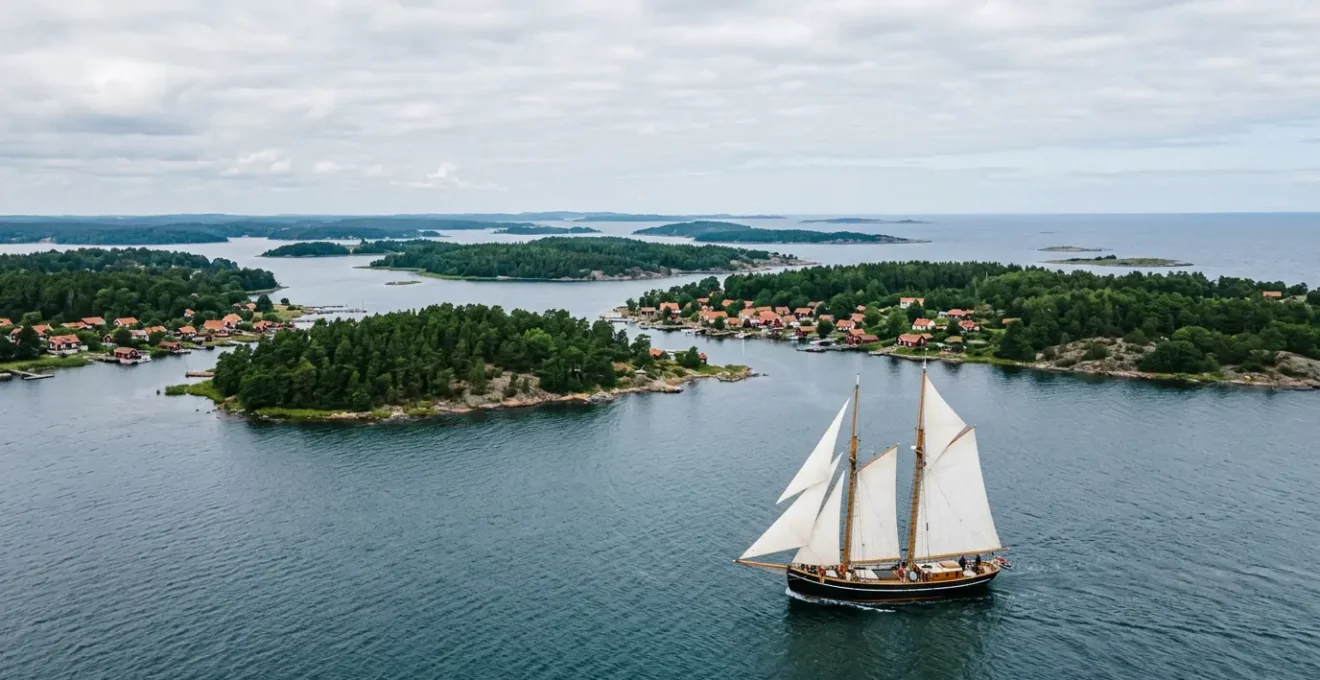
Truly exploring Denmark by sea is less about a fixed itinerary and more about mastering the art of ‘good seamanship’.
- You can rent smaller motorboats (<25HP) without a license, but a frank self-assessment of your skills is crucial before casting off.
- Plan your route daily based on forecasts from the Danish Meteorological Institute (DMI), always having ‘bail-out’ harbors in mind for safety.
Recommendation: Start your journey in the sheltered South Fyn Archipelago. It offers the perfect training ground with short, manageable passages between its 55 islands, allowing you to build confidence.
The call of the Danish archipelago is a siren song for any sailor. It’s a promise of quiet anchorages, storybook island villages, and the unique Nordic light dancing on the Baltic Sea. Many guides will give you a list of islands, a pin on a map. But they miss the point. To truly experience Denmark from the deck, you must do more than just navigate; you must connect with a maritime culture that has been thousands of years in the making. It’s a culture built on a principle called godt sømandskab—good seamanship.
This isn’t just about safety protocols; it’s a philosophy. It’s about respecting the weather, understanding your vessel’s limits and your own, and planning for the unexpected. The common advice to simply “rent a boat and go” is a dangerous oversimplification. The real key to unlocking the magic of the Danish isles lies not in a rigid itinerary, but in the confidence that comes from proper preparation. It’s about knowing when to sail, when to seek harbour, and how to read the subtle language of the sea.
This guide is your first mate. We will cast off from the practicalities of boat rental and crew opportunities, navigate through the jewels of the South Fyn Archipelago, and tackle the very real challenge of the Baltic chop. We will then plot a course using the Danish mindset of dynamic passage planning, connect with the ghosts of Viking longships, and understand why the ocean is the very soul of this nation. Finally, we’ll explore the coastline from a different perspective: the kayak. Prepare to weigh anchor and learn to sail like a Dane.
This article provides a complete overview for navigating the Danish waters. The summary below outlines the key legs of our journey, from the legal requirements for getting on the water to mastering the art of seamanship in this unique maritime landscape.
Summary: A Skipper’s Guide to the Danish Archipelago
- Can You Rent a Motorboat in Denmark Without a Sailing License?
- Schooners and Tall Ships: How to Join a Crew for a Day?
- South Fyn Archipelago: Which Islands Are Worth Docking At?
- choppy Baltic: How to Prevent Seasickness on Smaller Vessels?
- Upwind or Downwind: How to Plan a Sailing Route Around Danish Winds?
- Viking Ships waters: Is Roskilde Fjord the Best Place for Historical Paddling?
- Why Is the Ocean Central to Every Aspect of Danish Heritage?
- How to Kayak in Denmark: From City Canals to Open Sea?
Can You Rent a Motorboat in Denmark Without a Sailing License?
The short answer is yes, but this comes with significant responsibility. Danish maritime law is practical, focusing on horsepower rather than a universal license for all vessels. You are permitted to operate a motorboat under 15 meters in length without a license, provided its engine power does not exceed a certain threshold. Specifically, engines above 18 kW/25 HP require a compulsory license for operators. This opens up a wide range of smaller, manageable “jolle” boats and small cabin cruisers for day trips and coastal exploration for the visiting sailor.
However, legal permission is not the same as competence. The concept of ‘godt sømandskab’ (good seamanship) is the unwritten law. Rental companies are obligated to provide a thorough safety and operational briefing, and they have the right to refuse rental if they doubt your ability to handle the vessel safely. Before you even book, you must conduct an honest self-assessment. Are you capable of reading a nautical chart? Can you interpret weather forecasts from the Danish Meteorological Institute (DMI)? Do you know the correct procedure for anchoring or how to use a VHF radio in an emergency? The Baltic Sea can be unforgiving, and its weather can change in an instant. Being legally allowed to take the helm is only the first step; being truly prepared is what ensures a safe return to port.
- Legal Eligibility: Confirm your rental boat has an engine below 25 HP and is under 15 meters in length to qualify for license-free operation.
- Practical Skills: Can you read a nautical chart and identify buoys, markers, and navigation channels?
- Weather Competence: Are you able to interpret wind forecasts and wave height predictions using apps like DMI?
- Emergency Preparedness: Do you know how to handle unexpected wind changes, anchor properly, and use VHF radio for distress calls?
- Rental Briefing: Absorb every detail of the mandatory briefing on ‘good seamanship’ and safety protocols before departure.
Ultimately, the absence of a license requirement for smaller boats places the onus of safety squarely on your shoulders. It’s a testament to the Danish trust in personal responsibility, a trust you must honor.
Schooners and Tall Ships: How to Join a Crew for a Day?
For those who want to experience the raw power and romance of traditional sailing without the responsibility of captaining, Denmark offers a fantastic opportunity: becoming a crew member for a day or a week on a historic schooner. This isn’t a passive cruise; it’s a hands-on immersion into the world of gaff rigs, tarred ropes, and centuries-old seamanship. Many of these beautifully maintained vessels are part of the Træskibs Sammenslutningen (Danish Wooden Ship Association) and offer public sailing trips specifically designed for novices.
You don’t need any prior experience. The professional crew is there to teach you everything, from hoisting heavy canvas sails and coiling lines to taking a turn at the great wooden helm. These “gaffeldage” (hands-on days) are about participation and teamwork, recreating the very experience that forged Denmark’s maritime identity. Vessels like the Fulton of Marstal, built in 1915, and other historic ships offer everything from short trips to multi-day school voyages, preserving a vital piece of living history.
Case Study: A Day Aboard the Aron of Svendborg
The Aron, a traditional Marstal schooner built in 1906, offers a perfect example of this immersive experience. Operating from Svendborg in the South Funen Archipelago, the vessel takes on guests with zero sailing knowledge. Under the guidance of its Danish skipper couple, participants actively help hoist the 90-square-meter mainsail, coil ropes, and learn basic navigation. These 6-day island-hopping trips are not just a vacation; they are a hands-on lesson in the fundamentals of sail, offering a direct connection to the seafaring traditions of the past.
Joining the crew of a tall ship is perhaps the most authentic way to touch the soul of Danish maritime heritage, feeling the wind and the pull of the ropes just as sailors did over a century ago.
South Fyn Archipelago: Which Islands Are Worth Docking At?
The South Fyn Archipelago (Det Sydfynske Øhav) is the heartland of Danish sailing, a UNESCO Global Geopark comprised of 55 islands, islets, and holms scattered across the calm Baltic waters. With harbours and anchorages never more than a few nautical miles apart, it’s the perfect cruising ground for both novice and experienced sailors. The challenge isn’t finding a place to dock, but choosing which island’s unique personality to explore. Forget a simple checklist; the best way to plan your stops is to match an island to your desired experience.
Are you sailing with family and need easy walks and a world-class ice cream? Skarø is your port of call. Are you seeking utter solitude and the chance to spot rare white fallow deer? Point your bow towards Drejø’s quiet southern coast. For the foodie, the “fairy-tale town” of Ærøskøbing on Ærø offers local breweries, smokehouses, and a vibrant culinary scene. This approach transforms a simple sailing trip into a curated adventure, where each landfall is a deliberate choice tailored to your crew’s mood and interests.
The table below, based on insights from sources like VisitFyn’s island guides, breaks down some of the archipelago’s gems by “experience persona,” helping you plot a course that truly resonates.
| Experience Persona | Recommended Island | Key Attractions | Harbor Details |
|---|---|---|---|
| The Family Favourite | Skarø | Organic ice cream café with birch sap & sugar kelp flavors, playground, easy 600m walk from harbor to village | 35 min ferry from Svendborg |
| The Seeker of Solitude | Drejø | Quiet anchorages, coastal path along south coast, Næbbesodde cliff viewpoint, white fallow deer habitat | 1 hr 10 min from Svendborg, approx. 60 guest berths |
| The Foodie Haven | Ærø | Ærøskøbing ‘fairy-tale town’, local breweries, smokehouses, Marstal Maritime Museum, Dynamo roastery | 1 hr 15 min from Svendborg |
| The Hiker’s Paradise | Lyø | Pine forests, hiking trails, stone fences, protected nature areas, island café open in summer | 6 nautical miles from Bjørnø, depth 2.2m |
| The Minimalist’s Escape | Bjørnø | Car-free island, natural harbor (15 boats capacity), perfect for hiking, tranquility and nature | 3 nautical miles from Faaborg, depth 2m |
Choosing an island is less a navigational decision and more a declaration of intent for what you want your day to hold: adventure, peace, or culinary delight.
choppy Baltic: How to Prevent Seasickness on Smaller Vessels?
Let’s be blunt: seasickness can ruin a perfect day on the water. The Baltic Sea, particularly in the straits between islands, can develop a short, steep chop that is notoriously uncomfortable on smaller vessels. While some people are naturally more susceptible, prevention is far more effective than cure. Forget the myths; effective prevention is a combination of proactive physical preparation and psychological strategy. It starts the day before you even cast off.
Hydration is your best defense. Dehydration significantly amplifies the symptoms of nausea, so drink water continuously. The night before and the morning of your sail, eat light, bland foods like crackers or bananas. Avoid anything greasy, spicy, or acidic. Many local Danish sailors swear by ginger (ingefær), available as tea, chews, or capsules, as a natural stomach settler. Onboard, your position matters. On a monohull sailboat, the point of least motion is low down and near the boat’s center. On a motor cruiser, the main cabin is far more stable than the exposed flybridge. Stay out in the fresh air and keep your eyes fixed on the stable horizon.
Perhaps the most powerful technique is psychological: take the helm. The act of steering forces your brain to align with the boat’s motion, anticipating the rise and fall of the waves. It gives you a sense of control and purpose, which for many, dramatically reduces or eliminates nausea. This is seamanship in its most personal form—uniting your body and mind with the rhythm of the sea.
- Stay Hydrated: Drink water constantly; dehydration is a major trigger.
- Eat Light: Choose bland foods like toast and bananas before sailing.
- Use Ginger: Consume ginger products, a trusted natural remedy among local sailors.
- Position Yourself Wisely: Stay low and central in the boat where motion is minimized.
- Take the Helm: Actively steering aligns your body and mind with the sea’s movement, providing a powerful antidote to nausea.
- Monitor Weather Proactively: Use the DMI app to check not just wind, but bølgehøjde (wave height) to plan calmer routes.
Ultimately, managing seasickness is about taking control of the factors you can, which is the very essence of good seamanship and a prerequisite for enjoying your time on the water.
Upwind or Downwind: How to Plan a Sailing Route Around Danish Winds?
In Denmark, the wind is not an obstacle; it’s your partner. But like any partnership, it requires understanding and respect. A common mistake visiting sailors make is creating a rigid, multi-day itinerary. A true skipper’s plan is fluid, drafted in pencil, not ink. The most important part of your day is not the sailing itself, but the 15 minutes spent at the chart table each morning, coffee in hand, analyzing the latest forecast from the Danish Meteorological Institute (DMI).
You must plan your day’s passage not just around your destination, but around the wind’s speed and direction. Is it better to have a challenging sail upwind in the morning when you’re fresh, and a relaxing downwind run back in the afternoon? Or the other way around? As National Geographic Traveller UK notes, even in summer, conditions vary. According to their travel experts, “The warmer summer months (June to August) are high season, with light winds perfect for sailing and average temperatures of around 20C.” Yet, a sou’wester can still pick up, turning a millpond into a challenge.
This is where the core of Danish seamanship lies: your daily plan must include not just a destination, but two or three “bail-out” harbours. These are safe ports you can divert to if the weather turns, if a crew member feels unwell, or if you are simply getting tired. The beauty of the archipelago is that a safe haven is almost always just a few miles away. This strategy removes the pressure to “push on,” which is when most mistakes happen. It transforms the plan from a rigid schedule into a flexible decision tree, ensuring safety and enjoyment always come first.
Your Daily Passage Plan Checklist
- Check the Morning Forecast: Use the official DMI app immediately after waking to review wind speed, direction, wave height, and weather warnings for your planned route.
- Identify Your Destination AND Two ‘Bail-Out’ Harbours: Select your primary destination, then map two intermediate harbours where you can safely dock if conditions deteriorate. The close proximity of South Fyn islands makes this highly practical.
- Set a ‘Turn-Back’ Time: Calculate your departure and latest turn-back time to guarantee arrival at a safe harbour well before sunset. Denmark’s long summer evenings are no excuse for poor planning.
A successful day’s sail is not measured by the distance covered, but by the quality of the decisions made before even leaving the dock.
Viking Ships waters: Is Roskilde Fjord the Best Place for Historical Paddling?
For many, historical paddling in Denmark is synonymous with one place: Roskilde Fjord, home of the magnificent Viking Ship Museum. Gliding across the same waters as the Skuldelev ships is an undeniable thrill. However, to say it’s the *best* place for a historical journey is to overlook the richer, more layered story the rest of the archipelago tells. Focusing solely on the Viking era is like reading only one chapter of a long and fascinating book.
The true maritime heritage of Denmark is not a single-period event. It’s a continuous timeline etched into the coastline. For a paddler, this means you can traverse multiple epochs in a single day’s journey. Instead of limiting your experience to one fjord, a well-planned route can offer a much deeper historical narrative. This “multi-era” approach allows you to connect with the land and sea in a more profound way, understanding how each period has shaped the Danish identity.
By expanding your chart beyond Roskilde, you embrace a more complete and arguably more rewarding historical exploration, one where every paddle stroke can take you into a different century.
Case Study: The South Fyn Archipelago Multi-Era Paddling Route
The South Fyn Archipelago, a UNESCO Global Geopark since March 2024, offers a compelling alternative. A kayaking route from Svendborg can connect Bronze Age burial mounds on Avernakø (dolmens dating back 5,000 years), the 17th-century Valdemars Slot castle on Tåsinge, and 19th-century fishing villages like Marstal, with its museum housing over 200 model ships. This journey paddles through a 10,000-year-old ‘drowned ice age landscape,’ offering a far richer and more diverse historical experience than any single-era site.
The best historical paddling doesn’t just visit one moment in time; it travels through them, revealing the deep and continuous bond between the Danish people and their sea.
Why Is the Ocean Central to Every Aspect of Danish Heritage?
To understand Denmark, you must understand its relationship with the sea. It’s not just a feature of the landscape; it’s the nation’s lifeblood, its history, and its very identity. With over 444 islands (368 of which are uninhabited) and a geography where you are never more than 52 kilometers (32 miles) from the coast, the ocean is an inescapable and formative presence. This constant proximity has woven the sea into every thread of Danish culture, from its Viking origins to its status as a modern global shipping power.
This heritage is not something confined to museums. It’s a living, breathing reality you can feel in the harbour towns, in the prevalence of sailing clubs, and in the quiet competence of local mariners. The skills that built the Danish maritime empire were not forged on massive container ships, but on small, hardworking vessels navigating these very waters. As the Fulton of Marstal Foundation eloquently states, this legacy is built on a foundation of hard-earned experience.
Danish shipping today is based on the seamanship that was founded on board small, tall ships like Fulton, where thousands of sailors lived and worked on board under primitive conditions and in all kinds of weather.
– Fulton of Marstal Foundation, Fulton of Marstal Museum Ship Heritage Documentation
That spirit of resilience and practical skill—of ‘godt sømandskab’—is the direct inheritance of every Dane who takes to the water. When you sail here, you are participating in this continuum. You are not just a tourist but a temporary custodian of a very old tradition. Understanding this context elevates a simple boat trip into a meaningful cultural experience.
The salt is in the air, but it is also in the blood. Exploring the archipelago by boat is the only way to truly comprehend this fundamental truth about Denmark.
Key Takeaways
- Mastering ‘good seamanship’ (godt sømandskab) is more important than a fixed itinerary for a successful Danish sailing trip.
- Plan your daily route with flexibility, using the DMI weather app and always identifying “bail-out” harbors.
- The South Fyn Archipelago offers the ideal environment for all skill levels, with short passages and diverse island experiences.
How to Kayak in Denmark: From City Canals to Open Sea?
Sailing is not the only way to answer the call of the Danish waters. From the perspective of a kayak, the country reveals a different, more intimate side. Paddling offers access to shallow coves, narrow channels, and a water-level view that larger boats can’t provide. Denmark presents a perfect “skill-progression journey” for kayakers, allowing you to build your confidence and abilities systematically, from the most sheltered urban waterways to the challenging open sea.
This journey begins in the calm, protected canals of cities like Copenhagen and Aarhus. Here, the focus is on mastering basic strokes and navigating around harbour buses, all while enjoying a unique architectural tour. As your skills grow, the sheltered fjords like Vejle or Mariager offer the next logical step. These environments introduce gentle currents and the effects of wind-funneling, providing a safe space to learn about tidal influences. From there, you graduate to the archipelago adventurer, island-hopping in the South Funen Archipelago. The short passages between the 55 islands make it an ideal intermediate destination, with a network of kayak-friendly campsites (teltpladser) available. Finally, for the coastal expert, the open Baltic waters around Møns Klint or Bornholm offer a true test of skill against strong currents and open-sea conditions.
This structured progression is the safest and most rewarding way to explore Denmark by paddle. The following table outlines this journey, detailing the characteristics and safety considerations for each level.
| Skill Level | Location | Characteristics | Safety Considerations |
|---|---|---|---|
| Level 1: The Urban Explorer | Copenhagen/Aarhus Canals | Calm protected waters, architectural sightseeing, Harbour Buses (‘Havnebus’) navigation, designated kayak-only passages | Etiquette: yield to commercial traffic; legal landing spots for coffee breaks limited to designated areas |
| Level 2: The Fjord Apprentice | Vejle/Mariager Fjord | Sheltered waters with moderate currents, scenic forested shores, introduction to tidal influence | Be aware of wind-funneling effect in narrow fjords; check weather before departure |
| Level 3: The Archipelago Adventurer | South Fyn Archipelago | Island-hopping between close islands (3-9 nautical miles), short sheltered passages, access to ‘teltpladser’ (kayak campsites) | Use apps like ‘Shelter’ and ‘Brug min Baghave’ to find legal camping; respect bird sanctuaries March 1 – July 15 |
| Level 4: The Coastal Expert | Møns Klint/Bornholm | Open Baltic Sea exposure, dramatic chalk cliffs, strong currents in narrow straits (‘sund’ and ‘bælt’) | High-visibility gear essential in grey Baltic conditions; buddy system culturally expected; monitor ‘bølgehøjde’ (wave height) forecasts |
Your Danish kayaking adventure awaits, whether it’s a peaceful afternoon in a city canal or a multi-day expedition on the open sea. The key is to respect the water and know your limits, growing your skills one paddle stroke at a time.