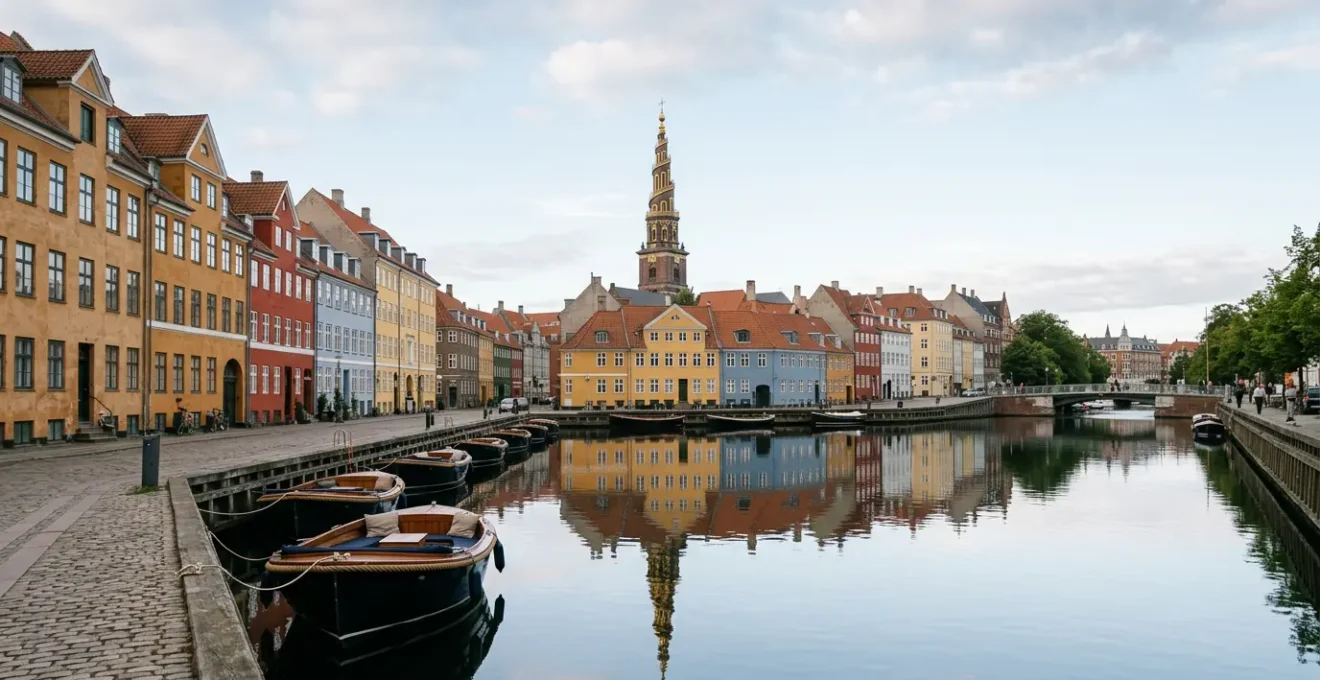
Most visitors come to Christianshavn for Freetown Christiania and miss the neighborhood’s true essence. The real magic isn’t found in one single place, but in embracing the area’s laid-back, nautical rhythm. This guide shows you how to experience Christianshavn like a local, by exploring its historic canals as your own captain, finding quiet moments on the 17th-century fortifications, and understanding the unwritten rules of its unique waterside culture. It’s about seeing the neighborhood as a living, breathing village, not just a tourist stop.
Crossing the Knippelsbro bridge from Copenhagen’s bustling center feels like stepping into another world. The noise fades, replaced by the gentle lapping of water and the distant clang of a ship’s mast. You’ve arrived in Christianshavn, our little waterside village. For many, this neighborhood is synonymous with one name: Freetown Christiania. And while Christiania is an undeniable part of our identity, it’s only the first page of a much richer story.
Too many visitors treat a day here as a quick detour, a box to be ticked before rushing back to the main sights. They miss the soul of the place, which isn’t found on a checklist but felt in its atmosphere. What if the key to truly experiencing Christianshavn wasn’t about seeing its most famous commune, but about adopting its pace? The secret lies in its canals, its history as a fortified merchant town, and the quiet, shared moments locals cherish.
This guide is your invitation to go deeper. We’ll explore the joy of captaining your own boat through our historic waterways, feel the vertigo and triumph atop a famous spire, and understand the etiquette of enjoying a beer on the docks. By the end of the day, you won’t just have seen Christianshavn; you’ll have felt its unique nautical rhythm.
To help you navigate this unique corner of Copenhagen, here is a look at how you can craft a perfect day that goes beyond the obvious and connects you with the authentic spirit of the neighborhood.
Summary: Exploring the Real Christianshavn, Canal by Canal
- GoBoat vs. Friendships: How to Captain Your Own Picnic Boat?
- Is the View from Our Saviour’s Church Worth the Vertigo?
- Why Was Christianshavn Built on Artificial Islands in the 17th Century?
- What Are the Dos and Don’ts When Entering the Green Light District?
- Where to Find the Best Sunset Spot on the Old Fortifications?
- Picnic Etiquette: Can You Drink Beer on the Wooden Docks?
- City vs. Coast: Is Urban Kayaking Harder Than Sea Kayaking?
- How to Enjoy Nyhavn Like a Local Instead of Just a Tourist?
GoBoat vs. Friendships: How to Captain Your Own Picnic Boat?
The absolute best way to understand Christianshavn is from the water. Forget the big, crowded tour boats for a moment and imagine being the captain of your own vessel. Services like GoBoat and Friendships make this a reality, offering small, silent, electric boats that you can drive yourself—no license required. The experience is less about speed and more about embracing the ‘hygge’ philosophy of slow, cozy enjoyment. The classic GoBoat, powered by solar energy, fits up to eight people around a central picnic table, making it perfect for a floating meal with friends.
Navigating the canals is part of the fun, giving you a water-level view of the charming houseboats, old warehouses, and hidden corners you’d otherwise miss. It’s an incredibly freeing experience, but with freedom comes a little responsibility. We share these waters with tour boats, kayakers, and people who live on the water, so a little local etiquette goes a long way.
Here are the unwritten rules for navigating our canals like a pro:
- Speed Limits: Keep it slow. The maximum is 6 knots in the main harbor, but you should drop to 4 knots in the narrow canals. This minimizes your wake and shows respect for the houseboats.
- Yielding Protocol: Bigger boats always have the right of way. Give plenty of space to the large tour boats and waterbuses; they can’t maneuver as easily as you can.
- Parking Etiquette: Only moor at designated public spots. Never tie up to a private jetty or block access for a residential boat.
- Sound Discipline: The electric motors are silent, which means your voice carries. Keep conversations at a moderate level, especially when passing residential areas.
Is the View from Our Saviour’s Church Worth the Vertigo?
Yes, without a doubt. But the real question isn’t about the view; it’s about the journey to get there. The spire of Vor Frelsers Kirke (Our Saviour’s Church) is an icon of the Copenhagen skyline, and climbing it is a rite of passage. The ascent involves 400 steps, with the final 150 famously winding their way up the external spiral staircase. As you climb, the wooden stairs creak, the wind picks up, and the safety railing feels like the only thing between you and the city below. It’s a thrilling, slightly terrifying experience.
The reward is a breathtaking 360-degree panorama of Copenhagen. You can trace the canals of Christianshavn, see the Øresund Bridge stretching towards Sweden, and watch the tiny boats navigate the harbor. It’s a perspective that puts the entire city into context. You’re not alone in facing the climb; an official report confirms that more than 200,000 people climb the stairway each year, sharing in that same mix of fear and exhilaration. The view is spectacular, but the feeling of conquering the golden spiral is what you’ll remember most.
Why Was Christianshavn Built on Artificial Islands in the 17th Century?
The canals and islands that define Christianshavn today aren’t natural; they are the result of a grand and ambitious vision from the early 17th century. Our neighborhood was born from the mind of King Christian IV, who, between 1618 and 1623, decided to transform a swampy, marshy area into a new district. He had a dual purpose in mind: defense and commerce.
Firstly, it was designed as a modern fortress to protect Copenhagen’s eastern flank from potential attacks. This is why the neighborhood is encircled by the massive earthen ramparts you can still walk on today. Secondly, Christian IV wanted to create a bustling merchant hub to rival the great trading cities of the time. He was heavily inspired by the canal systems of the Netherlands, hiring Dutch engineer Johan Semp to design a district with a grid of canals and straight streets, perfect for ships to load and unload goods directly at the warehouses. The entire area was constructed on artificial islands, built by reclaiming land with an ingenious mix of city waste and drained polders.
Originally, Christian IV envisioned Christianshavn as an independent town for wealthy merchants, but by 1674 it was fully absorbed into Copenhagen. This ambitious Amsterdam-inspired project left us with the unique architectural and atmospheric heritage we enjoy today. Every time you cross a bridge here, you’re walking on a piece of reclaimed history born from a king’s grand strategic dream.
What Are the Dos and Don’ts When Entering the Green Light District?
Freetown Christiania, our famous “freetown,” is a must-visit, but it’s crucial to enter with the right mindset. It’s not an amusement park; it’s a living community with its own culture and rules. While its reputation is built on its counter-cultural vibe, it’s also a place that attracts around half a million visitors annually, so being a respectful guest is paramount. The area once known as “Pusher Street” is evolving, but the core principles of the community remain.
The most important thing to remember is to move with the local rhythm. Walk calmly, be observant, and engage with the culture on its own terms. Forget the sensationalism and you’ll discover a place full of creativity, unique architecture, and a fierce sense of community. To ensure your visit is a positive one for both you and the residents, keep these essential guidelines in mind.
Your Checklist for a Respectful Visit to Christiania
- Pace Yourself: Never run. Running is associated with police raids and causes panic. Maintain a calm, steady walking pace throughout the entire area.
- Photography Guidelines: While general photography is now more accepted (post-2024), never photograph people without their explicit consent, especially in the former commercial areas. Discretion is key.
- Respect the Zones: Understand that Christiania has different areas. The entrance is open and artistic, the central hub is for events and gatherings, and the areas around the lake are quiet, private residential neighborhoods. Respect all boundaries.
- Zero Violence Policy: Christiania enforces a strict policy against violence, hard drugs, and gang activity. It is a community founded on peaceful principles.
- Support Local Culture: The best way to experience Christiania is to participate. Visit a music venue like Loppen, eat at the fantastic vegetarian restaurant Morgenstedet, and buy crafts directly from local artisans.
Where to Find the Best Sunset Spot on the Old Fortifications?
If you ask any local where they go to unwind, they’ll point you to Christianshavns Vold. These are the best-preserved 17th-century fortifications in all of Denmark, the same earthen ramparts built by Christian IV for defense. Today, their purpose is purely peaceful. They form a lush, green ribbon of parkland that encircles the neighborhood, acting as our collective backyard or “living room.” This is where we come to jog, walk our dogs, have picnics, and, most importantly, watch the sunset.
The winding path along the top of the ramparts offers elevated, unobstructed sunset views over the Copenhagen skyline. As the sun dips low, it casts a golden glow on the city’s spires and the calm waters of the canals. Find a spot on a grassy slope or a quiet bench, and you’ll be sharing the moment with locals soaking up the last light of the day. The atmosphere is quiet, contemplative, and deeply authentic.
These ramparts remained an active military installation until 1909 before being slowly transformed into the public park we cherish today. This history adds a layer of meaning to the experience; you’re relaxing on the very ground that was designed to protect the city centuries ago. It’s the perfect place to end your day of exploration, offering a moment of tranquility and one of the best free shows in town.
Picnic Etiquette: Can You Drink Beer on the Wooden Docks?
Absolutely. Grabbing a cold beer or a bottle of wine and finding a spot on a sunny wooden quay is one of the most quintessential Christianshavn experiences. It’s the very definition of hygge in our neighborhood. The key is to do it with the same relaxed and respectful attitude as the locals. This isn’t about loud parties; it’s about quiet enjoyment and soaking in the waterside atmosphere. As one visitor beautifully put it when describing their experience:
Cruising past Christianshavn while sipping wine and holding flowers just makes you feel like the main character. This isn’t a party boat, so skip the hard alcohol but do bring a bottle or two of wine, snacks and charcuterie board makings to share for a fancy picnic on the water… The atmosphere was relaxed and it was clear that both equipment and service were fine.
– A visitor’s reflection on Copenhagen’s canal culture
To join in seamlessly, just follow the simple, unwritten “Hygge-Compliant” code:
- Volume Control: Sound travels easily over water. Keep your conversations at a moderate level out of respect for the residents of the houseboats and waterfront homes.
- The ‘Pant’ System: In Denmark, all bottles and cans have a deposit fee (called ‘pant’). Never leave your empties behind. Take them to a return machine at any supermarket to get your deposit back—it’s good for your wallet and the environment.
- Friendly Acknowledgment: It’s common to give a friendly nod or a ‘skål’ (cheers) to people passing by in boats. It’s part of the social fabric.
- Zero-Trace Principle: The golden rule. Bring a bag for your trash and leave the quay cleaner than you found it.
- Public vs. Private: Stick to the open, public quays. If a jetty is gated or clearly part of a private residence, respect their boundary.
City vs. Coast: Is Urban Kayaking Harder Than Sea Kayaking?
Paddling a kayak through Christianshavn’s canals offers an even more intimate connection to the water than a GoBoat. You’re at eye-level with the cobblestones and can peek into hidden boat garages. But many people who are comfortable with sea kayaking wonder if navigating a busy urban harbor is more difficult. The answer is yes, but in a different way. It’s less about endurance and more about agility and awareness.
Urban Canal Kayaking is a game of constant maneuvering. You’re sharing narrow passages with everything from other kayakers to large tour boats, so you have to engage in a kind of “defensive paddling,” always aware of your surroundings. The challenges are man-made: bridge clearances, multi-directional traffic, and amplified sounds. In contrast, coastal sea kayaking is about finding a rhythm with nature, dealing with predictable swells and wind patterns over long, steady distances. It demands more physical endurance, while urban kayaking demands more reactive attention. A direct comparison of the two experiences highlights these crucial differences.
| Aspect | Urban Canal Kayaking (Copenhagen) | Coastal Sea Kayaking |
|---|---|---|
| Primary Challenge | Multi-directional canal traffic (tour boats, GoBoats, water buses, ferries) | Predictable ocean swells, wind, and current patterns |
| Navigation Complexity | High: constant defensive paddling, narrow passages, bridge clearances | Moderate: open water with natural rhythm |
| Acoustic Experience | Amplified sound under bridges, urban canyon acoustics, close waterfront conversations | Natural soundscape: waves, wind, seabirds |
| Visual Perspective | Water-line architectural details, 17th-century merchant warehouses, hidden boat garages, designed to be seen from canals | Coastal cliffs, natural formations, distant horizons |
| Pace & Rhythm | Stop-and-go; frequent yielding and maneuvering around obstacles | Steady, sustained paddling over longer distances |
| Physical Demand | Lower aerobic demand but higher reactive agility and attention | Higher sustained endurance and upper body strength |
Key Takeaways
- The best way to see Christianshavn is from the water; captaining your own silent, electric boat is the ultimate local experience.
- For the best sunset views, skip the crowded spots and join the locals on the grassy slopes of Christianshavns Vold, the old city ramparts.
- Embrace the ‘hygge’ culture by enjoying a drink on the public docks, but always follow the unwritten rules: keep the volume down and leave no trace behind.
How to Enjoy Nyhavn Like a Local Instead of Just a Tourist?
Just a short walk across the bridge from Christianshavn lies one of Copenhagen’s most famous and photographed sights: Nyhavn. Tourists flock to the sunny side of the canal, sitting at the pricey restaurants to snap a picture of the colorful gabled houses. But if you want to enjoy it like a local, you have to do the opposite. The real Nyhavn experience happens on the other side of the canal.
Here’s the local secret: we rarely, if ever, sit at those restaurants. Instead, we buy from a kiosk or a nearby supermarket and find a spot to sit on the quay with our legs dangling over the water. This side of the canal gets the wonderful afternoon and evening sun, and it’s where you’ll find Danes relaxing after work, sharing a six-pack, and watching the historic wooden ships bob in the harbor.
This simple act captures the Danish approach to public spaces. It’s informal, social, and completely free. You get the same million-dollar view without the tourist-trap prices. It’s the perfect final stop on your Christianshavn-area exploration, a last moment of authentic Copenhagen life before you head back into the city.
So next time you’re here, grab a drink, find your spot on the edge, and just enjoy the moment. Let the canals be your guide and the local rhythm set your pace. That’s how you truly discover the soul of Christianshavn and its surroundings.