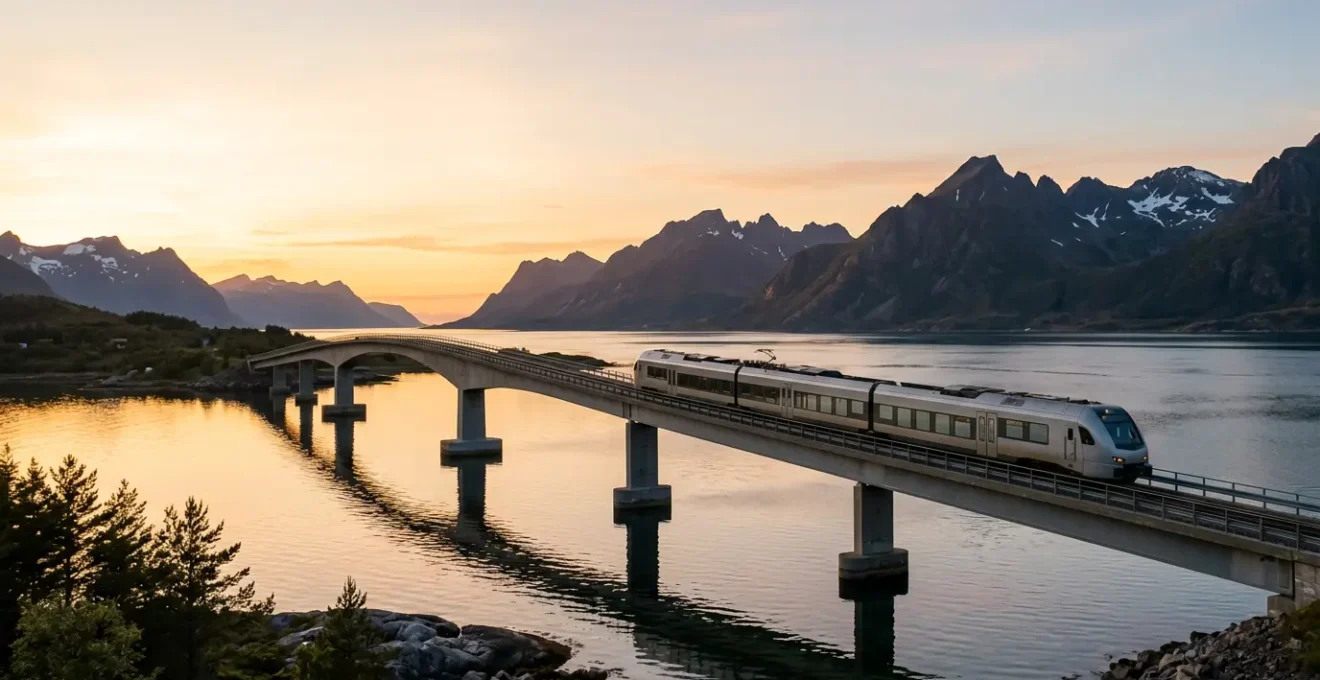
The key to a successful Scandinavian train tour is not simply booking tickets, but making strategic trade-offs between time, cost, and experience for each leg of the journey.
- The train forms the efficient backbone of your trip, but a hybrid approach—using a short-term car rental or an overnight ferry—is essential for specific regional explorations.
- A card-first, multi-currency app strategy is non-negotiable for navigating three different currencies (DKK, SEK, NOK) seamlessly and cost-effectively.
Recommendation: Prioritize your travel style early: choose Copenhagen for a compact, cozy ‘hygge’ experience and Stockholm for a grand, metropolitan feel spread across islands. This decision will dictate your time allocation.
The vision of a Scandinavian train journey—gliding through serene landscapes, connecting vibrant Nordic capitals, and experiencing a seamless blend of modern design and ancient heritage—is a powerful one. Many international travelers begin planning with a simple Eurail pass in mind, assuming it’s the one-size-fits-all solution. However, a truly successful multi-country trip through Denmark, Sweden, and Norway requires a more nuanced approach, one that a seasoned local travel agent would employ.
The common advice often overlooks the critical decisions that define the trip’s efficiency and enjoyment. It’s easy to say “pack layers,” but what does that mean when you’re moving from the relatively mild climes of Copenhagen to the potentially cooler, fjord-adjacent air of Oslo? It’s simple to suggest visiting the capitals, but how do you decide the strategic allocation of your precious days between the cozy “hygge” of Copenhagen and the grand archipelago of Stockholm? This is where planning becomes a game of intelligent choices.
But what if the key to the perfect Nordic itinerary wasn’t just about the route, but about understanding the trade-offs at every step? This guide is built on that very principle. We will move beyond the generic checklists to provide a decision-making framework. We’ll analyze the logistics of key border crossings, tackle the multi-currency challenge head-on, and even delve into the cultural context that makes this region so unique, ensuring your journey is not only smooth but also deeply enriching.
This article is structured to walk you through the most critical planning decisions you’ll face. By addressing each strategic question in order, you can build a robust and personalized itinerary that maximizes both your time and your travel experience.
Summary: Planning a Strategic Two-Week Nordic Rail Tour
- Train or Car: What Is the Best Way to Cross from Copenhagen to Malmö?
- DKK, SEK, NOK: How to Manage Three Different Crowns on One Trip?
- Raincoats to Parkas: What to Pack for a Trip Spanning Copenhagen to Oslo?
- Copenhagen vs Stockholm: Which City Should You Allocate More Days To?
- DFDS Overnight: Is the Ferry from Copenhagen to Oslo a Good Way to Save Time?
- Train or Car: What Is the Best Way to Cross the Country to Skagen?
- Welfare State 101: Why Are Danes Happy to Pay 50% Tax?
- How to Understand the Unique Danish Flavor of Nordic Heritage?
Train or Car: What Is the Best Way to Cross from Copenhagen to Malmö?
The journey from Copenhagen, Denmark, to Malmö, Sweden, is often the first border crossing on a Scandinavian tour, and your choice of transport here sets the tone for logistical efficiency. While driving across the magnificent Øresund Bridge is an iconic experience, for the vast majority of international travelers, the train is the superior strategic choice. The primary reason is the seamless integration into urban centers. The train delivers you from Copenhagen’s central station directly to Malmö’s, eliminating the complexities of city driving, expensive parking, and car rental logistics.
With trains departing every 10-20 minutes during peak times, the Øresundståg service offers a level of convenience that a car, subject to traffic and tolls, cannot match. The cost-benefit analysis further solidifies the train’s advantage, especially for solo travelers or pairs. The bridge toll alone for a car can be more than four times the price of a single train ticket.
The following comparison breaks down the core trade-offs between the main transport options.
| Method | Cost (One-Way) | Travel Time | Best For |
|---|---|---|---|
| Train (Øresundståg) | 77 DKK / 110 SEK (~$11) | 35-41 minutes | Solo travelers, heavy luggage, city-center to city-center |
| Car (incl. bridge toll) | 360 DKK / 515 SEK (~$52) toll + rental + parking | 35-60 minutes (traffic dependent) | Groups of 3-4, day trips, flexibility to stop |
| Bus (FlixBus/Nettbuss) | 69 DKK / 89 SEK (~$10) | ~40 minutes | Budget travelers |
Ultimately, a car only makes sense for a group of three or more on a dedicated day trip where the cost can be split and the flexibility to visit outlying areas is paramount. For a linear A-to-B journey within a larger itinerary, the train is the undisputed champion of logistical efficiency.
DKK, SEK, NOK: How to Manage Three Different Crowns on One Trip?
Navigating three different currencies—the Danish Krone (DKK), Swedish Krona (SEK), and Norwegian Krone (NOK)—can seem daunting, but a modern, card-centric strategy makes it remarkably simple. The most important thing to understand is that Scandinavia, and particularly Sweden, is rapidly moving towards a cashless society. In fact, Sweden is one of the most cashless societies in the world, where many establishments no longer accept cash at all. Trying to manage your trip with large wads of three different currencies is not only inefficient but impractical.
The optimal approach is to rely on a credit card with no foreign transaction fees as your primary payment method. Visa and Mastercard are almost universally accepted. This single tool will work seamlessly across all three countries. For smaller transactions or as a backup, a digital multi-currency account is your second key asset. This allows you to hold DKK, SEK, and NOK simultaneously and exchange between them at much better rates than you’d find at an airport currency exchange kiosk.
The role of physical cash is reduced to an emergency backup only. Withdrawing a very small amount (e.g., the equivalent of $30-$40 in each currency) upon arrival is sufficient. Always use official bank ATMs and decline the “Dynamic Currency Conversion” (DCC) option, which offers to charge you in your home currency at an unfavorable rate. Always choose to pay in the local currency (DKK, SEK, or NOK) to get the best rate from your bank.
Your 4-Step Checklist for Smart Currency Management
- Use a no-foreign-fee credit card as your primary payment method (cards widely accepted everywhere).
- Download a digital wallet app like Wise or Revolut to hold all three currencies (DKK, SEK, NOK) simultaneously and exchange at mid-market rates.
- Withdraw only small amounts of emergency cash (200 of each currency maximum) from official bank ATMs, avoiding tourist-trap ATMs like Euronet.
- Always decline Dynamic Currency Conversion (DCC) when paying – choose to pay in local currency (DKK/SEK/NOK), not your home currency, for the best rates.
Raincoats to Parkas: What to Pack for a Trip Spanning Copenhagen to Oslo?
Packing for a multi-country Scandinavian trip is an exercise in strategic layering. The weather can be notoriously fickle, and a journey from the southern reaches of Denmark to the fjords of Norway means preparing for a range of conditions. According to Nordic Visitor’s packing guide, even in summer, temperatures in Copenhagen and Stockholm can range from 50°F to 80°F (10-27°C), with the potential for sunny afternoons to turn into rainy, windy evenings in an instant. The key is not to pack for every eventuality with bulky items, but to have a system of adaptable layers.
Your packing list should be built around three core components: a moisture-wicking base layer (like merino wool), an insulating mid-layer (such as a fleece or a lightweight down jacket), and a waterproof and windproof outer shell. This system allows you to add or remove layers to perfectly match the day’s conditions, whether you’re cycling in sunny Copenhagen or taking a breezy ferry in the Oslo Fjord. Forget the heavy winter parka; a combination of these layers provides more warmth and versatility with a fraction of the bulk.
Beyond clothing, a few items are non-negotiable for a train journey. Comfortable, broken-in waterproof footwear is arguably the most critical item you will pack. You will be walking extensively. Also essential are a compact umbrella, a portable power bank for long train rides, and sunglasses, as the summer sun can be surprisingly strong. By focusing on a minimalist, high-quality layered system, you can easily fit everything into a carry-on, making transfers between trains and hotels swift and effortless.
Copenhagen vs Stockholm: Which City Should You Allocate More Days To?
This is one of the most common strategic dilemmas for first-time visitors: with limited time, does Copenhagen or Stockholm deserve the larger share? The answer depends entirely on your travel personality and preferred pace. There is no right or wrong choice, only a trade-off between two distinct urban experiences. Copenhagen is defined by its compact, walkable, and cycle-friendly layout, fostering a cozy and relaxed atmosphere known as ‘hygge’. Stockholm is a grander, more metropolitan capital spread across 14 islands, requiring more deliberate travel via metro or ferry to explore.
As a general rule, you can experience the core of Copenhagen in 3-4 days due to its density. Stockholm, with its expansive layout and exceptional museum offerings like the Vasa Museum and Skansen, often warrants 4-5 days to do it justice. The travel blogger Danny CPH aptly captures this difference:
Copenhagen is compact, walkable, and encourages leisurely exploration (‘strolling’). Stockholm, spread across 14 islands, has a grander scale that involves more deliberate travel (by metro or ferry) between neighborhoods, feeling more like a ‘conquest’.
– Danny CPH, Copenhagen vs. Stockholm Travel Guide
To help you make this crucial decision, consider this breakdown of each city’s character. A careful review of this information, based on an in-depth comparative analysis, will guide your itinerary planning.
| Aspect | Copenhagen | Stockholm |
|---|---|---|
| Recommended Days | 3-4 days | 4-5 days |
| City Feel | Compact, walkable, cycling culture, cozy ‘hygge’ atmosphere | Grand, spread across 14 islands, metropolitan, expansive |
| Getting Around | Cycle almost everywhere within 30 minutes | Requires metro/ferry between neighborhoods |
| Personality | Relaxed, warm, friendly, continental vibe | Grand history, stunning water views, more reserved |
| Top Day Trips | Malmö (Sweden), Kronborg Castle, Roskilde, Dragør | Archipelago, Uppsala, Drottningholm Palace |
| Museum Strength | Good (National Museum, Design Museum) | Exceptional (Vasa Museum, Skansen, ABBA Museum) |
If your ideal trip involves leisurely café hopping and spontaneous discovery on foot, give Copenhagen an extra day. If you are a museum lover who enjoys grand vistas and island hopping, allocate more time to Stockholm.
DFDS Overnight: Is the Ferry from Copenhagen to Oslo a Good Way to Save Time?
The overnight ferry from Copenhagen to Oslo presents an appealing proposition: combining transport and accommodation into one, saving a day of travel and a night’s hotel cost. However, from a purely logistical and time-saving perspective, the ferry is often a strategic misstep. It is better understood as a unique travel experience—a mini-cruise—rather than a time-efficient “hack.” The train journey, while requiring a separate hotel booking, is almost always the more time-effective option for city-center to city-center travel.
The ferry’s 17-hour journey time doesn’t account for the considerable overhead. You must check in at the port, typically 1-2 hours before departure, and the ports themselves are often located outside the immediate city center, requiring a taxi or public transport to reach. Upon arrival in Oslo, you have disembarkation procedures. When you sum up the total door-to-door time, it often equals or exceeds that of a relaxed day-time train journey plus a comfortable night’s sleep in a city hotel.
Case Study: The Ferry as a Maritime Experience
An analysis from travel experts at Fifty Degrees North highlights this trade-off. While the DFDS ferry replaces a train ticket and hotel night, the total cost including a mandatory cabin, dinner, and breakfast can often exceed the combined price of a train ticket and a comparable hotel. The ferry’s true value lies not in savings, but in the unique benefits it offers: enjoying sunset and sunrise at sea, the novelty of waking up in a new country, and access to onboard dining and entertainment. It is a choice for travelers seeking a distinct maritime experience, not those prioritizing logistical efficiency or budget.
Therefore, the decision is a classic trade-off. If your goal is to maximize your time on the ground in Oslo and travel as efficiently as possible, the train is the superior choice. If you value the journey as part of the destination and the idea of a mini-cruise on the Oslo Fjord appeals to you, then the ferry can be a memorable part of your adventure.
Train or Car: What Is the Best Way to Cross the Country to Skagen?
While a train-centric itinerary is the backbone of a Scandinavian tour, certain destinations demand a more flexible, hybrid approach. Skagen, the stunning northernmost tip of Denmark where two seas meet, is a prime example. The attractions here—such as the vast migrating sand dune of Råbjerg Mile and Grenen itself—are spread out and not easily accessible from the town’s train station on foot. Simply taking the train to Skagen and hoping to walk everywhere is an impractical strategy.
The most efficient method is to combine the strengths of Denmark’s excellent rail network with the flexibility of a car. This “hybrid strategy” maximizes both time and experience. You use the fast, comfortable intercity train for the long-haul journey from Copenhagen to a major northern hub like Aalborg or Frederikshavn. Upon arrival, you execute a short-term, 24-hour car rental. This gives you the freedom to explore the dispersed natural wonders around Skagen at your own pace without committing to a long, expensive cross-country drive.
This approach offers the best of both worlds: you avoid the fatigue and time-cost of driving the entire length of the country, while still gaining the necessary mobility for the “last mile” of your exploration. For travelers who are physically fit and packing light, a viable and eco-conscious alternative is renting bicycles in Skagen town to explore the famously flat, bike-friendly terrain.
Your Hybrid Strategy for Reaching Skagen’s Attractions
- Take the efficient train from Copenhagen to Aalborg or Frederikshavn, leveraging Denmark’s well-connected rail network.
- Rent a car for 24-48 hours upon arrival for focused exploration of the area’s spread-out attractions.
- Visit Grenen, the northernmost point where the Skagerrak and Kattegat seas collide, which is best accessed by car or a specialized vehicle like the Sandormen tractor bus.
- Explore Råbjerg Mile, one of Europe’s largest migrating sand dunes, which requires vehicle access to its parking area.
- For an alternative, rent bicycles in Skagen town to explore the local area on its famously flat, bike-friendly paths.
Welfare State 101: Why Are Danes Happy to Pay 50% Tax?
For many international visitors, Denmark’s high tax rates are a source of curiosity. Understanding the “why” behind this social contract offers a profound insight into the Danish way of life and directly impacts the quality of your travel experience. It’s not about politics; it’s about observing the tangible results of a system built on deep-seated societal trust, or ‘Tillid’. As a traveler, you are a direct beneficiary of this system every single day of your visit.
The high taxes fund the immaculate public infrastructure you’ll use constantly: the efficient and clean public transportation, the beautifully maintained parks and public squares, and the safe, well-lit streets you can walk at night. It funds world-class cultural institutions, many of which are free to enter, like the stunning Royal Library in Copenhagen. The high quality of these public services is not an accident; it’s a deliberate societal investment.
This system is underpinned by a level of mutual trust that can be surprising to outsiders. It manifests in everyday scenes that speak volumes about the culture.
Visitors to Denmark often observe tangible examples of ‘Tillid’ – the deep-seated societal trust that underpins the welfare system. Common sights include unattended baby prams left outside cafes while parents dine inside, roadside farm stalls with honesty boxes for payment, and the overall sense of safety and order in public spaces. This cultural phenomenon helps tourists understand why Danes willingly contribute high taxes: the system runs on mutual trust and shared benefits that everyone, including visitors, experiences.
– Onlooker Observation
So, when you enjoy a seamless train ride or a peaceful moment in a pristine public garden, you are experiencing the direct return on the Danes’ investment. Understanding this connection transforms your perspective from a mere tourist to an informed observer of a unique and successful social model.
Key Takeaways
- The train is the strategic backbone of a Nordic tour, but a hybrid approach (short-term car rental, overnight ferry) is key for specific legs like exploring Skagen or seeking a unique maritime experience.
- A card-first payment strategy using a no-foreign-fee credit card and a multi-currency app is essential for navigating the three different Scandinavian currencies efficiently and cost-effectively.
- Time allocation between cities is a personal choice: prioritize Copenhagen for a compact, cozy ‘hygge’ atmosphere and Stockholm for a grander, museum-rich metropolitan experience.
How to Understand the Unique Danish Flavor of Nordic Heritage?
As your train travels north from Copenhagen, you’re not just crossing borders; you’re traversing distinct cultural landscapes. While often grouped together, each Nordic country has a unique character. Denmark holds a special position as the most “continental” of the nations, acting as a historical and cultural bridge to the rest of Europe. This results in a cultural flavor that is noticeably different from its neighbors, a difference you can feel during your journey.
The Danish identity is famously centered around ‘hygge’—a concept of coziness, contentment, and convivial fellowship. It’s found in candle-lit cafes, shared meals, and a generally more relaxed, bon-vivant approach to life. This stands in contrast to the Swedish ideal of ‘lagom,’ which emphasizes balance, moderation, and a more reserved public demeanor. As your train glides from the flat, agricultural landscapes of Denmark into the vast forests of Sweden, you are moving between these two cultural poles.
Case Study: The Journey as a Cultural Narrative
The train routes themselves tell a historical story. The journey from Copenhagen to Oslo connects two capitals that were once united under the same crown during the Denmark-Norway union (1524-1814), sharing centuries of history. In contrast, the route from Copenhagen to Stockholm connects two historic rival kingdoms. This underlying narrative adds a layer of richness to the physical journey. The shift from Denmark’s relaxed, continental vibe to Sweden’s more structured and nature-focused identity becomes an observable part of the travel experience, transforming a simple train ride into a lesson in Nordic cultural nuances.
Recognizing these subtleties is what elevates a trip from a simple sightseeing tour to a genuine cultural immersion. Paying attention to the changing architecture, the demeanor of people in public spaces, and the very landscape outside your window provides a deeper understanding of what makes each Nordic country unique. Denmark, with its embrace of ‘hygge’, serves as the warm, welcoming gateway to this fascinating and diverse region.
With these strategic insights and cultural contexts, you are now equipped to build an intelligent and enriching Scandinavian journey that goes beyond the typical tourist path. The next step is to start mapping your own route, confident in the decisions you make.