In summary:
- Mastering Danish waterways is less about location and more about understanding the specific “codes” of each environment, from urban traffic to wildlife etiquette.
- In busy harbors like Copenhagen, your primary safety rule is the “Tonnage Rule”: large vessels always have priority, and your job is to stay clear.
- Embrace the “paddler’s mindset” by participating in initiatives like GreenKayak, where you can paddle for free in exchange for collecting trash.
- For multi-day trips, leverage Denmark’s unique “Right to Roam” and free shelter system, but plan meticulously for weather, food, and water.
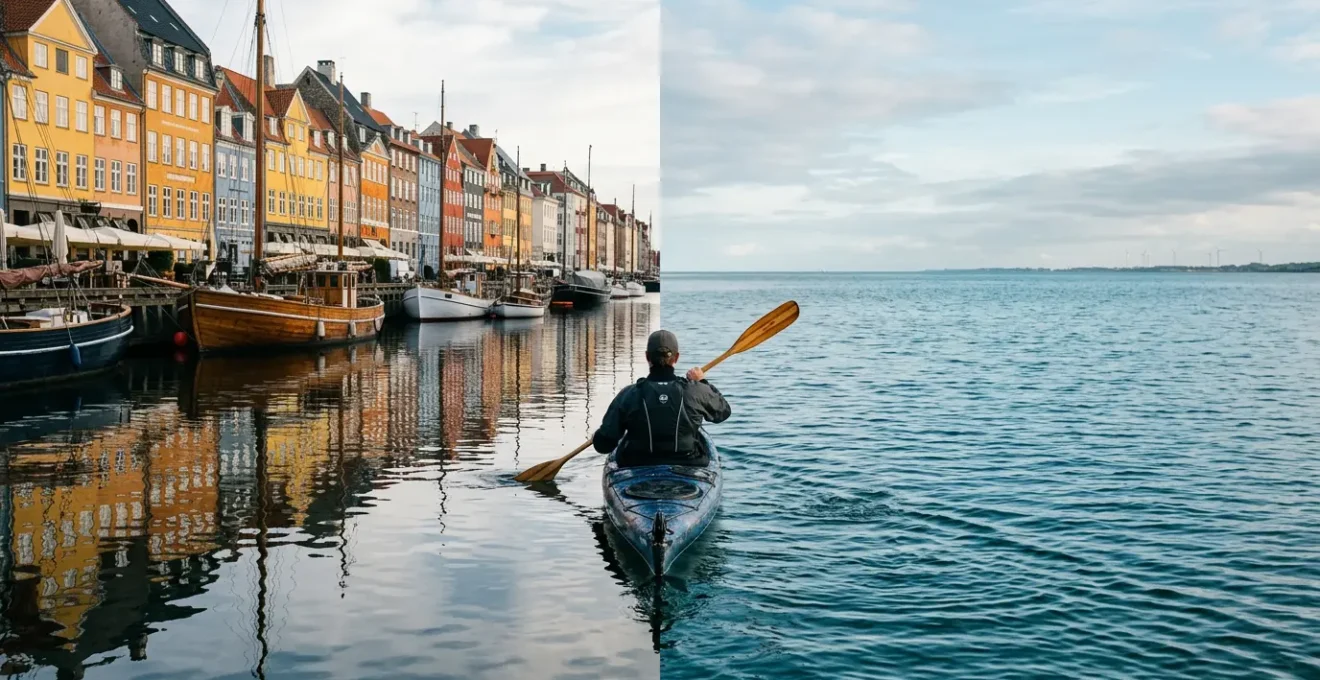
The image of kayaking in Denmark conjures two powerful, contrasting scenes: gliding silently through the historic heart of Copenhagen, modern architecture reflected on the water, and paddling the open sea, tracing the same routes Vikings navigated a thousand years ago. For the active traveler, it promises a unique, waterline perspective on Danish culture and nature. Many guides will give you a list of destinations, but they often miss the most crucial element. The true art of Danish kayaking isn’t just about knowing where to go, but understanding the unwritten rules and specific techniques required for each distinct environment.
Most beginners worry about their paddling strength or endurance. While important, the real challenge lies in adapting your mindset. Navigating the bustling canals of a city demands a different kind of awareness than scanning the horizon for seals in the quiet archipelago. It requires mastering a set of “waterway codes”—the blend of official rules, local etiquette, and environmental awareness that separates a tourist in a kayak from a confident water explorer. This guide is built on that principle. Instead of just a map, we’ll provide you with the instructor’s mindset needed to read the water, respect the traffic, and connect deeply with your surroundings.
We will start by dissecting the core differences between city and sea paddling before diving into the essential safety protocols for urban waters. From there, we’ll cover how to prepare for any paddle, where to responsibly encounter Denmark’s marine life, and how to connect with history on the water. Finally, we’ll explore the logistics of turning a day trip into an unforgettable island-hopping adventure, giving you the skills to truly captain your own Danish journey.
This comprehensive guide will walk you through everything you need to know, from the fundamental rules of the water to planning your own multi-day expedition. Explore the sections below to build your confidence and start your adventure.
Summary: Navigating Denmark from the Waterline
- City vs. Coast: Is Urban Kayaking Harder Than Sea Kayaking?
- How to Kayak for Free by Collecting Trash in the Harbor?
- Right of Way: Who Moves When a Harbor Bus Approaches Your Kayak?
- Dry Bags and Layers: What to Bring for a 4-Hour Paddle?
- Seals and Porpoises: Where Are You Most Likely to See Them from a Kayak?
- Viking Ships waters: Is Roskilde Fjord the Best Place for Historical Paddling?
- GoBoat vs. Friendships: How to Captain Your Own Picnic Boat?
- How to Explore the Danish Archipelago by Boat?
City vs. Coast: Is Urban Kayaking Harder Than Sea Kayaking?
The question isn’t about which is “harder,” but about what type of challenge you’re prepared for. Each environment requires a different skillset and, more importantly, a different mindset. Sea kayaking is a test of physical endurance and weather awareness. You’ll be dealing with wind, waves, and currents over longer distances. Your focus is on efficient paddling technique, navigation, and stamina. It’s a battle against the elements in a vast, open space.
Urban kayaking, particularly in a busy hub like Copenhagen harbor, is a test of constant vigilance and spatial awareness. The physical effort might be lower, but the mental load is significantly higher. You are not just a kayaker; you are a tiny, soft-shelled vehicle in a complex traffic system. The environment is dense with harbor ferries, tour boats, private speedboats, and other paddlers. As one analysis of the experience notes, the urban environment requires continuous alert paddling due to the sheer rush of watercraft. Your head must be on a swivel, constantly anticipating the movements of larger, faster, and less maneuverable vessels. While a beginner can absolutely enjoy the canals, they must do so with the understanding that safety here is about traffic management, not just staying afloat.
How to Kayak for Free by Collecting Trash in the Harbor?
Embracing the “paddler’s mindset” means becoming an active steward of the environment you’re enjoying. In Denmark, this philosophy is beautifully realized through GreenKayak, an initiative that allows you to explore the canals for free. The concept is simple and powerful: you are given a kayak, a bucket, and a litter picker for two hours, and in return for the free rental, you collect trash floating in the harbor. It’s a tangible way to leave the place better than you found it.
This isn’t just a token gesture; the impact is significant. Since its inception, more than 100 tons of trash have been collected by thousands of volunteers, according to the environmental NGO. Participating is straightforward: you book a session online in advance, sign an agreement, and set off on your mission. Upon your return, the collected waste is weighed and documented. It’s a fulfilling experience that connects you directly to the health of the harbor and shifts your perspective from a passive tourist to an active participant in the city’s ecosystem. Many find it one of the most memorable parts of their visit, combining adventure with a clear sense of purpose.
Right of Way: Who Moves When a Harbor Bus Approaches Your Kayak?
In a busy harbor, there is one simple, non-negotiable rule that governs your safety above all others: you move. As a kayaker, you are the most agile and least visible vessel on the water. Large commercial boats like the Copenhagen harbor buses, ferries, and tour boats operate on fixed schedules and have massive blind spots. They cannot stop or turn quickly. Your number one priority is to see them, be seen by them, and stay out of their way. This is often called the “Tonnage Rule”, and it trumps all other navigational courtesies.
As the experienced mariners at Maine Island Kayak Co. bluntly state in their safety guidelines for kayakers, “KAYAKS LOSE BY THE TONNAGE RULE. DO NOT CLAIM THE RIGHT OF WAY.” This isn’t about politeness; it’s about physics. Your strategy should always be to take early and obvious action to move aside, preferably into shallower water where larger vessels cannot follow. Making eye contact with the captain is a good practice, but never assume they have seen you until you see them actively change course, which they are unlikely to do. Your safety is your responsibility, and that means being predictable and defensive at all times.
Action Plan: Navigating Busy Harbor Channels
- Anticipate and Yield: Never impede a vessel that is restricted to a narrow channel. Identify large boats early and move well out of their path.
- Stay to the Side: Keep as far to the right (starboard) side of any channel as is safe. Utilize the shallow waters near the edges where kayaks can go but big boats cannot.
- Do Not Cross Blindly: Never cross a channel or fairway if it will force an oncoming vessel to alter its course. Wait for a clear opening.
- Be Visible and Clear: Wear brightly colored clothing. Use clear paddle signals to indicate your intentions if you must cross a path, but only after confirming you have been seen.
- Confirm Visual Contact: Before proceeding in front of a stopped or slow-moving vessel, make direct eye contact with the captain to ensure they are aware of your presence and path.
Dry Bags and Layers: What to Bring for a 4-Hour Paddle?
Proper gear preparation for a Danish paddle is about more than just staying dry; it’s about staying warm, safe, and comfortable. The weather can change in an instant, and being wet is manageable, but being wet and cold can be dangerous. The key is a system of layers and dry bags. Forget cotton entirely—it absorbs water and loses all insulating properties. Your clothing system should be based on synthetics or wool.
Think in terms of two separate kits stored in dry bags. First, a small 5-10 liter dry bag for on-water essentials that you need to access easily: your phone in a waterproof pouch, sunscreen, snacks, and your wallet. This can be clipped to the deck in front of you. Second, a larger 10-20 liter dry bag stowed in a hatch for your “post-paddle comfort kit.” This should contain a complete change of warm clothes, a small quick-dry towel, and an extra fleece or wool layer you don’t think you’ll need—because that’s the one you will be most grateful for if you get unexpectedly soaked. A crucial addition for a Danish paddle is a personal “hygge kit”: a small flask of hot coffee or tea and a Danish pastry in a waterproof container make any shore break infinitely more enjoyable.
Seals and Porpoises: Where Are You Most Likely to See Them from a Kayak?
One of the greatest rewards of kayaking in Denmark is the chance for intimate encounters with marine wildlife. The quiet, low-profile nature of a kayak makes it the perfect vessel for observing seals and harbor porpoises without disturbing them. Success isn’t just about luck; it’s about knowing where and when to look, and how to behave. The Little Belt (Lillebælt) between Jutland and Funen is a world-renowned hotspot for harbor porpoises, while the South Funen Archipelago offers a high concentration of both seals and porpoises.
Timing is everything. Porpoises are most active during the early morning and late evening as they hunt for fish. For seals, plan your paddle around low tide, when they are most likely to be “hauled out,” resting on exposed rocks and sandbars. Your chances are excellent; according to the University of Copenhagen’s marine wildlife tours in the Øresund, porpoises or seals were spotted on 100% of their trips in the previous year. The most important technique, however, is silent paddling. Use low-angle strokes, avoid hitting the hull with your paddle, and drift quietly. The rule is to always maintain a respectful distance (at least 50 meters) and let the animals approach you if they are curious. Never pursue them. This patient, respectful approach is far more rewarding and is the core of responsible wildlife observation from a kayak.
Viking Ships waters: Is Roskilde Fjord the Best Place for Historical Paddling?
For those looking to connect with Denmark’s legendary past, paddling on Roskilde Fjord offers an unparalleled “waterline perspective” on Viking history. It is here that five original Viking ships were excavated from the seafloor, and launching your kayak into these same waters feels like dipping your paddle directly into a saga. The fjord’s protected nature makes it exceptionally safe for paddlers of all levels, offering calm conditions to explore the very waterways that these ancient mariners navigated.
A guided kayaking tour here is more than just a paddle; it’s a floating history lesson. As you glide past the modern shoreline, instructors point out historic sites and share stories of the Viking age, all while you experience the timeless qualities of the fjord—the wind patterns, the natural contours, and the seabirds that have not changed in over a millennium. A perfect historical itinerary involves visiting the Viking Ship Museum in the morning to see the incredible preserved vessels, then launching into the fjord in the afternoon. This “then and now” experience, where you physically connect your modern paddle strokes to the ships you just saw, creates a profound and lasting memory. It solidifies the idea that the water itself is the truest link to the past.
GoBoat vs. Friendships: How to Captain Your Own Picnic Boat?
Exploring Copenhagen’s canals isn’t limited to kayaks. Social picnic boats like GoBoat and Friendships offer a completely different, yet equally Danish, way to experience the city from the water. The choice between them isn’t about which is better, but about the kind of experience you are seeking. Kayaking is an active, personal, and physically engaging journey. A GoBoat, by contrast, is a slow, social, floating living room—it’s pure “hygge on water.”
Powered by a silent electric motor and steered with a simple tiller, these boats require no prior experience and can hold up to eight people. The focus is on relaxation, conversation, and sharing a meal. However, being the captain of your own picnic boat comes with responsibilities. The “zero-trace principle” is paramount: everything you bring aboard must be packed out. You must also be a courteous neighbor, keeping music and conversation at a reasonable volume, especially in residential canals. While you have a motor, you are still one of the smaller vessels; navigating courteously means giving way to larger tour boats and being mindful of your wake when passing smaller craft like kayaks. This option is perfect for families, social gatherings, or anyone who wants the water experience without the workout.
The following table, based on information from operators like GoBoat, highlights the key differences to help you choose.
| Feature | GoBoat (Picnic Boat) | Kayak Rental (e.g. Kayak Republic) |
|---|---|---|
| Experience Type | Slow, social ‘hygge’ on water – lounge-focused | Active, personal exploration – physically engaging |
| Physical Effort | Minimal – electric motor powered, leisurely pace | Moderate to high – paddle-powered, full-body workout |
| Group Capacity | Up to 8 people, perfect for families and social groups | Single or tandem (2 people), intimate experience |
| Onboard Activities | Bring picnic, drinks, music – floating living room concept | Wildlife observation, photography, environmental connection |
| Navigation Skill | Very easy steering, no experience required | Basic paddling instruction needed, more skill development |
| Environmental Impact | Electric propulsion, can participate in Trash Pirates program | Zero emissions, GreenKayak option for trash collection while paddling |
| Best For | Relaxed socializing, celebrations, families with young children | Adventure seekers, fitness enthusiasts, nature photographers, solo reflection |
Key takeaways
- Denmark’s “Right to Roam” and network of free “shelterplads” (shelter sites) make multi-day kayak camping uniquely accessible and affordable.
- Successful island-hopping is a game of logistics: meticulously plan food, carry 3-4 liters of water per person per day, and always pack for one extra emergency day.
- Weather is the ultimate authority in the archipelago. Build buffer days into your itinerary to allow for flexibility when wind and sea conditions are unfavorable.
How to Explore the Danish Archipelago by Boat?
Graduating from day trips to a multi-day island-hopping expedition in the Danish archipelago is the ultimate expression of kayaking freedom. Areas like the South Funen Archipelago are a sea kayaker’s paradise, with dozens of small, beautiful islands and manageable open-water crossings, mostly between 4-8 km. This makes the area surprisingly accessible for paddlers ready to take the next step. What truly sets Denmark apart is its infrastructure for self-powered adventurers. The country’s “Right to Roam” on the water, combined with a unique network of free or low-cost “shelterplads” (shelter sites) on most islands, allows you to plan incredible journeys with unparalleled freedom.
This freedom, however, must be earned through meticulous planning. An expedition like this, as detailed in adventures through the South Funen Archipelago, is a serious undertaking. You are your own support system. Logistics are everything. You must carefully calculate your food supplies, carry enough fresh water for your entire trip (plus an emergency day), and have a deep understanding of your navigation tools. Your gear checklists for paddling, camping, and safety must be comprehensive. Most importantly, you must be a humble student of the weather. Wind and sea conditions can change rapidly, and having buffer days in your itinerary to wait out a storm is not a luxury—it’s a necessity. This level of paddling requires a fusion of all the skills: technique, vigilance, preparedness, and a deep respect for the power of the sea.
The journey from a nervous beginner in a canal to a confident explorer in the archipelago is a rewarding one. It is built on a foundation of respect for the water and a commitment to mastering the specific codes of each environment. Start by building your awareness in the city, then expand your skills to the open coast, and you will be well on your way to experiencing Denmark from its most authentic and beautiful perspective.