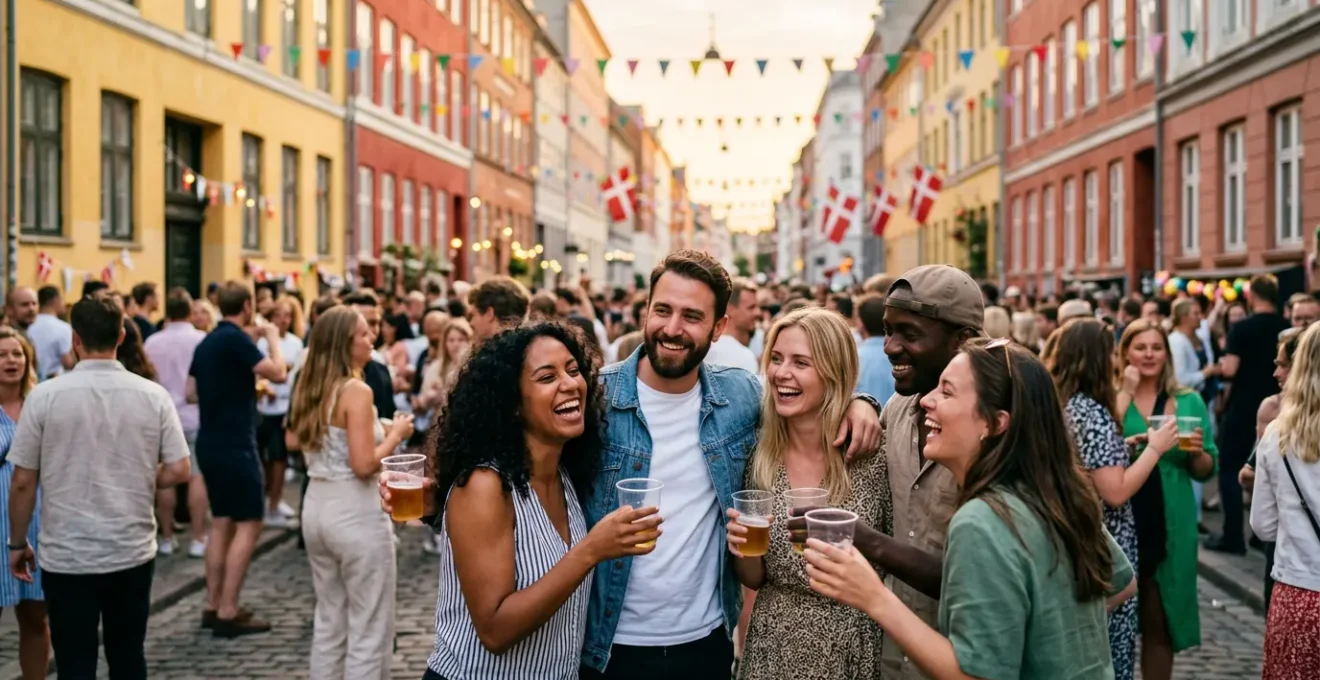
The secret to Copenhagen’s street parties isn’t just knowing where to go, but understanding the unwritten system that powers them.
- The “Forfest” (pre-party) is a non-negotiable social ritual, not just a way to save money.
- Denmark’s “Pant” deposit system is a micro-economy that can fund your night if you play it right.
- The strict 10 PM curfew is a social contract that allows these parties to exist in the first place.
Recommendation: Instead of chasing the biggest crowd, focus on matching your personal vibe to the specific energy of each neighborhood—Vesterbro for club culture, Nørrebro for multiculturalism, or a hidden courtyard for authentic ‘hygge’.
You hear it before you see it: a thumping bassline echoing between pastel-colored buildings, the collective cheer of a crowd, and the unmistakable clinking of bottles. Welcome to a Copenhagen street party. For any young traveler or music lover, the allure is magnetic. But showing up is easy; truly joining in like a local is an art form. Most guides will give you the same tired advice: “Go to Distortion festival” or “be warned, drinks are expensive.” They tell you the what, but never the *how*. They miss the point entirely.
The real Copenhagener experience isn’t about finding the biggest party; it’s about navigating the city’s unique cultural ecosystem. It’s a world of unwritten rules, social rituals, and clever economic hacks that turn a simple gathering into a city-wide phenomenon. Forget everything you think you know about partying. The key isn’t just attending the event, but mastering the system that makes it all possible—from the pre-party rituals to the post-curfew etiquette.
This guide is your key to that system. We’re not just going to list festivals; we’re going to deconstruct the entire local party machine. You’ll learn how to choose a festival that matches your soul, how to drink on a budget using a uniquely Danish system, why the party always stops at 10 PM, and how to find the real magic happening in hidden courtyards. Get ready to party less like a tourist and more like you live here.
Summary: Your Insider’s Playbook for Copenhagen’s Street Party Scene
- Distortion Festival: Is It a Chaotic Mess or the Best Party of the Year?
- Hipster or Multicultural: Which Neighborhood Festival Fits Your Vibe?
- How to Enjoy Street Festivals Without Spending a Fortune on Drinks?
- Why Do You Pay Extra for Your Plastic Cup at Festivals?
- The Curfew Rule: When Does the Music Stop in Residential Areas?
- When is Copenhagen Art Week and Should You Plan Your Trip Around It?
- Smoke-Filled Clubs or Open Parks: Which Jazz Venue Fits Your Mood?
- Copenhagen Jazz Festival: How to Find Free Concerts in Hidden Courtyards?
Distortion Festival: Is It a Chaotic Mess or the Best Party of the Year?
Let’s get it out of the way: Distortion is the 800-pound gorilla of Copenhagen street parties. It’s a week-long celebration of “orchestrated chaos” that completely takes over the city each June. For an outsider, it can seem like an impenetrable, overwhelming mess. But for locals, it’s a structured beast with multiple personalities. The key is understanding it’s not one party, but four distinct experiences rolled into one, attracting over 100,000 daily participants. Thinking of it as a single event is the first tourist mistake.
The “chaotic” part you see on Instagram is likely the free daytime street parties. These pop up in Nørrebro and Vesterbro, with dozens of small stages transforming residential streets into a massive, sprawling festival from 4 PM to 10 PM. This is the heart of Distortion’s original spirit. But the modern festival has evolved into a much more complex organism. For big-name headliners, there’s Distortion X, a ticketed, contained mega-stage. When the street music stops, the party moves indoors to Distortion Club, taking over the city’s best venues. Finally, the entire week culminates in Distortion Ø, a two-day electronic music finale on an industrial island, which is essentially Scandinavia’s largest rave.
So, is it a chaotic mess or the best party? The answer is both, and that’s the point. It’s a choose-your-own-adventure festival. The local’s play is to use the free street parties for daytime vibes and then strategically choose one or two ticketed events (Club or Ø) for the late-night experience, bypassing the overwhelming parts and curating a perfect party journey.
Hipster or Multicultural: Which Neighborhood Festival Fits Your Vibe?
Beyond the behemoth of Distortion, Copenhagen’s soul is found in its neighborhood-specific street parties, or ‘gadefester’. The biggest mistake a traveler can make is assuming all parties are the same. Each district has a fiercely independent identity, and its festivals are a direct reflection of that. Choosing the wrong neighborhood is like showing up to a techno club in a folk music mood. Vibe-matching is essential, and the two main arenas are Vesterbro and Nørrebro. Choosing between them will define your night.
Vesterbro, the city’s former red-light district, is now the undisputed capital of cool. Its festivals are an extension of its nightlife scene: trendy, electronic-music-focused, and centered around the food and drink culture of the Meatpacking District (Kødbyen). The crowd is a mix of young professionals, creatives, and dedicated clubbers. Contrast this with Nørrebro, celebrated for its raw energy and multiculturalism. With over 55 nationalities, its street parties are an eclectic, vibrant mix of world music, hip-hop, and family-friendly gatherings. It’s less about being seen and more about authentic community celebration. This detailed Copenhagen neighborhood guide highlights these stark differences.
| Neighborhood | Vibe & Crowd | Music Genres | Food Scene | Best For |
|---|---|---|---|---|
| Vesterbro | Trendy, hipster, nightlife-focused. Former red-light district turned coolest area. Young professionals & creatives. | Techno, house, electronic. Club culture dominant. | Meatpacking District (Kødbyen): craft beer bars, restaurants, street food. Værnedamsvej cafes. | Late-night clubbing, food scene explorers, design enthusiasts |
| Nørrebro | Multicultural, diverse (55+ nationalities), raw energy. Voted world’s coolest neighborhood by Time Out 2021. | Hip-hop, world music, reggaeton, eclectic mix reflecting diversity. | Turkish, Middle Eastern, ramen, pan-African. Jægersborggade food paradise. | Cultural exploration, authentic local experience, families & casual listeners |
| Amager/Sydhavnen | Lesser-known, hyper-local, authentic alternative to major festivals. | Varies by specific gadefest (spontaneous street party) | Local kiosks, neighborhood spots | Travelers seeking off-the-beaten-path authentic Danish street party culture |
For those truly seeking to get off the beaten path, smaller parties in areas like Amager or Sydhavnen offer a hyper-local glimpse into authentic Danish culture, far from the international crowds. Don’t just go to a party; go to *your* party.
Sometimes, the best parties aren’t on the main streets at all, but in the quiet, shared courtyards (‘gårds’) of residential buildings, offering a moment of ‘hygge’ amidst the festival chaos.
How to Enjoy Street Festivals Without Spending a Fortune on Drinks?
The sticker shock is real: a single beer at a festival bar can cost you a small fortune. Watching tourists queue up to pay premium prices is a classic local pastime. The secret to affordable drinking isn’t just about saving money; it’s about participating in two fundamental Danish social rituals: the ‘Forfest’ (pre-party) and the ‘Kiosk Crawl’. Mastering these is non-negotiable for an authentic experience.
The ‘Forfest’ is a sacred institution. Danes almost never meet at a bar; they gather at someone’s home or in a park to share supermarket-bought drinks first. This isn’t just a budget move; it’s the main social event. Joining a ‘forfest’ is where conversations happen and friendships are made. Grab some classic local beers like Tuborg or Carlsberg from a Netto or Føtex supermarket and you’re already halfway to being a local. Secondly, no one carries a heavy bag of warm beers all day. Instead, locals employ the ‘Kiosk Crawl’. As the day progresses, they simply pop into the myriad of nearby convenience stores (‘kiosks’) to buy cold drinks as needed. It’s a dynamic, pay-as-you-go system that keeps you mobile and your drinks cold.
Finally, the ultimate pro-move is to use the ‘Pant’ system to your advantage. Every can and bottle has a deposit value. Throughout the day, you can collect discarded containers and return them at a supermarket’s reverse vending machine. A single large bag can easily net you a voucher for 50-100 DKK, effectively giving you a massive discount on your next round of drinks or snacks. And don’t forget to stay hydrated at the free ‘vandposter’ (public water fountains) dotted around the city. It’s the key to surviving a long day of partying.
Why Do You Pay Extra for Your Plastic Cup at Festivals?
That 5 or 10 DKK you pay for a plastic cup isn’t a charge; it’s a deposit. Welcome to ‘Pant’, Denmark’s world-class recycling system and a core part of the street party micro-economy. Far from being an annoying fee, this system is a point of national pride. With it, Denmark’s ‘pant’ system achieves a 93% return rate, one of the highest on the planet. When you “buy” a cup, you’re buying into a circular system. You can either return it to any bar for your deposit back or, more commonly, exchange your empty cup for a new, full drink, paying only for the beverage.
But the ‘Pant’ system’s genius goes beyond simple recycling. It has created a unique and visible social phenomenon that truly comes alive during festivals. You will see people, known as ‘pant-samlere’ (can collectors), systematically and efficiently collecting discarded cups and cans. This practice turns an environmental initiative into a mechanism for social support.
The ‘Pant-Samlere’ Subculture and Festival Economy
The ‘pant’ deposit system has created a unique social phenomenon in Copenhagen: the ‘pant-samlere’ (can/cup collectors). These individuals, often from marginalized communities, collect bottles and cans from public spaces to return them for deposits, creating an informal but significant source of income. A crucial piece of festival etiquette is to support this system. Instead of crushing your can or throwing it in a bin, locals will consciously leave their empty containers on a bench, a ledge, or next to a bin. This small act makes collection easier for the ‘pant-samlere’. It’s a beautiful, un-spoken example of the Danish social contract in action, where environmentalism and social responsibility intersect in the middle of a party.
So when you pay that deposit, you’re not just paying for a cup. You are participating in a complex system of environmental stewardship and social solidarity. Leaving your cup for a collector isn’t littering; it’s an act of community participation. Understanding this changes your entire perspective on “waste” at a festival.
The Curfew Rule: When Does the Music Stop in Residential Areas?
To the uninitiated, it’s the most confusing part of any Copenhagen street party. You’re in the middle of a fantastic DJ set, the vibe is perfect, the sun is setting, and then, at 10 PM on the dot, the music abruptly cuts out. This isn’t a technical fault. This is The Curfew. It’s the most important, non-negotiable rule in the street party social contract. All outdoor amplified music in residential areas must stop by 10 PM, sometimes 11 PM for major, permitted events like Distortion.
This rule is the delicate compromise that allows these massive, disruptive parties to exist in the first place. It’s a pact between the city, the organizers, and the thousands of residents who have to live and sleep amidst the chaos. Respecting the curfew is paramount; it’s what ensures the parties can return next year. The moment the music stops, you’ll witness “The Great Exodus,” as tens of thousands of people spill out into the streets. The amateur move is to get stuck in this human traffic jam, waiting for an over-packed bus or metro.
The local’s play is to have a post-curfew strategy. The party doesn’t end; it just relocates. This is the moment to follow the flow of the crowd towards the ‘Efterfest’ (after-party). For many, this means heading to the Meatpacking District (Kødbyen), where clubs and bars are legally open until the early morning. A seasoned local anticipates this move.
Your Post-Curfew Action Plan: From Street to Club
- Know The Time: Be aware that the music will stop at 10 or 11 PM. This is the social contract that allows the party to happen.
- Follow the Flow: When the music dies, watch where the locals go. Many will be heading to an ‘Efterfest’ (after-party). Don’t be afraid to ask a friendly group for a tip.
- Target Kødbyen: The Meatpacking District is the city’s official late-night hub. This is the legal and logical continuation of the party, with venues open until 5 AM.
- Beat The Rush: Start moving towards a transport hub or your next destination 15 minutes *before* the curfew. Alternatively, plan a walk or grab a Donkey Republic bike to avoid the transport chaos.
- Book Ahead for Clubs: If you’re aiming for a specific Distortion Club event at a venue like Culture Box or Rust, secure your ticket in advance. They will sell out.
When is Copenhagen Art Week and Should You Plan Your Trip Around It?
If your ideal trip involves more than just bass drops and beer, strategic timing is everything. One of the best insider travel hacks is to align your visit with Copenhagen Art Week. Rebranded as the Art Matter Festival, this city-wide celebration of contemporary art takes place in late May and early June. During this period, the entire city transforms into a sprawling gallery, with a program that, according to organizers, Art Matter Festival presents close to 200 exhibitions and events across more than 40 venues.
Should you plan your trip around it? Absolutely, especially if you’re a fan of “event-stacking.” The late May/early June timing often overlaps perfectly with the beginning of the street party season, including Distortion. This creates a unique opportunity to experience two sides of Copenhagen’s culture at once. You can spend your afternoons absorbed in gallery openings (‘ferniseringer’)—which often serve free wine and have a party vibe of their own—and your evenings swept up in the neighborhood street festivals happening right outside.
The vibe of Art Week parties is distinctly different from the mainstream gadefester. You’ll find a crowd of artists, students, and creative professionals. The music might be more experimental, and you’re just as likely to encounter a live art performance as you are a DJ. These events are often more intimate, happening in gallery courtyards, artist-run spaces, and pop-up venues. To find them, you need to go digital: follow key art institutions like Kunsthal Charlottenborg and smaller project spaces on Instagram for announcements of impromptu block parties and public events. This art-and-party combo offers a richer, more layered experience of the city’s creative pulse.
Smoke-Filled Clubs or Open Parks: Which Jazz Venue Fits Your Mood?
Come July, the city’s soundtrack shifts from electronic beats to smooth saxophone riffs for the Copenhagen Jazz Festival. Just like with street parties, the key to a great experience is vibe-matching your venue. The festival offers a dizzying array of choices, from legendary, dimly lit clubs to sun-drenched public parks. The choice is a sensory one: do you want the focused, acoustic perfection of an indoor venue or the relaxed, social ‘hygge’ of an outdoor concert?
The indoor jazz clubs are temples of the genre. Venues like the historic La Fontaine or Jazzhus Montmartre offer superior acoustics, intimate proximity to world-class musicians, and a classic, focused listening atmosphere. This is the place for serious jazz aficionados. However, be aware that some older, more traditional ‘bodegas’ that host jazz gigs may still have a tangible presence of smoke, which can be a crucial factor for non-smokers. In contrast, the open-air concerts in parks like Kongens Have (The King’s Garden) or in hidden courtyards are all about the communal experience. This is where locals gather with picnic blankets, bottles of wine, and friends. The atmosphere is relaxed, social, and family-friendly, with the music serving as a beautiful backdrop to a summer evening. To make the best choice, consult a sensory guide. This is well explained in guides to Copenhagen’s seasonal events.
| Venue Type | Sensory Experience | Atmosphere | Audience Profile | Cost & Access |
|---|---|---|---|---|
| Indoor Jazz Clubs | Intimacy, superior acoustics, focused listening. Classic cocktails, dim lighting, close proximity to musicians. | Classic Copenhagen club culture. Designated smoking areas in older ‘bodegas’ (smoke can be literal for non-smokers—crucial to check). | Serious jazz enthusiasts, tourists seeking iconic venues, older demographic. | Ticketed individually, book in advance for famous artists. Drinks expensive (80-120 DKK). |
| Open Parks & Courtyards | Social ‘hygge’ atmosphere, picnic-friendly, casual. Natural light/evening ambiance, room to move. | Relaxed, communal. Where locals gather with friends, blankets, wine. Family-friendly with children welcome. | Locals, families, casual listeners, budget travelers. | FREE outdoor concerts. Bring your own food/drinks (BYOB is normal). No seating provided—bring blanket. |
| Unusual Venues | Unique acoustics and ambiance: churches (reverb/sacred feel), libraries (quiet respect), canal boats (gentle movement/water sounds). | Experimental, memorable. Each offers distinct sensory experience tied to location. | Adventurous festival-goers, architecture enthusiasts, locals seeking hidden gems. | Mix of free and low-cost ticketed. Often announced last-minute, follow festival program daily. |
For the truly adventurous, the festival also programs concerts in unusual venues like churches, libraries, and even on canal boats, each offering a unique acoustic and atmospheric experience that can become the most memorable part of your festival journey.
Key Takeaways
- The Forfest Ritual: The pre-party is a mandatory social event, not just a budget hack. Mastering it is key to the local experience.
- The Pant Economy: The deposit system for cups and cans is a participatory micro-economy. Use it to get discounts and support the community.
- The 10 PM Social Contract: Respect the curfew. It’s the unwritten rule that allows street parties to exist in residential neighborhoods year after year.
Copenhagen Jazz Festival: How to Find Free Concerts in Hidden Courtyards?
The Copenhagen Jazz Festival is a monumental event, with over 1,100 concerts across more than 100 venues. While many headline acts are ticketed, a huge number of high-quality performances are completely free. The real magic lies in finding them, often tucked away in places you’d never expect. The local approach isn’t to buy a dozen tickets, but to master the art of discovering these hidden gems. It requires a different mindset: you have to wander, listen, and keep your eyes peeled.
The most reliable analog tools are the small A-frame sandwich boards that pop up on pavements across the city. They’ll simply announce “FREE JAZZ HERE” with a time. If you see one, follow it. Your ears are your next best tool. In July, jazz literally spills out of doorways and windows. If you hear music coming from a courtyard or a building, be curious. Many of these spaces are semi-public, and you can often just walk in and join the audience. The official festival app is useful, but the true local’s toolkit involves a more hands-on approach.
To increase your chances, target areas known for these pop-up concerts. Wander the side streets of the Latin Quarter, Christianshavn, and Kongens Nytorv. Specific venues like public library courtyards and university campuses are also reliable hosts of free daytime shows. The etiquette for these events is simple but crucial: they are almost always BYOB (Bring Your Own Beverage), seating is never provided (bring a blanket), and you must clean up after yourself. This tradition of free, high-quality music relies on the audience’s respect. Abusing it means risking its disappearance. Arrive early for the more well-known free acts, as even a hidden gem can fill up fast.
Ultimately, whether it’s a massive street rave, an intimate jazz session in a courtyard, or a gallery opening that turns into a block party, the Copenhagen experience is about active participation. It’s about understanding the social contracts and unwritten rules that make these vibrant events possible. Now that you have the playbook, the next step is to get out there and become part of the system. Dive in, be respectful, and party like you belong here—because now, you know how.