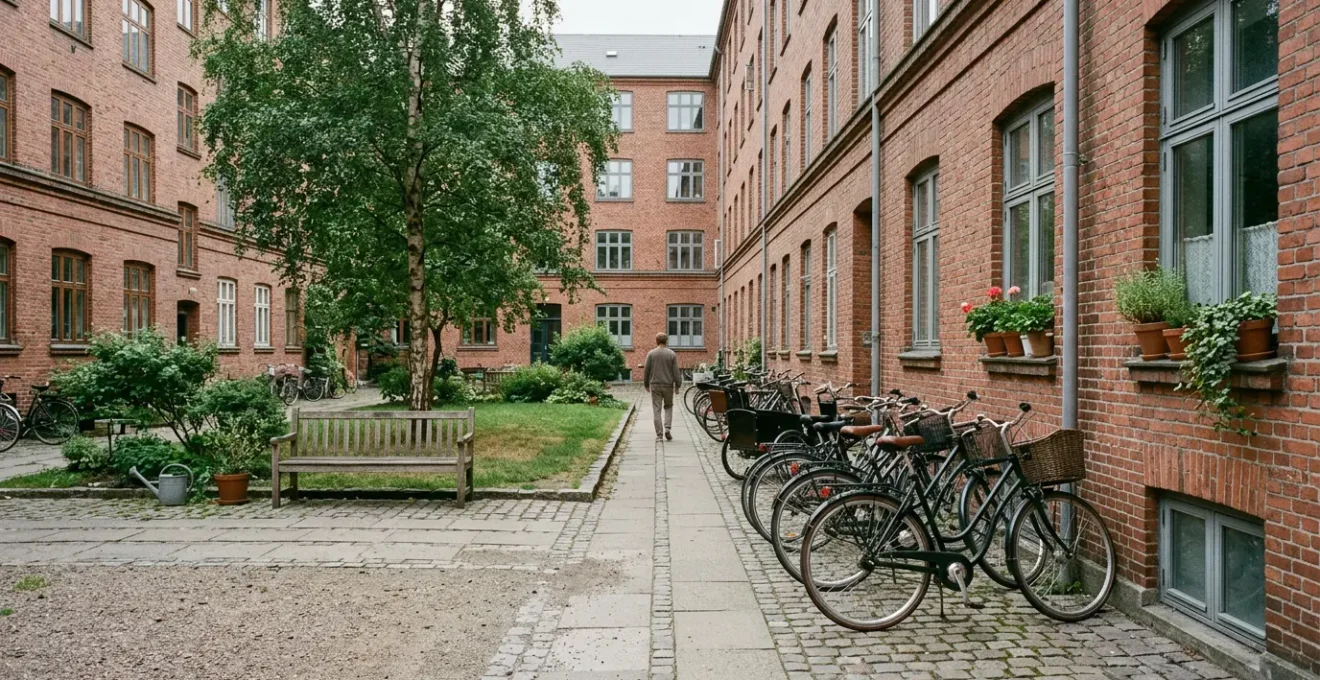
Living like a local in Denmark is less about what you do, and more about understanding the ‘why’ behind its unique social rules.
- Mastering cultural codes like ‘Jante Law’ and high-trust etiquette is more important than just learning the language.
- True integration happens through shared activities like ‘fællesspisning’ (community dinners) and ‘foreningsliv’ (club life).
Recommendation: Focus on participating in community-based systems rather than just observing from the outside.
You’ve seen the photos: impossibly stylish people on bicycles, cozy candlelit cafes, and a general sense of streamlined contentment. You’ve heard the word ‘hygge’ a thousand times. So, you decide to spend an extended period in Denmark, determined to do more than just see the sights. You want to feel it, to connect, to transition from a mere tourist to something more—a temporary local. But you quickly find that cycling and eating pastries only gets you so far. There’s an invisible barrier, a cultural code you can’t quite seem to crack.
Most travel advice focuses on the superficial: “rent a bike,” “visit a bakery,” “say ‘hej’.” While well-intentioned, this advice fails to address the fundamental mindset shift required to truly integrate. It’s like being given a few random keys without knowing which doors they open or why those doors are even locked. The real challenge isn’t learning a few words; it’s understanding the underlying social operating system that governs Danish interactions—a system built on pillars of high trust, communal responsibility, and profound subtlety.
But what if the key wasn’t to mimic Danish behavior, but to understand the psychological software running in the background? This guide is designed to be your manual for that software. We will move beyond the platitudes and explore the unwritten rules that dictate everything from how you say “thank you” to how you share your accomplishments. We will decode the silent language of public spaces and show you how to plug into the very heart of Danish community life. By the end, you won’t just be acting like a local; you’ll be thinking like one.
To help you navigate this cultural journey, this article breaks down the essential codes of Danish life. The following sections provide a structured path from understanding basic interactions to engaging in deep community life, turning your extended stay into a truly immersive experience.
Summary: A Practical Guide to the Danish Social Operating System
- Why Does Saying ‘Tak’ Instead of ‘Thanks’ Change Your Interactions?
- How to Navigate a Society Built on High Trust Without Being Naive?
- What is Fællesspisning and How Can Tourists Join a Community Dinner?
- The Unspoken Rule of Jante Law: How Not to Brag in Denmark
- Airbnb or Hotel: Which Neighborhood Offers the Most Authentic Daily Life?
- How to Crack the Code of Scandinavian Silence in Public Spaces?
- Sharepeeps and Facebook Groups: How to Borrow Tools from Neighbors?
- How to Feel the Real ‘Danish Spirit’ Beyond the Tourist Trail?
Why Does Saying ‘Tak’ Instead of ‘Thanks’ Change Your Interactions?
In many cultures, “thanks” is a simple pleasantry. In Denmark, ‘Tak’ is the entry point into a complex system of social reciprocity. Using the English word is polite, but using the Danish term signals you are attempting to engage with their social operating system. It’s a small gesture that communicates a much larger intent: you’re not just a passive visitor, but an active participant trying to understand their world. This simple switch can subtly shift the dynamic of an interaction from transactional to relational, opening doors to more genuine connection.
The power of ‘Tak’ extends far beyond a single word. It’s a key that unlocks a whole suite of phrases acknowledging shared time and experience. Mastering phrases like ‘Tak for mad’ (thanks for the meal) or the crucial ‘Tak for sidst’ (thanks for the last time we met) demonstrates a deep cultural awareness. These aren’t just words; they are rituals that reinforce social bonds and acknowledge a shared history, no matter how brief. This understated acknowledgement is far more valued than loud, effusive gratitude. To a Dane, your quiet, timely ‘Tak for sidst’ is worth a dozen enthusiastic ‘Thank you so much!’s’.
This emphasis on subtlety is a core part of the Danish communication style. The goal is not to perform gratitude, but to genuinely acknowledge the other person. To embody this, pair your words with understated body language. The image below captures the essence of this reserved but respectful interaction style, where a simple nod holds more weight than a grand gesture.
As you can see, the connection is genuine but not performative. It’s about mutual respect, not emotional display. By adopting this nuanced approach—using the right words at the right time with the right level of reserve—you are no longer just speaking a word of Danish; you are speaking the language of Danish social connection itself. It’s the first and most fundamental step in cracking the cultural code.
How to Navigate a Society Built on High Trust Without Being Naive?
One of the first things you’ll notice in Denmark is the unattended baby carriages parked outside cafes or the roadside stalls with produce and a cash box, completely unsupervised. This isn’t carelessness; it’s the physical manifestation of Denmark’s greatest asset: an incredibly high level of social trust. It’s a society that operates on the default assumption that people are honest and will do the right thing. In fact, research shows that an astonishing 78% of the Danish population generally trust most people. For an outsider, this can be both liberating and disorienting.
Navigating this high-trust infrastructure means recalibrating your own instincts. In many parts of the world, we are conditioned to be wary, to double-check, and to protect ourselves from being taken advantage of. In Denmark, such behavior can be misinterpreted as suspicion or, worse, an accusation. The key is to participate in the system of trust. This means leaving your laptop on the table when you go to the counter, paying for goods without explicit oversight, and engaging with strangers with an open, non-defensive posture. It’s about consciously choosing to believe in the goodwill of others until proven otherwise, which is the complete opposite of how many of us are taught to navigate urban environments.
This trust isn’t just analog; it’s deeply embedded in the country’s digital fabric. The widespread adoption of apps like MobilePay provides a perfect modern example of this principle in action.
Case Study: MobilePay as a Digital Pillar of Trust
MobilePay is more than a payment app; it’s a cornerstone of Denmark’s modern high-trust system. Used by a significant portion of the population for everything from peer-to-peer transfers to buying second-hand goods from strangers, it digitizes societal trust. According to a report on payment methods, over 70% of Danish merchants accept MobilePay, and it’s ubiquitous among younger demographics. People often send money for items on Facebook Marketplace before even receiving them, operating on the societal assumption of honesty. This digital ecosystem allows for seamless, near-frictionless transactions between strangers, demonstrating how a deeply ingrained cultural value enables modern technological and economic efficiency with minimal fraud.
To thrive as a temporary local, you must learn to lean into this trust. This doesn’t mean being naive or careless with your safety. It means understanding that the social contract is different here. Your participation is not just for convenience; it is a signal that you understand and respect the foundational value that makes Danish society function so smoothly. It’s an active choice to be part of the solution, not the exception.
What is Fællesspisning and How Can Tourists Join a Community Dinner?
If ‘trust’ is the invisible software of Danish society, then ‘fællesskab’—a concept of community and social unity—is its most cherished application. One of the purest expressions of this value is ‘fællesspisning’, or community dining. These are not restaurant experiences; they are low-cost, communal meals held in community centers, cultural houses, or even old warehouses, where strangers and neighbors gather to share simple, wholesome food at long tables. For a traveler looking to break through the tourist bubble, attending a fællesspisning is one of the most direct ways to plug into authentic local life.
The experience is a powerful lesson in Danish values. The atmosphere is egalitarian; everyone from students to families to pensioners eats the same meal together. There’s an expectation of self-service and shared responsibility—you’ll likely fetch your own plate and clear it afterwards. It’s a pragmatic solution to urban loneliness and a way to foster connection in a culture that can otherwise seem reserved. The purpose isn’t gourmet food, but the simple, powerful act of sharing a table with your community. This is where the reserved Dane you saw on the bus might open up in a relaxed, communal setting.
Finding and joining one is easier than you might think, as it’s an established part of urban life, particularly in cities like Copenhagen. You just need to know what to look for and what to expect. A great starting point is to search online for ‘folkekøkken’ (people’s kitchen) or ‘fællesspisning’ in the neighborhood you’re staying in. Flagship venues like Absalon in Copenhagen’s Vesterbro district are famous for their massive, welcoming community dinners. The key is to arrive with the right mindset: you are not a customer to be served, but a temporary member of a community coming together for a meal. Engage in light conversation, be prepared to share your space, and embrace the beautifully simple, functional collectivism of it all.
This isn’t just about getting a cheap meal; it’s about participating in a ritual that reinforces core Danish ideals. By showing up, you’re not just an observer of ‘fællesskab’—you’re actively helping to create it. It is an authentic, lived experience that no museum or guided tour can ever replicate.
The Unspoken Rule of Jante Law: How Not to Brag in Denmark
As you begin to integrate, you might notice something peculiar in conversations: Danes rarely boast. Achievements are downplayed, success is attributed to the team, and individual excellence is seldom highlighted. This isn’t false modesty; it’s the cultural influence of an unspoken social code known as ‘Janteloven’, or the Law of Jante. While its grip has loosened with modern generations, its ghost still profoundly shapes social interactions. Understanding Jante Law is crucial for avoiding social missteps and for decoding the Danish approach to success and individuality.
The concept originates from a 1933 novel by Aksel Sandemose, but it perfectly captured a pre-existing Nordic sentiment of egalitarianism. It’s a social code that prioritizes the collective over the individual. As Sandemose famously articulated it:
You are not to think you’re anyone special, or that you’re better than us.
– Aksel Sandemose, Law of Jante from the novel ‘A Fugitive Crosses His Tracks’
For someone from a more individualistic culture, this can be a minefield. Talking enthusiastically about your promotion, your expensive purchase, or your child’s achievements can be perceived as arrogant bragging. The Danish way is to use ironic understatement or self-deprecating humor. Instead of saying “I got the top score,” a Dane might say, “I managed not to fail completely.” The key is to reframe your language from “I” to “we,” share stories about shared experiences, and avoid any statement that creates a social hierarchy. It’s a delicate dance of communicating your value without explicitly stating it.
The visual of a communal table, as shown above, perfectly symbolizes this. Everyone has a place, no one seat is more important than another, and the focus is on the collective conversation. Navigating Jante Law isn’t about hiding your accomplishments; it’s about presenting them in a way that reinforces group harmony rather than individual superiority. It’s a complex but essential piece of the cultural code-cracking process.
Airbnb or Hotel: Which Neighborhood Offers the Most Authentic Daily Life?
Where you sleep has a profound impact on your ability to transition from tourist to temporary local. A hotel, no matter how nice, insulates you. It places you firmly in the role of a visitor being served. An Airbnb or apartment rental, on the other hand, offers the potential for genuine immersion—but only if you choose wisely. The question isn’t just about Airbnb versus a hotel, but about which type of neighborhood and building will plug you into the rhythm of authentic daily life rather than a curated tourist experience.
Your goal should be to find a place in a residential neighborhood where you can observe and participate in the daily routines of locals. This means looking beyond the hyper-touristy Indre By (city center) of Copenhagen. As a comparative guide from the official tourism board itself shows, different neighborhoods offer vastly different levels of authenticity.
| Neighborhood | Character | Best For | Local Experience Factor |
|---|---|---|---|
| Nørrebro | Multicultural, vibrant, working-class heritage | Food diversity, street culture, authentic bars | High – most culturally diverse area |
| Vesterbro | Former red-light district, now trendy and family-friendly | Nightlife, hip cafés, creative scene | High – mix of gritty and cool |
| Amager (including Islands Brygge) | Beach-suburb vibe, liveability, water life | Outdoor swimming, lower tourist-to-local ratio | Very high – off-beaten path |
| Østerbro | Quiet, family-friendly, green spaces | Residential calm, parks, authentic daily routines | Moderate – affluent but genuine |
| Indre By (City Center) | Historic, touristy, commercial | Sightseeing, shopping, hotel access | Low – heavy tourist presence |
Choosing a neighborhood like Nørrebro or Vesterbro is a good first step, but the real secret lies in the specifics of the accommodation. You need to become a detective, looking for signs of real life. Does the listing mention it’s an ‘andelsbolig’ (housing co-op)? This is a great sign, as it often means access to shared courtyards (‘gård’) and laundry rooms (‘vaskekælder’), both prime locations for passive, low-stakes interactions with residents. Is the apartment above a local bakery or a noisy tourist bar? The answer tells you everything about the building’s place in the community. To truly find an authentic spot, you need a clear plan of what to look for.
Your Action Plan: The Daily Life Litmus Test for Accommodation
- Prioritize ‘andelsbolig’ (housing co-op) listings to access shared courtyards (‘gård’), laundry rooms (‘vaskekælder’), and resident interactions.
- Check the immediate surroundings: is the listing above a noisy bar or a quiet local bakery? The latter signals residential integration.
- Verify access to a shared green space or courtyard where you can observe how locals gather and interact.
- Analyze kitchen photos for signs of actual daily use—worn cutting boards, local brands, real cooking tools—rather than sterile, staged aesthetics.
- Consider a week in a smaller city like Aarhus or Odense, where the tourist-to-local ratio is inherently lower and daily life is more visible.
How to Crack the Code of Scandinavian Silence in Public Spaces?
You step onto a bus or a metro train in Copenhagen, and an almost reverent silence greets you. Everyone is in their own world, reading, listening to music, or simply staring out the window. There’s no loud chatter, no phone conversations. To an outsider, this can feel cold or even unwelcoming. But this silence isn’t anti-social; it’s a deeply ingrained cultural norm rooted in a respect for public space and personal boundaries. Cracking this code requires understanding the concept of situational social energy.
Danish social life operates within what can be described as ‘designated social zones’. The function of a space dictates the acceptable level of social interaction. Public transport is a space for transit, not for socializing. The silence is a form of collective respect for everyone’s right to a peaceful, non-intrusive journey. It’s a shared agreement to protect the public sphere from personal noise. Trying to strike up a conversation with a stranger on the S-train is therefore not just a neutral act; it’s a violation of this unspoken social contract.
However, this reserved public demeanor is only one side of the coin. The same Dane who sat in complete silence on the metro can become animated, loud, and incredibly social in a different context. This is the ‘designated social zone’ theory in practice.
The ‘Designated Social Zones’ Framework
Danish public behavior follows a clear contextual framework. Spaces like buses, trains, and libraries are designated for quiet, individual activity. Here, social energy is low, and respect for personal space is paramount. In contrast, spaces like cafes, bars, parks on a sunny day, or Friday afternoon work gatherings (‘fyraften’) are designated social zones. In these contexts, conversation is not only accepted but expected. This explains the apparent paradox of Danish behavior: the culture isn’t inherently quiet, it’s situationally appropriate. The energy level of the space dictates the energy level of the people within it, which is why a national football match or a music festival can be an incredibly loud and collective experience.
As a temporary local, your task is to learn to read the room—or the train car. Instead of interpreting the silence as rejection, see it as a form of civic grace. Then, when you find yourself in a designated social space like a ‘bodega’ (a traditional Danish pub) or a park, you’ll be better prepared to engage with the more open and expressive side of the Danish spirit. It’s not about being quiet; it’s about being quiet at the right time.
Sharepeeps and Facebook Groups: How to Borrow Tools from Neighbors?
In a high-trust society with a strong emphasis on community and sustainability, the concept of a sharing economy is not a trendy startup idea; it’s a way of life. For a temporary resident, tapping into this network is a powerful way to integrate. It’s not just about saving money or getting access to a drill; it’s about participating in the local ecosystem of mutual support. Digital platforms, especially hyper-local Facebook groups, are the modern-day village square where this happens.
However, simply joining a neighborhood group for ‘2200 Nørrebro’ and immediately posting “Can I borrow a blender?” is the wrong approach. It positions you as an extractive outsider. The key is to first build a small amount of social capital. As a coach, I advise my clients to practice what I call ‘digital ethnography’: join a group and spend a week just observing. Learn the local in-jokes, understand the common complaints (usually about mis-parked bikes or noisy neighbors), and get a feel for the communication style. This silent observation is an act of respect.
Your first post should be an offer, not a request. Something simple like, “Hi everyone, I’m new to the neighborhood for a few months. If anyone needs a dog-walker or someone to water their plants while they’re away, I’d be happy to help!” instantly reframes your position from a taker to a potential giver. This gesture aligns with the Danish value of contributing to the community (‘fællesskab’). Once you’ve established this baseline of goodwill, a future request to borrow a tool is far more likely to be met with warmth and a genuine desire to help.
Beyond general neighborhood groups, you should seek out ‘byttegrupper’ (swapping groups) and ‘genbrug’ (second-hand) pages. These are central to the Danish mindset of sustainability and reuse. Participating in this circular economy is another powerful signal that you understand and respect local values. Platforms like ‘Nabohjælp’ (Neighbor Help) also provide insights into community safety and cooperation. By strategically engaging with these digital communities, you move beyond being a resident and become a neighbor.
Key Takeaways
- True integration comes from understanding the ‘why’ behind Danish social codes like trust and egalitarianism, not just mimicking behaviors.
- Participating in shared community activities like ‘fællesspisning’ (community dinners) and ‘foreningsliv’ (club life) is the most direct path to local connection.
- Success in social interactions depends on mastering subtlety, from understated gratitude to navigating the unspoken rules of ‘Jante Law’.
How to Feel the Real ‘Danish Spirit’ Beyond the Tourist Trail?
You’ve navigated the trust-based society, you’ve attended a community dinner, and you’ve learned not to brag. You are well on your way. But to feel the true pulse of the ‘Danish spirit’, you need to access the very core of its social structure: ‘foreningsliv’. This translates to “association life” or “club life,” and it is the engine of Danish civil society. From sports clubs and political groups to board game cafes and choirs, Danes organize their social lives around these shared-interest associations. And according to research from the Danish Centre for Social Research, Denmark has a very high level of volunteer work, which is the bedrock of this association life.
For a temporary local, ‘foreningsliv’ is the ultimate key to integration. Unlike a one-off pub conversation, joining a club or association provides structured, repeated interactions with the same group of locals over time. This is how friendships are formed in Denmark. Joining a ‘løbeklub’ (running club) for a few weeks, taking a short-term ceramics class, or finding a board game cafe with public game nights moves you from a transient visitor to a temporary teammate. You are no longer an outsider looking in; you are an insider with a role to play.
Volunteering is another powerful access point. Major events like the Copenhagen Jazz Festival or smaller neighborhood street parties are heavily reliant on volunteers. Working a few shifts at a bar or helping with setup provides you with an instant ‘team’ of local contacts and a shared sense of purpose. It bypasses the initial social reserve because you are all working towards a common goal. This is ‘fællesskab’ in its most active and rewarding form.
Finally, understanding the Danish spirit means recognizing its seasonal duality. The winter spirit is about ‘hygge’—seeking coziness, intimacy, and warmth indoors in small groups, often in ‘bodegas’ or at home. The summer spirit is the opposite: an explosion of life outdoors. The city moves to its parks, harbor baths, and street-side tables. To truly understand the culture, you must experience both modes. Seek out the quiet, candlelit ‘hygge’ in January, and join the joyful, collective rush to the water in July. This seasonal rhythm is the heartbeat of the nation.
Your journey from visitor to temporary local begins not with a grand gesture, but with the first small step into a shared space, a conscious decision to participate rather than just observe. Start today by seeking out one of these opportunities for connection.