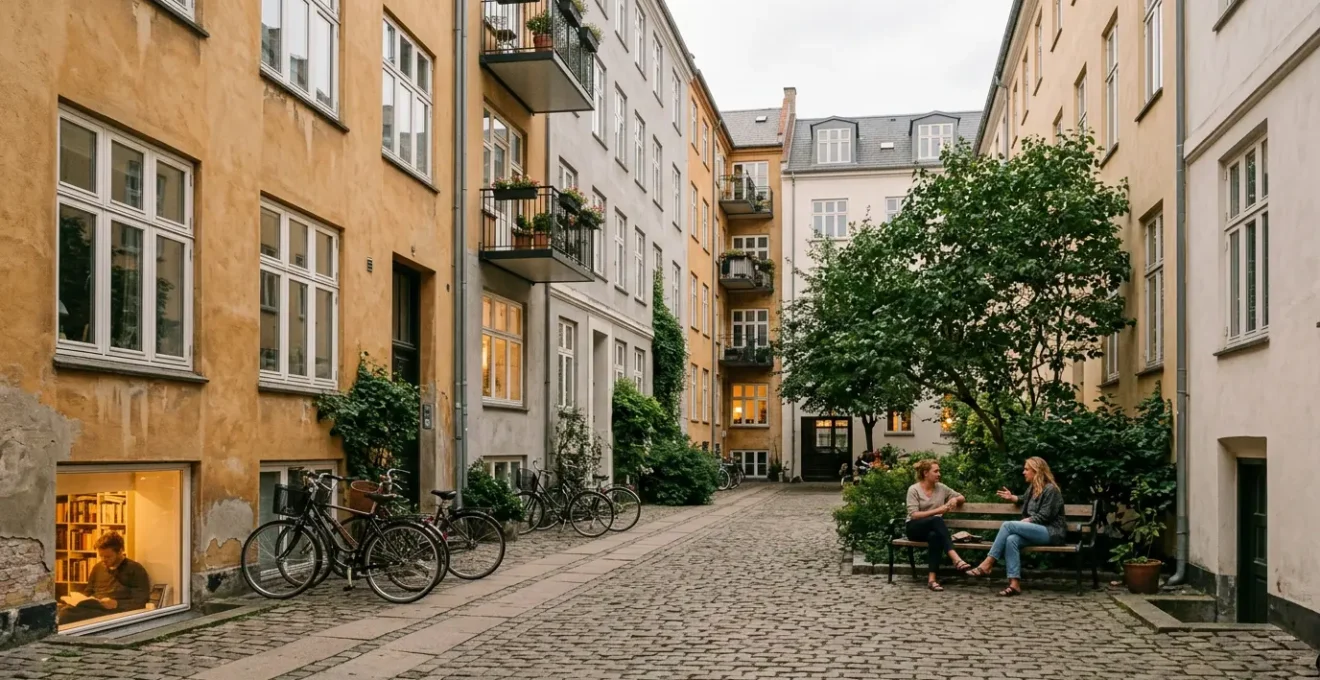
The real “Danish spirit” isn’t found in pastries or design shops; it is the observable result of a deeply ingrained social operating system.
- It’s a system built on an exceptionally high level of social trust, which manifests as visible freedom and safety in daily life.
- It redefines work-life balance not as a personal goal but as a collective social contract, prioritizing community over corporate presenteeism.
Recommendation: To truly connect with Danish culture, shift your focus from replicating commercial clichés (like buying candles for ‘hygge’) to observing the invisible infrastructure of trust, consensus, and social norms that govern daily interactions.
For the sociology-minded traveler, Denmark presents a fascinating paradox. You see the evidence of a well-functioning society everywhere: the serene cyclists, the impossibly chic design, the constant appearance on “world’s happiest countries” lists. Yet, it’s easy to feel like you’re observing it all from behind a pane of glass. You can buy the cinnamon roll, the designer chair, and the cozy blanket, but the authentic ‘Danish spirit’—that intangible atmosphere of contentment and community—remains elusive.
Most travel guides suggest the key lies in mastering *hygge*, often reduced to a simplistic checklist of candles, coffee, and comfort. While pleasant, this commercialized version barely scratches the surface. It misses the complex social machinery working silently in the background. The truth is, the Danish spirit is not a product to be consumed. It’s the output of a sophisticated and deeply ingrained social operating system, a set of unwritten rules and shared assumptions that govern everything from office hours to social interactions.
To truly understand Denmark, one must move beyond the role of a tourist and adopt the mindset of a cultural anthropologist. The goal is not to *imitate* Danish life, but to *decode* it. This is not a guide to the best sights, but an ethnographic map to the national psyche. We will dissect the observable phenomena of Danish life—the early office exodus, the pervasive irony, the unlocked bicycles—to reveal the underlying principles of trust, social consensus, and engineered contentment that truly define the Danish art of living.
This analysis will deconstruct the core components of this social operating system, offering a framework for observing and understanding the authentic Danish experience. The following sections will guide you through the key pillars that shape daily life and social interaction in Denmark.
Summary: Decoding the Danish Social Operating system
- Why Do Danes Leave the Office at 4 PM and How Does It Affect Service?
- Irony and Sarcasm: Why Did the Local Just Make Fun of You?
- Bicycles and Unlocked Doors: What Does Freedom Look Like in Daily Life?
- Fredagsbar: Can Tourists Crash Friday Office Drinks at Public Venues?
- Are Danes Actually Happy or Just Content with Low Expectations?
- How Does Urban Design Influence the ‘Danish Art of Living’?
- How to Navigate a Society Built on High Trust Without Being Naive?
- How to Experience Genuine Hygge and Not Just Buy Candles?
Why Do Danes Leave the Office at 4 PM and How Does It Affect Service?
The sight of offices emptying at 4 PM sharp is often one of the first cultural shocks for visitors to Denmark. This is not a sign of laziness, but a powerful and visible manifestation of the Danish social contract. Work is a part of life, but it is not life itself. The standard workweek is structured to allow for a rich existence outside of the office—time for family, for community engagement, for personal pursuits. This collective rhythm is a cornerstone of the national work-life balance.
According to Denmark’s official data on the subject, most employees work a standard 37-hour week and leave around 4 PM. This isn’t just a habit; it’s a deeply ingrained cultural expectation. Staying late is often viewed not as a sign of dedication, but of poor time management or an inefficient workflow. This philosophy prioritizes results and efficiency during work hours to protect the sanctity of personal time.
As the official government portal on Danish life notes, this structure is fundamental to family and social life:
Staying extra hours is discouraged, and most employees leave at around 4pm to pick up their children and begin preparing the evening meal.
– Denmark.dk, Official Danish Government Portal on Work-Life Balance
For the traveler, this has a practical impact. Service-oriented businesses, from shops to public offices, operate within this framework. Expecting late-night service or round-the-clock availability is a misunderstanding of the local system. The efficiency of Danish society is built on this shared schedule. The ‘service’ is not just the transaction, but the societal benefit of a well-rested, socially engaged populace. The trade-off for limited opening hours is a more stable, less stressed social fabric.
Irony and Sarcasm: Why Did the Local Just Make Fun of You?
A conversation with a Dane can be a bewildering experience for the uninitiated. A deadpan compliment that feels like an insult, a self-deprecating comment that seems to invite pity but receives none—this is the landscape of Danish irony. It is not a sign of hostility; it is a highly sophisticated tool for social leveling and building connection. In a culture deeply suspicious of hierarchy and self-aggrandizement, irony functions as a way to test social boundaries and affirm shared, unspoken norms.
To praise someone or oneself too earnestly is considered poor form. Instead, Danes often use understatement or gentle mockery to convey affection or respect. If a Dane makes fun of your new jacket by calling it “terribly fancy,” it may very well be a compliment. The ability to receive and return this gentle ribbing without taking offense is a key marker of social integration. It shows you understand the implicit rule: no one is better than anyone else, and we are all in this together.
This communication style is the verbal equivalent of Janteloven (the Law of Jante), a set of unspoken rules that discourages individual success and ambition at the expense of the collective. While often criticized, it is also the glue that fosters a sense of equality and community. Engaging in irony is an act of trust; it assumes the other person is intelligent enough to understand the subtext and secure enough not to be offended. It’s a complex social dance where the real meaning lies between the lines.
Bicycles and Unlocked Doors: What Does Freedom Look Like in Daily Life?
The image of streets lined with untied bicycles or strollers left unattended outside cafés is perhaps the most potent symbol of the Danish social operating system. This is not naivety; it is the physical manifestation of an exceptionally high-trust society. This trust is the invisible infrastructure upon which Danish daily life is built, creating a palpable sense of freedom and security that is rare in the modern world.
This isn’t just an anecdotal observation. It’s backed by extensive social science research. A study from a leading Danish university highlights this extraordinary social capital, finding that an astonishing 78% of Danes trust people they have no previous acquaintance with. This fundamental belief in the goodwill of others is the default setting, and it dramatically reduces the friction of daily life. People assume you will follow the rules, pay your way, and act with integrity, because that is the collective norm.
This trust permeates all levels of society, from the highest institutions down to the smallest neighborhood interactions. It’s a self-reinforcing loop: because the systems (legal, social, political) are perceived as fair and reliable, people feel safe trusting both the systems and each other.
Walking in the Danish streets, one usually sees untied bicycles in front of homes. Most of the time, people using means of transportation do not need to show their booked trip tickets; rarely would anybody attempt to get a free ride.
– International Student Blog, Aarhus University Denmark’s Greatest Asset: The Social Capital
For the traveler, this environment can feel liberating. This freedom, however, comes with an implicit responsibility to uphold that trust. The system works because everyone contributes to it. Cutting in line, haggling aggressively, or trying to “get away with” something is not just a personal transgression; it’s a violation of the foundational social contract.
Fredagsbar: Can Tourists Crash Friday Office Drinks at Public Venues?
The concept of *Fredagsbar* (Friday bar) is a quintessential Danish social ritual, yet it operates in a gray area that can be confusing for outsiders. These are not commercial bars, but informal, often-impromptu gatherings held within workplaces, university departments, or cultural institutions to mark the end of the week. The question of whether a tourist can “crash” one is a matter of context and social intelligence.
The first rule is to understand the venue. A *Fredagsbar* held in the lobby of a large, public-facing institution like a university library or a design center is semi-public. Here, an outsider might be able to blend in, buy a beer, and observe. The key is to be discreet, respectful, and not to treat it as a tourist attraction. The goal is quiet observation, not active participation unless invited. You are a guest in someone else’s ‘work living room’.
Conversely, a *Fredagsbar* in a private architecture firm or a small tech startup is a closed event. It’s an internal social function, akin to a private office party. Attempting to join would be an awkward and unwelcome intrusion. The Danish social code, while informal, is very clear about the distinction between public and private spheres. These events are crucial for internal team bonding and rely on a shared history and context that a tourist simply does not have.
The best approach for a curious traveler is to look for *Fredagsbars* hosted by universities or student organizations, as these are often the most open and accustomed to an international crowd. Even then, the correct etiquette is not to “crash” but to enter quietly, buy a drink, find a corner, and observe the social dynamics. It’s a fantastic ethnographic opportunity to see Danes in their relaxed, post-work state, but it requires the delicate touch of an anthropologist, not the entitlement of a consumer.
Are Danes Actually Happy or Just Content with Low Expectations?
Denmark’s consistent high ranking in global happiness surveys is a core part of its international image. However, the word “happy” can be misleading. The Danish concept of happiness, or *lykke*, is less about euphoric joy and more about a deep, quiet contentment. It is an “engineered contentment,” a societal condition fostered by a system designed to minimize stress and maximize security.
While the latest World Happiness Report data reveals Denmark scoring an impressive 7.583 out of 10, ranking it second globally, the cultural interpretation of this score is nuanced. It’s not that Danes are constantly smiling; it’s that the foundational anxieties that plague many other societies—fear of unemployment, catastrophic healthcare bills, or personal ruin—are largely absent. The robust social safety net acts as a societal pressure valve, allowing people to pursue life with a baseline of security.
This perspective suggests that Danish happiness is not about having high expectations and meeting them, but about having realistic expectations and a society structured to reliably fulfill them. It is the quiet confidence that things will be okay. This is not a lack of ambition, but a redefinition of what a successful life looks like: one with less worry and more stability.
This focus on contentment over elation is a fundamental aspect of the national psyche. It is a pragmatic, sustainable form of well-being. It is the peace of mind that comes from knowing the system works for the collective good, which in turn frees up mental and emotional energy for personal and community life. The “happiness” is the absence of deep-seated worry.
How Does Urban Design Influence the ‘Danish Art of Living’?
In Denmark, particularly in cities like Copenhagen, urban design is not merely about aesthetics or efficiency; it is an active instrument of social policy. The streets, squares, and public spaces are meticulously planned to foster the very pillars of the Danish spirit: trust, community, equality, and well-being. The city itself is the physical hardware for the nation’s social operating system.
The most famous example is the cycling infrastructure. It’s more than just a green transportation method; it’s a profound statement of egalitarianism. The bicycle is the great equalizer—students, CEOs, and politicians all share the same paths. It promotes public health, reduces stress, and creates chance encounters that strengthen the community fabric. The sheer scale is staggering; as Copenhagen’s official cycling statistics show, 45% of all trips to work and study are made by bike, facilitated by nearly 400 km of dedicated paths.
This philosophy extends beyond bike lanes. Danish urbanism emphasizes “human-scale” design. Buildings are often limited in height to ensure sunlight reaches the street level. Public squares are furnished with thoughtfully designed benches angled to encourage conversation, not just solitary rest. The prevalence of large windows and the cultural norm of not covering them with heavy curtains create a sense of transparency and connection between private and public life. It’s a city designed for people, not cars; for interaction, not isolation.
Observing how Danes use their public spaces is to watch the art of living in action. The city is not just a backdrop; it is an active participant in creating a society that is healthier, more connected, and fundamentally more content. The design choices are a constant, physical reinforcement of the nation’s core social values.
How to Navigate a Society Built on High Trust Without Being Naive?
The high-trust nature of Danish society is its greatest asset, but navigating it as an outsider requires understanding its unwritten rules. It’s not about blind trust in every individual, but about trusting a highly reliable system and the shared civic-mindedness, known as ‘Samfundssind’, that underpins it. The trust is placed in the integrity of the collective and its institutions. Being naive would be to ignore this distinction and assume every person is infallible; being savvy is to understand and operate within the established, trustworthy systems.
This means trusting that the digital identity system (MitID) is secure, that the tax authority is fair, and that public services will be delivered as promised. It means assuming the person on the bus has paid their fare, not because you’ve seen them do it, but because the social cost and consequences of not doing so are commonly understood and respected. It is a system built on transparency and accountability, where deviations from the norm are easily spotted.
While Danes have immense faith in their public institutions and social contracts, they are not fools. For private, unregulated transactions—like finding a room to rent on a social media marketplace—they exercise the same caution as anyone else. The key is to differentiate between system-based trust and interpersonal trust. The following framework can help you navigate this complex environment effectively.
Action plan: Navigating Danish trust systems
- Trust the System: Rely on the high reliability of official digital platforms, public services, and infrastructure. Assume they work as intended because they almost always do.
- Understand Institutional Faith: Recognize that Danes’ trust in the government, police, and healthcare is based on a history of low corruption and predictable, fair outcomes. Interact with these institutions accordingly.
- Use Caution in Private Deals: For unregulated transactions (e.g., buying a second-hand item online), apply standard global practices of verification. High social trust doesn’t eliminate private scams.
- Recognize the Social Contract: Be aware that high trust is maintained by ‘Samfundssind’ (civic-mindedness) and invisible social pressure. Adhering to small rules (like waiting for the green light to cross an empty street) signals you respect this contract.
- Appreciate Verifiable Trust: Notice how many informal transactions are backed by digital records. Using a service like MobilePay for a small payment creates an instant, verifiable digital trail, reinforcing accountability without bureaucracy.
Key takeaways
- Work-Life Balance as a Pillar: The 4 PM exodus isn’t a perk; it’s a foundational element of the Danish social contract that prioritizes community and family life, strengthening the entire social fabric.
- Trust as Infrastructure: The palpable safety and freedom in Danish society are direct results of an exceptionally high-trust environment, a form of invisible infrastructure built on reliable institutions and shared civic duty.
- Hygge as a Social Outcome: Genuine hygge is not a consumer product but a social experience—the creation of a safe, intimate, high-trust space with a close circle, born from a collective need for connection.
How to Experience Genuine Hygge and Not Just Buy Candles?
In the global consciousness, *hygge* has been commodified into an aesthetic of chunky knits, warm lighting, and artisanal ceramics. But to a Dane, this is like describing a gourmet meal by listing its ingredients. Genuine *hygge* is not an aesthetic; it is a feeling. It is the specific emotional state of effortless intimacy and psychological safety experienced within a small, trusted group. It is the reward, not the process.
The candles and blankets are not *hygge* itself; they are merely tools used to help create the desired atmosphere. The true essence of *hygge* is social. It is about letting your guard down, removing the formalities and performance of public life, and enjoying a moment of simple, unpretentious connection with people you trust. It is the opposite of networking. There is no agenda, no goal beyond the shared pleasure of the present moment.
This is why it is so difficult for a tourist to “experience” authentic *hygge*. It cannot be scheduled or purchased. It arises spontaneously from established relationships built on the same high-trust principles that govern the rest of Danish society. It’s the feeling of being with friends or family where conversation can flow or fall silent without any awkwardness. It is the social embodiment of “a life without so much worry or stress.”
Therefore, the way for a traveler to get closer to *hygge* is not to buy more things, but to create small moments of quiet connection. It could be sharing a simple home-cooked meal with a host, having a long, uninterrupted conversation without phones, or simply enjoying a quiet moment of reflection in a beautiful, calm public space. It’s about shifting the focus from consumption to connection, and from performance to presence.
The next time you are in Denmark, shift your perspective from that of a tourist to that of an ethnographer. Observe these social mechanics at play—in the rhythm of the workday, the subtext of conversations, and the design of the city itself. It is by understanding this underlying social operating system that you will experience a far deeper and more authentic version of the Danish spirit.