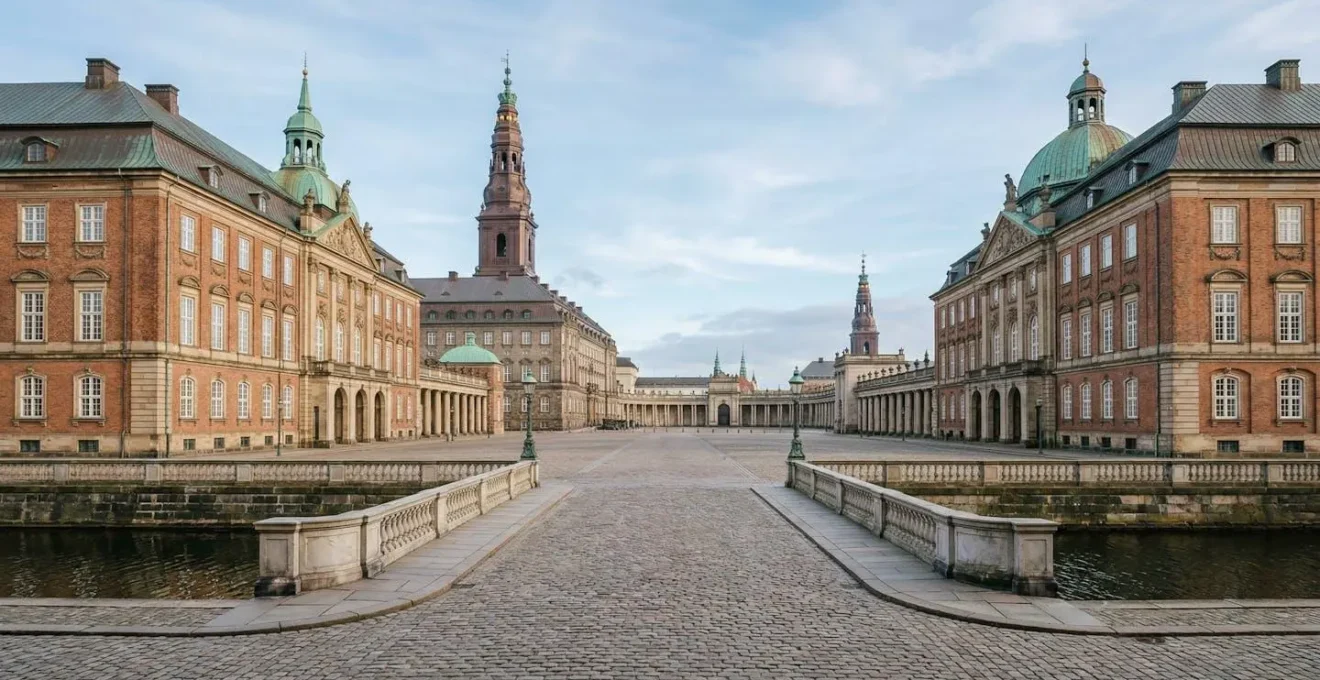
In summary:
- To understand the Danish monarchy’s evolution, visit Copenhagen’s palaces in chronological order: Rosenborg (Day 1), Christiansborg (Day 2), and Amalienborg (Day 3).
- This itinerary traces the shift from Christian IV’s absolute power, through the rise of parliamentary democracy, to the modern constitutional monarchy.
- Plan ahead for key events like the Changing of the Guard by knowing the route and best viewing spots away from the main crowds.
- Use a single ticket like the Royal Palace Pass to streamline access to the Amalienborg Museum, Rosenborg Castle, and Christiansborg Palace.
Copenhagen’s cobblestone streets whisper tales of kings, queens, and architectural ambition. For the history enthusiast, the city is a living museum, with each palace and tower holding a piece of the Danish Monarchy’s sprawling, thousand-year-old saga. Yet, faced with a constellation of royal sites, a common challenge arises: how does one connect these magnificent buildings into a coherent narrative? It’s easy to hop between Rosenborg, Amalienborg, and Christiansborg, ticking them off a list, but this approach often leaves one with a fragmented collection of beautiful rooms and impressive artifacts, missing the overarching story.
But what if these landmarks could tell a story of power, ambition, and transformation? What if the very order in which you visit them could unravel the evolution of a nation? This itinerary is designed not as a checklist, but as a chronological journey. We will follow the Danish monarchy from the peak of its absolute power, through the intricate dance with democracy, to its modern, accessible role in the 21st century. Instead of just seeing buildings, we will read them as chapters in a grand historical narrative, understanding why they were built, who lived within their walls, and what they symbolize today. This is your guide to walking through time, one royal landmark at a time.
To help you navigate this rich historical landscape, this guide is structured to follow the monarchy’s own timeline. The following sections offer a detailed plan, practical tips, and the historical context needed to transform your visit from a simple tour into a deep, narrative-driven exploration of Denmark’s royal past.
Summary: A Chronological Guide to Denmark’s Royal Legacy
- Why Did Christian IV Build So Many Towers Across Copenhagen?
- What Is the Best Order to Visit Rosenborg, Amalienborg, and Christiansborg?
- Queen Margrethe II vs. Crown Prince Frederik: Who Live Where?
- The Changing of the Guard: How to Get a Good View Without the Crush?
- The Crown Jewels: What Not to Miss in the Rosenborg Treasury Basement?
- How to Choose the Best Renaissance Castle Day Trip from Copenhagen?
- Which of the Four Amalienborg Palaces Can You Actually Enter?
- How to witness the Royal Life at Amalienborg Without Breaking Protocol?
Why Did Christian IV Build So Many Towers Across Copenhagen?
To walk through Copenhagen is to walk in the shadow of Christian IV (1588-1648), often called the “Builder King.” His reign was marked by an almost obsessive architectural ambition that reshaped the city’s skyline. This was not mere vanity; it was a calculated projection of power, wealth, and a vision to transform Copenhagen from a provincial town into a major European capital. His projects, from stock exchanges to entire new districts, were designed to bolster Denmark’s economy and military might. The numerous towers he erected were the most visible symbols of this new era of Danish prestige.
His architectural legacy, including the iconic Rosenborg Castle, was developed over decades. His reign saw a flurry of projects, with Rosenborg Castle’s construction unfolding in several clear stages between 1606 and 1634, creating the Dutch Renaissance masterpiece we see today. But his vision extended beyond royal pleasure. The famous Round Tower (Rundetårn) serves as a prime example of his forward-thinking mindset.
The Round Tower as Denmark’s Scientific Ambition
Christian IV’s ambition was not limited to military and commercial structures. He was a man of the Renaissance, fascinated by science and discovery. When the famed astronomer Tycho Brahe proposed building a new observatory, the King provided the funding. The result was the Round Tower, completed in 1642. At nearly 40 meters high, it was a marvel of engineering, but its true purpose was celestial. It became the oldest functioning observatory in Europe, used by the University of Copenhagen for over two centuries. This project demonstrates that Christian IV built towers not just to defend his kingdom or display his wealth, but to elevate its status in the worlds of science and knowledge.
Each tower, whether part of a castle, a church, or an observatory, was a statement. They signaled a departure from the medieval past and heralded Denmark’s arrival as a modern, sophisticated, and powerful European state, with Christian IV as its masterful architect.
What Is the Best Order to Visit Rosenborg, Amalienborg, and Christiansborg?
To truly grasp the narrative of the Danish monarchy, the order of your visits is paramount. Treating the three main palaces—Rosenborg, Christiansborg, and Amalienborg—as chapters in a book allows you to trace the dramatic shift from absolute monarchy to a modern, constitutional one. This chronological approach transforms a series of visits into a compelling story of power evolving over 400 years. The recommended sequence is not based on geography, but on history.
Start your journey where the absolute monarchs reigned in splendid isolation. Rosenborg Castle represents the world of Christian IV, a private pleasure palace that also houses the ultimate symbols of power.
As the visual above suggests, the basement of Rosenborg holds the dazzling Crown Jewels. By starting here, you begin with the undiluted power and personal wealth of the monarchy at its zenith. The following three-day plan provides a clear path through this history.
- Day 1: Rosenborg Castle (Early 1600s): Begin your journey at Rosenborg Castle to immerse yourself in the era of absolute monarchy. This was Christian IV’s private world. Explore his personal chambers and then descend into the treasury to witness the magnificent Crown Jewels. This first step establishes the baseline of supreme, unquestioned royal power.
- Day 2: Christiansborg Palace (Founded 1167, Current Palace 1928): On your second day, witness the great power shift. Christiansborg is the seat of the Danish Parliament (Folketinget), the Supreme Court, and the Prime Minister’s Office. While the monarch still uses the Royal Reception Rooms for official functions, the building physically embodies the sharing of power. Exploring its political heart alongside the royal rooms tells the story of Denmark’s transition to a constitutional democracy. Don’t miss the ruins beneath the palace, which date back 800 years.
- Day 3: Amalienborg Palace (1760s): Conclude your historical tour at the present-day residence of the monarch. Amalienborg is not a fortress or a secluded palace but four elegant Rococo mansions facing a public square. Its design and function represent the modern, public-facing monarchy. Witnessing the daily Changing of the Guard here brings the story into the living present, completing the journey from absolute ruler to head of state.
Queen Margrethe II vs. Crown Prince Frederik: Who Live Where?
A visit to Amalienborg Palace often sparks a simple question: with four identical palaces, who actually lives where? The answer reveals the practical and symbolic arrangement of the modern Danish royal family. Following her abdication in early 2024, Queen Margrethe II continues to reside in Christian IX’s Palace. This palace has a deep connection to the Glücksburg dynasty, as it became the residence of Christian IX in 1863. He was famously known as the “father-in-law of Europe” due to his children’s marriages into other major royal houses.
Meanwhile, the reigning monarch, King Frederik X, and his family reside in Frederik VIII’s Palace. This palace was their main residence even as Crown Prince and Princess following extensive restoration. This division of the palaces allows the former and current heads of state to maintain official residences within the same complex, ensuring both proximity and privacy. The other two palaces serve distinct functions: Christian VII’s Palace is used for official receptions and to host important guests, while Christian VIII’s Palace is open to the public as the Amalienborg Museum.
The Symbolic Geography of Amalienborg’s Four Palaces
The allocation of residences at Amalienborg is a living map of the royal lineage. Queen Margrethe II resides in Christian IX’s Palace, her ancestral home connecting her to the “father-in-law of Europe.” King Frederik X and Queen Mary live in Frederik VIII’s Palace, establishing it as the home of the current monarch’s family. This arrangement elegantly balances historical continuity with the needs of the modern family. The remaining two palaces, Christian VII’s (receptions) and Christian VIII’s (museum), are dedicated to public and state functions, reinforcing Amalienborg’s role as both a private home and a national symbol.
This residential arrangement is not static throughout the year. As with many European monarchies, the royal family follows a traditional seasonal pattern. King Frederik X often spends summers at Marselisborg Palace or Gråsten Palace, spring and autumn at Fredensborg Palace, and the winter months at their primary residence in Amalienborg.
The Changing of the Guard: How to Get a Good View Without the Crush?
The daily Changing of the Guard at Amalienborg is one of Copenhagen’s most iconic ceremonies, but its popularity can lead to dense crowds, especially during peak season. For a history enthusiast, witnessing this ritual is not just about the spectacle; it’s about observing a living tradition. Fortunately, with a bit of strategic planning, you can enjoy the experience without being caught in the crush of the main square. The key is to understand the guards’ full route.
The Royal Life Guard (Den Kongelige Livgarde) marches from their barracks at Rosenborg Castle to Amalienborg Palace every day, with the changeover happening at 12:00 PM. This 30-minute parade through the city offers several quieter opportunities to see them up close. By positioning yourself along the route, you can see the guards in their full regalia, often with a musical escort, in a much more relaxed setting.
Here are a few strategies for the best view:
- See the Departure (11:27 AM): The most effective way to avoid Amalienborg crowds is to see the parade begin. Position yourself near the barracks at 100 Gothersgade (adjacent to Rosenborg Castle) shortly before 11:30 AM to watch the guards depart.
- Catch them En Route: The guards march along a set path that includes streets like Rosenborggade, Købmagergade, and across the large square of Kongens Nytorv. These locations offer excellent, less-crowded vantage points to see the full procession.
- Strategic Placement at Amalienborg (11:45 AM): If you do want to witness the final ceremony at the palace, arrive 15-20 minutes early. Don’t just stand anywhere in the square. Look for the designated green viewing areas and secure a spot there, respecting the 1.5-meter distance from the palace walls.
- The Royal Presence Indicator: Pay attention to the flag. The type of ceremony depends on who is in residence. If the royal standard is flying above Frederik VIII’s Palace, it means the King is home. This signals a “King’s Watch,” the most elaborate ceremony, complete with the full Royal Guards music band.
The Crown Jewels: What Not to Miss in the Rosenborg Treasury Basement?
Descending into the treasury in the basement of Rosenborg Castle is like stepping into the very heart of the Danish monarchy’s power and history. The Crown Jewels are not merely decorative; they are functional regalia, still used by the monarch for significant events, and their story is intertwined with the nation’s own. While the entire collection is breathtaking, a few key pieces and their stories are essential for any history enthusiast.
The most important items are the four official sets of regalia: the crown of Christian IV, a masterpiece of Renaissance goldsmithing; the later and more famous crown of Christian V, which symbolizes the age of absolute monarchy; the scepter; the globus cruciger (the orb); and the sword of state. Look closely at the intricate enamel work and the sheer size of the gemstones, which were meant to project an image of immense wealth and divine right. Also unmissable is the Queen’s Crown and the stunning collection of emeralds, considered among the finest in the world.
Beyond their glitter, these jewels hold a powerful narrative of resilience. Their public display is a relatively recent phenomenon. It was only since 1922 that the crown jewels have been on permanent public display. This makes their survival even more remarkable, especially considering the turmoil of the 20th century. During the German invasion of Denmark in 1940, these priceless national symbols were secretly buried deep within the castle’s basement for safekeeping, a poignant chapter in their long history.
When you visit, don’t just look at the jewels. Consider their journey through time: from symbols of absolute power worn in lavish ceremonies to national treasures hidden from invaders, and finally, to carefully preserved artifacts that tell the story of a kingdom’s endurance. This context transforms them from precious objects into profound historical documents.
How to Choose the Best Renaissance Castle Day Trip from Copenhagen?
Once you’ve explored the royal heart of Copenhagen, a day trip to one of the magnificent castles in the surrounding Zealand region offers a deeper perspective on Danish history. Each castle has a distinct personality and tells a different part of the national story. Choosing the “best” one depends entirely on what fascinates you most: art history, military power, or the complete royal lineage.
Frederiksborg Castle is an art lover’s paradise, Kronborg Castle is a must for Shakespeare fans and military history buffs, and Roskilde Cathedral is the ultimate destination for those wishing to trace the royal family tree to its very roots. The travel times from Copenhagen are all quite manageable by train, making any of them a feasible and rewarding day trip. To help you decide, the following table compares the three main options.
This table, based on information from expert tour guides, provides a clear comparison to help you choose the day trip that best aligns with your historical interests. As a comparative analysis shows, each destination offers a unique window into Denmark’s past.
| Castle | Primary Focus | Best For | Travel Time | Key Highlight |
|---|---|---|---|---|
| Frederiksborg Castle | Museum of National History | Visual storytelling of Denmark through art, coats of arms, and tapestries | ~40 min by train | Chapel of the Orders & Great Hall |
| Kronborg Castle | Military fortress & Hamlet legend | Maritime trade history, Shakespeare enthusiasts, UNESCO site | ~45 min by train | Transformed Renaissance fortress captured by Sweden in 1658 |
| Roskilde Cathedral | Royal necropolis | Tracing the complete lineage from Viking kings to modern monarchs | ~30 min by train | Burial site of Danish royalty spanning 1000 years |
For a visual feast and a comprehensive lesson in Danish history through art, Frederiksborg is unparalleled. For a dramatic tale of military might and literary fame, Kronborg is the clear choice. And for the most direct and profound connection to the 1000-year lineage of Danish kings and queens, the hallowed halls of Roskilde Cathedral are where you need to go.
Which of the Four Amalienborg Palaces Can You Actually Enter?
While the Amalienborg complex serves as the primary residence of the Danish royal family, it is not an impenetrable fortress. One of its four identical Rococo palaces is open to the public, offering a fascinating glimpse into the lives of the monarchs who have lived there for the past 150 years. You can enter Christian VIII’s Palace, which has been converted into the Amalienborg Museum. This is your gateway to understanding the Glücksburg dynasty, which ascended to the Danish throne in 1863.
The museum’s exhibits are arranged to showcase the private chambers of previous kings and queens, meticulously preserved to reflect the style and daily life of their time. It provides a more intimate and personal counterpoint to the grand state rooms you might see elsewhere. An audio guide is highly recommended to enrich your tour through the royal halls. It’s fascinating to see the evolution of royal life, from the formal Victorian-era rooms to the more contemporary studies of later monarchs.
The origin of Amalienborg itself is a unique story in royal architecture. In the mid-18th century, the four palaces were built by four different noble families, who were granted tax immunity for their service to the crown. This project created what is now considered one of Europe’s great masterpieces of Rococo architecture. Only after a fire at Christiansborg Palace in 1794 did the royal family purchase the complex and make it their home.
Planning Your Visit to the Amalienborg Museum
The Amalienborg Museum in Christian VIII’s Palace offers several ticketing options. As per the official site, adult admission purchased online is 125 DKK. For history enthusiasts planning to follow this guide’s itinerary, the Royal Palace Pass is an excellent value at 345 DKK. This combined ticket grants admission to the Amalienborg Museum, Rosenborg Castle (including the Crown Jewels), and the Royal Reception Rooms at Christiansborg Palace, valid over three days. The museum also accepts the Copenhagen Card for free admission, making it an easy addition to a packed sightseeing schedule.
Key takeaways
- For a narrative experience, visit Copenhagen’s royal palaces chronologically: Rosenborg (absolute power), Christiansborg (shared power), and Amalienborg (modern monarchy).
- The daily Changing of the Guard is best viewed away from the Amalienborg square crowds, either at its 11:27 AM start near Rosenborg or along the parade route.
- A day trip is essential for deeper context: Frederiksborg for art history, Kronborg for military and literary history, and Roskilde Cathedral for the complete royal lineage.
How to witness the Royal Life at Amalienborg Without Breaking Protocol?
Witnessing royal life at Amalienborg is a unique experience, as it’s both a public square and a private home. Observing the proper etiquette ensures a respectful experience for you, the guards, and the royal residents. The protocol is mostly common sense, centered on maintaining a respectful distance and not interfering with official duties. The key is to remember that while it’s a tourist attraction, two of the palaces are functioning homes and offices.
The most visible aspect of protocol involves the Royal Life Guard. They are not ceremonial figures; they are active soldiers on duty. Approaching them, posing in their guard boxes, or obstructing their path is a serious breach of etiquette. The palace square has designated green viewing areas marked on maps, and visitors should remain within them. Photography is generally permitted, but it should never disrupt the flow of a ceremony or involve intrusive shots of the residential palace windows.
One of the most elegant parts of Amalienborg’s design is the equestrian statue of King Frederik V at its center. This statue is not just a decorative element; it’s a powerful symbol of 18th-century power dynamics. Reportedly, the statue by French artist Saly cost more to build than any one of the surrounding palaces. It symbolically faces the grand Marble Church, surrounded by the homes of the kingdom’s highest nobles, visually cementing the king’s central role. To ensure you respectfully enjoy your visit, follow this simple checklist.
Your Royal Etiquette Checklist at Amalienborg
- Maintain a minimum distance of 1.5 meters from all palace buildings. Never sit on the palace stairs.
- Position yourself only in the designated green viewing areas marked on the square map, especially during the Changing of the Guard.
- While photography is allowed, never obstruct the guards’ movements, disrupt the ceremony, or attempt to pose inside the red guard boxes.
- Identify which royals are in residence by observing the flags: the royal standard over Frederik VIII’s Palace for the King, or over Christian IX’s Palace for Queen Margrethe.
- Respect that two palaces are private homes. Avoid approaching entrances or taking unauthorized, close-up photos of residential windows.
Now, armed with this historical roadmap and an understanding of royal etiquette, you are ready to embark on your own journey through time. Step into Copenhagen’s streets and witness the story of a monarchy unfold before your very eyes.