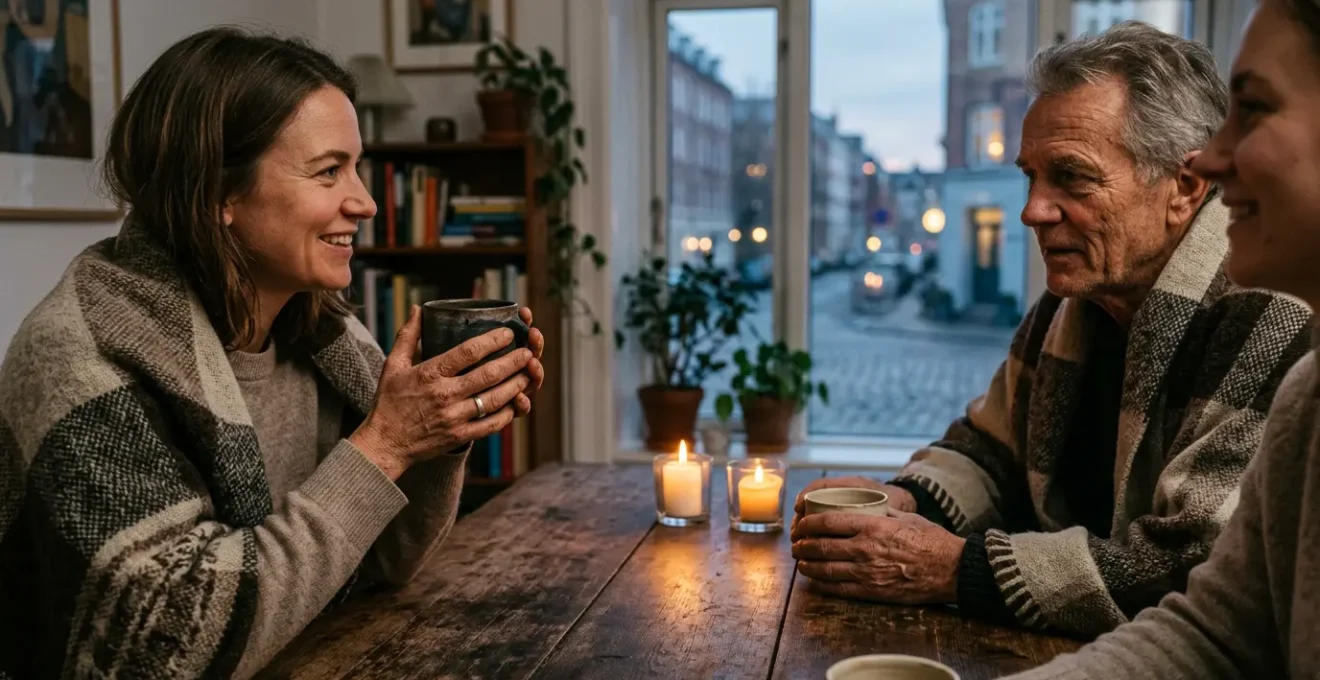
Contrary to commercial hype, true hygge isn’t about buying more candles or blankets. It’s a Danish social ritual you actively create with others through intentional presence and shared experiences. This guide dismantles the clichés and shows you how to find authentic coziness in summer bonfires, community game nights, and shared pastries—no tour bus required.
If you’ve walked into any lifestyle store in the past few years, you’ve been sold a version of hygge. It’s usually a scented candle, a chunky knit blanket, or a ceramic mug promising “the Danish art of coziness.” And while these things are lovely, they often leave you with a feeling that something is missing. You’ve bought the props, but the feeling remains elusive. This is the great misunderstanding of hygge: it has been marketed as a style to be purchased, when it is, in fact, a social ritual to be practiced.
The real currency of hygge isn’t money; it’s time and attention. It’s the conscious decision to create a warm, informal, and appreciative atmosphere with a handful of people you care about. It’s less about the perfect interior design and more about imperfect, heartfelt connection. The commercial version tells you to accumulate objects; the authentic Danish version teaches you to cultivate moments.
So, how do we bridge the gap between the hygge you can buy and the hygge you must feel? This article will guide you away from the consumer trap and toward the genuine article. We will explore how hygge thrives in the long days of summer, how to craft its atmosphere in your own home, where to find its spirit in Copenhagen, and why its deepest magic is unlocked not with a credit card, but with good company.
Summary: The Real Danish Guide to Finding Authentic Hygge
- Is Hygge Only for Winter or Can You Find It in July?
- Lighting and Textiles: How to Replicate the Danish Atmosphere at Home?
- Where to Find a Cafe with Board Games and Fireplaces in Copenhagen?
- The ‘Hygge Tour’ Trap: Why You Can’t Buy Atmosphere on a Bus?
- Why Is Hygge Best Experienced in Small Groups of Friends?
- Vienna Bread: Why Do Danes Call Danish Pastries ‘Viennese’?
- How to Reach Coastal Gems Using Only Public Transport?
- Sct. Peders Bageri or Meyers: Who Bakes the Ultimate Wednesday Snail?
Is Hygge Only for Winter or Can You Find It in July?
One of the biggest myths peddled by commercial hygge is that it’s a winter-exclusive phenomenon. The reality is that Danes don’t stop practicing the art of coziness just because the sun is out. Summer hygge is a vibrant and essential part of the culture, trading indoor candlelight for the golden glow of the midnight sun. It’s found in picnics in King’s Garden, shared beers by the harbour baths, and late-night chats in a courtyard illuminated by fairy lights. The principle remains the same: simple pleasures, good company, and a relaxed atmosphere.
Perhaps the most potent example is Sankt Hans Aften (Midsummer’s Eve). On this night, Danes gather at beaches and parks to light enormous bonfires. It’s a powerful social ritual celebrating community and the peak of summer, often with nearly 17 hours of daylight. As the case study of the tradition shows, this event is far from a tourist spectacle; it’s a deeply rooted community gathering with speeches, songs, and a shared sense of togetherness that is the very definition of hygge. It proves that hygge isn’t about escaping the cold, but about celebrating the present moment, whatever the season.
As you can see, the setting changes, but the core elements do not. The feeling of warmth and connection is simply transposed from a fireplace to a bonfire, from a living room to a sun-drenched pier. It’s about adapting the spirit of togetherness to the environment, proving that hygge is a mindset, not a season.
Lighting and Textiles: How to Replicate the Danish Atmosphere at Home?
While genuine hygge isn’t for sale, you can absolutely become a craftsman of its atmosphere. It begins with light. Danes are masters of light, and their obsession with candles is not just a stereotype. According to the European Candle Association, Danes burn more candles per capita than any other nation in Europe, consuming around 6 kilograms of wax per person annually. But the secret isn’t just burning candles; it’s *how* they are used. It’s about banishing the harsh, single overhead “big light” in favor of creating multiple, small “islands of light” around a room.
This creates a softer, more intimate, and human-scale environment. As Meik Wiking, CEO of the Happiness Research Institute, notes in his work, “the lower the temperature of the light is, the more hygge.” This means choosing warm-toned bulbs and placing lamps strategically to create inviting nooks rather than illuminating the entire space with a flat, uniform glare. Combined with natural textiles—a soft wool blanket, a linen cushion, a simple sheepskin throw over a chair—you are not just decorating. You are engineering a sensory experience of comfort and security.
Your Action Plan: Creating Light Islands for a Hygge Atmosphere
- Replace overhead ceiling lights with multiple low-level lamps positioned at different heights throughout the room.
- Use 2700K warm LED bulbs or 2200K vintage-style filament bulbs in floor and table lamps to mimic candlelight temperature.
- Create ‘pools of light’ by strategically placing lamps to define intimate conversation zones rather than flooding entire spaces.
- Group 3-5 candles together at varying heights on coffee tables and mantels to form natural focal points.
- Install 5-amp power sockets for lamps so they can be controlled via wall switches or smart home systems as integrated lighting layers.
Ultimately, it’s about curating a space that encourages people to draw closer together, to speak in softer tones, and to feel relaxed. This is atmosphere crafting, and it’s a foundational skill for practicing hygge.
Where to Find a Cafe with Board Games and Fireplaces in Copenhagen?
While the home is the true epicenter of hygge, its spirit is alive and well in certain public spaces that prioritize community over commerce. If you’re looking for a physical embodiment of hygge in Copenhagen, bypass the trendy minimalist coffee shops and seek out a place like Bastard Café. Located in the city’s Huset-KBH cultural center, it’s not just a café; it’s a living library of over 7,100 board games and a hub for genuine social connection.
What makes a place like Bastard Café so hyggelig is its explicit mission to foster community. It employs volunteer “game gurus” to help strangers learn new games and join existing tables. It’s a space designed for interaction, laughter, and low-stakes competition. It’s the antithesis of a sterile, transactional café experience where everyone is isolated behind a laptop. Here, the focus is on the shared experience at the table. This is the “social ritual” of hygge in public form, a place where the main product is not coffee, but shared presence and entertainment.
The atmosphere is intentionally inclusive and relaxed, attracting locals who see it as a genuine neighborhood hangout. As one regular patron, a Danish high school student, explained in an interview:
This is kind of a place to just chill and do something with your friends. So it’s just entertainment in a very wholesome way.
– Sally Thorsen, Cultivating Copenhagen’s Community Through Games
This simple sentiment captures the essence. It’s not about a grand event; it’s about wholesome, simple, shared fun. Finding a place with board games, a fireplace, or comfy armchairs isn’t about the objects themselves, but about finding a place that signals permission to linger, connect, and just be.
The ‘Hygge Tour’ Trap: Why You Can’t Buy Atmosphere on a Bus?
This brings us to the core of the issue: the ‘Hygge Tour’ trap. The moment hygge becomes a scheduled, ticketed event viewed from the window of a tour bus, it ceases to be hygge. Atmosphere, by its very nature, cannot be packaged and sold as a commodity. It must be co-created and experienced from within. True hygge is about participation, not observation. It’s the difference between watching a play and being part of the cast.
If you’re seeking a truly immersive hygge experience, you need to look where Danes themselves look for deep community and learning: the Folk High School (højskole). These unique residential schools offer non-academic courses on everything from pottery to politics. Students and teachers live, eat, and learn together in a communal setting that is the absolute pinnacle of hygge. There are no grades or exams; the goal is learning for life and personal growth. It is an environment built entirely around community weaving and shared discovery, a stark contrast to a passive tour.
For international visitors, the International People’s College offers courses in English, providing a direct entry point into this authentic Danish world. By sharing meals, chores, and late-night conversations, you are not just learning about hygge; you are living it. This is the deep, transformative experience that no guided tour could ever replicate.
Why Is Hygge Best Experienced in Small Groups of Friends?
At its heart, hygge is an intimate art form. It thrives in small, trusted circles where you can truly let your guard down. It’s about creating a safe haven from the demands and judgments of the outside world. This is why, according to Meik Wiking’s research, 7 out of 10 Danes say they experience the most hygge at home. The home is the ultimate sanctuary, the stage where the most authentic social rituals unfold.
In a small group of friends, the “we” becomes more important than the “I.” The conversation flows without agenda, the silences are comfortable, and everyone contributes to the collective well-being. This is not about networking or performing; it’s about simply being. As one Danish expatriate explained to National Geographic, authentic hygge “should have no label other than just meeting up with no time restriction. It’s just about being present with the people you like.” This concept of intentional presence is the magic ingredient.
While one can certainly experience a form of hygge alone—curled up with a good book and a cup of tea—its most potent and culturally significant form is social. It is the act of consciously weaving a stronger social fabric through shared, low-key experiences. It is a gentle rebellion against a world that is increasingly fast-paced, individualistic, and transactional. In the cozy circle of friends, there is no goal other than enjoying each other’s company.
Vienna Bread: Why Do Danes Call Danish Pastries ‘Viennese’?
Wander into any Danish bakery (bageri), and you’ll be greeted by an incredible array of pastries. But if you ask for a “Danish,” you might get a confused look. In Denmark, these world-famous treats are called *wienerbrød*, which translates to “Viennese bread.” This isn’t false modesty; it’s a delicious piece of history that speaks to the cross-pollination of European cultures.
The story goes back to 1846. A widespread strike among bakery workers in Copenhagen forced bakery owners to hire replacements from abroad. Many of these new bakers came from Vienna, Austria, and they brought with them new techniques and recipes. The Austrians were masters of laminated dough, a painstaking process of folding and rolling butter into dough to create dozens of light, flaky layers. This technique was known as the “Viennese” method.
Danish bakers, once they returned to work, didn’t just abandon these new methods. They adopted them, adapted them, and perfected them, adding more butter and creating the rich, indulgent pastries we know today. So, when a Dane calls their national pastry “Viennese bread,” they are paying homage to the Austrian bakers who introduced the foundational technique. It’s a humble and accurate nod to the origins of their most famous culinary export, a sweet reminder that even the most iconic national symbols often have international roots.
How to Reach Coastal Gems Using Only Public Transport?
Experiencing Denmark like a local means embracing its superb public transport system. Forget the expensive rental car; reaching the country’s stunning coastal towns and cultural landmarks is easy, efficient, and very hyggelig. The key is the national travel card system, Rejsekort, and understanding the network of S-trains (for the Copenhagen metro area) and regional trains.
From Copenhagen Central Station, the country is your oyster. For a classic coastal experience, take the regional train north towards Helsingør. Along this “coastal line” (Kystbanen), you can hop off at Klampenborg to visit the Jacobsen-designed Bellevue beach or continue to Humlebæk to visit the world-renowned Louisiana Museum of Modern Art, which is dramatically situated overlooking the Øresund strait. The journey itself is part of the experience, offering beautiful sea views.
For a more rugged, “end of the line” feel, take the S-train to Hillerød and then switch to a local train towards Gilleleje or Tisvildeleje. These are charming, historic fishing villages with thatched-roof houses, sandy dunes, and fantastic fish restaurants. Using public transport forces you to slow down, to walk from the station through the town, and to discover things at a human pace. It aligns you with the rhythm of local life, making the destination feel earned and the journey an adventure in itself. A simple trip on a Danish train can be a masterclass in functional, peaceful design—clean, quiet, and on time.
Key Takeaways
- Hygge is a year-round social ritual, not just a cozy winter aesthetic.
- Authentic atmosphere is ‘crafted’ with layered light and comfort, not just bought.
- The most genuine hygge moments happen in small, present groups, often in homes or community-focused spaces.
Sct. Peders Bageri or Meyers: Who Bakes the Ultimate Wednesday Snail?
To truly understand Danish culture, you must understand the *onsdagssnegl*, or “Wednesday snail.” This is not just any cinnamon roll; it’s a social institution. Many workplaces and families have a ritual of sharing these oversized, buttery, cinnamon-and-glaze-laden pastries specifically on Wednesdays, a little hyggelig hump-day treat. But this shared ritual comes with a fierce, if friendly, debate: who makes the best one?
In Copenhagen, the battle often comes down to two titans. On one side, you have Sct. Peders Bageri, the city’s oldest bakery, founded in 1652. Their *onsdagssnegl* is a classic, gloriously sticky, and sold at a discount on Wednesdays, leading to lines out the door. It’s a taste of history, a no-frills, deeply satisfying pastry that has been loved for generations. It represents tradition and nostalgia.
On the other side is Meyers Bageri, founded by culinary entrepreneur Claus Meyer (a co-founder of Noma). The Meyers snail is a more modern, refined creation. It often uses high-quality organic flour and cardamom, with a perfect balance of spice and a less overwhelming sweetness. It represents the New Nordic philosophy applied to a classic: innovation, quality ingredients, and refined technique. So, who wins? The answer is that the debate itself is the point. Arguing with a friend or colleague over which snail is superior, while sharing one (or both), is the real hygge. It’s a shared, delicious, and utterly Danish social ritual.
Now that you know the difference between buying things and creating moments, the next step is to practice. Start small: invite a friend for a simple coffee, no phones allowed, and see where the conversation takes you. That’s where the real hygge begins.