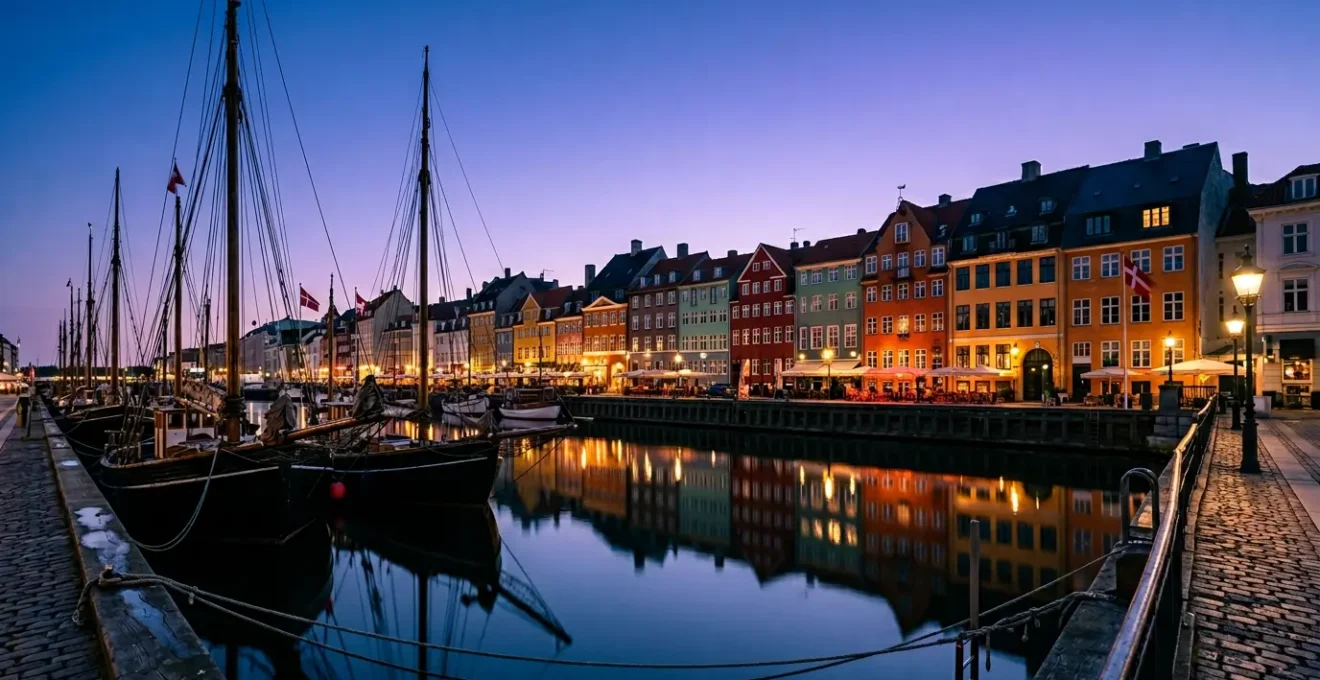
The secret to loving Nyhavn is knowing how to escape its crowded, expensive “front stage” for the authentic experiences just steps away.
- The best, most affordable food isn’t on the main drag, but just across the bridge at a vibrant street food market.
- Smaller, captain-led boats offer a far more personal and memorable canal tour than the large, crowded vessels.
- The iconic colorful facades have a more recent history than the common myths suggest, tied to a 20th-century city project.
Recommendation: Use this insider’s guide to trade the postcard-perfect but hollow visit for a genuinely savvy and enjoyable Copenhagen experience.
Let’s be honest: the image of Nyhavn’s brightly colored gabled houses reflected in the canal is probably why you’re coming to Copenhagen. It’s an undeniable icon, a real-life fairytale scene. But as someone who lives a stone’s throw from the harbor, I see the other side every day: the throngs of people shuffling shoulder-to-shoulder, the overpriced and underwhelming “tourist menu” restaurants, and the general feeling that you’re in a theme park, not a living city. Most guides will tell you to take a photo, eat some herring, and move on. They treat Nyhavn like a museum piece to be glanced at.
But what if the real magic of Nyhavn isn’t in staring at the famous sunny side, but in understanding its pulse? What if the key to a memorable experience lies not in the crowded restaurants, but in knowing which bridge to cross? The truth is, locals love Nyhavn too, but we experience it differently. We know when to go, where to eat, and how to use it as a jumping-off point to explore the city’s true soul. This isn’t a guide about ticking a box; it’s an insider’s playbook for experiencing the harbor with savvy and genuine enjoyment, leaving the tourist traps to the tourists.
This article will guide you through making the smart, local choices. We’ll start by deconstructing the famous view itself, then navigate the crucial decisions on boat tours and food. From there, we’ll expand our view, just like a local would, to explore the stories, adjacent neighborhoods, and unique architectural gems that make this corner of Copenhagen so special. Get ready to see the harbor through a new lens.
Summary: How to Experience Nyhavn and Copenhagen Like an Insider
- Why Are the Houses in Nyhavn Painted Different Colors?
- Classic Tour or Hey Captain: Which Boat Experience Is Worth the Money?
- Where to Eat in Nyhavn Without Paying Double for Mediocre Food?
- When to Visit Nyhavn to Get a Photo Without 500 People in It?
- What Lies Behind the Facades of Nyhavn 18 and 20?
- Can You Rent a Motorboat in Denmark Without a Sailing License?
- Paustian House: Why Is the Building as Important as the Furniture Inside?
- How to Spend a Day in Christianshavn Beyond Just Freetown Christiania?
Why Are the Houses in Nyhavn Painted Different Colors?
The common myth you’ll hear is that the houses were painted in vibrant colors so that drunken sailors could find their way home to the right building after a long night in the harbor’s many taverns. It’s a charming tale, but the real story is a bit more modern and speaks to Copenhagen’s talent for urban reinvention. While Nyhavn is historic, with its oldest house at number 9 dating back to 1681, the kaleidoscope of colors we see today is largely a 20th-century phenomenon.
For much of its history, the area was a gritty, working-class port. By the mid-20th century, it had become derelict and run-down. The transformation began in earnest in the 1960s. In a major urban renewal project, the old, dilapidated tenement houses were carefully restored. It was during this period that the decision was made to paint them in the now-famous spectrum of warm, pastel colors. This was a deliberate choice to breathe new life and a sense of cheerfulness into the district.
According to a report on the architectural revitalization, this project was key to transforming a neglected port into the city’s most iconic waterfront. So, the colors aren’t just for sailors; they’re a symbol of Copenhagen’s ability to honor its past while creating a vibrant future. It’s less about drunken navigation and more about a conscious design choice that turned a forgotten corner into a global postcard.
Classic Tour or Hey Captain: Which Boat Experience Is Worth the Money?
Seeing Copenhagen from the water is non-negotiable, and Nyhavn is the epicenter of canal tours. The choice paralysis is real: you’ll see the large, flat-topped Stromma or Netto-Bådene boats packed with people, and then you’ll spot the smaller, more intimate boats from companies like Hey Captain. As a local, I can tell you the experience is vastly different, and the “best” choice depends entirely on what you value: budget and efficiency, or personality and “hygge.”
The large, classic tours are essentially floating buses. They run frequently, cover all the main sights, and are very budget-friendly (especially since they are often included in the Copenhagen Card). You’ll get a pre-recorded or live-but-scripted audio guide. It’s efficient, but it can feel impersonal with 100-150 other passengers. In contrast, smaller boat companies like Hey Captain are built around a different philosophy. As they state on their website, their ambition is to deliver a more personal and social tour.
Hey Captain is a charming canal tour with a local vibe. Our ambition is to deliver a personal, social and informative tour.
– Hey Captain Official, Hey Captain Copenhagen website
This translates to a conversational atmosphere with a live captain who is also your guide, a much smaller group (typically 12 passengers max), and often the ability to navigate narrower, more charming canals the big boats can’t access. You pay a premium, but you’re paying for a curated experience, not just a ride.
To make a savvy choice, you need to compare the options side-by-side. The following breakdown, based on an analysis of Copenhagen canal tours, clarifies the trade-offs between cost, capacity, and experience.
| Tour Option | Price (DKK) | Capacity | Experience Type | Key Features |
|---|---|---|---|---|
| Netto-Bådene | ~60 (Adults) ~30 (Children) |
Large boats (100-150 people) | Budget-friendly | Basic canal tour, trilingual audio |
| Stromma (Classic Tour) | ~129 (Adults) ~65 (Children) |
Large boats (100-150 people) | Comprehensive sightseeing | Audio guide or live guide, free with Copenhagen Card, established since 1904 |
| Hey Captain | ~250+ | Small boats (max 12 passengers) | Social & personalized | Live captain/guide, conversational atmosphere, access to narrower canals, drinks included |
| Harbour Bus (Havnebussen) | Standard public transport ticket | Ferry-sized | Local authentic | Water-level harbor views used by Copenhageners, routes 901-904, stops at Nyhavn |
Where to Eat in Nyhavn Without Paying Double for Mediocre Food?
Here is the single most important piece of insider advice I can give you about Nyhavn: do not eat at the restaurants on the main sunny side (the “front stage”). While the view is lovely, you’ll be paying a significant premium for food that is, frankly, often mediocre and designed for high-volume tourism. So, what do locals do? We use the “Bridge-Walk Rule.” The best food is a mere five-minute walk across the iconic Inderhavnsbroen (Inner Harbor Bridge).
On the other side, in Christianshavn, you’ll find Broens Gadekøkken (The Bridge Street Kitchen). This is not just any food market; it’s a high-quality, chef-driven space developed in part by the owners of the world-renowned restaurant noma. Here, you can get incredible burgers from Gasoline Grill, authentic Greek food, fresh pasta, and more, all for a fraction of the price of a sit-down meal in Nyhavn. You grab your food, sit at the communal waterfront tables, and enjoy an arguably better view looking back at the harbor you just left.
This vibrant, relaxed atmosphere is the antithesis of the stuffy tourist restaurants. It’s where you’ll find Copenhageners enjoying a summer evening. For an even more authentically Danish and budget-friendly option, look for a traditional pølsevogn (hot dog stand). These are a national institution and serve up high-quality sausages with all the fixings. It’s a quick, delicious, and deeply local experience.
Your Action Plan: Eating Smartly Near Nyhavn
- Cross the Inderhavnsbroen (Inner Harbor Bridge) from Nyhavn to reach Broens Street Food on the Christianshavn side.
- Explore the diverse, high-quality food stalls, featuring everything from gourmet burgers to fresh pasta, curated by top chefs.
- Grab your food and find a spot at the waterfront tables to enjoy phenomenal views back towards Nyhavn at a much lower cost.
- For a truly authentic alternative, seek out a traditional pølsevogn (Danish hot dog stand) nearby for a classic and affordable taste of Denmark.
- Consider the ‘bakery picnic’ strategy: buy world-class smørrebrød (open-faced sandwiches) or pastries and enjoy them on a quieter spot along the canal.
When to Visit Nyhavn to Get a Photo Without 500 People in It?
With Copenhagen welcoming what travel photography guides estimate as over 30 million tourists a year, getting that perfect, crowd-free shot of Nyhavn can feel like an impossible mission. During peak hours in summer, the waterfront is a sea of selfie sticks. But “Hygge Hacking” your visit is possible with a bit of strategic timing and creative thinking. Forget midday in July; the best photos are taken when most visitors are still in bed or at dinner.
The most effective strategy is to go at the extremes of the day. Early morning, before 7:00 AM, is magical. The light is soft and golden, the water is still, and you’ll share the space with only a few joggers and locals starting their day. The other golden window is the “blue hour,” the period about 30-45 minutes after sunset. The crowds have thinned out, the building lights are on, and the sky turns a deep, saturated blue, creating a stunning contrast with the warm glow from the windows. This is often more dramatic than a standard sunny day shot.
Don’t be afraid of “bad” weather. A misty or rainy day can provide incredibly atmospheric and unique photos. The glistening cobblestones, dramatic clouds, and moody reflections in the canal offer a far more interesting composition than a cloudless blue sky. Here are some key strategies to get your shot:
- Early Morning Strategy: Arrive before 7:00 AM on a weekday for soft light and minimal crowds.
- Blue Hour Technique: Shoot 30-45 minutes after sunset for a deep blue sky and illuminated buildings.
- Bad Weather Advantage: Embrace rain or mist for moody, atmospheric shots with glistening reflections and no crowds.
- Shoot from the ‘Shady Side’: Position yourself on the quieter, southern side of the canal to photograph the famous northern facade for cleaner compositions.
- Off-Season Visits: Plan your trip for September-April. September, in particular, often has beautiful late-summer light with a fraction of the July-August crowds.
What Lies Behind the Facades of Nyhavn 18 and 20?
While the colorful facades of Nyhavn are beautiful as a whole, a few of them hold specific stories that add a layer of depth to the postcard view. The most famous resident of the harbor was, without a doubt, the fairytale author Hans Christian Andersen. He lived in three different houses in Nyhavn during his life, and two of them, numbers 18 and 20, are right in the heart of the iconic strip.
Today, Nyhavn 18 houses a souvenir shop, but Andersen lived there from 1871 to 1875, near the end of his life. More significantly, at Nyhavn 20, which is marked with a memorial plaque, a younger Andersen lived earlier in his career. It was here, between 1834 and 1838, that he wrote some of his very first and most famous fairytales, including ‘The Tinderbox’, ‘Little Claus and Big Claus’, and ‘The Princess and the Pea’.
It’s fascinating to stand there and imagine him looking out his window. He wouldn’t have seen the polished, tourist-friendly scene of today. Instead, he would have witnessed the raw, bustling reality of a 19th-century port: sailors, merchants, fishwives, and the constant noise and smell of maritime trade. This gritty, lively environment provided a stark contrast to the magical, often whimsical worlds he was creating on paper. Knowing this story transforms the buildings from simple photo backdrops into a tangible link to one of the world’s greatest storytellers.
Can You Rent a Motorboat in Denmark Without a Sailing License?
This is a fantastic question and a key to unlocking one of the best local experiences. The answer is a resounding yes, you absolutely can, provided you stick to a specific type of boat. You don’t need any kind of license or prior experience to rent the small, slow-moving electric picnic boats you’ll see gliding through the canals. Companies like GoBoat or Friendships have made exploring the harbor on your own terms incredibly accessible.
These boats are designed for ease of use and safety. They are powered by quiet, eco-friendly electric motors (many are solar-powered) and have a maximum speed of around 3-4 knots (about 5-7 km/h), which is basically a brisk walking pace. This makes them very easy to handle, even for complete beginners. The rental company will give you a quick 5-minute instruction on how to operate the boat (it’s usually just a simple tiller for steering and a knob for forward/reverse) and a map of the harbor, pointing out which areas you can explore.
The best part is the freedom it gives you. You become your own captain. You can pack a picnic and some drinks, gather a few friends, and chart your own course through the main harbor and the charming, narrower canals of Christianshavn. It offers a completely different, more intimate “water-level perspective” of the city compared to the large tour boats. It’s a favorite summer activity for Copenhageners for a reason: it’s social, relaxing, and lets you experience the city’s heart—its waterways—at your own pace.
Paustian House: Why Is the Building as Important as the Furniture Inside?
While Nyhavn represents Copenhagen’s historic charm, a short trip to the Nordhavn (North Harbor) area reveals the city’s modernist soul. Here you’ll find Paustian House, a furniture showroom that is a pilgrimage site for design lovers. The twist? The building itself, designed by the legendary Jørn Utzon—the architect of the Sydney Opera House—is just as, if not more, important than the iconic Danish design pieces it contains.
The building is a masterpiece of Utzon’s concept of “Additive Architecture.” As detailed in official Copenhagen travel guides on architecture, Utzon envisioned the building not as a static box, but as a living system that could grow and adapt organically. You experience this as you walk through a “forest” of tall, white concrete columns that blossom at the top, supporting a soaring, modular roof. It feels less like being inside a building and more like walking through a structured, man-made landscape.
Utzon was a master of light and place. The skylights and the entire concrete framework are designed to channel the unique, ever-changing Nordic light throughout the day, turning the interior into a dynamic sculpture. The building is in constant “architectural dialogue” with its harbor environment, much like his Sydney Opera House interacts with the water and sails. He drew inspiration from natural forms—beech forests, shells, clouds—to create a space that is both monumental and deeply human. Visiting Paustian is not just about shopping for a chair; it’s about experiencing how a world-class architect can turn concrete and light into poetry.
Key Takeaways
- Ditch the tourist-trap restaurants in Nyhavn for superior and more affordable street food just a five-minute walk across the bridge.
- Choose your canal tour wisely: large boats for budget sightseeing, small boats for a personal, “hygge” experience.
- The best, crowd-free photos of Nyhavn are taken at dawn, during the post-sunset “blue hour,” or on a rainy day.
How to Spend a Day in Christianshavn Beyond Just Freetown Christiania?
Using Nyhavn as our starting point, the “Bridge-Walk Rule” leads us directly into Christianshavn, a neighborhood that perfectly encapsulates the authentic, alternative spirit of Copenhagen. While many visitors make a beeline for the famous Freetown Christiania and then leave, they miss the true soul of this “Little Amsterdam” district. To spend a day here like a local is to embrace its blend of historic charm, bohemian creativity, and stunning canal-side life.
Start your day with a wander along the canals themselves, Overgaden Neden Vandet and Overgaden Oven Vandet. This is where you’ll find charming houseboats, beautifully converted 17th-century warehouses, and hidden courtyards. It’s quieter, more residential, and infinitely more charming than the main harbor. The undisputed highlight for panoramic views is climbing the Church of Our Saviour. The final ascent is via the iconic external golden spiral spire—with 400 steps in total—offering breathtaking 360-degree views across the entire city.
Christianshavn is a place of contrasts, where historic sublime architecture meets contemporary design. A walk across the modern, artistic Cirkelbroen (Circle Bridge), designed by Olafur Eliasson, provides stunning views of the Black Diamond library across the water. A perfect day here involves a mix of sightseeing, relaxing at a canal-side café, and soaking in the unique atmosphere.
- Morning: Begin with a walking tour along Christianshavn’s canals—Overgaden Neden Vandet and Overgaden Oven Vandet—to discover houseboats and historic warehouses.
- Mid-Morning: Stop at a canal-side café on Overgaden Oven Vandet for a Danish pastry while watching the boats drift by.
- Midday: Climb the 400 steps of the Church of Our Saviour’s external spiral spire for the most epic panoramic views across Copenhagen.
- Afternoon: Cross the modern Cirkelbroen (Circle Bridge) to enjoy waterfront views and the contrast between old and new architecture.
- Evening: Explore the quirky, creative atmosphere of Sofiegade, a street whose uniquely painted houses embody Christianshavn’s eccentric and artistic spirit.
By shifting your perspective just slightly—crossing a bridge, choosing a smaller boat, visiting at a different time—you transform a predictable tourist outing into a series of authentic discoveries. Start exploring Copenhagen with this insider’s mindset, and you’ll find the real city waiting for you just beyond the crowd.