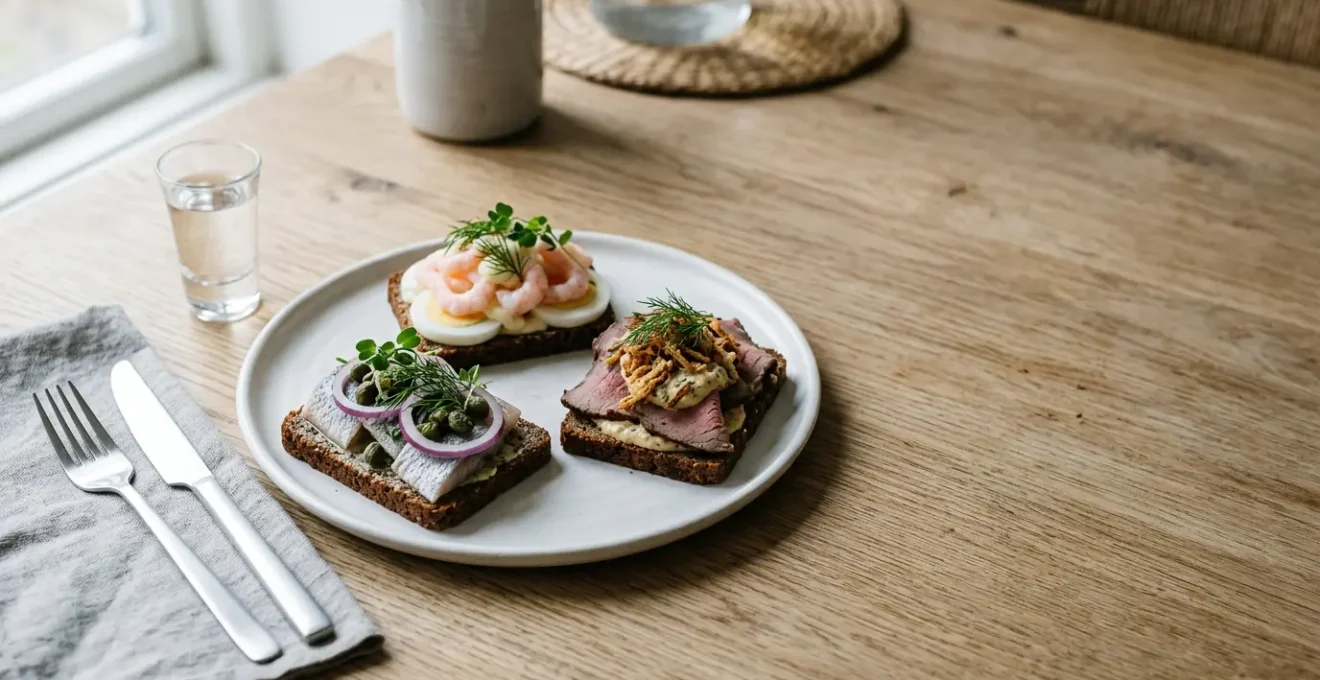
Eating Danish smørrebrød is not about choosing your favorite topping; it is a structured culinary ritual where the sequence is everything.
- The tasting journey must follow a strict progression: start with fish (especially pickled herring), move to other seafood, then proceed to meat, and finally, finish with cheese.
- A knife and fork are mandatory at all times, not for etiquette’s sake, but to maintain the delicate architecture of each creation.
Recommendation: Master this culinary grammar to dine with confidence and show true respect for Danish tradition, transforming your meal from a simple lunch into a cultural experience.
Imagine the scene: you are at a formal business lunch in Copenhagen. A platter arrives, bearing not sandwiches, but miniature works of art. These are smørrebrød, meticulously layered creations of vibrant colors and textures. It is both beautiful and deeply intimidating. You have heard the whispers of rules, of a specific order and the forbidden use of hands. These are not mere suggestions; they are the foundation of a century-old culinary tradition. Many guides will tell you it’s an “open-faced sandwich” or that you should “eat fish first.” This is a dangerous oversimplification.
The truth is that smørrebrød has a formal grammar. To eat it out of order is not just a social faux pas; it is a culinary insult, akin to reading a book from the last chapter or listening to a symphony in reverse. The sequence is designed to create a specific flavor arc, a journey for the palate that moves from the light and oceanic to the rich and earthy. Disrespecting this order collapses the entire experience. It is the difference between simply eating and truly dining.
As a chef who lives by these rules, I am here to guide you through this sacred ritual. We will not just cover the ‘what’, but the ‘why’. We will explore the non-negotiable foundation of the bread, the role of its liquid accompaniment, the absolute necessity of cutlery, and the classic compositions that define this iconic Danish lunch. By the end, you will be able to approach any smørrebrød table not with fear, but with the confidence and respect of a seasoned local.
This guide provides a complete framework for mastering Denmark’s most iconic lunch. From the foundational bread to the final toast, each section breaks down a non-negotiable rule of the smørrebrød experience.
Summary: A Chef’s Guide to the Rules of Smørrebrød
- Rye Bread Only: Why Can’t You Eat Smørrebrød on White Bread?
- Akvavit Pairing: Which Snaps Goes Best with Pickled Herring?
- Knife and Fork: Why Is It Forbidden to Eat Smørrebrød with Your Hands?
- Dyrlægens Natmad: What Is ‘The Vet’s Midnight Snack’ Made Of?
- Aamanns or Schønnemann: Which Restaurant Serves the Best Modern Smørrebrød?
- Where to Grab Quick but Authentic Lunch Near Major Attractions?
- Stegt Flæsk: Why Is Fried Pork with Parsley Sauce the National Dish?
- Is Noma the Only Game in Town for New Nordic Cuisine?
Rye Bread Only: Why Can’t You Eat Smørrebrød on White Bread?
Let us begin with the first commandment of smørrebrød: the foundation must be rugbrød. This is not a preference; it is a structural and philosophical necessity. Danish rye bread is a dense, dark, slightly sour, and fiber-rich loaf that serves as the very soul of the dish. To even consider using a flimsy, characterless slice of white bread is a profound misunderstanding of the entire concept. White bread lacks the integrity to hold the generous toppings and, more importantly, it lacks the earthy, malty flavor required to counterbalance the richness of pâté or the sharp brine of herring.
The rugbrød is not a mere vehicle; it is an active participant in the flavor profile. As the experts at Nordic for Beginners aptly state in their guide, “Smørrebrød: The Danish Way of Lunch”:
Danish rye bread is not merely a vehicle for toppings; it is an integral part of the experience. Rye has been a staple in Danish agriculture for centuries, thriving in the country’s cooler climate.
– Nordic for Beginners, Smørrebrød: The Danish Way of Lunch
This bread has been the bedrock of the Danish diet for generations; indeed, most Danes eat rugbrød every day. It provides a sturdy, reliable base that absorbs the juices from meat or fish without dissolving into a soggy mess. Choosing rugbrød is choosing authenticity and respect for the dish’s architecture. It is the first and most fundamental step in building a proper smørrebrød.
Akvavit Pairing: Which Snaps Goes Best with Pickled Herring?
The perfect smørrebrød lunch is incomplete without its liquid counterpart: akvavit, or snaps. This is not simply a drink to be had on the side; it is a palate cleanser and a flavor enhancer, an essential tool for navigating the culinary journey from fish to meat. The most classic and critical pairing is with pickled herring. The sharp, briny, and often sweet flavors of the herring demand a spirit that can cut through the richness and reset the palate. For this, a caraway or dill-infused akvavit is the traditional and undisputed choice. The herbal notes of the spirit beautifully complement the pickling spices and the oily fish.
To truly appreciate this pairing, one must observe the ritual of the toast, the “Skål.” It is a moment of connection and respect among diners, governed by its own strict etiquette:
- Raise your glass: Lift your snaps and make direct eye contact with your fellow diners.
- Proclaim “Skål!”: Say the word clearly while maintaining that crucial eye contact.
- Sip the snaps: Take a small, sharp sip of the ice-cold akvavit.
- Acknowledge again: Make eye contact once more before setting your glass back on the table.
This ritual is as much a part of the experience as the food itself. The visual below captures the sacred moment just before the toast, showcasing the harmony between the crisp akvavit and the rich herring.
Breaking eye contact is considered a serious breach of etiquette. The Skål is a pact of shared enjoyment, and the akvavit is the key that unlocks the next layer of flavor in your smørrebrød sequence. It is not for intoxication, but for clarification and celebration.
Knife and Fork: Why Is It Forbidden to Eat Smørrebrød with Your Hands?
This is perhaps the rule that most surprises visitors. A smørrebrød is an open-faced sandwich, so why can’t you simply pick it up? The answer is a matter of pure practicality and respect for the artistry of the chef. These are not sandwiches; they are delicate, multi-layered architectural creations. Attempting to eat one with your hands would result in immediate structural collapse, a messy and undignified affair. You would be wearing your lunch, and the chef’s careful composition would be destroyed before you even took a bite.
A knife and fork are the essential tools for navigating this culinary landscape. As the guide “Smørrebrød: The Danish Way of Lunch” explains, their purpose is precision: “A knife and fork allow you to navigate the layers without creating a mess… It’s customary to take small bites, savoring each flavor combination rather than devouring it in one go.” You must use the Continental dining style: fork in the left hand with tines facing down, and knife in the right. This allows you to secure the smørrebrød to the plate while cutting a perfect, complete bite containing a portion of every layer.
Case Study: Adapting to Danish Dining Etiquette
The cultural and practical importance of this rule is perfectly illustrated by the experience of foreigners living in Denmark. For instance, American expat Brooke Black, who moved to the country in 2020, quickly had to adapt. She learned to eat smørrebrød with her fork in her left hand and knife in her right, a technique that she found was essential. An analysis of the Continental dining style’s adoption highlights how this prevents the elaborate sandwiches from falling apart, demonstrating that the etiquette is born from both functionality and civility.
Using cutlery is not about being “posh.” It is about honoring the structural integrity of the dish and ensuring you experience the combination of flavors exactly as the chef intended.
Dyrlægens Natmad: What Is ‘The Vet’s Midnight Snack’ Made Of?
Among the pantheon of classic smørrebrød, “Dyrlægens Natmad” holds a special place. The name itself, translating to “The Veterinarian’s Midnight Snack,” is intriguing and speaks to its storied origin. This is not a random collection of ingredients, but a specific, historic composition that tells a tale of 1920s Copenhagen. The layers are precise and unchangeable: a base of rugbrød spread with warm leverpostej (liver pâté), topped with a slice of saltkød (salt beef), a shimmering layer of sky (meat stock aspic), and garnished with raw red onion rings and cress.
The origin of this iconic sandwich is as rich as its ingredients. The story comes from the famous Oskar Davidsen’s sandwich restaurant, a Copenhagen institution.
According to food historian Nina Bauer, the famous sandwich is named after one of the restaurant’s regulars, a distinguished veterinarian named Sigurd Kejlgaard… He would stop by Oskar Davidsen’s sandwich restaurant in Copenhagen every night in the 1920s and order the same combination: rugbrød with liver pâté, sliced salt beef, meat stock aspic, and red onion rings on top.
– As documented in the history of Dyrlægens natmad
Each component is critical. The warm, savory pâté contrasts with the cool, salty beef. The aspic adds a unique jelly-like texture and a deep, savory flavor, while the raw onion provides a sharp, crisp bite. To see it is to understand the complexity involved. The layers are distinct, each contributing to a harmonious whole.
“The Vet’s Midnight Snack” is a perfect example of a meat smørrebrød, to be eaten later in the sequence, after the fish and lighter options have been enjoyed. It is a piece of living history on a slice of rye.
Aamanns or Schønnemann: Which Restaurant Serves the Best Modern Smørrebrød?
In Copenhagen’s vibrant food scene, the question of where to find the “best” smørrebrød often leads to a debate between two titans: Schønnemann and Aamanns. However, this is not a question of which is better, but rather which philosophy you wish to experience. They represent two perfect yet different expressions of the same art form: the unwavering preservation of tradition versus the exciting frontier of innovation.
Schønnemann is a bastion of classicism. A meal here is a step back in time. The menu is a long checklist, the `smørrebrødsseddel`, featuring dozens of time-honored combinations that have remained unchanged for decades. The atmosphere is that of a historic `frokostrestaurant` (lunch restaurant), where the goal is the perfection of tradition. Aamanns, on the other hand, is the face of the smørrebrød renaissance. Helmed by Adam Aamann, this establishment champions a New Nordic approach, focusing on seasonal, local ingredients and innovative, chef-composed plates that are as visually stunning as they are delicious. The menu is shorter, more curated, and changes with the seasons.
This comparative analysis of smørrebrød styles is best understood visually. The following table breaks down the core differences between these two iconic philosophies.
| Aspect | Traditional (Schønnemann) | Modern (Aamanns) |
|---|---|---|
| Menu Style | Long checklist menu (smørrebrødsseddel) with dozens of classic options | Shorter, seasonal menu with pre-composed creations |
| Philosophy | Perfecting tradition – recipes unchanged for decades | New Nordic approach – local, seasonal, innovative presentation |
| Atmosphere | Classic frokostrestaurant with historic ambiance | Contemporary dining room with modern Danish design |
| Typical Order | Customer selects individual toppings from extensive list | Chef-composed seasonal plates with unique flavor combinations |
| Price Range | Moderate – authentic lunch experience | Higher – fine dining interpretation |
The choice is not between good and bad, but between two different, equally valid, and delicious worlds. To truly understand smørrebrød, one should ideally experience both: the comforting embrace of tradition at Schønnemann and the creative spark of the new at Aamanns.
Where to Grab Quick but Authentic Lunch Near Major Attractions?
When you are exploring a city, especially near major tourist hubs like Nyhavn or Tivoli Gardens, you are surrounded by temptation. Multilingual picture menus and aggressive hosts beckon you into restaurants that often prioritize convenience over quality. As a chef, it pains me to see visitors fall into these tourist traps, receiving a mediocre imitation of our cherished national lunch. A truly authentic smørrebrød experience requires a discerning eye.
A genuine `frokostrestaurant` is a calmer, more deliberate place. It is where locals go for their midday meal. The focus is on fresh, high-quality ingredients and time-honored preparation, not on high-volume turnover. But how can you, a traveler, tell the difference? You must look for the subtle signals of authenticity. To help you on your quest, I have compiled a checklist of what to look for and what to avoid.
Checklist: Spotting an Authentic Frokostrestaurant vs. a Tourist Trap
- Menu Language: Is the menu written primarily in Danish, featuring classic names like ‘Dyrlægens Natmad’ or ‘Sol over Gudhjem’? Authentic places cater to locals first.
- The Clientele: Look inside during peak lunch hours (12 PM – 2 PM). Do you see local Danes enjoying their meal, or is it filled exclusively with other tourists?
- Interior and Ambiance: Does the restaurant have a classic Danish design, perhaps with historic photographs and a sense of heritage, or does it feel generic and modern?
- The Magic Word: Is the word ‘frokost’ (lunch) prominently displayed on the signage or menu? This indicates a specialization in the traditional midday meal.
- Red Flags: Vigorously avoid restaurants, especially on the Nyhavn waterfront, that use large, glossy picture menus and have staff on the street trying to lure you in. Authenticity does not need to shout.
By using these points as your guide, you can confidently step away from the crowded tourist paths and find a hidden gem where you can enjoy smørrebrød as it is meant to be: delicious, authentic, and prepared with care.
Stegt Flæsk: Why Is Fried Pork with Parsley Sauce the National Dish?
It is a source of some confusion for visitors that in 2014, Danes voted Stegt flæsk med persillesovs (fried pork belly with parsley sauce) as their official national dish. It is a hearty, comforting, and deeply traditional meal, to be sure. It consists of thick slices of pork belly, fried until crisp, served with boiled potatoes and a creamy parsley béchamel sauce. It is the epitome of Danish ‘hygge’ on a plate, a dish for cold evenings and family gatherings.
However, declaring it the *national dish* does not diminish the absolute sovereignty of smørrebrød over the Danish lunch table. The two dishes occupy entirely different spheres of Danish culinary life. Stegt flæsk is an evening meal, a heavy and satisfying dinner. Smørrebrød, on the other hand, is the undisputed king of ‘frokost’ (lunch). It is what fuels the nation through the workday, what is served at business meetings, and what is celebrated on special midday occasions.
As The Nordic Dish guide rightly observes, the cultural dominance of smørrebrød at lunchtime is absolute.
In Denmark, smørrebrød isn’t on the lunch menu — it practically is the lunch menu.
– The Nordic Dish, Danish Open-Faced Sandwich (Smørrebrød) – A Complete Guide
So while Stegt flæsk may hold the official title, it is a title related to a specific type of meal. For the midday meal, which is the context of your formal lunch, there is no contest. Smørrebrød is not just an option; it is the entire institution. It represents the daily, practical, and yet elegant heart of Danish food culture.
Key Takeaways
- The Sacred Sequence: The order is non-negotiable. Always start with fish (herring first), proceed to other seafood, then meat, and finish with cheese if it is offered.
- Tools are Mandatory: A knife and fork are not optional. They are essential for maintaining the structural integrity of the smørrebrød and eating with dignity.
- The Foundation is Rye: Authentic smørrebrød is built exclusively on dense, dark rugbrød. Any other bread is a departure from tradition.
Is Noma the Only Game in Town for New Nordic Cuisine?
The global ascent of Noma has cast a long, brilliant shadow over Danish cuisine, leading many to equate “New Nordic” solely with its pioneering, foraging-focused ethos. While Noma’s influence is undeniable, it is by no means the only expression of this culinary movement. The New Nordic philosophy—a focus on local, seasonal, and pure ingredients—has permeated every level of Danish gastronomy, and nowhere is this more beautifully demonstrated than in the evolution of smørrebrød.
Our traditional open-faced sandwiches are being reinterpreted through this modern lens. As noted by culinary observers, “These open sandwiches are being picked up in what is dubbed ‘new Nordic’ or ‘new Danish’ cooking with some twists on the classic toppings.” Chefs at restaurants like Aamanns are applying New Nordic principles to our most cherished lunch dish, creating compositions that are both innovative and deeply rooted in Danish terroir. They might pair local smoked cheese with foraged berries or create a new kind of herring pickle using wild herbs.
This movement has breathed new life into the entire smørrebrød ecosystem. In fact, culinary history shows that the smørrebrød renaissance in the 2000s gave a second wind to related traditions, such as the drinking of akvavit. This modern revival proves that smørrebrød is not a museum piece. It is a living, breathing art form that continues to evolve, balancing a deep respect for tradition with a bold creative spirit. Noma is a spectacular star, but the galaxy of New Nordic cuisine is vast, and smørrebrød is one of its brightest constellations.
Now that you understand the rules, the history, and the respect they command, you are prepared. You can attend your next Danish lunch not as an intimidated tourist, but as an informed and confident guest. You are ready to partake in the ritual. Order with confidence, and Skål!