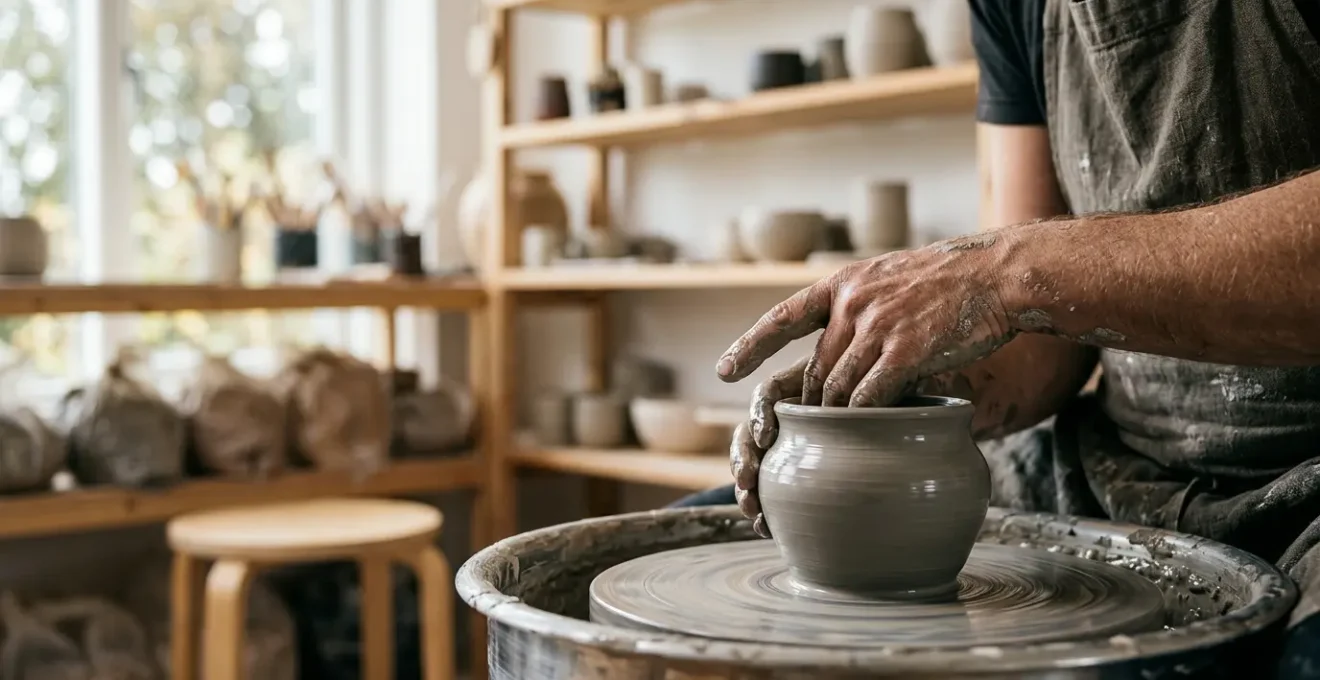
You’re looking for a Danish souvenir that feels more meaningful than a magnet or a keychain. The solution isn’t just to buy a piece of design, but to immerse yourself in its creation. This guide reframes a simple pottery class as a journey into the heart of Danish design philosophy, teaching you how to use your own hands to craft not just a pot, but a personal story connected to place, material, and history.
There’s a unique feeling that comes with travel—a desire to bring a piece of a place home with you. In Denmark, the home of world-renowned design, it’s easy to be captivated by the clean lines and thoughtful forms you see in shops. You could buy a piece of iconic Royal Copenhagen porcelain or a contemporary studio ceramic. But what if you could connect with Danish design on a deeper, more tactile level? What if the most precious souvenir wasn’t something you bought, but something you made?
Many guides will simply list pottery studios. They might tell you where to go, but not why it matters. They overlook the most crucial part: the philosophy. Creating your own piece of pottery in Denmark is an opportunity for a hands-on masterclass in design. It’s about engaging with the very principles of form, function, and material honesty that have defined Danish modernism for a century.
The real magic happens when you stop thinking about making a “perfect” pot and start thinking like a Danish designer. Suddenly, the clay in your hands is not just mud; it’s a connection to a landscape, and the shape you create is a dialogue with history. This guide is your invitation to that conversation. We’ll explore the soul of Danish ceramics, from its historic heartland to its modern urban hubs, and show you how to infuse your own creation with the spirit of a design legend. This isn’t just about getting your hands dirty; it’s about crafting a memory you can hold.
Summary: Your Guide to Crafting a Personal Piece of Danish Design
- Bornholm or Nørrebro: Where is the Center of Danish Ceramics?
- Do You Need to Speak Danish to Join a Local Pottery Wheel Class?
- Blue Fluted: Why Is This Pattern So Iconic and Expensive?
- How to Pack Unfired or Fresh Ceramics for a Flight Home?
- Matte or Glossy: What Defines the ‘Scandi Style’ in Modern Ceramics?
- Jacobsen vs. Wegner: Which Architect Defined the Modernist Look?
- Vesterbro Galleries: Where to Buy Affordable Art from Rising Stars?
- Where to Blow Your Own Glass Souvenir in the Copenhagen Area?
Bornholm or Nørrebro: Where is the Center of Danish Ceramics?
To understand Danish ceramics, you must understand its geography. The soul of the craft is split between two poles: the historic, elemental island of Bornholm and the vibrant, contemporary workshops of Copenhagen’s Nørrebro district. Bornholm, a rugged island in the Baltic Sea, is the historical cradle. Its very geology, featuring large sedimentary layers of clay along its coastal cliffs, made it a natural center for pottery. This isn’t just history; it’s a lesson in material honesty. For centuries, the island’s potters have had a direct, physical connection to their primary resource.
This legacy is tangible at places like Hjorths Fabrik, a factory that has been shaping Bornholm clay since 1859. The island’s history is rich, with records showing over 200 independent potters and 24 ceramic factories active there since the early 19th century. To visit Bornholm is to connect with the deep roots and the raw, earthy origins of the craft.
In contrast, the streets of Nørrebro and Vesterbro in Copenhagen represent the craft’s dynamic present. Here, in studios like YŌNOBI, Let’s Clay, and Studio Arhoj, the tradition is being reinterpreted by a new generation. While Bornholm is about heritage and earth, Copenhagen is about community, experimentation, and global fusion. The “center” of Danish ceramics, then, is not a single place. It’s a creative tension between the island’s raw material and the city’s refined ideas—a journey every visiting maker can experience.
Do You Need to Speak Danish to Join a Local Pottery Wheel Class?
This is a common concern for many travelers wanting to dive into a local experience, but you can breathe a sigh of relief. The short answer is a resounding ‘no’. Copenhagen’s creative scene is incredibly international, and its pottery studios are a perfect example of this open, welcoming spirit. They are not just businesses; they are community hubs where language is a bridge, not a barrier. As the team at Kulki Studio in Nørrebro clearly states, “Both courses and workshops are taught in English.”
This bilingual approach is the standard, not the exception. Instructors are well-accustomed to guiding an international mix of students, from absolute beginners to experienced potters. The language of creativity—of gesture, demonstration, and the shared tactile experience of shaping clay—often transcends spoken words. Your focus can remain entirely on the hum of the wheel and the feeling of the clay in your hands, without worrying about translation.
To help you find your temporary creative home, many studios are particularly geared towards visitors. They understand the traveler’s timeline, offering short, single-session workshops and even international shipping services for your finished piece. This transforms the experience from a logistical challenge into a seamless part of your itinerary. As a starting point, this table showcases a few of Copenhagen’s most language-friendly studios, each with its own unique charm.
This table of welcoming workshops, sourced from local listings like those found on Let’s Clay’s popular platform, shows just how accessible the craft is for international visitors.
| Studio Name | Location | English Instruction | Workshop Duration | Tourist-Friendly Features |
|---|---|---|---|---|
| YŌNOBI | Nybrogade 28, Copenhagen Center | Yes, all instructors speak English | 2-3 hours (single session) | Shipping service available, pieces ready in 3-4 weeks |
| Let’s Clay | Vesterbro (near Central Station) | Yes, fully bilingual | 2 hours wheel throwing | Rated best ceramics workshop in Copenhagen, walk-in friendly |
| Kulki Studio | Nørrebro | All courses taught in English | 6-8 week courses or 3-hour workshops | Beginner-focused, international community |
| Royal Copenhagen Workshop | Amagertorv, City Center | Yes, multilingual staff | 1 hour hand-painting | Paint on pre-made porcelain, same-day pickup after firing |
Blue Fluted: Why Is This Pattern So Iconic and Expensive?
The delicate cobalt blue lines on pristine white porcelain known as Blue Fluted are more than just a pattern; they are a piece of Danish national identity. To understand its iconic status, you have to look at its incredible history. Produced by Royal Copenhagen, the pattern is a testament to endurance and tradition, having been in continuous production for over 249 years since 1775. This longevity alone makes it a living artifact of design history.
The expense and prestige come from the sheer human skill invested in every single piece. This is not a printed decal. Each floral motif is hand-painted in a free-hand style by highly trained artists who have often apprenticed for years. They work without stencils or outlines, meaning every plate, cup, and bowl is subtly unique—an original work of art. The cost reflects the time, training, and artistry required to master this delicate process.
What’s truly fascinating for a modern maker is how the pattern evolved, teaching a lesson in design iteration. The original Blue Fluted Plain is minimalist. Over time, as detailed in a historical overview by the design archive Replacements, Ltd., variations like Half Lace and the ornate Full Lace were introduced. The latter features hand-pierced lace-like edges, representing the pinnacle of craftsmanship and complexity. This evolution from simple to ornate and back to reinterpreted modern versions shows how a strong design concept can be adapted across centuries without losing its core identity. It’s a masterclass in how to develop a signature style while allowing for growth and variation.
How to Pack Unfired or Fresh Ceramics for a Flight Home?
You’ve spent hours pouring your creativity and focus into a piece of clay, and now you have a fragile, personal treasure. The thought of getting it home in one piece can be daunting, but with the right technique, it’s entirely manageable. The key is to think like a museum registrar and create a protective system where your piece “floats” within your bag, shielded from pressure and impact. Forget just wrapping it in a sweater; this requires a more strategic approach.
The biggest mistake is putting fragile ceramics in checked luggage. No matter how well you wrap it, the rough handling and pressure changes make it a huge gamble. Your creation must travel with you in your carry-on. The goal is to create a small, rigid fortress around your piece that is then cushioned by the soft contents of your bag. This double-box method is the gold standard for shipping and travel.
It’s all about preventing direct contact and movement. When you shake your packed bag, you should feel absolutely no rattling. This silence is your confirmation that the piece is secure. Following a methodical process will give you the confidence to transport your work safely, transforming airport anxiety into the calm assurance that your handmade souvenir will make it home to its new shelf.
Your Action Plan: The ‘Floating Method’ for Carry-On Packing
- Protect the Weak Points: Fold 12-inch sections of bubble wrap and secure them with painter’s tape over fragile areas like handles or spouts first. According to professional packing guides, you should never use packing tape directly on the ceramic surface as it can damage it.
- Cocoon the Piece: Wrap the entire object in 3-5 layers of bubble wrap. Crucially, the bubbles should face inward, toward the ceramic. This compresses the air pockets and provides the best shock absorption.
- Create the Inner Sanctum: Place your bubble-wrapped piece inside a small, hard-sided container, like a sturdy Tupperware or a small, thick-walled cardboard box. This is the ‘floating’ box that will absorb external pressure.
- Cushion in Your Carry-On: Pack this inner box in the very center of your carry-on suitcase. It should be surrounded on all sides—top, bottom, and all four sides—by soft clothing like sweaters and socks, ensuring it’s at least 3 inches from any suitcase wall.
- The Rattle Test: Before you leave for the airport, gently shake your carry-on bag. If you hear or feel any movement from the inner box, you need to add more soft cushioning until it is completely immobilized.
Matte or Glossy: What Defines the ‘Scandi Style’ in Modern Ceramics?
Choosing a glaze is the moment you give your piece its final personality. While the options can seem endless, the contemporary ‘Scandi style’ often leans towards a specific aesthetic that is both modern and deeply rooted in nature. It’s a look heavily influenced by the Japanese concept of wabi-sabi, which finds beauty in imperfection, and the shared design philosophy now known as ‘Japandi’. As the design studio Olive et Oriel summarizes this aesthetic, it’s about embracing:
Irregular shapes, visible throwing marks, matte glazes in cream, charcoal, and natural clay.
– Olive et Oriel Design Studio, Japandi Interior Design: Complete Guide
This points to a preference for honesty and tactility. A matte or satin-matte glaze allows the texture of the clay to subtly show through. It absorbs light rather than reflecting it, giving the piece a quiet, calm presence. Visible throwing rings—the faint spirals left by the potter’s fingers—are not seen as flaws but as a beautiful record of the making process. It’s about celebrating the hand of the maker and the nature of the material.
This doesn’t mean glossy glazes are forbidden. Often, the most interesting pieces play with contrast: a rough, matte exterior paired with a smooth, glossy interior. This is also a highly functional choice, as a glossy surface is easier to clean. To help you find inspiration, think of your glaze choice as ordering from a menu. Here are a few modern Scandinavian combinations you could discuss with your workshop instructor:
- Speckled Oatmeal Exterior + Celadon Interior: A warm, tactile matte oatmeal glaze with natural iron speckles on the outside, paired with a high-gloss pale green celadon inside.
- Raw Clay Band + Satin White: Leave a horizontal band of unglazed, burnished clay around the middle or base of the piece, with the rest covered in a soft satin-matte white glaze.
- Charcoal Matte Monochrome: A single deep charcoal or graphite matte glaze covering the entire piece. This option emphasizes form over decoration.
- Reactive Blue-Grey Gradient: A reactive glaze that creates natural, unpredictable variations from pale grey to deeper slate blue, embodying the wabi-sabi principle of accepting imperfection.
Jacobsen vs. Wegner: Which Architect Defined the Modernist Look?
When you sit at the pottery wheel, you’re not just shaping clay; you’re making a series of design decisions. To elevate your piece from a simple pot to a piece of Danish-inspired design, it helps to have a philosophy. And there are no better guides than the two titans of Danish modernism: Arne Jacobsen and Hans J. Wegner. Though they were contemporaries, their approaches to form and material were distinctly different, offering two clear paths for your own creative process.
Arne Jacobsen was the master of the single, sculptural form. Think of his iconic Egg™ and Swan™ chairs: seamless, enveloping shapes where the structure is hidden. His was an approach of total design, of industrial precision where the form itself is the primary decoration. A Jacobsen-inspired pot would be a smooth, singular vessel, perhaps with a bold, monochrome glaze, where the curve of the body is the entire story.
Hans Wegner, on the other hand, was the poet of materials and joinery. He believed in “material honesty.” In his famous Wishbone Chair, the construction is not hidden but celebrated. The joints are visible, the wood grain is tactile. A Wegner-inspired pot would celebrate the process: leaving throwing rings visible, letting the texture of the clay speak, or using a matte glaze that feels earthy and natural. It’s about showing how the piece was made. So, the question isn’t who was “better,” but who will you be today at the wheel? The sculptor of pure form, or the poet of honest materials?
This framework, inspired by a design-thinking approach from sources like Scandinavia Standard, can help you make conscious choices as you create.
| Design Element | Arne Jacobsen Approach | Hans Wegner Approach | How to Apply to Your Pottery |
|---|---|---|---|
| Form Philosophy | Sculptural, single-form, almost industrial precision | Celebrating material, visible joinery, honest construction | Jacobsen-style: Throw a seamless vessel where form IS the decoration. Wegner-style: Leave visible throwing rings or hand-building marks |
| Iconic Example | Egg Chair (1958): Enveloping, organic shell | Wishbone Chair (1949): Exposed Y-back shows construction | Jacobsen-inspired: Create a curved, all-in-one bowl without handles or additions. Wegner-inspired: Add a pulled handle showing connection point |
| Material Treatment | Surfaces are smooth, uniform, often upholstered to hide structure | Natural wood grain celebrated, minimal finish, tactile | Jacobsen-style: Use a flawless high-gloss monochrome glaze. Wegner-style: Use matte glaze that shows clay texture or leave sections unglazed |
| Color Palette | Bold single colors (orange, teal) or monochrome (grey, black) | Natural timber tones (oak, walnut), warm neutrals | Jacobsen-style: Choose one bold glaze color for entire piece. Wegner-style: Use cream, oatmeal, or natural clay tones |
| Design Intent | Gesamtkunstwerk (total artwork): every element designed as part of whole environment | Democratic design: beautiful objects for everyday use by everyone | Jacobsen-style: Design a ‘set’ (cups, plates) with unified aesthetic. Wegner-style: Focus on one perfect mug for daily ritual |
Vesterbro Galleries: Where to Buy Affordable Art from Rising Stars?
Before you even touch the clay, one of the most valuable things you can do is fill your head with inspiration. A pottery workshop is not an isolated event; it’s a creative response to the world around you. Treating a gallery visit as a formal part of your “design pilgrimage” can completely transform the piece you end up making. And in Copenhagen, the galleries of Vesterbro and the Meatpacking District (Kødbyen) are fertile ground for this kind of research.
Here you’ll find work from emerging ceramicists that is often more accessible and affordable (€50-€200) than that of established names. But you’re not just here to shop. You are here to see with a maker’s eye. Your mission is to deconstruct what you see. How did they achieve that glaze texture? How is that handle attached? What story is the artist telling? Go mid-week when galleries are quiet and the staff might have time to share insights about the artists they represent.
The goal is to move from passive admiration to active analysis. By visiting these spaces *before* your workshop, you arm yourself with ideas and questions. This turns the generic instruction of a class into a personalized consultation, allowing you to co-create something truly aligned with your own aesthetic vision.
- Visit Before, Not After: Treat galleries as your inspiration phase. Key studios and shops to see include Tasja P. Ceramics on Jægerborggade, the internationally-featured Studio Arhoj, and WAUW ceramics.
- Focus on 3 Elements: For each piece you like, analyze (1) the glaze innovation, (2) the unique form (handle, lip, base), and (3) the artist’s story. Ask permission before taking photos.
- Create a Mood Board: Take pictures of 3-5 pieces that resonate with you. On your phone, note what attracts you: the color, the texture, the raw imperfection?
- Time Your Visit: Go to Vesterbro/Kødbyen galleries on a Wednesday or Thursday afternoon. They’re less crowded, and staff are more available to talk.
- Bring Your Research to the Studio: During your workshop, show your instructor your favorite photos and ask the magic question: “How can I create an effect like this on my piece?”
Key Takeaways
- Creating Danish pottery is a journey that connects the raw landscape of places like Bornholm to the contemporary studios of Copenhagen.
- Your creative choices can be guided by the philosophies of design giants like Jacobsen (pure form) and Wegner (material honesty).
- The true souvenir is not the finished object, but the process of learning to see, touch, and think like a Danish designer.
Where to Blow Your Own Glass Souvenir in the Copenhagen Area?
As you explore the world of Danish craft, you might notice another art form that dances with fire: glassblowing. Like ceramics, it’s a transformative process, turning raw material into something beautiful. In fact, glassblowing has seen significant growth on the island of Bornholm in the last 20 years, creating a parallel craft culture to its ancient ceramic heritage. But while both involve heat and artistry, the experience for a beginner is profoundly different.
Choosing between a pottery and a glassblowing workshop is a choice between two distinct sensory worlds. Ceramics is a slow, meditative, and forgiving process. It’s an intimate, hands-on connection with cool, earthy material. You have time to think, to correct mistakes, to feel the form emerge directly under your fingertips. It is a contemplative craft.
Glassblowing is the opposite: fast, intense, and performative. It’s a dance with urgency as the molten glass cools rapidly. The experience is visceral, defined by the intense heat of the 1000°C furnace and the feeling of working at a distance with long metal tools. It is a dramatic craft. Due to the inherent risks, a beginner’s role is more participatory, with the instructor handling a significant portion of the technical work. Understanding these differences is key to choosing the experience that best suits your creative temperament.
| Dimension | Pottery/Ceramics Workshop | Glassblowing Workshop |
|---|---|---|
| Pace & Rhythm | Slow, meditative, contemplative. You control the speed. Sessions last 2-3 hours with breaks. | Fast, intense, performative. Glass cools quickly—you must work with urgency. Sessions are 1-2 hours, continuous. |
| Tactility & Control | Direct hands-on connection. Your fingers shape the clay directly. Very forgiving—mistakes can be reworked. | Tool-based and at-a-distance. You use metal tools; instructor may co-create. Glass is unforgiving—one mistake means starting over. |
| Physical Sensation | Cool, wet, earthy. Sensory experience of water and soil. Minimal heat exposure. | Intense heat (1000°C+ furnace). You feel radiant heat on face and arms. Dramatic and visceral. |
| Outcome Aesthetic | Earthy, organic, matte or satin surfaces. Opaque. Feels grounded and solid. | Fluid, transparent or translucent, glossy. Captures and reflects light. Feels ethereal. |
| Beginner Friendliness | Very beginner-friendly. Instructors guide but you do 90% of the work. Tolerates experimentation. | Moderate. Instructor does 50-70% of technical work due to safety. You participate but less independent control. |
Ultimately, the choice to work with clay is a choice for a slower, more personal, and deeply tactile connection to Danish design. You are now equipped with the context, philosophy, and practical tips to make it a truly memorable and meaningful creative act. The wheel is waiting.