In summary:
- Participating in a Danish Christmas Eve (‘Juleaften’) is about respectfully joining in, not just observing.
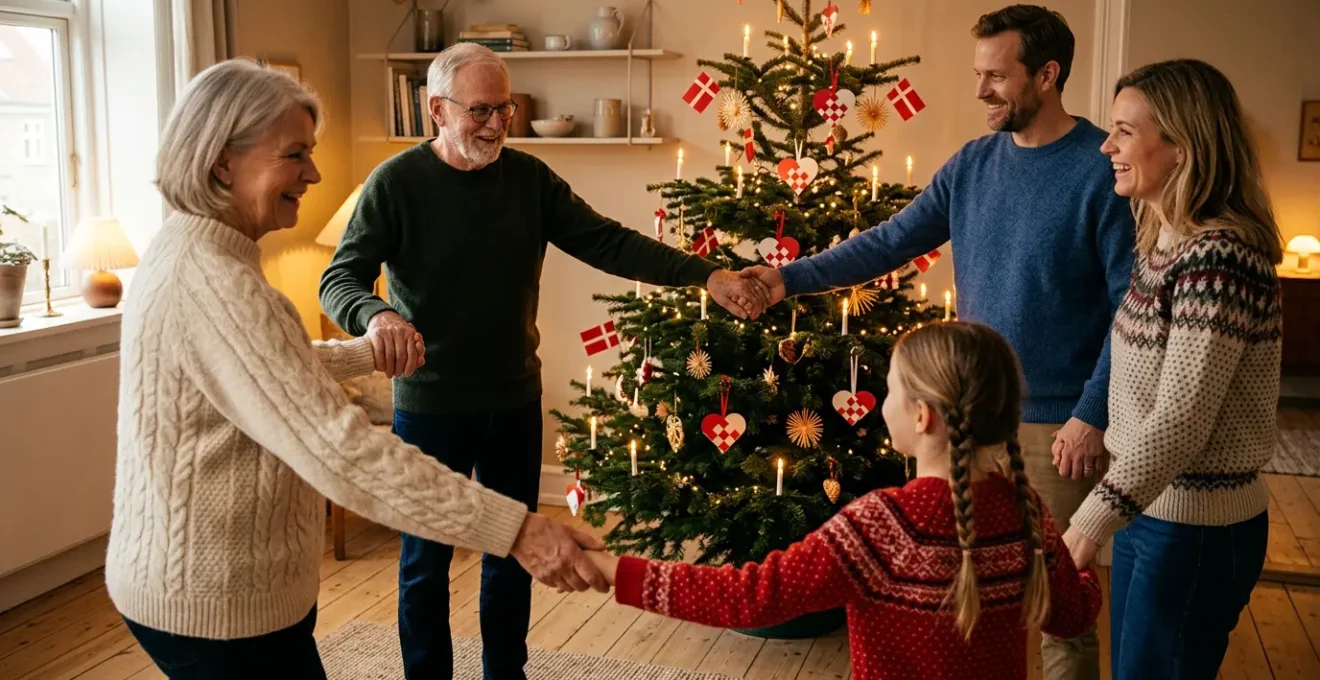
- Key rituals include holding hands to sing and dance around the Christmas tree, which is adorned with real candles.
- The Christmas dinner debate between duck and pork is a matter of deep family and regional tradition.
- Understanding the flow of the evening, from the meal to the gift-giving, is essential guest etiquette.
- The spirit of ‘hygge’ is found in these shared moments of collective joy and cultural resonance.
The image of a Danish Christmas often conjures scenes of cozy ‘hygge,’ glowing candles, and festive markets like Tivoli Gardens. While these are wonderful parts of the season, the true heart of the Danish Christmas beats behind closed doors on the evening of December 24th: ‘Juleaften.’ Being invited to share this intimate family celebration as a tourist is a rare honor and a unique opportunity for cultural immersion. It’s a world away from simply observing public festivities.
Many guides will tell you what Danes do—they dance around the tree, eat rice pudding, and sing carols. But they often miss the most crucial part for a guest: how to participate with grace and understanding. This isn’t just a party; it’s a sequence of cherished rituals, each with its own rhythm and unwritten rules. The key to a memorable experience lies not in knowing every word to every song, but in understanding the cultural resonance behind each tradition and embracing the shared experience.
This guide moves beyond observation to offer a practical guest protocol. We will explore the ‘why’ behind the ‘what,’ from the spirited dance around the tree to the great Christmas dinner debate. Understanding these traditions will allow you to be more than a spectator; you’ll be a welcome participant in one of Denmark’s most treasured cultural moments.
To help you navigate this festive landscape, this article breaks down the core traditions you’ll encounter on Christmas Eve, alongside other significant Danish celebrations you might witness during your winter visit. Each section provides the context and etiquette needed to feel comfortable and engaged.
Summary: A Guide to Danish Festive Traditions
- Why Do Danes Hold Hands and Run Around the Christmas Tree?
- Hitting the Barrel: How to Join the Danish Version of Halloween?
- Snaps and Herring: How to Survive a 7-Hour Easter Lunch?
- Why Are Teenage Confirmations Such Huge Events in Denmark?
- New Year’s Eve: Why Does the Whole Country Stop at 6 PM?
- Duck or Pork Roast: What Is the Debate for Christmas Dinner?
- St. Lucia Parades: Is This Tradition Danish or Swedish?
- Where to Eat Authentic Frikadeller Like a Danish Grandmother Makes?
Why Do Danes Hold Hands and Run Around the Christmas Tree?
After the rich Christmas dinner, the evening’s centerpiece ritual begins. The family gathers around the Christmas tree—often decorated with real, lit candles—joins hands, and begins to circle it while singing ‘julesalmer’ (Christmas hymns). This isn’t a solemn ceremony; it’s an act of collective joy and togetherness. It symbolizes the unity of the family and the shared celebration of Christmas. The tradition is so central to Danish identity that the country is a major producer of Christmas trees, with an industry that exported nearly 9 million Christmas trees in 2024.
As a guest, being invited to join the circle is a sign of inclusion. The initial pace is a gentle walk, but as the songs progress, especially to the lively “Nu er det jul igen” (“Now it is Christmas again”), the tempo builds into a playful, joyful run through the adjoining rooms of the house. Don’t worry if you don’t know the words; your participation is what matters. The act of holding hands and sharing in the movement is a powerful expression of communal hygge.
This ritual participation culminates in the opening of presents, which are piled underneath the tree. For a visitor, understanding the flow from dinner to dance to gifts is key to navigating the evening smoothly. It’s an arc of celebration that builds to a warm, happy conclusion.
Guest Etiquette: Your Guide to the Christmas Tree Dance
- Join the circle by holding hands with family members when invited after dinner.
- If you don’t know the Danish Christmas songs, hum along or clap gently to the rhythm.
- Popular songs include ‘Nu er det jul igen’ and ‘Dejlig Er Den Himmel Blå’ – focus on the melody.
- Walk (don’t run initially) around the tree in the same direction as everyone else.
- As the tempo increases, match the group’s energy – it often becomes a joyful run by the end.
- Be mindful of the real candles on the tree and keep a safe distance.
Hitting the Barrel: How to Join the Danish Version of Halloween?
While Juleaften is the heart of winter, a visit to Denmark around February or March might reveal another unique tradition: ‘Fastelavn.’ Often described as a Danish-style Halloween or Mardi Gras, this celebration involves children dressing up in costumes and participating in the ‘slå katten af tønden’ or “hitting the cat out of the barrel.” Historically, this involved a live cat in a barrel (a practice long since abandoned), but today, the barrel is filled with candy. Children take turns hitting it until it breaks, and the one who knocks down the last piece is crowned ‘Kattedronning’ (Cat Queen) and the one who knocks down the barrel’s bottom is ‘Konge’ (King).
This tradition is a fascinating glimpse into Danish folklore and community life. While it’s primarily for children, public celebrations are common and welcoming to tourists who wish to observe this festive and colorful event.
The visual spectacle of decorated barrels and costumed children creates a vibrant, playful atmosphere that contrasts with the more serene mood of many Christmas traditions. For a visitor, it’s a chance to see a different, more raucous side of Danish festivities.
Case Study: The Amager Fastelavn Horseback Procession
For a truly memorable experience, the island of Amager near Copenhagen offers one of Denmark’s most accessible Fastelavn celebrations. According to a guide on Danish traditions, the event features a horseback procession through towns like Dragør and Store Magleby. Riders in traditional attire are offered punch by locals and sing songs, culminating in them hitting barrels on horseback. It’s an authentic and tourist-friendly event that has even been attended by members of the Royal Family, showcasing a perfect blend of local culture and welcoming spirit.
Snaps and Herring: How to Survive a 7-Hour Easter Lunch?
Food is a pillar of Danish celebrations, and no event illustrates this better than the ‘Påskefrokost,’ or Easter Lunch. While not a Christmas tradition, understanding the structure of this marathon meal provides invaluable insight into the Danish approach to festive dining, which you’ll also see during Christmas Day’s ‘julefrokost’. A ‘frokost’ is not a quick bite; it’s a multi-hour affair built around a sequence of courses, copious amounts of rye bread (‘rugbrød’), and, crucially, snaps.
The meal unfolds in distinct rounds, a ritual that can be confusing for the uninitiated. Expect a progression that typically follows this order:
- Round 1 – Fish: The meal begins with various types of pickled herring, followed by smoked salmon and shrimp.
- Round 2 – Meats: Next come cold cuts, warm liver pâté (‘leverpostej’), and ‘frikadeller’ (meatballs).
- Round 3 – Warm Dishes: Heavier, warm dishes may appear mid-meal.
- Round 4 – Cheese: The savory portion concludes with a selection of cheeses.
- Round 5 – Dessert: Finally, after a potential walk to aid digestion, comes cake and coffee.
Each round is punctuated by toasts of snaps. The guest protocol is simple but important: when the host raises their glass for a “Skål!”, you should raise yours, make eye contact, sip, and make eye contact again before setting your glass down. It’s a gesture of mutual respect and celebration.
Why Are Teenage Confirmations Such Huge Events in Denmark?
During a spring visit, you might notice Danish towns filled with well-dressed teenagers celebrating their confirmation. Though Denmark is largely secular, the Lutheran confirmation remains a major cultural rite of passage. It marks the transition from childhood to youth and is celebrated with a fervor and scale comparable to a wedding. An incredible 66.5% of Danish teenagers still choose to be confirmed, highlighting its cultural importance over its religious origins.
These events are significant family gatherings, involving a church ceremony followed by a large, lavish party that can last all day. The investment is substantial; research from Nordea Bank indicates that families spend between 26,000 and 37,000 kroner (approx. $3,700-$5,300) for the celebration. The day is filled with formal seating, multi-course meals, and a series of heartfelt (and often humorous) speeches and personalized songs written by guests for the teenager.
For a visitor, witnessing a confirmation party offers a profound insight into the Danish emphasis on family and life’s milestones. If you are ever invited to one, here is some essential guest etiquette:
- Gift: Cash is the standard gift, with the amount depending on your relationship with the teen.
- Dress Code: Formal attire is expected (suits for men, dresses for women).
- Speeches: It is common for guests to give speeches or present a custom-written song. Be prepared to say a few words.
- Pacing: Be ready for a long celebration, with speeches and songs interspersed between food courses.
New Year’s Eve: Why Does the Whole Country Stop at 6 PM?
If you find yourself in Denmark on New Year’s Eve, you’ll witness a fascinating and immovable tradition. At precisely 6 PM, the entire country comes to a standstill. Streets empty, parties pause, and families gather around their televisions. The reason for this nationwide halt is the monarch’s New Year’s address. For decades, first Queen Margrethe II and now King Frederik X have delivered a speech that reflects on the year past and looks to the year ahead.
This speech is more than just a royal formality; it is a shared national moment that unifies the country. It sets the tone for the evening’s celebrations and serves as a point of common reference for Danes everywhere, whether at home or abroad. The monarch often touches upon themes of national identity, global events, and the values that bind Danish society. For many, it’s the official start to the New Year’s festivities.
Immediately after the speech concludes, the celebrations erupt. Champagne corks pop, and the evening’s dinner parties, which were on hold, commence. This tradition is a powerful example of the blend of modern life and deep-seated respect for national institutions that characterizes Danish culture. For a tourist, observing this collective pause is to witness a quiet, profound expression of national identity and unity before the fireworks light up the sky at midnight.
Duck or Pork Roast: What Is the Debate for Christmas Dinner?
The centerpiece of the Danish Christmas Eve dinner, or ‘julemiddag,’ is the source of a passionate, albeit friendly, national debate: should it be ‘andesteg’ (roast duck) or ‘flæskesteg’ (roast pork)? While some families serve goose, the choice for most households boils down to these two iconic roasts. This decision is rarely about simple preference; it is deeply rooted in family history and regional identity. The importance of this meal is so great that, as noted by the official government website, its preparation has a measurable impact on the country’s infrastructure.
Denmark’s electrical and gas utilities can measure a spike in usage when people across the country turn on their ovens to cook the traditional roast duck, roast pork, or roast goose.
Both dishes are served with a specific set of accompaniments: boiled potatoes, caramelized potatoes (‘brunede kartofler’), warm red cabbage (‘rødkål’), and a rich brown gravy. For the ‘flæskesteg,’ the ultimate measure of success is achieving perfectly crispy crackling, or ‘svær.’ The crunch of the pork skin is a sound synonymous with a successful Christmas dinner.
Case Study: The ‘Flæskesteg’ and Family Identity
The choice between duck and pork is a matter of cultural heritage. Families often defend their traditional choice for generations, linking it to their regional roots or a specific matriarch’s recipe. The debate is less about which tastes better and more about “what our family does.” This culinary tradition is a powerful expression of family identity, and as a guest, praising whichever roast is served is a gesture of respect for that family’s history and pride.
St. Lucia Parades: Is This Tradition Danish or Swedish?
On the morning of December 13th, another beautiful Scandinavian tradition of light unfolds: the St. Lucia Day parade. While heavily associated with Sweden, where it is a major national celebration, Denmark has wholeheartedly adopted this festival of light. The tradition commemorates Saint Lucy, a Christian martyr, and involves a procession of young girls and boys dressed in white gowns, singing the ‘Sankta Lucia’ song.
The procession is led by one girl chosen to portray Lucia. She wears a crown of candles (today, often electric for safety) on her head, symbolizing the light that breaks through the winter darkness. The rest of the children hold candles as they walk through schools, hospitals, nursing homes, and churches, bringing light and song to the community. It’s a serene and deeply moving spectacle, especially in the dark Scandinavian winter.
So, is it Danish or Swedish? The modern tradition as it’s celebrated today was imported from Sweden in the early 20th century, but it has become a firm and beloved part of the Danish Christmas season. For tourists, it’s a wonderful, non-commercial tradition to witness. Here are some places you might experience it:
- Tivoli Gardens: Copenhagen’s famous amusement park often hosts a large, beautiful Lucia parade.
- Churches: Many local churches hold special St. Lucia services with processions.
- Kayaking Processions: In cities like Copenhagen, you might even see a magical Lucia parade of kayaks decorated with lights on the canals.
Key takeaways
- Danish celebrations are deeply rooted in family, community, and ritual, whether for Christmas, Easter, or confirmations.
- Food is a central element of any celebration, with specific dishes and sequences marking the occasion.
- Participating as a guest is about showing respect for tradition and sharing in the collective joy, not perfect performance.
Where to Eat Authentic Frikadeller Like a Danish Grandmother Makes?
‘Frikadeller,’ the humble Danish meatballs, are a cornerstone of the nation’s cuisine. You’ll find them at the Christmas and Easter ‘frokost’ tables, as a quick lunch on a piece of rye bread (‘smørrebrød’), or as a hearty dinner. But as any Dane will tell you, the best frikadeller are the ones made at home, from a family recipe—’mormor-mad,’ or “grandma’s cooking.” They are typically a mix of pork and veal, pan-fried to have a perfectly browned crust while remaining juicy inside.
So, where can a tourist find an authentic version that comes close to this homemade ideal? The key is to look for establishments that pride themselves on traditional Danish cuisine. You won’t find the best frikadeller at a trendy fusion restaurant. Instead, your search should focus on places that celebrate heritage cooking.
Look for traditional inns, known as a ‘kro,’ which are often found in the countryside and have served classic Danish dishes for centuries. In cities, seek out lunch restaurants specializing in smørrebrød, as their frikadeller are often a point of pride. Finally, look for restaurants that explicitly advertise ‘mormor-mad.’ This is a promise of unpretentious, soulful food made with care—the closest you can get to being invited into a Danish grandmother’s kitchen.
Ultimately, experiencing authentic Danish culture is about embracing these moments of shared food and tradition. To truly complete your culinary journey, seek out a place that serves food not just to impress, but to comfort and connect—that is the true taste of Denmark.