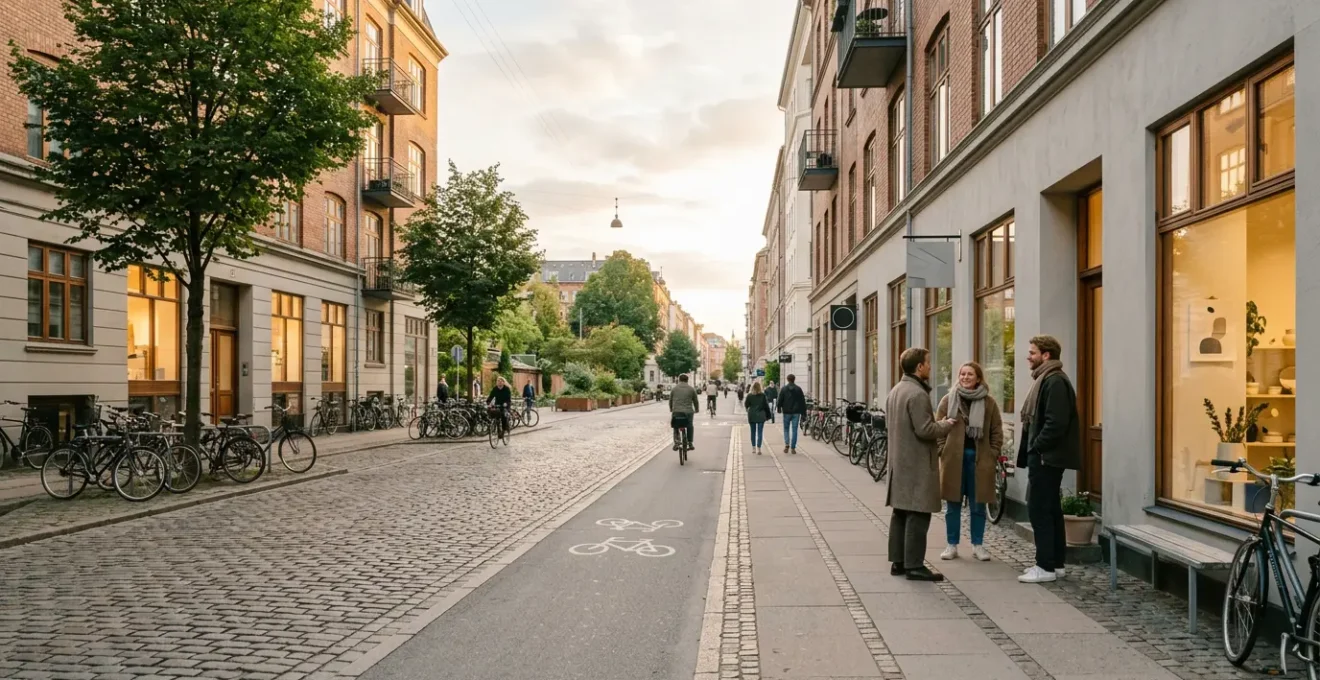
Danish happiness is not a cultural mystery; it’s an engineered outcome of a city designed as an ‘infrastructure of happiness’.
- Urban planning choices in Copenhagen intentionally create social trust, efficiency, and community as the default experience.
- Physical structures, from bike lanes to building layouts, are the primary tools that enable the famous Danish work-life balance and high-trust society.
Recommendation: To understand a city’s quality of life, analyze its physical infrastructure’s impact on human behavior, not just its cultural labels.
For decades, the world has been captivated by Danish happiness, often attributing it to the cozy, untranslatable concept of hygge. We imagine candle-lit rooms and warm social gatherings as the source of this profound contentment. But this romantic view misses the point entirely. It mistakes the symptom for the cause. The remarkable quality of life in cities like Copenhagen is not an accident of culture; it is a meticulously engineered result of decades of visionary urban design. The city itself is a machine built for well-being, an ‘infrastructure of happiness’ where the physical environment is calibrated to make the good life the easy life.
While many discussions focus on lifestyle choices, they overlook the structural foundation that makes those choices possible, even inevitable. Danes cycle not just because they are eco-conscious, but because the infrastructure makes it the safest, fastest, and most logical way to move. They trust their neighbors not because they are inherently more virtuous, but because the city is built on a human scale, with transparent, shared spaces that foster accountability and connection. This approach challenges us to look beyond cultural clichés and examine the concrete, replicable strategies embedded in the streets, buildings, and public squares.
This analysis will deconstruct the physical and systemic mechanisms behind the celebrated Danish art of living. We will explore how Copenhagen’s urban fabric is intentionally woven to produce specific social outcomes: strong communities, profound efficiency, deep-seated trust, and a sustainable future. Forget the candles; the real secret is in the concrete, the bike lanes, and the blueprints.
This article explores the core components of this ‘infrastructure of happiness’. By dissecting Copenhagen’s approach to housing, work, safety, and public space, we reveal the tangible design principles that any city can learn from to improve its citizens’ well-being.
Summary: Deconstructing Copenhagen’s Infrastructure of Happiness
- Co-housing Projects: Why Do Danes Choose to Share Kitchens and Gardens?
- The 37-Hour Work Week: How Do Danes Actually Get Things Done?
- Strollers Outside Cafes: Is It Really Safe to Leave Babies Unattended?
- Playgrounds as Art: Why Are Copenhagen’s Play Spaces So Creative?
- Cargo Bikes: Is It Hard to Transport Kids and Groceries on Two Wheels?
- Why Does Copenhagen Aim to Be Carbon Neutral by 2025?
- How to Navigate a Society Built on High Trust Without Being Naive?
- How to Witness the Future of Green Cities in Copenhagen?
Co-housing Projects: Why Do Danes Choose to Share Kitchens and Gardens?
The Danish decision to embrace co-housing is not a nostalgic return to communal living; it is a pragmatic and highly engineered response to modern social needs. These projects, where private homes are supplemented with shared facilities like large kitchens, dining areas, and green spaces, function as a physical infrastructure for community. They are designed to combat loneliness and increase daily efficiency by making pro-social behavior the path of least resistance. Rather than leaving social interaction to chance, the architecture itself creates natural opportunities for connection, shared meals, and informal childcare.
This model is so successful that the demand far outstrips the supply, demonstrating its appeal beyond a niche group. It is seen as a structural solution for a better quality of life. The evolution of this concept from grassroots initiatives to large-scale, developer-led projects further proves its viability as a modern housing solution.
Case Study: The Shift to Developer-Driven Co-Housing
Since 2018, Denmark has seen a boom in co-housing projects initiated not by residents, but by developers who recognize the market for engineered community. A recent analysis shows these new settlements often contain around 75 dwellings, double the size of traditional projects. This top-down model allows for the rapid creation of heterogeneous communities at scale. While it presents challenges in fostering the same level of voluntary participation as smaller, resident-led initiatives, it represents a significant structural shift: treating community not as a happy accident, but as a feature that can be designed and delivered through urban planning.
By designing for shared resources, co-housing also offers a more sustainable and often more affordable lifestyle. It’s a prime example of how physical design can generate social capital, proving that community can be built into the blueprints of a neighborhood.
The 37-Hour Work Week: How Do Danes Actually Get Things Done?
The Danish 37-hour work week, one of the shortest in the developed world, is often viewed with a mix of envy and disbelief. How can a society work so little yet maintain such high levels of productivity and economic output? The answer lies not in a relaxed work ethic, but in a culture of radical efficiency underpinned by urban design. The city itself is structured to minimize the “dead time” that plagues modern life. Short, safe commutes—often by bike—mean less time and stress in transit. Proximity of housing, schools, and shopping creates a “15-minute city” reality that allows errands to be integrated seamlessly into the day.
This structural efficiency enables a highly focused approach to work. Meetings are punctual and purposeful, and office hours are for working, not for performing presence. The culture respects that everyone has a life to get back to. As the official portal Denmark.dk notes, this focus pays off, as “despite limited working hours, Denmark has some of the world’s highest productivity rates.” The data confirms this reality; recent figures show Danes work on average 1,394 hours per year, 22% lower than the OECD average of 1,746 hours, without a corresponding drop in output.
This system is a powerful demonstration of how work-life balance isn’t just a personal responsibility or a company policy; it’s a city-scale design feature. By engineering a low-friction daily life, Copenhagen empowers its citizens to accomplish more in less time, freeing up valuable hours for family, community, and leisure—the very activities that fuel overall well-being.
Strollers Outside Cafes: Is It Really Safe to Leave Babies Unattended?
For visitors, the sight of baby strollers parked outside a Copenhagen cafe while parents relax inside is a profound culture shock. It begs the question: is it truly safe? The answer is a resounding yes, but this safety is not an accident. It is the most visible outcome of a deeply embedded “infrastructure of trust,” where urban design, social policy, and low crime rates intersect. The practice is grounded in the statistical reality of a hyper-safe society; Denmark’s homicide rate of 0.8 per 100,000 population, for instance, is among the lowest in the world.
However, low crime is only part of the equation. The physical design of the city actively enables this trust. This is the concept of “engineered trust” in action, where the built environment makes trusting others the most logical behavior.
As this image illustrates, Copenhagen’s architecture favors large, street-facing windows, wide sidewalks, and human-scale buildings. This creates a high degree of passive surveillance—the “eyes on the street” phenomenon famously described by Jane Jacobs. There are no dark corners or hidden alleyways. The public realm is transparent and observable, making deviant behavior difficult and unlikely. Parents can see their child from inside the cafe, and fellow citizens implicitly become guardians of the shared public space.
Leaving a baby to nap outside is therefore not an act of blind faith but a rational decision based on a reliable system. It symbolizes a social contract reinforced by bricks and mortar, where the city’s design constantly whispers that you are safe and that your community is watching out for you.
Playgrounds as Art: Why Are Copenhagen’s Play Spaces So Creative?
Copenhagen’s playgrounds are not an afterthought; they are treated as essential pieces of public art and social infrastructure. Ditching generic plastic slides and sanitized rubber floors, the city’s play spaces are imaginative, often surreal landscapes—giant birds, crooked houses, and sprawling octopuses that invite exploration and creative expression. This approach is not a modern fad but stems from a deeply rooted pedagogical philosophy that values autonomy and managed risk in child development. This philosophy is about creating “designed spontaneity.”
The very concept of the modern adventure playground has Danish roots. As academic research on the topic highlights, a foundational moment was the creation of the first “junk playground” in Copenhagen’s Emdrup district. According to one study, “the first junk playground was introduced in 1943 in the Emdrup district of Copenhagen, favoring children’s autonomous play, direct experience, creativity and invention.” This philosophy—that children learn best by building, experimenting, and even facing small, manageable dangers—persists today.
These creative spaces are designed to challenge children physically and mentally. They encourage problem-solving (How do I climb this? How do I balance here?) and social negotiation. Instead of prescribing a single way to play, they offer a rich palette of textures, levels, and abstract forms that fuel imagination. They are a physical manifestation of a society that trusts its children to be competent and resilient. In this context, a playground is not just a place for kids to burn off energy; it is a training ground for life, fostering the creativity, confidence, and risk-assessment skills they will need as adults.
Cargo Bikes: Is It Hard to Transport Kids and Groceries on Two Wheels?
The cargo bike, or ladcykel, is an icon of Copenhagen life, effortlessly hauling children, groceries, and even furniture through the city streets. To an outsider accustomed to car-centric cities, piloting such a vehicle seems daunting. But the question “Is it hard?” misses the point. In Copenhagen, it is made easy—and often preferable—by a world-class infrastructure designed specifically for cycling. The city has systematically removed the physical and psychological barriers that make cycling difficult or dangerous elsewhere.
The key is a network of physically separated, dedicated bike lanes. These are not just painted lines on a busy road; they are often curbed, raised, or otherwise protected from car traffic, creating a genuine feeling of safety. This infrastructure-led behavior change is the reason why 47% of citizens commute by bike. The system is so intuitive that children learn to navigate it from a young age, and adults see it as the most efficient mode of transport for trips under 5 kilometers.
This image of a protected lane shows the reality of cycling in Copenhagen. It is not an athletic feat but a calm, practical, and safe part of daily life. The infrastructure includes features like dedicated traffic signals for bikes, footrests at intersections, and even slightly downhill slopes on green-lit routes to provide a small boost. The cargo bike isn’t just a vehicle; it’s the perfect tool for a transport system designed around human power, and a rolling symbol of a city where the sustainable choice is also the most convenient one.
Why Does Copenhagen Aim to Be Carbon Neutral by 2025?
Copenhagen’s ambitious goal to become the world’s first carbon-neutral capital by 2025 is more than an environmental policy; it is the ultimate expression of its commitment to human-centric urbanism. For Copenhagen’s planners, sustainability and liveability are two sides of the same coin. A city with clean air, quiet streets, green energy, and abundant public spaces is not just better for the planet—it is fundamentally better for people’s physical and mental health. The carbon-neutral target acts as a unifying framework for a series of investments that directly enhance the quality of life.
This vision is realized through concrete infrastructural projects. The city has invested heavily in a city-wide district heating and cooling system that is among the world’s most efficient. It promotes green building standards and has woven green spaces and “blue” elements (water management) into the urban fabric to mitigate climate impacts. The commitment is also visible in its energy profile, where a significant portion of the nation’s electricity is sustainably sourced.
Of course, mobility is central to this plan. The massive investment in cycling infrastructure, with its network of over 390 kilometers of cycle lanes, is a cornerstone of the carbon reduction strategy. But it’s also a strategy for public health, social equity, and noise reduction. By framing its green ambitions around the direct benefits to citizens, Copenhagen builds broad public support and demonstrates that a sustainable city is a more desirable city. The goal is not about sacrifice, but about building a better, healthier, and ultimately happier urban future.
How to Navigate a Society Built on High Trust Without Being Naive?
Danish society operates on an exceptionally high level of social trust, a resource more valuable than any physical commodity. This is a culture where people trust their government, their institutions, and each other. This isn’t naivete; it’s a rational response to a system that is overwhelmingly reliable and transparent. Navigating this environment means understanding that trust is an outcome of the social and physical infrastructure—it is earned, not given blindly.
The robust social welfare system is a key pillar of this “engineered trust.” By providing a strong safety net—including universal healthcare, education, and unemployment benefits—the state reduces the systemic inequalities and personal desperation that can erode social cohesion and breed crime. As one analysis from The Danish Dream puts it, “Denmark’s social welfare systems promote high levels of trust and reduce inequality.” This creates a virtuous cycle: when people feel secure, they are more likely to trust the system and their fellow citizens.
This trust is reflected in hard data. For example, a 2022 Justice Ministry survey found that 87% of the population trusts the police, and 89% feel safe in their own neighborhoods. To navigate this society is to participate in the social contract: you pay your high taxes, and in return, you receive security and high-quality services. You leave your laptop on a cafe table when you use the restroom because the shared understanding is that the system works for everyone. The key is not to be less cautious, but to recognize that the incentives are aligned toward cooperation, not exploitation.
Key Takeaways
- Danish happiness is a design feature, not a cultural quirk. The city’s physical infrastructure is the primary driver of well-being.
- Urban design can “engineer” social outcomes like trust, community, and efficiency by making pro-social behaviors the easiest and most logical choice.
- A truly sustainable city is one where green policies directly align with and enhance the daily quality of life for its citizens.
How to Witness the Future of Green Cities in Copenhagen?
To truly understand how Copenhagen engineers happiness, one must experience its infrastructure firsthand. For urban planners, architects, and curious citizens, the city is a living laboratory—a blueprint for a future where sustainability and human well-being are inextricably linked. Witnessing this future means looking beyond the tourist sights and learning to read the urban fabric for the principles it embodies. It means observing how design choices directly shape the flow of daily life, fostering a sense of ease, safety, and connection.
From the harbor baths that turned industrial waterfronts into social hubs, to the renewable energy plant (CopenHill) with a ski slope on its roof, the city constantly redefines what urban infrastructure can be. Every bench, bike lane, and shared garden is a data point in a grand experiment of creating a city that works for people. By exploring these spaces with a strategic eye, you can deconstruct the “magic” of Danish living into a set of tangible, replicable strategies.
Action Plan: Auditing Copenhagen’s Green Urbanism
- Identify Key Systems: List the core systems you want to observe: mobility (cycling, public transport), housing (co-housing, new developments), public space (parks, playgrounds), and energy/waste (CopenHill, harbor quality).
- Map Your Sites: For each system, identify specific locations to visit. Examples include the Ørestad district for modern architecture and mobility, Nordhavn for sustainable urban expansion, and Superkilen park for community-driven public space.
- Observe and Document: At each site, document how the design influences behavior. How are people using the space? What makes the sustainable choice the easy choice? Note the quality of materials, the human-scale dimensions, and the integration of nature.
- Analyze the “Software”: Look beyond the “hardware” (the physical construction). Observe the social “software” it enables: levels of social interaction, perceived safety, and evidence of trust (e.g., unattended belongings).
- Synthesize Learnings: Connect your observations back to the core principles. How did the design of this bike lane increase efficiency? How did this public square build social trust? Formulate these connections as actionable insights for your own context.
By following this process, you can move from simply admiring Copenhagen to actively learning from it, bringing home not just souvenirs, but a structural understanding of how to build happier cities.