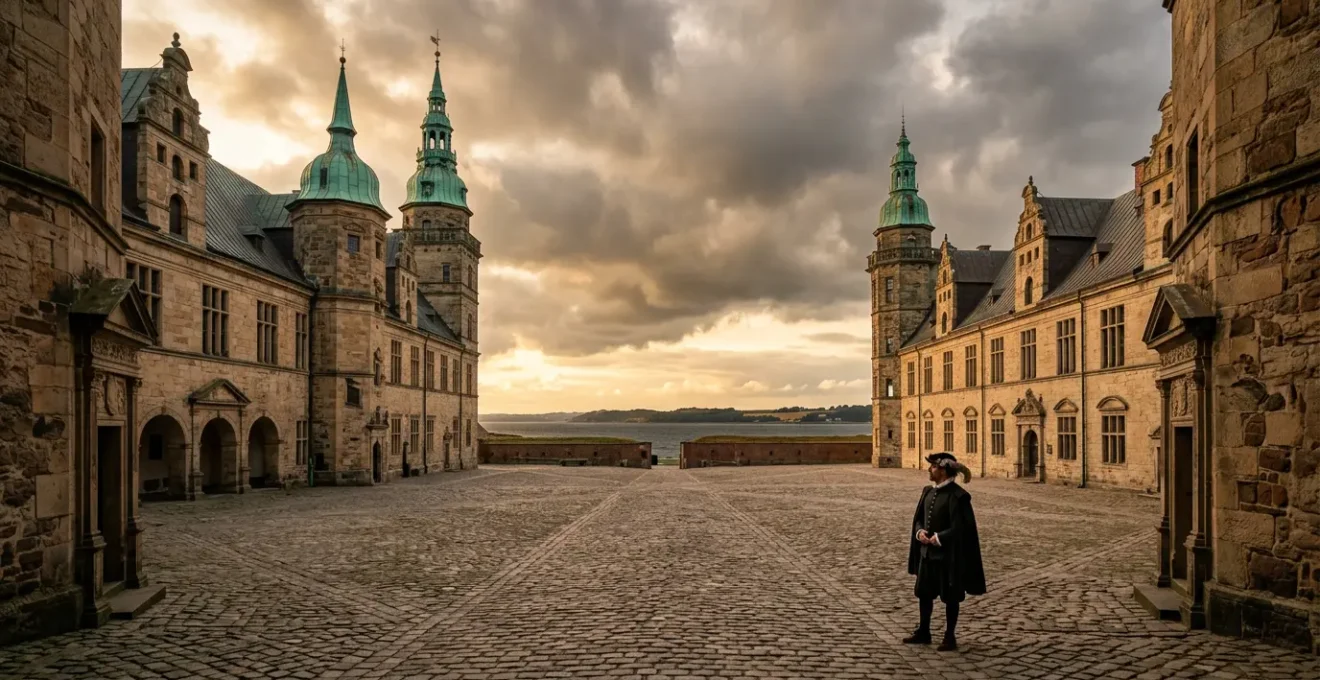
The ‘Hamlet Live’ experience is not an ‘extra’—it is the very soul of a visit to Kronborg, transforming a historical site into a breathtaking piece of immersive theatre.
- The performance is included with the standard castle ticket, making the “extra cost” a misnomer; the value is immense.
- Actors interact with visitors, breaking the fourth wall and weaving the audience into the unfolding tragedy throughout the castle.
Recommendation: Prioritize your visit around the ‘Hamlet Live’ schedule. It’s the rare chance to step out of the role of tourist and into the living, breathing world of Shakespeare’s most famous play.
The question hangs in the salt-tinged air of Helsingør like a ghost on the battlements: in a castle brimming with history, is the interactive “Hamlet Live” experience truly worth the price of admission? Many travelers, ticking off UNESCO sites, approach Kronborg Castle as a museum—a static collection of royal apartments, cold stones, and historical plaques. They consult guides, plan their routes, and seek the quickest path to understanding.
But what if the key to unlocking Kronborg’s spirit isn’t found in a history book, but in the flicker of a tragic prince’s eye? What if the most profound experience lies not in observing the past, but in allowing it to accost you in a hallway? This guide casts aside the traditional tourist checklist. We will not merely walk through Kronborg; we will inhabit it. We will treat the castle not as a destination, but as a stage, and evaluate its central performance. The central thesis here is a piece of critical advice: stop seeing “Hamlet Live” as an attraction. It is the narrative framework, the emotional architecture that gives the ancient stones their voice. This article will dissect the performance, explore the castle’s other myths and realities, and ultimately guide you in crafting a day trip worthy of the drama itself.
This guide offers a critic’s perspective on structuring your visit to Kronborg Castle. We will move from the central performance to the historical foundations, practical logistics, and adjacent wonders, helping you compose a truly memorable Danish day trip.
Summary: Hamlet Live: Is the Interactive Theater at Kronborg Worth the Extra Cost?
- Hamlet Live: Is the Interactive Theater at Kronborg Worth It?
- Did Hamlet Actually Live at Kronborg Castle?
- The Dark Casemates: Do You Need a Flashlight for the Underground Passages?
- Where to Photograph the Castle to Get Sweden in the Background?
- When Does the Spire Master Fire the Cannons at Kronborg?
- Is the M/S Maritime Museum Worth Adding to a Castle Visit?
- What Lies Behind the Facades of Nyhavn 18 and 20?
- How to Choose the Best Renaissance Castle Day Trip from Copenhagen?
Hamlet Live: Is the Interactive Theater at Kronborg Worth It?
Let us begin with the central drama. Is “Hamlet Live” worth it? This is, forgive the theatricality, the wrong question. The right question is: can one truly experience Kronborg *without* it? The answer, from a critical perspective, is a resounding no. This is not a quaint historical reenactment; it is a masterclass in site-specific, immersive theatre. The first point to clarify is that the experience is included with the standard 145 DKK castle admission, so the “extra cost” is a fiction. The true value is immeasurable.
Throughout the day, from June to August, professional actors inhabit the roles of Hamlet, Ophelia, Claudius, and the court. They do not remain politely on a stage; the castle is their stage. A tense argument erupts in the Great Hall. A melancholic Ophelia might be found distributing flowers by a window. You turn a corner and nearly collide with a scheming Polonius. This is the genius of the production: it shatters the fourth wall. Visitors are not mere spectators; we are extras, silent witnesses in the court of Elsinore, our presence acknowledged with a nod, a glare, or a conspiratorial whisper.
The experience breathes life into the very architecture, transforming a stone corridor from a passageway into a site of imminent betrayal. As one visitor noted, this is what elevates Kronborg above other historical properties. A Tripadvisor review captures the magic perfectly, highlighting the dedication of the cast:
We visit a LOT of castles and period properties, and this has been the best experience by far! There was a jester, in character, buzzing about all day. Absolutely fantastic, never slipping from character. There was also a king and queen buzzing about and even performing a full Hamlet scene in the ballroom!
– Visitor Review, TripAdvisor
To treat this as an optional sideshow is to miss the point entirely. It is the heart of the matter, the living ghost that animates this magnificent fortress. To get the most from this theatrical marvel, a strategy is required.
Action Plan: Maximizing Your Hamlet Live Experience
- Arrive at the 10 am opening to witness the first scenes in the main courtyard, setting the stage for the day’s drama.
- Position yourself in the Great Hall mid-morning; this is often the setting for the pivotal ‘play within a play’ scene involving the full cast.
- Follow the sound of drama: scenes in English occur roughly every 30 minutes, with actors moving between locations and roaming the halls in character.
- Embrace the interaction: don’t be shy if a character addresses you. Allow them to guide the encounter—you are part of their world now.
- Plan for a full day: the performances run from 10 am to 5 pm, and the narrative evolves, rewarding those who stay for the tragic final act.
Did Hamlet Actually Live at Kronborg Castle?
With the drama of Hamlet Live fresh in our minds, we must address the foundational question that draws so many here. Did the melancholy prince of Denmark truly walk these halls? The answer, like a good tragedy, is layered. Historically, no. Hamlet is a figure of legend, first chronicled by Saxo Grammaticus centuries before Kronborg was built in its current Renaissance form, and later immortalized by Shakespeare. The Bard never visited Denmark, but the castle’s formidable reputation as “Elsinore” was enough to capture his imagination.
Yet, to dismiss the connection is to miss the point. The castle is not where Hamlet lived, but where his legend has come to reside. Kronborg has so thoroughly adopted this role that the fiction has become a powerful, self-perpetuating truth. The castle is the world’s most famous stage for performances of Hamlet, and this theatrical identity is what gives the location its unique power. The line between history and literature is not just blurred here; it’s artfully erased.
This potent blend of real history and literary myth is undeniably effective, attracting over 300,000 visitors each year, all seeking a brush with the ghost of a fictional prince. They come for Hamlet, and in doing so, they participate in the castle’s grandest performance: the ongoing play of being “Hamlet’s Castle.” The stones may be historically Frederick II’s, but the soul of Kronborg belongs to Shakespeare. The “Hamlet Live” actors are not just performing a play; they are upholding the castle’s most vital and lucrative identity. So while you won’t find Hamlet’s birth certificate in the archives, you will feel his presence in every shadow and whisper—a testament to the power of storytelling to create a reality all its own.
The Dark Casemates: Do You Need a Flashlight for the Underground Passages?
Descending from the regal light of the royal apartments into the subterranean casemates is a journey into a different kind of Danish legend. This is a chilling intermission, a descent from Shakespeare’s courtly drama into the raw, chthonic myths of the nation. The air grows cool and damp, the sound of the sea a distant memory. These dark, labyrinthine passages were designed as soldiers’ quarters during times of siege, a grim, functional space built for survival.
Do you need a flashlight? While the main paths are dimly lit, a phone light or small torch is highly recommended. Not for navigation, but for exploration. The official lighting is atmospheric, designed to create mood, but your own light allows you to probe the dark corners, to trace the centuries of dampness on the brickwork, and to truly feel the oppressive, claustrophobic reality of a soldier’s life here. It transforms you from a passive tourist into an active explorer of the dark.
The true purpose of this descent, however, is to pay pilgrimage to the castle’s other great spirit: Holger Danske (Ogier the Dane). Deep within the casemates sits a brooding statue of the mythical king, slumbering until the day Denmark is in mortal peril, at which point he will awaken to defend the realm. Finding him in the gloom is a powerful moment. He is the castle’s silent, sleeping heart, a stark contrast to the verbose, tormented prince above ground. Hamlet wrestles with the soul of Denmark; Holger Danske *is* its soul, forged in stone and waiting in darkness. The question of a flashlight becomes secondary; the real illumination comes from understanding this deep, mythic counterbalance to the drama unfolding in the sunlit halls above.
Where to Photograph the Castle to Get Sweden in the Background?
Emerging from the mythological darkness of the casemates, the modern visitor’s concern often snaps back to the tangible: capturing the perfect image. The castle’s strategic position on the Øresund strait, a mere 4km from the Swedish coast, offers a unique photographic opportunity. Capturing Kronborg with Sweden in the background is not just a holiday snap; it is a visual testament to the castle’s entire reason for being—its absolute dominance over this narrow waterway.
The key is elevation and angle. While many tourists crowd the shoreline, the most commanding views are found by turning back toward the castle itself and using its own fortifications. The eastern ramparts, specifically near the Cannon Tower, provide the ideal vantage point. From here, the Danish flag, the castle’s formidable structure, and the hazy silhouette of Helsingborg, Sweden, can be framed in a single, powerful composition. This isn’t just a pretty picture; it’s a visual narrative of power, geography, and history.
For the dedicated photographer, achieving the definitive shot requires more than just finding the right spot. It demands a strategy that considers light, perspective, and equipment. Here are the key elements to orchestrating your perfect shot:
- Golden Hour is Crucial: The soft, angled light of early morning or late afternoon will illuminate the castle’s facade while providing a clear, beautifully lit view across the strait.
- Creative Framing: Avoid the obvious “postcard” shot by using the castle’s own architecture. Frame the view of Sweden through one of the cannon ports for a more creative and historically resonant perspective.
- Go Wide, Go Sharp: A wider lens (24-35mm range) combined with a smaller aperture (f/8 or higher) will help ensure that both the castle in the foreground and the Swedish coast in the background remain in sharp focus.
- The Water-Level Perspective: For a truly unique angle, take the ferry that runs between Helsingør and Helsingborg. The view of Kronborg from the water level, with the town and spires behind it, is a perspective few bother to capture.
- The Ultimate Panorama: For those willing to climb the 144 steps to the castle tower, the reward is an unrivaled 360-degree panoramic view that places Kronborg at the center of its historic maritime domain.
When Does the Spire Master Fire the Cannons at Kronborg?
The image of cannons at Kronborg is inseparable from its identity. They are not mere decoration; they are the iron teeth of the fortress, the instruments of its historic power. Visitors often ask when they are fired, hoping to witness a dramatic spectacle. While daily firings are not part of the regular schedule, ceremonial firings do occur on special occasions, such as royal birthdays. However, the true story of these cannons is not about spectacle, but about economics.
For over 400 years, Kronborg’s primary role was not military defense in the traditional sense, but the enforcement of the “Sound Dues” (Sundtolden). This toll was a tax levied on every single foreign ship passing through the narrow Øresund strait. The cannons were the muscle behind this incredibly lucrative protection racket. Their presence was a constant, powerful reminder to merchant captains to drop anchor, sail into Helsingør, and pay their dues to the Danish Crown. The threat of their fire was far more profitable than its actual use.
The sheer scale of this operation is staggering. It is the economic engine that funded the Danish Renaissance and transformed Kronborg from a simple fortress into the magnificent castle we see today. According to UNESCO, the historical record of this toll is one of the most complete and extensive in the world, documenting a period when approximately 1.8 million ships paid toll between 1429 and 1857. Every brick of the Great Hall, every tapestry, was paid for by this cannon-backed enterprise.
So, when you look at the silent cannons today, don’t imagine them firing in the heat of battle. Instead, imagine them as the ultimate cash registers, ensuring a steady flow of gold into the royal coffers with every ship that passed under their silent, menacing gaze. The most powerful sound they made was often the jingle of coins in the king’s treasury. The absence of a daily cannon blast is, in itself, a more accurate reflection of their true historical purpose: a deterrent so effective it rarely needed to be used.
Is the M/S Maritime Museum Worth Adding to a Castle Visit?
Just outside Kronborg’s ramparts lies a surprising and brilliant counterpoint: the M/S Maritime Museum of Denmark. The question of whether to add it to your castle visit is a question of narrative. If Kronborg is the story of power *on* the sea, the museum is the story of life, trade, and humanity *from* the sea. It is an essential second act, and for lovers of architecture, it is a destination in its own right.
Designed by the world-renowned Bjarke Ingels Group (BIG), the museum is an architectural marvel. To preserve the iconic view of the UNESCO-protected castle, the entire museum was built underground, inside and around a former dry dock. Visitors descend into the earth, walking on sloping bridges that crisscross the vast concrete void. The New York Times aptly named it ‘a cutting-edge cultural venue,’ and its design is a breathtaking fusion of industrial heritage and modern innovation. The museum presents Denmark’s vast maritime history, from Viking longships to modern container shipping, using interactive and multimedia exhibits that are both educational and deeply engaging.
But is it worth the extra time and potential “castle fatigue”? The decision depends on your interests and stamina. For families, the “Dream Ship” play area is a godsend. For architecture buffs, the building itself is the main exhibit. For history lovers, it provides the rich context of the trade that made Kronborg possible. The following table breaks down the decision-making process:
| Factor | Castle Only (Express Tour) | Castle + Museum (Full Experience) |
|---|---|---|
| Time Required | 2-3 hours | Full day (5-6 hours) |
| Best For | Shakespeare/Hamlet fans on a tight schedule | Architecture enthusiasts, families, comprehensive learners |
| Physical Demand | Moderate (tower steps, uneven surfaces) | High (extensive walking, underground exploration) |
| Key Highlights | Hamlet Live, Royal Apartments, Holger Danske | All castle highlights + BIG architecture, interactive exhibits |
| Visitor Fatigue Risk | Low | High – plan for breaks and coffee |
Ultimately, skipping the museum is like reading only the first half of a great book. The castle tells you *what* the power was, but the M/S Maritime Museum tells you *how* that power was built and who it affected. Together, they offer a complete, compelling narrative of Denmark’s relationship with the sea.
What Lies Behind the Facades of Nyhavn 18 and 20?
Before you even board the train to Helsingør, your Danish story likely begins or ends at Nyhavn, Copenhagen’s iconic harbor. The brightly colored 17th-century facades are the city’s picture-postcard image, a bustling scene of cafes, boats, and tourists. But this vibrant starting point provides a crucial narrative contrast to the solemn, monolithic grandeur of Kronborg Castle. Nyhavn is intimate, human-scaled, and chaotic; Kronborg is imposing, regal, and orderly. The day trip is a journey between these two poles of Danish identity.
Behind the specific facades of Nyhavn 18 and 20 lies another ghost of Danish literature: Hans Christian Andersen. The famed fairytale writer lived at number 20, where he wrote some of his earliest tales, and later at number 18. His presence haunts this harbor just as Hamlet’s haunts Kronborg. One brought us “The Little Mermaid,” the other “to be or not to be.” One represents the whimsical, imaginative soul of Denmark, the other its existential, brooding intellect.
Thinking about your day trip from this perspective elevates it from a simple logistical exercise. Your journey from Copenhagen to Kronborg is a symbolic trip from the world of Andersen to the world of Shakespeare. You leave the colorful, lively harbor where stories are told to children and travel to a stark, windswept fortress where kings are murdered and princes contemplate suicide. It’s a journey from the light into the shadow, and it makes the return to Nyhavn’s cheerful chaos at the end of the day feel all the more welcome and earned.
So, as you sit at a Nyhavn cafe, planning your castle excursion, take a moment. Look at the houses, the water, the people. You are at the heart of one story. Soon, you will travel to the heart of another. The tension between these two worlds—the bustling city and the lonely castle, the fairytale and the tragedy—is what makes this particular day trip so uniquely profound.
Key Takeaways
- ‘Hamlet Live’ is not an optional extra but an essential, immersive theatrical experience included in the standard castle ticket.
- The castle’s identity is a powerful blend of real Renaissance history and the adopted literary legend of Shakespeare’s Hamlet.
- A complete visit should embrace both the courtly drama above ground and the mythical darkness of the casemates below.
How to Choose the Best Renaissance Castle Day Trip from Copenhagen?
The final act of planning your trip involves a pragmatic choice. Kronborg is magnificent, but it is not the only Renaissance castle vying for your attention. Nearby Frederiksborg Castle offers a different, yet equally compelling, experience. Choosing the “best” day trip is less about a definitive ranking and more about aligning the destination with your personal interests, time, and budget. It is here that practical tools like the Copenhagen Card enter the stage.
The decision to purchase a Copenhagen Card is a financial calculation that depends entirely on your itinerary. It is not a one-size-fits-all solution. For a traveler focused solely on a single-day trip to Kronborg, the card is likely not cost-effective. However, for those planning a multi-attraction blitz, it can offer significant savings and convenience. A careful cost-benefit analysis is essential.
Here’s a breakdown of the financial considerations when using the Copenhagen Card for a castle-focused itinerary:
- All-Inclusive Coverage: The card includes train travel from Copenhagen to Helsingør, plus free entry to both Kronborg Castle and the M/S Maritime Museum.
- The Break-Even Point: A 24-hour Copenhagen Card becomes cost-effective if you visit at least two major attractions (like Kronborg and the Maritime Museum) and use public transport within the city on the same day.
- Single-Focus Trip Calculation: A direct round-trip train ticket costs around 160 DKK, and castle entry is 145 DKK, totaling 305 DKK. The 24-hour card is more expensive, so it only makes sense if you add more sights.
- The Multi-Day Strategy: The card’s best value is often realized over several days, allowing you to visit Kronborg on one day and perhaps Frederiksborg or attractions in Copenhagen on another, maximizing the “free” travel and entry benefits.
Ultimately, choosing your Renaissance castle day trip is the final scene you must write. If your soul yearns for drama, for the raw meeting of literature and history on a windswept coast, then Kronborg is your undeniable star. If you seek opulent interiors and landscaped gardens, Frederiksborg may call to you. The “best” choice is the one that provides the most satisfying conclusion to your own Danish story.
Armed with this critical insight, you are now prepared not just to visit a castle, but to engage with a living performance. Orchestrate your perfect day trip, choose the acts that resonate with you, and step onto the stage of Denmark’s most dramatic story.