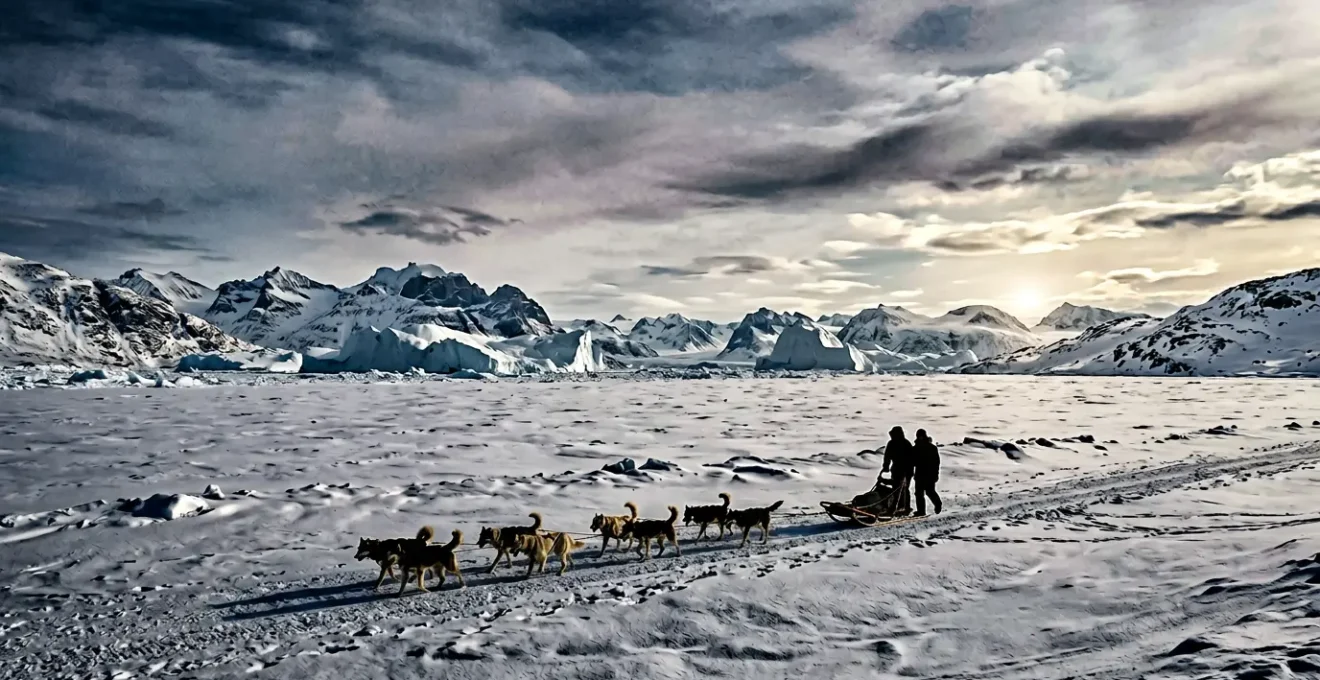
Executing a successful dogsledding expedition in Greenland from Copenhagen is a matter of precise logistical choices, not a simple holiday add-on.
- Authenticity depends on understanding that dogsledding is a form of cultural transport, not a tourist ride.
- Your physical readiness and choice of gear are not suggestions; they are critical safety parameters for the Arctic.
Recommendation: Shift your mindset from ‘booking a tour’ to ‘planning an expedition,’ focusing on cultural respect and operational readiness as your primary goals.
You’re in Copenhagen, soaking in the hygge and Scandinavian design, but your mind is further north. The real call of the wild—the vast, frozen expanse of Greenland—is just a short flight away. Many travelers dream of adding an Arctic bookend to their Danish trip, picturing themselves gliding across the snow behind a team of energetic dogs. It seems simple enough: book a flight, book a tour, and go.
This is the first and most critical mistake in underestimating the Arctic. The common advice to “pack warm” and “book in advance” barely scratches the surface. This isn’t like adding a day trip to a nearby city; it’s a logistical and environmental pivot from a temperate European capital to one of the world’s most demanding environments. The real challenge isn’t just getting there; it’s about being prepared, respectful, and ready for an experience that is far more than a tourist attraction.
But what if the key to a truly unforgettable dogsledding journey wasn’t just in the ‘what’ or ‘where’, but in the ‘how’ and ‘why’? This guide is your tactical briefing. We will move beyond the glossy brochures to dissect the critical decisions you need to make. We’ll cover timing, gear, physical demands, and the profound cultural context of dogsledding, equipping you to plan not just a trip, but a genuine expedition.
This article provides a complete operational blueprint. To help you navigate this mission-critical information, the following summary outlines the key intelligence points we will cover, from seasonal strategy to your final destination choice.
Summary: Your Tactical Guide to an Arctic Dogsledding Expedition
- April or February: When Is the Snow Best for Sledding in Kangerlussuaq?
- Working Animals vs Pets: Why You Shouldn’t Try to Pet the Sled Dogs?
- Seal Skin or Gore-Tex: What Clothing Do You Need for -20 Degrees?
- Passenger or Musher: How Physically Demanding Is Driving Your Own Sled?
- Sledding Traditions: How to Experience Dogsledding as a Cultural Transport?
- Wind Chill Factor: Why 50km/h Makes -10 Feel Like -30?
- Raincoats to Parkas: What to Pack for a Trip Spanning Copenhagen to Oslo?
- Svalbard or Lapland: Which Snowmobile Destination pairs best with a Danish Trip?
April or February: When Is the Snow Best for Sledding in Kangerlussuaq?
Your first strategic decision is timing. An Arctic expedition is dictated by the seasons, and dogsledding has a specific operational window. While winter in Greenland stretches for months, the prime time for a dogsledding mission out of Kangerlussuaq is not a matter of guesswork. The period from February to April is consistently identified as the sweet spot. This is the cold-weather calculus in action: you need a deep, stable snowpack that has consolidated over the winter, but also the increasing daylight of late winter and early spring.
February offers the raw, crisp heart of winter. The cold is profound and the snow is often powdery and deep. This is when you’re most likely to combine your sledding journey with the ethereal glow of the Aurora Borealis. However, the days are shorter and the conditions more demanding. April, by contrast, brings the promise of spring. The sun is higher and stronger, offering longer days for exploration and slightly more forgiving temperatures. The snow is often hard-packed and fast, providing excellent sledding conditions, though your chances of seeing the Northern Lights diminish as the nights grow shorter.
Choosing between them depends on your mission priorities. Do you want the classic, deep-winter Arctic experience with a high probability of auroras? Choose February. Do you prefer longer daylight hours for extended travel and photography, with more comfortable conditions? Aim for March or April. Both months offer world-class conditions, but they provide two very different textural experiences of the Arctic landscape.
Working Animals vs Pets: Why You Shouldn’t Try to Pet the Sled Dogs?
One of the most profound shifts in mindset required for a Greenlandic expedition is understanding the nature of the Greenland Dog. These are not the friendly, fluffy huskies you might find in more tourist-oriented locations. Approaching them as pets is a fundamental, and potentially dangerous, misunderstanding of their role and heritage. The Greenland Dog is a professional working animal, a four-legged polar athlete with an ancient and powerful lineage.
This is a distinct breed, protected by law in Northern Greenland, with a genetic history that is remarkably pure. In fact, research shows the breed has a traceable history of nearly 9,500 years back to Eastern Siberia, making them one of the oldest and most unchanged dog breeds on Earth. They are bred for strength, endurance, and a hierarchical pack mentality, not for human companionship in the way we understand it with domestic pets. Their excitement before a run is not a plea for affection; it is the raw, primal urge to work and pull.
As the experts at Greenland by Topas note, this focus is absolute. “Greenlandic sled dogs are keen working dogs. Before departure, the dogs bark with excitement, pulling at their harness to get going. They’re extremely robust and can tolerate temperatures as low as minus 57 degrees Celsius.” Your role as a visitor is one of respect, not familiarity. Always follow the musher’s instructions. Do not approach, touch, or feed the dogs without explicit permission, which is rarely given. Your safety, and the integrity of the pack’s working dynamic, depends on it. Admire their power and history from a respectful distance.
Seal Skin or Gore-Tex: What Clothing Do You Need for -20 Degrees?
In the Arctic, your clothing is not fashion; it is life-support equipment. The difference between a successful expedition and a dangerous ordeal is your layering system. While traditional Inuit clothing made from seal skin and caribou fur represents millennia of perfected adaptation, the modern adventurer will rely on a technical layering system. The core principle is not simply to pile on thick clothes, but to manage moisture and trap air effectively.
The system is built on three pillars: a base layer to wick sweat away from your skin, a mid-layer to insulate and trap body heat, and an outer shell to protect you from wind and water. Forget cotton, which holds moisture and freezes. Your life depends on merino wool or high-quality synthetics. A common mistake is focusing only on the jacket. Your legs, feet, hands, and head are equally, if not more, vulnerable. Insulated boots, a warm hat, a balaclava or face mask, and a dual-glove system (thin liners inside thick mittens) are non-negotiable pieces of your survival kit.
Remember that you will often be provided with a heavy-duty outer suit and boots by your tour operator. However, what you wear underneath is your personal responsibility and the key to your comfort and safety. Dressing for -20°C is about building a personal microclimate that you can adjust as your activity level changes. It’s a science, and it demands respect and preparation.
Your Arctic Layering System Checklist
- Base Layer: Procure moisture-wicking thermal underwear (merino wool or synthetic) to pull sweat away from the skin.
- Mid Layer: Select an insulating fleece or down jacket designed to trap warm air close to the body for thermal regulation.
- Outer Shell: Ensure you have a windproof and waterproof jacket and pants to shield you from Arctic elements and the severe wind chill.
- Extremity Protection: Assemble your protection for hands, feet, and face: liner gloves inside thick mittens, wool socks with liner socks, and a balaclava.
- Footwear: Confirm your insulated, waterproof boots are rated for extreme cold and are sized one size larger to accommodate thick socks without restricting circulation.
Passenger or Musher: How Physically Demanding Is Driving Your Own Sled?
The fantasy of dogsledding often involves passively sitting in a sled, wrapped in furs, while a musher handles the work. In Greenland, this is certainly an option and a fantastic way to experience the landscape. However, for the true adventurer, the option to “drive your own sled” is a powerful draw. It is also a commitment that requires a serious and honest assessment of your physical fitness. This is not a leisurely ride; it is an active, demanding sport.
As a musher, you are an active partner with the dogs. You will be standing on the runners for hours, constantly adjusting your balance. You will need to run alongside the sled, often in deep snow, to help the dogs up steep inclines. You must have the core and leg strength to “pedal” with one foot to give the sled momentum. And if you fall off—which you will—you need the agility and cardiovascular endurance to get up, run, and jump back on the moving sled before it disappears over the horizon. As the Iditarod Trail Committee bluntly states, “Mushers need to have upper body strength, lower body strength, core strength, cardio-vascular endurance, flexibility and mental stamina.”
The experts at Petter Karlsson Sleddogs provide a stark, tactical assessment of the requirements. A successful participant should be able to run 60-100 metres in deep snow and have the balance to hop on and off a moving sled. This is the baseline. The physical demands increase exponentially with difficult terrain or fresh snowfall. If you are not in good physical condition, opting to be a musher is not just unwise, it’s a liability to yourself, your guide, and the dogs. Be honest in your self-assessment: are you a passenger or are you a crew member? The answer will define the nature of your expedition.
Sledding Traditions: How to Experience Dogsledding as a Cultural Transport?
To experience dogsledding in Greenland is to participate, however briefly, in a cultural tradition stretching back thousands of years. For over 4,000 years, the dog sled was the primary means of transportation, hunting, and survival in the Greenlandic winter. It is a cornerstone of Inuit culture, a living symbol of the deep, symbiotic relationship between humans and animals in the Arctic. Today, however, this tradition is at a complex crossroads, challenged by climate change and the advent of the snowmobile.
The shift is stark. While the snowmobile is more efficient for many practical tasks, it has also contributed to a significant decline in the sled dog population. Conservation data indicates the population halved over 20 years to just 12,000 dogs by 2021. This makes your decision to participate in a traditional dogsledding tour a vital act of cultural and economic support. By choosing an authentic tour led by a local Greenlandic musher, you are not just buying an experience; you are investing in the preservation of this working heritage.
To experience dogsledding as cultural transport, you must approach it with curiosity and respect. Ask your musher about their dogs, their family history with sledding, and the techniques passed down through generations. Listen to the sounds of the sled on the snow and the musher’s commands to the dogs. Understand that you are not merely a tourist on an excursion, but a witness to a profound cultural practice. This perspective transforms the journey from a simple activity into a meaningful cultural exchange, connecting you to the very soul of Arctic Greenland.
Wind Chill Factor: Why 50km/h Makes -10 Feel Like -30?
The thermometer is a liar in the Arctic. The number it shows is only one part of the equation. The single most important environmental factor you will face on a dogsled is the wind chill. This is not a psychological feeling of being colder; it is a physical phenomenon that dramatically accelerates heat loss from your body. A -10°C day can feel pleasant in calm, sunny conditions. But add a 50 km/h wind as your sled picks up speed, and the perceived temperature plummets to a life-threatening -30°C or colder.
Wind chill works by stripping away the thin layer of warm air trapped next to your skin by your clothing. The faster the wind, the more quickly this heat is removed. This is why a windproof outer shell is the most critical piece of your gear—far more important than the thickest fleece. As Arctic clothing experts explain, even a moderate 20 mph wind at 0°F (-17°C) creates a wind chill of -22°F (-30°C). Your body reacts to this perceived temperature, and so must your planning.
Understanding wind chill is a matter of safety and survival. It’s the reason why no exposed skin is acceptable, and why a balaclava and ski goggles are essential, not optional. It dictates how you protect your gear, as batteries in phones and cameras will die almost instantly when exposed to extreme wind chill. Pay more attention to the wind forecast than the temperature forecast. It is the wind that carries the true bite of the Arctic, and respecting its power is fundamental to a safe expedition.
Raincoats to Parkas: What to Pack for a Trip Spanning Copenhagen to Oslo?
The logistical challenge of a Copenhagen-to-Greenland trip is one of climatic extremes. You will be packing for two completely different planets. In Copenhagen, you might need a light jacket or raincoat. In Kangerlussuaq, you need a technical apparel system designed to withstand polar conditions. This requires smart, modular packing, not just more luggage.
Your strategy should be to pack two distinct modules. The “City Module” contains your clothing for temperate, urban Scandinavia. The “Arctic Module” contains your specialized layering system: thermal base layers, fleece or down mid-layers, and your personal accessories like wool socks, balaclava, and liner gloves. The heavy, bulky items—the expedition-grade parka and insulated boots—are often provided by your Greenlandic outfitter, so confirm this before you pack. Your own high-quality, windproof/waterproof outer shell (jacket and pants) remains essential, serving you well in a Danish downpour and as a critical component of your Arctic system.
This dual-packing approach allows you to travel relatively light. You can leave the bulk of your city clothes in storage at your Copenhagen hotel while you make the Greenland pivot. The journey itself is surprisingly straightforward; the direct flight from Copenhagen to Kangerlussuaq takes only about 4.5 hours, a small temporal leap for such a massive environmental one. The key is to pack with intention, ensuring every item in your Arctic module is a high-performance, field-tested tool, not just an article of clothing.
Key takeaways
- Timing is Tactical: Choose February for deep winter and auroras, or April for longer days and faster snow. This decision sets the tone for your entire expedition.
- Respect the Athletes: Greenland Dogs are working professionals, not pets. Your safety and their focus depend on you keeping a respectful distance.
- Gear is Life Support: Your layering system is a technical tool for survival. Master the principles of base, mid, and outer layers, and leave no skin exposed to the wind.
Svalbard or Lapland: Which Snowmobile Destination pairs best with a Danish Trip?
As you finalize your Arctic plans, it’s wise to understand where Greenland sits in the spectrum of northern destinations. If your primary goal is an authentic, culturally-rooted dogsledding experience, Greenland is arguably unparalleled. But adventurers often consider other Nordic regions like Lapland (in Finland or Sweden) and Svalbard (Norway). Each offers a different “theater of operations” with unique characteristics.
Lapland is generally more accessible and commercialized. The dogsledding often involves Siberian or Alaskan huskies—bred more for their friendly nature—on well-trodden forest trails. It’s a fantastic European winter holiday, often combined with reindeer experiences and visits to Santa Claus Village, but it lacks the raw, vast emptiness and the specific Inuit cultural connection of Greenland.
Svalbard, on the other hand, is even more extreme and remote than Greenland. It is the kingdom of the polar bear, and while dogsledding exists, the primary mode of travel is the snowmobile. An expedition here is less about cultural transport and more about confronting a stark, high-Arctic polar desert. The logistics from Copenhagen are also more complex, typically requiring a connection through Oslo. For the traveler based in Denmark, Greenland offers the most direct and culturally distinct dogsledding expedition.
| Destination | Dogsledding Experience | Cultural Connection | Logistics from Copenhagen | Unique Features |
|---|---|---|---|---|
| Greenland (Kangerlussuaq) | Authentic cultural transport with pure-bred Greenlandic dogs on vast open ice | Former Danish territory, strong historical link via Air Greenland | Direct 4.5-hour flight, simplest connection | Inuit culture, colossal icebergs, Inland Ice Sheet access |
| Lapland (Finland/Sweden) | Commercialized husky safaris through forests, more tourist-oriented | Sámi indigenous culture, Santa Claus Village | Budget airlines available, feels like European winter holiday | More accessible, milder temperatures, reindeer sledding alternative |
| Svalbard (Norway) | Dogsledding available but snowmobiling is primary activity | Norwegian Arctic territory, polar bear capital | Requires connection via Oslo, more complex for short trip | Polar bear viewing, stark polar desert landscape, northernmost settlement |
With this tactical briefing complete, your mission is clear. It’s time to move from the planning phase to execution. Evaluate your fitness, audit your gear, and choose the expedition that aligns with your goal for an authentic Arctic experience.