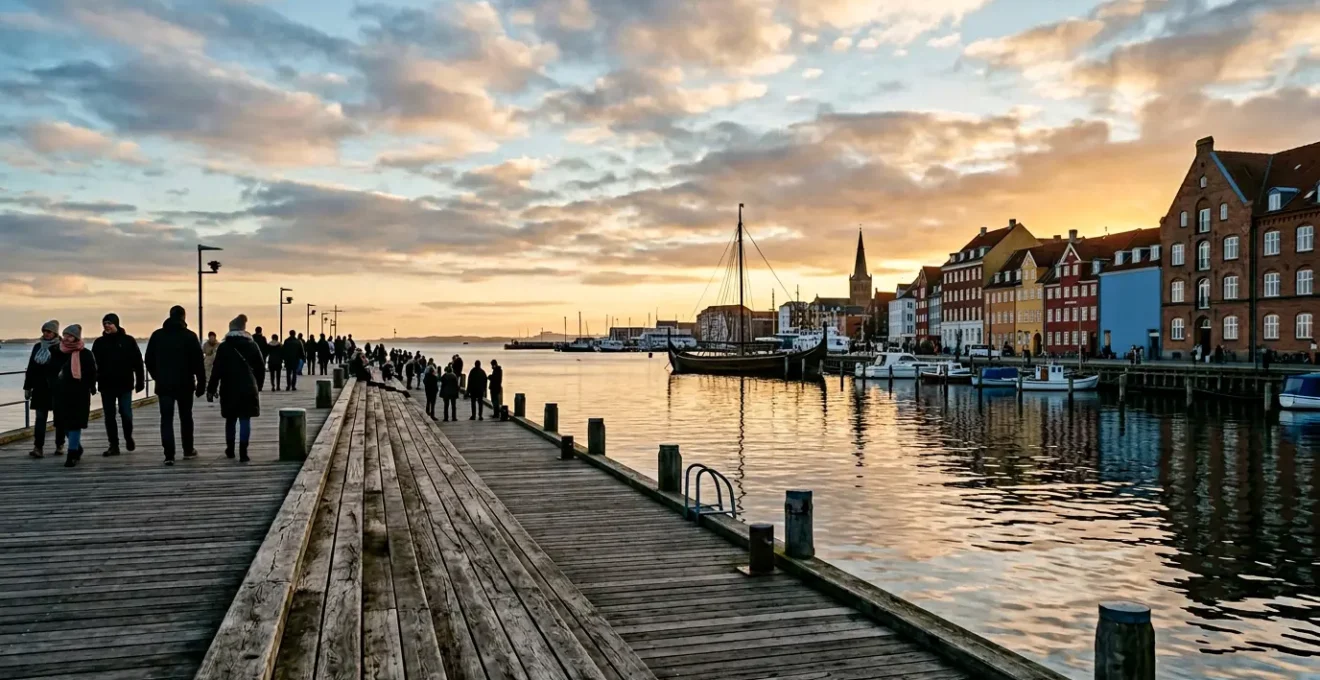
The real Viking experience isn’t in a museum; it’s a living, breathing force you can touch, taste, and feel across Denmark.
- Discover how ancient rituals like winter bathing and midsummer bonfires are thriving modern communities.
- Learn to distinguish authentic Viking-era food and crafts from tourist traps.
- Uncover the living legacy of the Vikings in Denmark’s language, landscape, and even its modern technology.
Recommendation: Your first step is to trade the tourist mindset for an adventurer’s heart and seek out experiences that engage your senses.
So, you want to find the Vikings? Most guides will point you toward glass cases in Copenhagen or the silent stones of a windswept field. They’ll tell you to look at reconstructed longships and read plaques about sagas long past. And you will see history, yes, but you won’t feel it. You won’t hear the roar of the fire, taste the salt on your lips, or feel the spirit of community—the fællesskab—that bound our ancestors together. As a reenactor, a modern-day Viking, I can tell you that the true spirit of the Northmen isn’t a relic to be observed; it’s a current to be stepped into, a fire to gather around, a craft to be learned with your own two hands.
Forget the horned helmets and the Hollywood clichés. The soul of the Viking age is not dead; it has simply changed its form. It lives in the courage of a winter swimmer plunging into a freezing harbour, in the shared warmth of a midsummer bonfire, and in the quiet pride of a craftsman using ancient techniques. This is not a history lesson. This is an invitation. An invitation to stop being a spectator and start living the saga.
This guide is your oath-brother, sworn to lead you past the tourist trails and into the heart of Denmark’s living heritage. We will not just look at history; we will participate in it. We will explore where to find these authentic experiences, how to join in respectfully, and what you need to know to separate the genuine echoes of the past from the hollow tourist calls. Your adventure into the real Viking world begins now.
This journey is structured to take you from visceral, personal experiences to the great legacy of the Viking Age in Denmark. Follow along to discover how to truly connect with the past.
Summary: How to Experience Viking Traditions Alive in Modern Denmark?
- Why Do Danes Jump in the Freezing Harbor Like Their Ancestors?
- Sankt Hans Aften: How to Join the Midsummer Bonfire Rituals?
- Mead and Smoke: Where to Eat a Historically Accurate Viking Meal?
- Can You Learn to Forge Iron or Carve Wood Like a Viking?
- The Mistake of Walking on Burial Mounds: Etiquette for Ancient Sites
- Viking Myths vs. Reality: What Will You Actually Find in Denmark?
- What Is a ‘Kro’ and Why Should You Stop at One for Dinner?
- How to Understand the Birth of Denmark at the Jelling Monuments?
Why Do Danes Jump in the Freezing Harbor Like Their Ancestors?
The first step to understanding the Viking spirit is a shock to the system. It’s the sharp, biting cold of the Danish sea in winter. This isn’t a modern health craze; it’s a deep-rooted tradition of testing one’s mettle against the elements. When you see Danes cheerfully plunging into icy water, you’re witnessing a modern echo of the Norse resilience. This act builds more than just circulation; it forges community, or fællesskab. The shared gasp, the rush of adrenaline, and the communal warming-up in a sauna afterwards create a powerful bond, not unlike warriors sharing a mead hall after a raid.
This isn’t a fringe activity. It’s a massive, organized part of Danish culture. Official 2022 data shows there are over 68,000 members in 182 clubs dedicated to winter swimming. These clubs are the keepers of the flame—or rather, the keepers of the cold. They provide a safe and welcoming way for newcomers to take the plunge. Places like Islands Brygge Havnebad in Copenhagen offer public access, allowing you to test the waters without a full membership. The key is to embrace the initial shock with controlled breathing, stay in for only a few minutes as a beginner, and then fully participate in the warm, social gathering that follows. It’s in that contrast between the fierce cold and the human warmth that the tradition truly comes alive.
This is more than a swim; it’s a baptism into a core element of Danish identity, proving that the courage of the old Northmen still flows in the veins of their descendants.
Sankt Hans Aften: How to Join the Midsummer Bonfire Rituals?
From the trial of cold water, we turn to the communal comfort of fire. Every year on the evening of June 23rd, Denmark’s coastlines and parks flicker to life with massive bonfires for Sankt Hans Aften (Saint John’s Eve). While its name is Christian, the soul of this festival is purely pagan—a solstice ritual to ward off dark spirits and celebrate the longest day of the year. This is a direct line to the rituals our ancestors performed, a night where the entire country gathers to sing, share food, and watch the flames climb into the Nordic twilight.
Joining in is simple and requires no special invitation. Find a public park or a beach in any town, and you will find a gathering. People arrive with picnic blankets, food, and drinks, settling in for the evening. As the Museum of Danish America notes, the fire itself became the central point of the celebration. They explain, “Over time, the tradition of lighting bonfires became dominant and other rituals gradually withered away as people enjoyed the coziness of gathering around a warm fire.” This coziness is palpable. It’s a moment of national hygge, where the fire becomes a hearth for the whole community, a symbol of light and life in the face of the encroaching darkness of the year. To participate is to connect with one of the most ancient and unifying forces in human history: the shared gaze into the heart of a fire.
This isn’t a performance for tourists; it’s a living, breathing piece of cultural heritage that you are welcome to become a part of.
Mead and Smoke: Where to Eat a Historically Accurate Viking Meal?
A true Viking journey must engage the sense of taste. But beware the “Viking feasts” in tourist brochures, often serving roasted pig with a plastic helmet on the side. The authentic taste of the Viking Age is subtler, smokier, and rooted in the ingredients that could be farmed, foraged, or pulled from the sea a thousand years ago. It’s a cuisine of necessity and preservation: smoked fish, salted meats, hearty rye bread, bitter herbs, and earthy root vegetables. The sweetness came not from sugar, but from honey, berries, and, of course, mead.
For a truly authentic experience, seek out places that prioritize historical ingredients over theatricality. A prime example is Café Knarr at the Viking Ship Museum in Roskilde. They developed a concept called New Nordic Viking Food, which reinterprets saga-era ingredients with modern culinary skill. As detailed in their approach, they focus on authentic preservation methods like smoking and salting, using ingredients like herring, rye, and foraged herbs. You can even create your own historically-inspired meal. Head to a Danish supermarket and gather the staples: dense rye bread (rugbrød), pickled herring, smoked mackerel, skyr (a yogurt-like cheese), and root vegetables like parsnips and turnips. This simple, robust meal, eaten by the water, is far more authentic than any banquet hall feast. It’s a direct taste of the landscape and the resourcefulness that defined the Viking Age.
This is how you eat like a Viking: not with excess, but with a deep appreciation for the powerful, elemental flavors of the Nordic lands.
Can You Learn to Forge Iron or Carve Wood Like a Viking?
The Vikings were not just raiders; they were master craftspeople. Their ships, tools, and jewelry were marvels of design and function. To truly connect with this part of their identity, you must put your own hands to work. In Denmark, you can go beyond observing artifacts and learn the actual skills of a Viking artisan. Centers across the country offer workshops where the clang of the blacksmith’s hammer and the scent of carved wood are not just for show—they are for you to experience.
Two of the most renowned centers for this are the Viking Ship Museum in Roskilde and the Ribe VikingeCenter. As the Smithsonian Magazine powerfully states about Ribe, “The center holds workshops and classes every day to indoctrinate visitors into Viking life,” offering everything from archery to ancient handicrafts. This is not passive learning; it’s active participation. You can feel the heat of the forge as you learn blacksmithing basics or the grain of the wood as you try your hand at carving. These centers offer a range of experiences, from short drop-in sessions to more intensive classes, making it accessible for any traveler.
Choosing between them depends on your interests. Roskilde is focused on the maritime world, while Ribe offers a broader view of town life. This table gives you a clear comparison:
| Location | Craft Workshops Offered | Duration | Language | Booking |
|---|---|---|---|---|
| Viking Ship Museum, Roskilde | Rope making, wood carving, coin minting, jewelry workshop, shield painting, boat building | Half-day to full-day sessions | English & Danish | Online advance booking recommended |
| Ribe VikingeCenter | Blacksmithing, archery, glass bead-making, silversmithing, leatherwork, natural dyeing, pottery, weaving, bread baking | Daily drop-in workshops & multi-hour sessions | English, Danish, German | Walk-in available; group bookings online |
Creating something with your hands, no matter how simple, forges a connection to the past far deeper than any museum display ever could.
The Mistake of Walking on Burial Mounds: Etiquette for Ancient Sites
As you journey through Denmark, you are walking on sacred ground. The landscape is dotted with højmark (burial mounds) and ancient runestones—the final resting places of chieftains and the storybooks of kings. These are not just historical curiosities; they are protected monuments and places of deep cultural significance. The biggest mistake a traveler can make is to treat them as mere hills to be climbed or stones to be touched. This is a profound sign of disrespect, akin to walking over graves in a modern cemetery.
Understanding the etiquette of these ancient sites is non-negotiable for any respectful adventurer. The mounds are the most sensitive; the thin layer of grass protects a complex internal structure that is easily damaged by foot traffic. Danish law protects these fortidsminder (ancient monuments) with serious penalties, but the real reason to be respectful is cultural. These places are a tangible link to the ancestors. Likewise, runestones should never be touched. The oils from our hands, and especially any attempt to make a rubbing, can cause irreparable damage to the thousand-year-old carvings. Observe them, photograph them, and contemplate their meaning from a respectful distance. This is how you honor the legacy, not by consuming it, but by preserving it for the next generation.
Your Action Plan: The Respectful Explorer’s Codex
- Burial mounds (højmark): Never walk on top of burial mounds—these are protected ancient graves. Walk around the base to observe and photograph.
- Runestones: Do not touch runestones or use chalk/rubbings to trace carvings. Photography from a respectful distance is permitted.
- Ancient church frescoes: Maintain distance from medieval frescoes; flash photography may be prohibited to prevent pigment degradation.
- Legal protection: Understand ‘fortidsminder’ (ancient monuments)—Danish law protects these sites with significant penalties for damage.
- Re-enactor interaction: At living history centers like Ribe VikingeCenter, ask permission before photographing re-enactors; respect immersive experiences by engaging respectfully.
True connection comes from reverence, not from conquest. Approach these sites with the quiet respect they have earned over centuries.
Key Takeaways
- The most authentic Viking experiences engage your senses—the cold of the sea, the heat of a bonfire, the taste of smoked food.
- Authenticity is found in the details: historical ingredients, traditional craft methods, and the spirit of community (fællesskab).
- Respect is the ultimate key to connection; ancient sites are sacred spaces, not tourist playgrounds.
Viking Myths vs. Reality: What Will You Actually Find in Denmark?
The image of the Viking in popular culture is a caricature—a brutish warrior in a horned helmet, bent on pillage. Before you can find the real Viking spirit in Denmark, you must first shed these myths. The reality is far more complex, interesting, and accessible. The Vikings were not a homogenous horde of fighters; they were a sophisticated society of traders, farmers, explorers, and artisans. As historical research confirms, these early Northmen were “mainly farmers and fishermen who lived in small communities.” Their influence came as much from their trade routes and settlements as from their raids.
Debunking these myths isn’t just about historical accuracy; it’s about knowing where to look for the truth. If you’re searching for horned helmets, you’ll only find them in souvenir shops. But if you’re looking for the legacy of Viking farmers and traders, you will find it everywhere: in the layout of ancient market towns like Ribe, in the names of villages ending in ‘-by’ or ‘-rup’, and in the DNA of modern Danish language and design. The Viking legacy isn’t a vanished civilization; it’s the very foundation of the country you’re standing in.
This table helps separate the popular fiction from the historical fact, and more importantly, tells you where to go to experience the reality for yourself.
| Myth | Reality | Where to Experience the Truth |
|---|---|---|
| Vikings wore horned helmets | 19th-century opera and nationalism created this myth; no archaeological evidence exists for horned helmets in battle | National Museum Copenhagen exhibits authentic Viking helmets (hornless); learn how modern Denmark leverages the ‘Viking brand’ in design and marketing |
| Vikings were homogenous warriors | Complex society of traders, farmers, craftspeople, and explorers with sophisticated trade networks | Ribe (oldest Scandinavian town, 710 AD) shows marketplace culture; reconstructed farms at Ribe VikingeCenter; Viking Ship Museum displays merchant vessels |
| Vikings vanished completely | Their legacy lives in language, place names, and cultural practices | Danish towns ending in ‘-by’ (town), ‘-rup’ (village), ‘-lev’ (inheritance) reveal Viking settlements; Old Norse roots persist in modern Danish vocabulary |
By seeking the authentic legacy, you will find a story far richer and more enduring than any myth.
What Is a ‘Kro’ and Why Should You Stop at One for Dinner?
After a day of exploring windswept coasts and ancient mounds, you’ll seek what our ancestors sought: a warm hearth, a hearty meal, and good company. In modern Denmark, the closest you’ll come to the atmosphere of a Viking longhouse’s great hall is a traditional countryside inn, or kro. These are not just restaurants or hotels; they are historic institutions, community hubs that have offered shelter and sustenance to travelers for centuries. A kro is the living descendant of the Viking tradition of hospitality, a place where the concept of hygge feels ancient and deeply rooted.
But not all inns are created equal. To find an authentic kro, you need to know what to look for. The most historic ones often bear a sign declaring them ‘Kongeligt Privilegeret’ (Royally Chartered), a privilege granted sometimes hundreds of years ago. Their menus will feature egnsretter—regional specialty dishes made with local ingredients, a far cry from generic tourist fare. Inside, the atmosphere is key: aged wooden beams, a convivial crowd of locals, and an innkeeper (krovært) who often serves as the community’s storyteller. Stopping at a kro is about more than dinner; it’s about plugging into the social heart of rural Denmark, a tradition of communal gathering that stretches back over a millennium.
In the warm glow of a historic kro, you’ll find that the Viking spirit of community is not just a memory, but a feeling you can still share today.
How to Understand the Birth of Denmark at the Jelling Monuments?
All your journeys through Denmark—the cold plunges, the fiery festivals, the smoky meals—lead to this one place: Jelling. This site is not just a collection of old stones; it is the nation’s birth certificate. Here, in the 10th century, the Viking king Harald Bluetooth erected a massive runestone to declare his accomplishments: that he had united Denmark under one crown and brought Christianity to its people. These monuments, including two great burial mounds and the two runestones, are so significant they are a UNESCO World Heritage Site recognized as the place where Denmark was born.
But the story of Jelling is not trapped in the 10th century. Its legacy is the ultimate proof of how Viking heritage is alive and shaping our world right now, in ways you might not expect. The most powerful example is in the pocket of nearly every person on Earth.
The Bluetooth Connection: How Ancient Runes Became Modern Technology
The Jelling Stones, particularly the large stone erected by King Harald Bluetooth around 965 AD, contain runic inscriptions that declare Harald united Denmark. The wireless technology was named after this very king because his great achievement was uniting the disparate tribes of Denmark, just as the technology unites different devices wirelessly. The logo for Bluetooth is not an abstract symbol; it is a combination of two ancient runic letters: ᚼ (Hagall) for ‘H’ and ᛒ (Bjarkan) for ‘B’—Harald Bluetooth’s initials. This direct, intentional link transforms the thousand-year-old monument from ancient history into startlingly relevant modern heritage, a saga-worthy tale of how a Viking king’s legacy continues to connect the world.
Standing at Jelling, you understand that the Viking spirit isn’t just an echo from the past. It’s the source code for modern Denmark, a living heritage that continues to unite and innovate. Your own saga, lived through the experiences in this guide, is now part of that endless story.