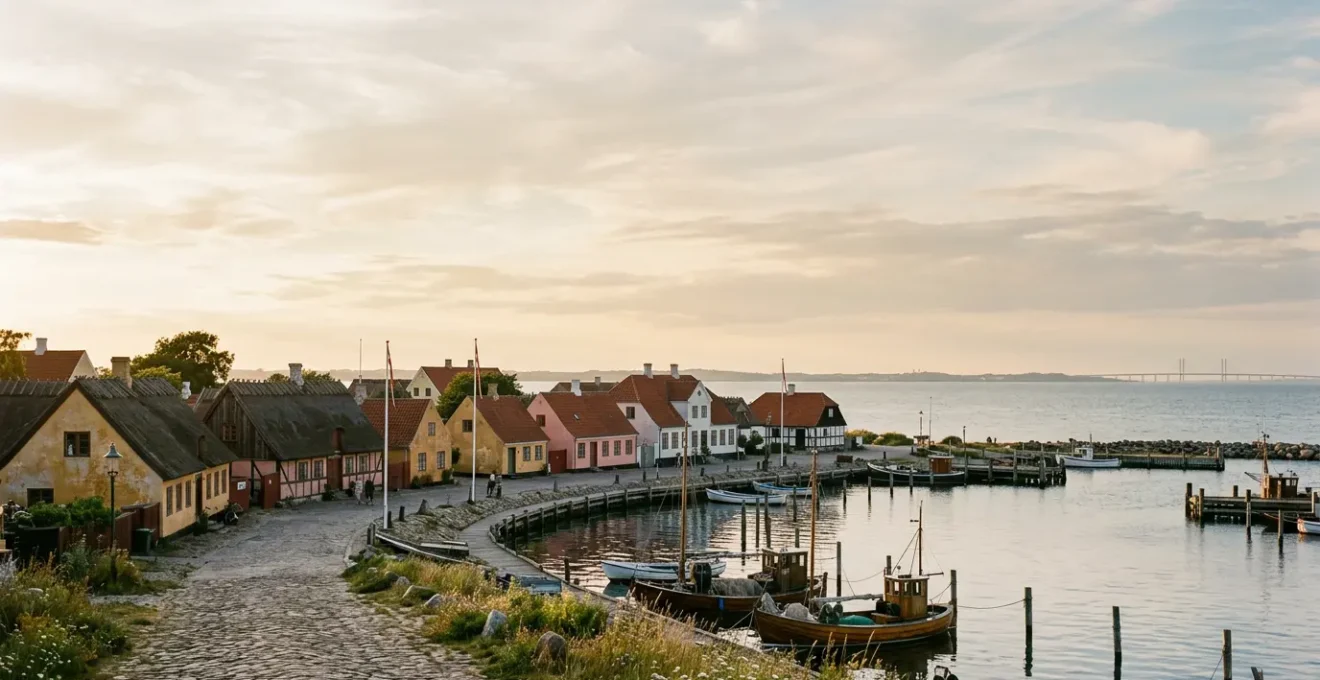
The true charm of a Danish coastal village is discovered not by seeing its sights, but by understanding its soul.
- Your ideal village depends on your personality: choose the historic intimacy of Dragør or the lively Riviera feel of Hornbæk.
- Authentic experiences are found in small moments: paying for berries at a trust-based roadside stall or understanding why ‘Danish’ pastries are called Viennese.
Recommendation: Embrace the slow travel ethos by using Denmark’s excellent public transport and visiting on a quiet weekday to truly feel the local rhythm.
The call of the sea is a constant whisper in Denmark, a country defined by its intricate coastline. For city dwellers in Copenhagen, the desire for a lungful of salty air and a slower pace becomes a tangible need. The common answer is often a hurried trip to a well-trodden spot, a quick photo, and a return to the urban bustle. This approach offers a glimpse, but it misses the essence of Danish coastal life.
True discovery goes beyond just visiting a place. It involves understanding its living heritage, from the curious history of its pastries to the enduring craft of its architecture. It’s about learning to read the landscape, whether it’s the dramatic chalk cliffs of Møn or the quiet, winding fjords. It means participating, even in a small way, in the culture of trust that allows an unmanned strawberry stall to flourish on a country lane. The real magic isn’t in a checklist of attractions, but in attuning yourself to the unique rhythm of each village.
This guide is built on that philosophy. We will explore how to choose a destination that fits your spirit, how to reach it mindfully, and how to see the cultural stories hidden in plain sight. It’s an invitation to trade the city’s frantic pace for the gentle cadence of the waves and discover a side of Denmark that reveals itself only to those who take the time to look.
To help you plan your escape, this article breaks down everything you need to know, from choosing a village to understanding the cultural details that make each trip memorable. Follow along as we explore the heart of Danish seaside charm.
Summary: A Slow Traveler’s Guide to Danish Coastal Villages
- Dragør or Hornbæk: Which Seaside Vibe Fits Your Personality?
- How to Reach Coastal Gems Using Only Public Transport?
- Why Are Thatched Roofs Still Used in Modern Danish Villages?
- Roadside Stalls: How to Pay for Strawberries When There’s No Shopkeeper?
- Weekdays vs Weekends: When to Visit to Avoid the Summer Cottage Crowds?
- Where to Find the Most Photogenic Coastlines in Denmark?
- Vienna Bread: Why Do Danes Call Danish Pastries ‘Viennese’?
- How to Visit the Meeting Point of Two Seas at Grenen?
Dragør or Hornbæk: Which Seaside Vibe Fits Your Personality?
The question isn’t “which village is best?” but “which village is best for you?” The soul of a Danish coastal town is a unique blend of history, pace, and atmosphere. Choosing your day trip destination based on your own personality is the first step towards a truly restorative escape. Your preference for quiet contemplation or social energy will lead you to very different, yet equally enchanting, experiences. The two villages of Dragør and Hornbæk, both accessible from Copenhagen, offer a perfect contrast in character.
Dragør is a whisper from the past. Its narrow cobblestone streets, lined with impeccably preserved 18th-century houses painted in distinctive shades of yellow, invite slow, meandering walks. It feels intimate, a historic fishing village where the primary activities are wandering the harbor, admiring the maritime heritage, and soaking in a peaceful, almost reverent, atmosphere. It’s a haven for history buffs, photographers, and introverts seeking authentic Danish charm without the crowds. In contrast, Hornbæk is the heart of the “Danish Riviera.” It’s chic, lively, and social. While it has its own history, the modern experience is defined by its wide, sandy beaches, fashionable holiday homes, and bustling café culture. The pace is energetic, revolving around beach clubs and boutique shopping. It draws sun-seekers and extroverts who thrive on a vibrant, stylish scene. In summer, its population swells, with some estimates suggesting that over 35,000 people rent properties, transforming it into a buzzing social hub.
To help you decide, consider what a perfect day looks like. Is it losing track of time in a maze of historic lanes, or is it feeling the sun on your face on a bustling beach? The following comparison breaks down their distinct characters.
| Characteristic | Dragør | Hornbæk |
|---|---|---|
| Atmosphere | Historic & Intimate | Chic & Expansive |
| Pace | Slow & Meandering | Lively & Social |
| Architecture | Cobblestone streets, yellow-painted 18th-century houses, thatched/red-tiled roofs | Fashionable holiday homes, wide sandy beaches, modern beach culture |
| Primary Experience | Maritime history, fishing village heritage, harbor wandering | Beach clubs, boutique shopping, Nordic Riviera lifestyle |
| Distance from Copenhagen | 12 km (20-minute drive) | 12 km from Helsingør (1.5 hours by train from Copenhagen) |
| Best For | History buffs, introverts, photographers seeking authentic Danish charm | Sun-seekers, extroverts, beach lovers, trendy café culture |
Ultimately, both Dragør and Hornbæk offer a beautiful escape from the city. By choosing the one that aligns with your mood and personality, you ensure your day trip will be more than just a visit; it will be a genuine connection with a place.
How to Reach Coastal Gems Using Only Public Transport?
Embracing slow travel begins the moment you decide to leave the car behind. Denmark’s public transport system is a model of efficiency and integration, making it not just possible, but genuinely pleasant to reach even the most charming coastal villages without driving. This approach allows you to relax, watch the landscape shift from urban to rural, and arrive with a clearer mind, ready to explore. The key is understanding Copenhagen’s zone-based ticket system and the different travel options available.
The Greater Copenhagen area is divided into numbered zones, with the city center as Zone 1. The price of your ticket is determined by the number of zones you travel through. For a day trip, you have a few excellent options. The Rejsekort is a tap-on, tap-off travel card that automatically calculates your fare, offering a slight discount. Alternatively, the DOT Tickets app allows you to buy single journey tickets directly on your phone. For tourists planning multiple excursions, the Copenhagen Card is often the most cost-effective choice. For maximum flexibility, it offers unlimited travel across all zones from 1 to 99, which includes destinations as far as Roskilde, Hillerød (for Frederiksborg Castle), and Helsingør (for Kronborg Castle and the onward connection to Hornbæk).
Getting to our two example villages is straightforward. Dragør, being very close to the city and airport, is a simple 20-30 minute journey by bus, typically requiring a ticket for only 2 or 3 zones. For Hornbæk, the journey itself is part of the experience. You’ll take a scenic regional train to the historic city of Helsingør, a trip of about an hour. From there, a charming local train line hugs the coast for another 25 minutes, dropping you just a two-minute walk from Hornbæk’s beach and town center. This seamless connection transforms the 90-minute journey into a relaxing prelude to your coastal escape.
By opting for the train or bus, you’re not just choosing a mode of transport; you’re choosing a different way to travel. You’re aligning with a more mindful, observant pace that is the very essence of a slow travel day trip.
Why Are Thatched Roofs Still Used in Modern Danish Villages?
A thatched roof, or stråtag, is more than just a picturesque feature of a Danish coastal village; it’s a piece of living heritage. Far from being a relic of the past, thatching is a vibrant craft that continues to protect and beautify homes today. These roofs embody a deep connection to nature and a tradition of sustainable building that feels more relevant than ever. Their presence is a testament to a Danish appreciation for materials that are both functional and beautiful, blending human dwellings seamlessly into the natural landscape.
The endurance of thatch is due to its remarkable properties. A well-laid thatched roof is a fantastic natural insulator, keeping homes warm in the winter and cool in the summer. It’s breathable, helping to regulate humidity within the house, and when properly maintained, it can last for decades. Today, there are an estimated 54,695 thatched buildings in Denmark, a number that includes thousands of modern holiday homes, proving its appeal is not purely historical. This architectural soul is a core part of what makes villages like Dragør so visually cohesive and charming.
Of course, a modern homeowner might worry about practicalities like fire safety. This concern has been addressed through significant research and innovation, ensuring thatch remains a viable and safe option for contemporary construction.
Case Study: Modern Fire Safety Standards for Thatched Roofs
For years, strict regulations on the distance between thatched buildings limited their use. However, the perception of thatch as a high fire risk was challenged by the Danish Thatchers’ Guild. After extensive research and fire tests, Danish building authorities officially updated their regulations in 2016. They recognized that modern thatched roofs, often treated with fire retardants and installed with fireproof membranes, are significantly more fire-resistant than their historical counterparts. This landmark revision marked a major breakthrough, making it easier to build with thatch and validating it as a safe, sustainable material for modern architecture.
So, when you admire a thatched roof, you’re not just looking at a quaint cottage. You’re seeing the result of centuries of craftsmanship, a commitment to natural materials, and a modern embrace of sustainable, beautiful design.
Roadside Stalls: How to Pay for Strawberries When There’s No Shopkeeper?
Imagine cycling down a quiet country lane, the air sweet with the scent of summer. You round a bend and see it: a simple wooden table laden with baskets of glistening strawberries (jordbær) or bunches of new potatoes (nye kartofler). There’s a hand-painted sign with the price, but no one is there. This is your introduction to one of Denmark’s most endearing cultural practices: the unmanned roadside stall, a cornerstone of the nation’s trust economy.
This system, built on a deeply ingrained sense of social responsibility and honesty (tillid), is a beautiful thing to witness and participate in. It operates on the simple honor system: you take what you want, and you leave the correct payment. In the past, this meant dropping coins into a small cash box, or pengekasse. Today, technology and tradition coexist seamlessly. While the cash box is still common, you are far more likely to see a small sign with a phone number and the logo for MobilePay. Recent payment data shows that 92% of the Danish population uses MobilePay, a mobile payment app that has become the de facto way to pay for everything from coffee to farm-fresh produce.
Your Guide to Denmark’s Trust-Based Roadside Stalls
- Find the Payment Info: Look for the MobilePay number or QR code first. If you don’t have a Danish bank account to use the app, locate the pengekasse (cash box).
- Calculate Your Total: Check the price on the handwritten sign and add up what you’ve selected. It’s helpful to have some small change on hand.
- Pay Your Share: If using cash, place your payment directly into the box’s slot. The social contract is simple and unspoken: you pay for what you take.
- Embrace Seasonality: Look for strawberries in June and July, new potatoes in early summer, and apples or pumpkins in the autumn. The stalls are a living calendar of the harvest.
- Identify Authenticity: The most genuine stalls are run by the farm families themselves. Look for their proximity to fields and the charmingly imperfect, handwritten signs.
Stopping at one of these stalls is more than a transaction. It’s a moment of connection to the land, the season, and a culture of trust that feels wonderfully refreshing. And the taste of a sun-warmed strawberry, paid for with a simple act of honesty, is a memory that will stay with you long after you’ve returned to the city.
Weekdays vs Weekends: When to Visit to Avoid the Summer Cottage Crowds?
The secret to capturing the tranquil soul of a Danish coastal village often lies not in *where* you go, but *when*. The difference between a peaceful, reflective experience and a bustling, energetic one can be as simple as choosing a Tuesday over a Saturday. This is the art of rhythmic travel: aligning your visit with the natural pulse of a place, especially during the popular summer months.
On a summer weekend, popular villages like Hornbæk transform. The beaches fill with sunbathers, cafés buzz with conversation, and the streets are alive with fellow visitors and the owners of the thousands of summer cottages who flock to the coast. This atmosphere is vibrant and exciting, perfect if you’re seeking energy and social opportunities. However, if your goal is to escape the city’s crowds and find quiet contemplation, a weekend visit can feel like trading one form of busyness for another.
A weekday visit, particularly in the morning, offers a completely different world. You’ll find yourself sharing the cobblestone streets with locals on their way to the bakery. The beaches are vast and empty, the only sounds being the cry of gulls and the gentle shush of the waves. You can find a table at any café, linger over your coffee, and feel the authentic, unhurried pace of daily life. This is when the subtle charms of a village truly reveal themselves—the play of light on an old wall, the smell of salt and roses in the air, the quiet industry of the harbor. This is the experience that truly recharges the soul.
Choosing a weekday is a simple strategic decision that pays enormous dividends in peace and authenticity. It allows you to step out of the role of a tourist and become, for a few hours, a quiet observer, fully present in the serene beauty of the Danish coast.
Where to Find the Most Photogenic Coastlines in Denmark?
Denmark’s beauty is written in its coastline. With impressive statistics showing over 7,200 kilometers of coastline, the country offers a staggering diversity of seaside landscapes, each with its own photographic potential. The quest for the “most photogenic” spot is not about finding a single famous viewpoint, but about understanding the different types of coastal beauty available and learning to see the picture-perfect moments that exist everywhere. It’s about developing an eye for sensory mapping—tuning into textures, light, and composition.
The Danish coast is a rich tapestry of different environments. You have the powerful, dramatic landscapes like the towering white chalk cliffs of Møns Klint, which plunge into the turquoise Baltic Sea, offering a scale that feels almost otherworldly. Then there is the wild, windswept West Coast of Jutland, with its vast, dune-backed sandy beaches in places like Blåvand, perfect for minimalist compositions and capturing the raw power of the North Sea. In contrast, the country’s many fjords, such as Roskilde Fjord, provide intimate scenes of calm, reflective water, misty mornings, and lush, forested shores.
And of course, there is the man-made charm of the historic harbor villages themselves. Places like Dragør and Gilleleje are a photographer’s dream, offering a wealth of architectural details, from colorful fishing boats and their tangled nets to hollyhocks (stokroser) blooming against yellow-painted walls. The key is to shift your focus from grand vistas to “macro-charm”—the small, authentic details that tell a bigger story. A bicycle leaning against a picket fence, the texture of a thatched roof, the weathered paint on a wooden door—these are the images that capture the true hygge and soul of coastal Denmark.
Your Photo-Scouting Checklist: Finding Your Perfect Danish Coastline
- For Drama: Seek out the chalk cliffs of Møns Klint. Aim for the golden hour (early morning or late afternoon) when the low sun creates dramatic shadows and warm light on the white cliffs.
- For Minimalism: Visit the wide, sandy beaches of the West Coast (e.g., Fanø). Use a long exposure to smooth the waves into a mist and focus on a single element, like a weathered groyne or a lone dune.
- For Reflections: Explore the shores of a fjord on a calm morning. Look for mirror-like reflections of boats, trees, and sky in the still water.
- For Architectural Charm: Wander the streets of a historic village (e.g., Dragør). Focus on capturing textures—cobblestones, wood grain, fishing nets—and the interplay of color between the houses and the harbor.
- For “Hygge” Details: Practice “macro-charm” photography. Look for bicycles, blooming flowers against old walls, cozy window scenes, and other small details that tell a story of everyday life.
Ultimately, the most photogenic coastline is the one you connect with. By learning to see the beauty in both the grand and the granular, you’ll return not just with beautiful pictures, but with a deeper appreciation for the diverse character of the Danish shore.
Key Takeaways
- Your perfect coastal village is a match for your personality; choose between historic intimacy and lively beach culture.
- Embrace the slow travel ethos by utilizing Denmark’s efficient public transport system for a more relaxing and observant journey.
- True charm lies in the “living heritage”: notice the craftsmanship of thatched roofs and participate in the trust-based system of roadside stalls.
Vienna Bread: Why Do Danes Call Danish Pastries ‘Viennese’?
One of the most delicious paradoxes you’ll encounter in a Danish bakery is that the world-famous “Danish pastry” is known locally as wienerbrød, which translates directly to “Vienna bread.” This isn’t a case of national modesty, but a delicious piece of living heritage that tells a fascinating story about craft, culture, and a pivotal moment in Danish labor history. To understand why Danes credit Vienna for their iconic pastry is to take a bite out of the 19th century.
The story begins in 1850. A widespread strike among bakery workers swept across Denmark. With their ovens sitting cold and their customers demanding bread and cakes, Danish bakery owners were forced to look for replacement workers from abroad. They found them in Austria, hiring a group of Viennese bakers to come to Denmark and fill the void. These Austrian craftsmen brought with them their own traditions, techniques, and recipes, which were new to the Danish palate.
Among these new methods was the art of lamination—the technique of folding and rolling dough with thin layers of butter to create a light, flaky, and airy texture. While the Danish bakers eventually returned to work, they had learned the new techniques from their Austrian counterparts. They adapted the recipes, adding more butter and egg to create the richer, more indulgent pastry we know today. However, in honor of the bakers who first introduced the technique, they forever called the creation wienerbrød. It’s a tribute baked into the very name of their most famous culinary export.
So, the next time you enjoy a flaky, buttery pastry in a cozy Danish café, remember its journey. You’re not just tasting a Danish treat; you’re tasting a piece of European history, a story of a strike that inadvertently changed a nation’s culinary identity forever.
How to Visit the Meeting Point of Two Seas at Grenen?
There are few places on Earth where you can stand with a foot in two different seas, but Denmark offers this rare and powerful experience at its northernmost tip. This place is called Grenen, a long, sandy spit near the town of Skagen where the waters of the Skagerrak and Kattegat seas dramatically collide. A visit here is more than a day trip; it’s a pilgrimage to a place of elemental power, a fitting grand finale to any exploration of the Danish coast.
Grenen, meaning “The Branch,” is a dynamic landscape, a sandbar that is constantly reshaped by the wind and currents, growing by about 10 meters each year. The visual spectacle is undeniable. The Skagerrak, which flows into the North Sea, and the Kattegat, which connects to the Baltic Sea, have different densities and salinities, preventing them from fully mixing. This creates a visible line in the water, a turbulent seam where the waves of two mighty bodies of water meet and crash against each other. It’s a raw, windswept, and profoundly beautiful sight.
Reaching this unique geographical point is an adventure in itself. The journey begins in Skagen, a historic artists’ colony famous for its special light. From the town, you can drive or take a bus to the main parking area near Grenen. From there, the final leg of the journey to the very tip of the sandbar is made aboard the Sandormen (“The Sand Worm”), a large tractor-bus specifically designed to navigate the soft sand. The 15-20 minute ride is an experience in itself, taking you through a protected nature reserve teeming with birdlife and offering a slowly building sense of anticipation as you approach the meeting point.
A trip to Grenen is a powerful reminder of nature’s scale and force. It’s a moment of perspective, a place that makes you feel small in the best possible way, and it provides a profound connection to the wild, untamed spirit that defines the Danish coastline.