Contrary to popular belief, a powerful flashlight isn’t the key to safety in Dyrehaven at night. True security and a magical wildlife experience come from embracing a “nocturnal etiquette”—understanding animal behaviour, respecting their world, and learning to see in the dark. This guide provides a park ranger’s perspective on how to become a silent, respectful guest among the deer, rather than an intruder.
The iron gates of Jægersborg Dyrehaven close to cars as dusk settles, but for those on foot, the ancient forest park never truly shuts. It simply transforms. As the last dog walkers head home, a profound quiet descends, soon broken by the rustle of unseen things in the undergrowth. For many, the thought of walking among 2,000 free-roaming deer in near-total darkness is a mix of thrill and trepidation. The question isn’t just *can* you do it—the park is open 24/7 and free to enter—but *how* do you do it safely and respectfully?
Many believe the answer lies in a high-lumen flashlight, cutting a stark beam through the woods. As a ranger, I can tell you this is the first mistake. It shatters your own night vision and alerts every creature to your presence. The real key to a profound and safe nocturnal visit isn’t about conquering the darkness, but about surrendering to it. It’s about learning a kind of nocturnal etiquette.
This isn’t just about avoiding danger; it’s about unlocking a richer experience. When you move quietly and use light judiciously, the forest accepts you. You stop being a spectator and start becoming a part of the nocturnal landscape. This guide will walk you through the essential principles of this etiquette, from understanding the primal drama of the autumn rut to the science of seeing in the dark, and even how to witness the cosmos far from the city’s glow.
This article provides a complete framework for your nocturnal adventure. We will cover the most intense moments in the deer calendar, the right equipment to use, and other hidden natural wonders that only reveal themselves after sunset. Follow these steps to transform a simple night walk into an unforgettable communion with nature.
Summary: A Ranger’s Guide to Dyrehaven After Dark
- Red Deer Rut: When Can You Hear the Stags Roaring in Autumn?
- Why Should You Use Red Flashlights When Observing Wildlife at Night?
- Mønsted Limestone Mines: Where Is the Best Place to See Bats Swarming?
- Solo vs Guided: Should You Attempt a Night Hike in Mols Bjerge Alone?
- ISO Settings: How to Capture Wildlife Shadows Without a Flash?
- Dark Sky Park: Why Is Møn the Best Place to See the Milky Way?
- Singing Ice: Why Do Frozen Lakes Make Strange Laser Sounds?
- Aurora Borealis from Denmark: Is It Possible to See the Northern Lights?
Red Deer Rut: When Can You Hear the Stags Roaring in Autumn?
The most dramatic event in Dyrehaven’s calendar is the red deer rut. From the crisp evenings of early autumn, the air begins to fill with a sound that seems to belong to a prehistoric age: the deep, guttural roar of a stag. This is not just noise; it is a declaration of power, a challenge to rivals, and a call to hinds. The peak of this incredible acoustic landscape occurs from September to October. During this period, the park’s dominant stags are at their most impressive and most aggressive, their hormones surging as they gather and defend their harems.
According to the Danish Nature Agency, the rut is a spectacular time when around 300 red deer stags gather with hinds in Dyrehaven. While hearing them is a primary goal for many night visitors, witnessing their behaviour requires the utmost respect and caution. A rutting stag is a formidable animal, weighing over 200kg and focused entirely on defending its territory. Approaching too closely is not only foolish but disrespectful to the natural processes unfolding. True appreciation comes from observing from a safe and respectful distance, using your ears more than your eyes.
Action Plan: Observing Rutting Deer Safely
- Maintain Respectful Distance: Stay at least 100 metres away from rutting deer. Never approach a stag directly. Use binoculars or a telephoto lens for a closer view, not your feet.
- Recognize Warning Signs: If a stag stops roaring, turns to face you, or begins walking parallel to you while glancing over, you are too close. This is a display of dominance. You must back away slowly and immediately.
- Never Surround an Animal: Always ensure the deer have a clear and open line of retreat. Making an animal feel cornered is a primary cause of defensive aggression.
- Keep Dogs on a Leash (or at Home): Dogs are perceived as predators (like wolves) and can provoke a violent reaction from a stag protecting his hinds. During the rut, it’s wisest to leave them at home.
- Stay Calm and Quiet: Avoid loud noises and sudden movements. The goal is to be an invisible observer, not a participant in the drama. Let the sounds of the rut be the only loud noises in the forest.
Understanding these behaviours is the first step in your nocturnal etiquette training. It transforms fear into informed respect, allowing you to witness one of nature’s greatest spectacles without putting yourself or the animals at risk.
Why Should You Use Red Flashlights When Observing Wildlife at Night?
The single most important piece of equipment for a night walk is not the brightest flashlight, but the most considerate one. White light is a shock to the nocturnal system—for both you and the wildlife. When a bright white beam hits your eyes, it effectively bleaches the rhodopsin in your rod cells, the photoreceptors responsible for low-light vision. It can take up to 30 minutes for your eyes to fully readapt to the darkness, leaving you blind to the subtle world around you. This is where the simple genius of red light comes in.
Most mammals, including deer, have dichromatic vision and are less sensitive to long-wavelength light, like red. While they can still see it, it doesn’t trigger the same alarm or dazzle them like a white beam. More importantly, red light preserves your own precious night vision. An authoritative study in Scientific Reports confirmed that red light conserves night vision, which is why it’s used by astronomers, on submarine bridges, and by wildlife biologists.
As the image above illustrates, under red light your pupils remain wide, continuing to gather as much ambient light as possible. This is the essence of light discipline. You use a quick flash of red light to navigate a tricky patch of trail or check a map, and seconds later, your eyes are already back to work, deciphering the shapes in the moonlit landscape. You remain part of the night, rather than declaring war on it. Investing in a headlamp with a dedicated red LED mode is the best decision a nocturnal explorer can make.
This simple switch from white to red light is a cornerstone of nocturnal etiquette. It’s a gesture of respect that allows you to see more, disturb less, and truly blend into the after-dark environment.
Mønsted Limestone Mines: Where Is the Best Place to See Bats Swarming?
Your nocturnal adventures in Denmark need not be limited to deer. The country is home to a rich variety of other creatures that thrive in the dark, most notably bats. While you might spot them flitting through Dyrehaven, the most spectacular place to witness them is at Mønsted Kalkgruber, the world’s largest limestone mine. This subterranean labyrinth becomes one of Northern Europe’s most important bat hibernation sites in winter.
This underground cathedral provides a stable, cold, and humid environment, perfect for the deep sleep of hibernation. It’s an incredible sanctuary that, according to Atlas Obscura, hosts around 18,000 bats from 5 different species each winter, including the pond bat and Daubenton’s bat. While you cannot enter the caves during the hibernation period to see them sleeping, the real spectacle happens outside during the “swarming” season in late summer and autumn. This is when bats gather at the mine entrance at dusk, a social behaviour that is still not fully understood by scientists but is breathtaking to observe.
Case Study: Mønsted Mines’ Bat Conservation Protocol
The management of Mønsted Limestone Mines provides a masterclass in balancing tourism with conservation. To protect the hibernating population, the caves are completely closed to all visitors from November 1 to April 1. Furthermore, they implement strict restrictions on evening visits during the sensitive swarming and emergence periods (March 16-May 10 and September 1-October 31). This protocol ensures the bats are not disturbed as they prepare for or emerge from hibernation. The constant 8°C temperature and 98% humidity inside are crucial for the bats to lower their metabolism and survive the winter, and human presence can disrupt this delicate balance.
Visiting Mønsted during the swarming season, armed with your knowledge of red-light use and quiet observation, offers a chance to see a different facet of Denmark’s nocturnal world. It’s a reminder that the darkness is alive with more than just large mammals.
Solo vs Guided: Should You Attempt a Night Hike in Mols Bjerge Alone?
Once you’re comfortable with the principles of nocturnal etiquette, you might consider exploring other wild areas, like the rugged hills of Mols Bjerge National Park. This raises a new question: should you go alone or with a guide? There is no single right answer; it depends entirely on an honest self-assessment of your skills, preparation, and comfort level. A guided tour offers expertise and security, but a solo hike provides a unique sense of solitude and self-reliance.
As a ranger, I neither universally encourage nor discourage solo night hiking. Instead, I encourage preparedness. Before attempting a solo night hike in an unfamiliar and hilly area like Mols Bjerge, you must be confident in your abilities. The darkness simplifies the landscape but complicates navigation. A familiar daytime trail can become a maze of confusing forks at night. Your senses are heightened, but so are the consequences of a wrong turn. A solo journey is a rewarding challenge, but only for those who have done their homework.
Checklist: Solo Night Hike Readiness
- Navigation Mastery: Can you confidently use a map and compass without relying solely on a phone? Do you have an offline map and a power bank for your GPS device as a backup?
- Essential Gear: Are you carrying the “ten essentials” of hiking? This includes robust illumination (headlamp with spare batteries), insulation (extra layers), first-aid supplies, and an emergency shelter like a bivy sack.
- Communication Plan: Have you shared your detailed route, start time, and estimated finish time with a reliable contact? Have you agreed on a “panic” time when they should call for help if they haven’t heard from you?
- Physical Fitness: Is your fitness level appropriate for the terrain and distance? Hiking in the dark is more mentally and physically taxing than hiking in daylight.
- Local Knowledge: Have you researched recent trail conditions, potential hazards (like flooded paths or aggressive livestock), and the specific wildlife you might encounter in Mols Bjerge?
Modern technology can also provide a crucial safety net. As the travel blog The Broke Backpacker wisely notes when discussing hiking safety in Denmark:
Features like real-time activity sharing and Lifeline let you share your location with trusted contacts—a smart safeguard when hiking solo or on less-populated trails
– The Broke Backpacker, Hiking in Denmark safety guide
If you can tick every box on that checklist with confidence, a solo night hike can be a deeply rewarding experience. If not, joining a guided tour is a fantastic way to build skills and confidence for the future.
ISO Settings: How to Capture Wildlife Shadows Without a Flash?
Observing the nocturnal world is one thing; capturing it on camera is another challenge entirely. The first and most absolute rule of night wildlife photography is: no flash. Ever. A flash is not only disruptive and stressful for the animals, but it also creates flat, ugly images with red-eye. The art of night photography is about painting with the available light, however faint it may be. This means embracing the shadows and learning to control your camera’s sensitivity.
Your two best friends are a “fast” lens (one with a wide aperture like f/1.8) and a high ISO setting. A wide aperture lets in more light, while a high ISO amplifies that light electronically. This comes with a trade-off: higher ISO settings introduce digital “noise” or grain into the image. However, a slightly grainy photo that captures a magical moment is infinitely better than a blurry, dark one. The key is to find the balance that works for your equipment and the specific conditions. Don’t be afraid to push your ISO to 3200, 6400, or even higher.
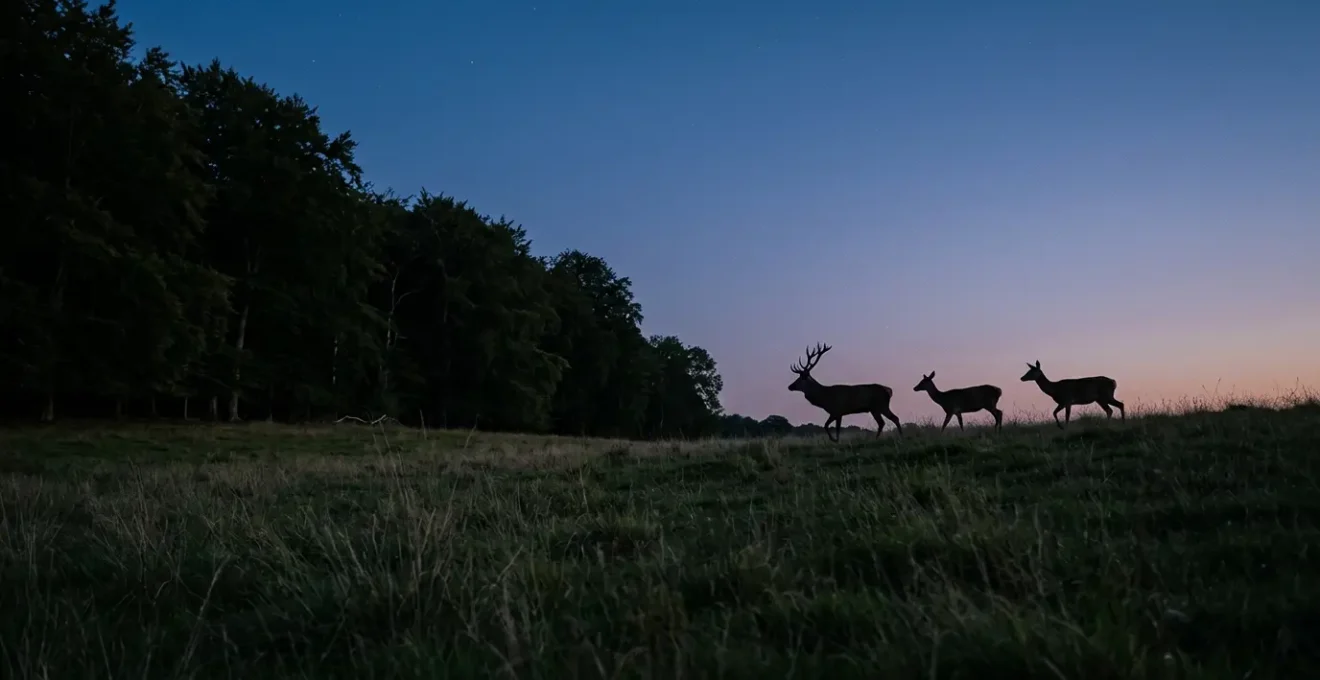
Sometimes, the best approach is to stop fighting the darkness and use it to your advantage. As the photo above demonstrates, placing an animal against the faint glow of the twilight horizon can create a powerful and dramatic silhouette. Here, the shadow *is* the subject. You are capturing the animal’s form and presence, not the details of its coat. This technique requires you to expose for the bright background, plunging the foreground subject into deep shadow. The following table breaks down the core technical trade-offs for night photography.
| Technique | Settings | Light Gathering | Trade-off | Best Use Case |
|---|---|---|---|---|
| High ISO | ISO 3200-6400+ | Sensor amplification increases brightness | Introduces digital noise/grain in image | When movement is fast and shutter speed must be maintained |
| Fast Prime Lens | f/1.4 or f/1.8 aperture | Gathers 4-8x more light than f/4 | Extremely shallow depth of field, requires precise focus | Most effective single tool for night wildlife – prioritize this first |
| Slow Shutter | 1/30s – 1/50s | Longer exposure gathers more light | Subject motion blur unless animal is stationary | Silhouettes and stationary deer at rest |
| ETTR (Expose to the Right) | Slight overexposure in camera | Maximizes light data captured | Requires RAW shooting and post-processing skills | Advanced technique to minimize noise in shadows |
By learning these flash-free techniques, you adhere to the highest standard of nocturnal etiquette, ensuring your creative pursuits never come at the expense of the animals’ well-being.
Dark Sky Park: Why Is Møn the Best Place to See the Milky Way?
The practice of “light discipline” benefits more than just wildlife observation; it opens up a view to the grandest spectacle of all: the cosmos. In a world awash with artificial light, true darkness is becoming a rare resource. This is why “Dark Sky Parks” are so important. These are areas officially recognized for their exceptional starry nights and protected against light pollution. Denmark is proudly home to one of the first in Scandinavia: Dark Sky Park Møn and Nyord.
What makes Møn special is its unique geography. As an island, it is naturally shielded from the light domes of major cities. Local communities have made a conscious commitment to preserving this darkness by using downward-shielded, warm-coloured lighting and turning off unnecessary lights at night. The result is a breathtakingly clear view of the night sky. On a moonless night, the Milky Way arches across the heavens not as a faint smudge, but as a brilliant, textured river of stars. You can see constellations, nebulae, and meteor showers with a clarity that is simply impossible closer to Copenhagen.
Visiting Møns Klint at night is a humbling experience. The great white chalk cliffs, glowing faintly under starlight, create a surreal foreground to the cosmic display above. It’s the perfect place to practice your sensory acclimatization. After 30 minutes away from any light source (including your phone), your eyes will reveal a universe of staggering beauty. It connects your walk in the woods to a much larger, older world, reminding you that the nocturnal life of Dyrehaven is just one small part of a vast, interconnected natural system that thrives in the dark.
A trip to Møn is a pilgrimage for any lover of the night. It’s a chance to see the world as our ancestors did, and as the wildlife of Dyrehaven still does: under a canopy of countless stars.
Singing Ice: Why Do Frozen Lakes Make Strange Laser Sounds?
As autumn gives way to the deep cold of winter, Denmark’s nocturnal acoustic landscape changes once again. The roaring of stags is replaced by a profound silence, which can be broken by one of nature’s strangest and most beautiful sounds: singing ice. If you are walking near a frozen lake in Dyrehaven or elsewhere on a very cold, clear night, you may hear it—eerie pings, zaps, and whistles that sound uncannily like sci-fi laser blasts. It’s a magical experience that can be startling if you don’t know its origin.
This phenomenon isn’t supernatural; it’s simple physics. The sound is the result of the ice sheet cracking under stress. As temperatures plummet, particularly after sunset, the top layer of ice cools and contracts much faster than the water-insulated ice below it. This tension builds until it is released in the form of a fracture. Sometimes these are tiny, creating a high-pitched “ping.” Other times they are long, rapid cracks that create the zinging “laser” sound as the vibration travels across the ice sheet.
The ice of a large, clear lake acts like a giant musical instrument. The sound can travel for kilometres across its hard, uniform surface with very little dampening. What you are hearing is the lake breathing, shifting, and settling under the immense force of the cold. It’s part of the living, changing acoustic landscape of the winter night. Standing by a frozen lake, under the stars, listening to its strange dialect is a profoundly peaceful and uniquely Scandinavian experience.
It requires no special equipment, only patience, warm clothes, and a willingness to stand still and listen to the music of the cold.
Key Takeaways
- Master the Rut: The autumn deer rut is an incredible spectacle. Maintain a respectful distance of at least 100 metres and learn to read a stag’s warning signs to ensure safety for all.
- Embrace Red Light: Ditch the white flashlight. A headlamp with a red LED mode preserves your night vision and is far less disturbing to wildlife, making you a stealthier observer.
- Explore the Full Nocturnal World: Denmark’s night is more than just deer. From the bat swarms of Mønsted to the singing ice of frozen lakes and the star-filled skies of Møn, a whole world awaits after dark.
Aurora Borealis from Denmark: Is It Possible to See the Northern Lights?
Of all the nocturnal wonders, the Aurora Borealis is the most coveted. The ethereal dance of green and purple lights across the sky is a bucket-list item for many. This raises the ultimate question for the Danish night explorer: is it possible to see the Northern Lights from Denmark? The honest ranger’s answer is: yes, it is possible, but it is rare and requires a perfect celestial storm.
Denmark lies at the southern edge of the auroral zone. To see the lights this far south, we need a significant geomagnetic storm, measured by a high Kp-index (typically 5 or higher). This happens when a powerful solar flare sends a wave of charged particles hurtling towards Earth, interacting with our planet’s magnetic field. You need this strong solar activity to coincide with a clear, dark, moonless night and an unobstructed view to the north.
Managing Expectations: Aurora Sighting Conditions in Denmark
Travel blogs and astronomy forums are filled with questions about seeing the aurora from Denmark. As the blog ‘Wanna Be Everywhere’ confirms, it’s a frequent query that highlights the need for realistic expectations. While sightings are reported several times a year, especially from the northern coasts of Jutland or islands like Møn, they are not a guaranteed event. The lights often appear as a faint green glow on the northern horizon, rather than the vibrant, overhead curtains seen in Norway or Iceland. Success depends on a combination of luck, patience, and diligent monitoring of aurora forecast apps.
Chasing the aurora from Denmark shouldn’t be the sole goal of a night out; it should be the potential, magical bonus. The true reward is the journey itself: the crisp air, the star-filled sky, the quiet companionship of the forest. If, while you are out there practicing your nocturnal etiquette, the sky begins to glow, consider it the universe’s applause for your respectful presence.
With this guide’s knowledge, you are now equipped not just to walk safely in the dark, but to engage with it respectfully and deeply. Plan your visit, check the aurora forecast, and step out into the magical nocturnal world that awaits.