Copenhagen’s status as a green capital isn’t magic; it’s a result of deliberate, complex, and sometimes contradictory engineering and policy decisions.
- Iconic projects like CopenHill reveal a fundamental tension between ambitious green goals and pragmatic operational needs, such as importing waste to function.
- True climate resilience is achieved through systemic integration, where infrastructure for water, energy, and transport are designed to work in symbiosis.
Recommendation: Look beyond the aesthetics of Copenhagen’s projects to analyze the underlying systems, policy frameworks, and trade-offs—that is where the true lessons for future cities lie.
Copenhagen is often presented as a sustainable utopia, a city where cyclists glide along serene harbor fronts and citizens swim in crystal-clear urban waters. For architects, urban planners, and eco-conscious travelers, it stands as a living gallery of green innovation. We see the ski slope on a power plant and the elegant bicycle bridges, and we are told this is the future. But this postcard view, while inspiring, often obscures the more complex and instructive reality.
The common narrative focuses on the what: clean water, bike lanes, carbon-neutral ambitions. It rarely delves into the how or the why. How, precisely, is a post-industrial harbor kept clean enough for swimming? Why was a celebrated waste-to-energy plant built so large it needs to import trash? What happens when a city’s bold climate promises collide with the realities of national funding policies? These are the critical questions that reveal the true genius—and the cautionary tales—of Copenhagen’s model.
This article moves beyond the surface. Our guiding principle is that Copenhagen’s green marvels are not isolated miracles but the visible outputs of a deeply interconnected system. We will dissect the functional reality behind the icons, exploring the engineering trade-offs, the policy-driven design, and the infrastructural symbiosis that define this urban laboratory. This is not just a tour of green buildings; it’s an architect’s blueprint for understanding the complex machinery of a city actively building its future.
Through this exploration, we will uncover the tangible design principles, strategic investments, and systemic thinking that other cities can learn from. This guide breaks down Copenhagen’s most celebrated achievements to reveal the engineering and policy frameworks that make them possible.
Summary: Deconstructing Copenhagen’s Green Blueprint
- CopenHill: Is Skiing on a Waste-to-Energy Plant Safe and Fun?
- The Bicycle Snake: How Infrastructure Became Art in the Harbor?
- Why Can You Swim in Copenhagen’s Harbor When Other Cities Are Polluted?
- Nordhavn: What Does a Climate-Resilient Neighborhood Look Like?
- Will Copenhagen Actually Reach Carbon Neutrality or Is It Hype?
- How to Plan a Zero-Waste Trip to Copenhagen Without Sacrificing Comfort?
- How Does Copenhagen Keep the Harbor Water Clean Enough to Drink?
- How Does Urban Design Influence the ‘Danish Art of Living’?
CopenHill: Is Skiing on a Waste-to-Energy Plant Safe and Fun?
CopenHill, or Amager Bakke, is the ultimate symbol of “hedonistic sustainability”—a concept where green infrastructure provides public amenity. It is a high-performance waste-to-energy plant that also features a year-round artificial ski slope, a hiking trail, and the world’s tallest climbing wall. From an engineering standpoint, it is a triumph of infrastructural symbiosis. It processes non-recyclable waste and, in doing so, provides district heating to 160,000 households and electricity to 62,500 residences. Its advanced filtration systems ensure that air quality is maintained, with NOx emissions drastically reduced before release.
However, the project also embodies a significant systemic trade-off. The plant was designed with a capacity that outstripped Copenhagen’s own waste production—a testament, ironically, to the city’s successful recycling programs. This created an operational paradox: to remain financially viable and efficient, the plant must burn a consistent volume of waste. As a result, Denmark has become a significant importer of waste from other countries.
Case Study: The CopenHill Waste Importation Paradox
To keep the massive €500 million facility running, Copenhagen found itself in the position of needing more fuel. This led to Denmark importing approximately one million tonnes of waste in 2018 from places like the UK and Germany. While this helps other nations manage their landfill problems, it raises complex questions about outsourced emissions and locks Copenhagen into a future of large-scale incineration, potentially disincentivizing further advancements in waste reduction. It’s a powerful lesson in the unintended consequences of ambitious, large-scale green projects.
So, is it safe and fun? Absolutely. The experience is unique and the technology is sound. But for urban planners, the real story is the complex balance between creating a celebrated landmark and navigating the economic and environmental compromises required to sustain it. CopenHill isn’t just a power plant; it’s a full-scale lesson in resource logistics and long-term strategic planning.
The Bicycle Snake: How Infrastructure Became Art in the Harbor?
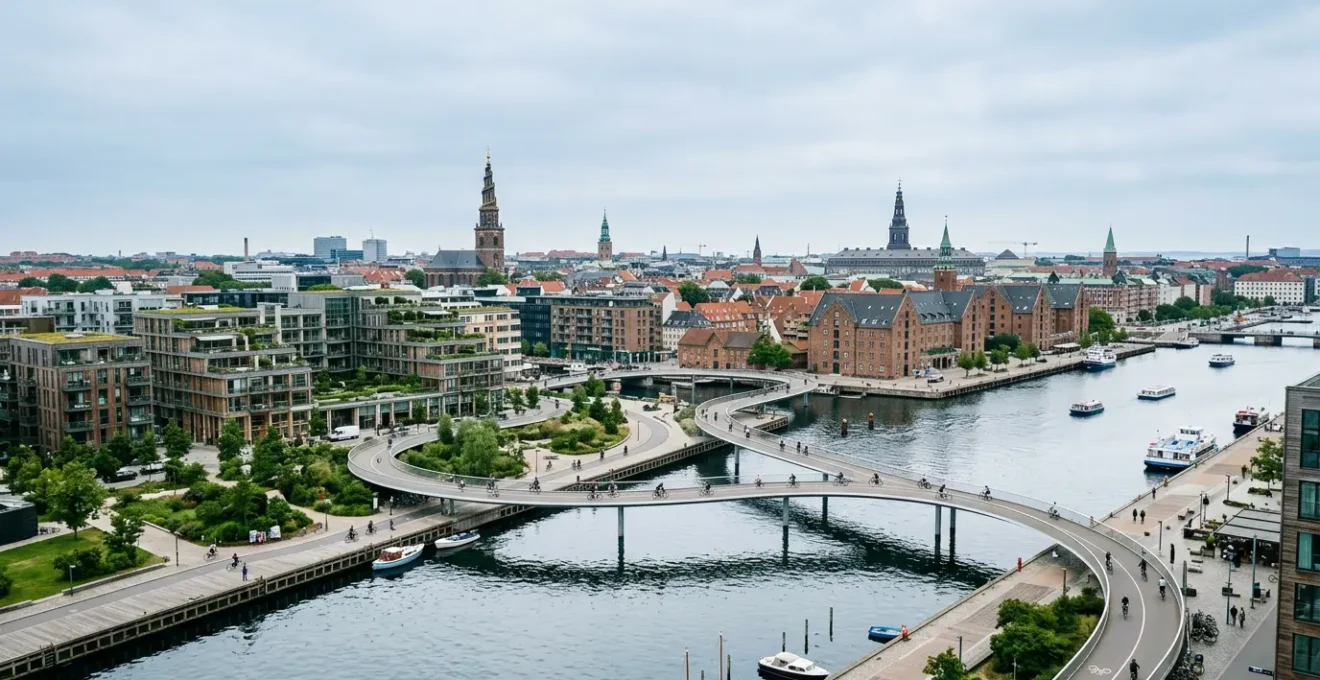
In most cities, cycling infrastructure is a pragmatic, often uninspired, addition—a painted line on a busy road. In Copenhagen, it is elevated to an art form. The “Cykelslangen,” or Bicycle Snake, is the perfect embodiment of this philosophy. This bright orange, elevated ramp elegantly winds its way from a busy dyke down to the harbor quay, separating cyclists from pedestrians and creating a seamless, joyful journey. It is more than a bridge; it’s a piece of kinetic sculpture that enhances the urban landscape.
The design of the Bicycle Snake addresses a specific urban problem with grace and efficiency. Previously, cyclists had to navigate a cumbersome staircase, carrying their bikes up and down. The new ramp provides a gentle gradient, allowing for a smooth, uninterrupted flow of traffic. This is a core principle of Copenhagen’s mobility strategy: make the sustainable choice the easiest and most pleasant choice. This is human-scale engineering in action, prioritizing user experience to encourage a desired behavior.
What makes the Bicycle Snake “art” is its deliberate aesthetic consideration. Its slender profile and sweeping curves are designed to be visually light, complementing the harbor setting rather than dominating it. It demonstrates that functional infrastructure doesn’t have to be brutish or utilitarian. By investing in high-quality design, the city transforms a simple connector into a landmark, a point of pride, and a powerful symbol of its commitment to cycling. It proves that when function and form are given equal weight, infrastructure can actively contribute to a city’s beauty and identity.
Why Can You Swim in Copenhagen’s Harbor When Other Cities Are Polluted?
The ability to swim in the central harbor is perhaps Copenhagen’s most astonishing achievement, transforming a post-industrial waterway into a recreational hub. This isn’t a happy accident; it’s the result of decades of massive investment and a sophisticated, policy-driven design approach to water management. The primary challenge wasn’t just industrial pollutants but a far more common urban problem: combined sewer overflows (CSOs), where heavy rain overwhelms the sewer system, forcing a mix of rainwater and raw sewage into the harbor.
A turning point was the catastrophic cloudburst of July 2011, a single storm event that caused approximately $1 billion in damage. This shock spurred the creation of the Cloudburst Management Plan, a 20-year strategy involving around 300 projects. The core idea is to treat rainwater as a resource, not a problem, by creating a “blue-green city.” This involves building new infrastructure designed to delay and retain stormwater on the surface, where it can be absorbed or slowly channeled away, rather than flooding the sewers.
This strategy manifests as dual-use infrastructure across the city. Streets are redesigned to act as canals during deluges, and public parks are engineered to double as massive retention basins. A prime example is Enghaveparken.
Case Study: Enghaveparken, the Climate Park
This historic park was retrofitted to function as a climate-adaptive space. On a normal day, it’s a beloved community area with basketball courts and green spaces. During an extreme rainfall event, however, it can hold up to 23,000 cubic meters of water. A low wall around its perimeter turns the entire park into a temporary reservoir, protecting the surrounding neighborhood from flooding. This approach is brilliant because it adds resilience without sacrificing public space; in fact, it enhances it, demonstrating how climate adaptation can improve urban life.
By tackling the root cause of overflow—excessive stormwater overwhelming the system—Copenhagen has drastically improved its harbor water quality, making the iconic harbor baths possible. It’s a lesson in proactive, systemic infrastructure planning.
Nordhavn: What Does a Climate-Resilient Neighborhood Look Like?
If CopenHill is a single project and the Cloudburst Plan is a city-wide strategy, Nordhavn is where it all comes together at the neighborhood scale. This former industrial port is being transformed into a blueprint for future urban living, planned to accommodate 40,000 residents and 40,000 jobs over the next 50 years. Nordhavn is designed from the ground up to be a “5-minute city,” where residents can reach shops, schools, and public transport within a five-minute walk, drastically reducing reliance on cars.
But its true innovation lies in its function as a living laboratory for smart energy systems. It goes far beyond simply installing solar panels. As the EnergyLab Nordhavn project highlights, the district is a testbed for an integrated, flexible, and intelligent energy grid. This is infrastructural symbiosis at its most advanced.
Nordhavn is a full-scale smart city energy lab, which demonstrates how electricity, heating, buildings and transportation can be integrated into an intelligent, flexible energy system. The EnergyLab Nordhavn project ties buildings, batteries, heat pumps, EVs, and low-temperature district heating into one control stack with real-time data guiding when to store, shift, or shed.
– EnergyLab Nordhavn / State of Green, Nordhavn: The smart urban area of the future
In practical terms, this means the neighborhood operates like a single, responsive organism. Buildings are designed to be highly energy-efficient, and their thermal mass is used as a form of energy storage. Heat pumps can draw warmth from seawater, and the entire system is connected to a low-temperature district heating network that is more efficient than traditional systems. Data from electric vehicles, building sensors, and the wider energy grid is analyzed in real time to optimize energy consumption, shifting demand to times when renewable energy is plentiful and cheap. This “smart grid” approach is essential for balancing a power system that relies heavily on intermittent sources like wind and solar.
Nordhavn demonstrates what a climate-resilient neighborhood looks like in practice: it’s not just green, it’s smart. It’s a place where buildings are no longer passive consumers of energy but active participants in a dynamic, data-driven system.
Will Copenhagen Actually Reach Carbon Neutrality or Is It Hype?
Copenhagen famously set the ambitious goal of becoming the world’s first carbon-neutral capital by 2025. This target has been a powerful driver for many of the innovations discussed, and the city has made remarkable progress, cutting emissions by over 75% compared to 2005 levels. The strategy was built on four pillars: energy efficiency, increased renewable energy production (primarily from wind and biomass), green mobility, and city administration leading by example. The plan was celebrated globally as a model for urban climate action.
However, the 2025 goal will not be met. The story of why is a crucial lesson in the complexities of policy-driven design and the dependencies between municipal goals and national politics. The final piece of the puzzle to close the emissions gap was supposed to be the implementation of Carbon Capture and Storage (CCS) technology at the Amager Resource Center (CopenHill).
Case Study: The CCS Controversy That Derailed the 2025 Goal
The city’s climate plan relied on capturing up to 500,000 tonnes of CO₂ annually from the waste-to-energy plant. This technology was essential to offset the remaining, hard-to-abate emissions. However, securing the necessary funding depended on a national grant. In 2022, the Danish government announced the criteria for this funding, and the municipally-owned utility operating the plant was deemed ineligible. As researchers noted, the city’s climate roadmap presented in 2021 already had a shortfall, and the failure to secure national funding for CCS was the final blow. According to an analysis in The Conversation, this created an accountability crisis, revealing a systemic flaw where a city’s climate goals depended on national support that never materialized.
So, is it all hype? Not at all. The progress is real and substantial. But the failure to meet the 2025 target is a sobering reality check. It highlights that even for a global leader like Copenhagen, achieving full carbon neutrality is fraught with political and financial challenges that can lie outside a city’s direct control. It’s a lesson that ambitious pledges must be backed by robust, multi-level governance and secured funding to become reality.
How to Plan a Zero-Waste Trip to Copenhagen Without Sacrificing Comfort?
Witnessing Copenhagen’s sustainable systems is one thing; participating in them is another. For the eco-conscious traveler, the city offers a unique opportunity to experience a low-impact lifestyle firsthand, without sacrificing comfort or convenience. The key is to tap into the systems that residents use every day. This starts with food. Copenhagen is a leader in organic consumption; an impressive 88% of the food served in the city’s public institutions is organic, and organic products make up a significant portion of total food sales.
To eat sustainably, seek out restaurants with the “Ø-label” (the red, official Danish organic certification) and visit local food markets like Torvehallerne to buy directly from producers. The city’s tap water is famously clean and safe to drink, so carrying a reusable water bottle is a simple way to eliminate single-use plastic waste. Furthermore, engage with the “pant” deposit-return system. Nearly all bottles and cans have a small deposit fee that is refunded when you return them to a machine found in any supermarket. It’s a highly efficient circular economy in action.
Getting around is inherently low-waste. Embrace the cycling culture by renting a bike or using the city’s bike-share system. The infrastructure is so safe and comprehensive that cycling is often the fastest way to get around. For longer distances, the public transport system—trains, metro, and harbor buses—is efficient, electric, and seamlessly integrated. A single City Pass gives you unlimited travel across all modes, including to and from the airport.
Action Plan: Your Checklist for a Conscious Copenhagen Visit
- Points of Contact: Identify key zero-waste opportunities: food, drink, transport, and shopping.
- Collect: Pack essentials for waste reduction: a reusable water bottle, a coffee cup, and a tote bag for shopping.
- Coherence: Align your choices with local systems. Prioritize tap water, use the “pant” deposit system for any purchased drinks, and opt for cycling or public transport.
- Memorability/Emotion: Focus on experiences over things. Visit a climate-adaptive park, eat at an organic-certified restaurant, or take a harbor bus instead of a standard tour boat.
- Plan for Integration: Before booking accommodation, check its proximity to metro stations or bike lanes to ensure sustainable mobility is the default option.
By making these small, deliberate choices, you move from being a passive observer to an active participant in Copenhagen’s green ecosystem. It’s a way to travel more deeply and responsibly, aligning your visit with the very values the city champions.
How Does Copenhagen Keep the Harbor Water Clean Enough to Drink?
While the Cloudburst Plan addresses stormwater, it’s only half the story of Copenhagen’s pristine harbor. The other, equally critical component is a radical overhaul of the city’s wastewater infrastructure. For over a century, the harbor was a cesspool, receiving untreated sewage and industrial runoff. The transformation required a multi-billion-kroner investment over 30 years to fundamentally re-engineer how the city handles its wastewater.
The core of this effort was to expand the capacity of wastewater treatment plants and, crucially, to reduce the number of overflow channels. The city has built massive underground reservoirs and conduits that can hold excess wastewater during heavy rainfall. This has allowed for the closure of 55 overflow channels, meaning that polluted water is only discharged directly into the harbor during the most extreme and infrequent rainfall events. This infrastructural upgrade is the invisible foundation upon which the clean harbor is built.
But infrastructure alone isn’t enough to guarantee safety for swimmers. The final piece of the puzzle is a sophisticated, real-time monitoring and warning system. This is where technology and public safety converge to create confidence.
The system constantly monitors the harbour’s water and predicts the concentration of the indicator bacteria Escherichia coli and Enterococci. Green and red lights at the harbour baths signal to swimmers whether the water is safe at that very moment, with the limit values for good bathing water quality set at 500 E. coli per 100ml of water.
– DHI Group / Copenhagen Municipality, Bathing Water Forecast System
This “Bathing Water Forecast” system combines physical sensors in the water with predictive models that account for weather, currents, and potential overflow events. The public-facing result is simple and effective: a green light means it’s safe to swim, and a red light means you should stay out. This transparency and reliability are essential for building public trust. The clean harbor is therefore a product of three things: long-term investment in wastewater infrastructure, smart management of stormwater, and a commitment to data-driven, real-time public safety information.
Key Takeaways
- Copenhagen’s green success stems from systemic thinking, not isolated projects.
- True resilience is achieved through dual-use infrastructure that serves both community and climate adaptation.
- Ambitious climate goals are vulnerable to political and financial realities that exist outside of municipal control.
How Does Urban Design Influence the ‘Danish Art of Living’?
All the large-scale engineering and climate strategies in Copenhagen ultimately serve a single purpose: to improve the quality of life for its citizens. This is where the city’s technical prowess connects with the famous Danish concept of “hygge”—a sense of coziness, well-being, and contentment. This feeling is not an accident; it is actively cultivated through thoughtful, human-scale urban design.
One key principle is the creation of “soft edges” where public and private realms meet. Instead of blank, hostile building facades, Copenhagen’s planners encourage designs that offer something back to the street. Wide window sills become informal benches, and storefronts are designed to be transparent and inviting. This blurs the line between inside and outside, creating a more engaging and comfortable pedestrian experience. The city feels less like a collection of separate buildings and more like a continuous, shared living room.
Lighting is another powerful tool used to foster hygge. The city has moved away from the harsh, uniform glare of traditional streetlights, which create a sense of exposure and anonymity. As noted in urban design analyses of the “Københavner-belysning” strategy, the focus is on warmer, more targeted lighting. Lights are often placed lower to the ground, are sometimes motion-activated, and are carefully directed to illuminate paths and social spaces while leaving other areas in comfortable shadow. This creates a sense of safety and intimacy at a human scale after dark, transforming a simple walk home into a pleasant experience.
From the seamless flow of a bicycle ramp to the reassuring glow of a well-lit public square, Copenhagen’s design philosophy is consistently people-first. The city demonstrates that sustainability is not just about carbon accounting and energy grids; it’s about designing a physical environment that fosters community, safety, and a profound sense of belonging. The ‘Danish Art of Living’ is not just a cultural trait; it’s a direct outcome of intentional design.
By deconstructing these projects, we see that the future of green cities requires more than just technology; it demands a holistic vision that integrates engineering, policy, and a deep understanding of human needs. To apply these lessons, the next step is to analyze how these principles can be adapted to your own local context.