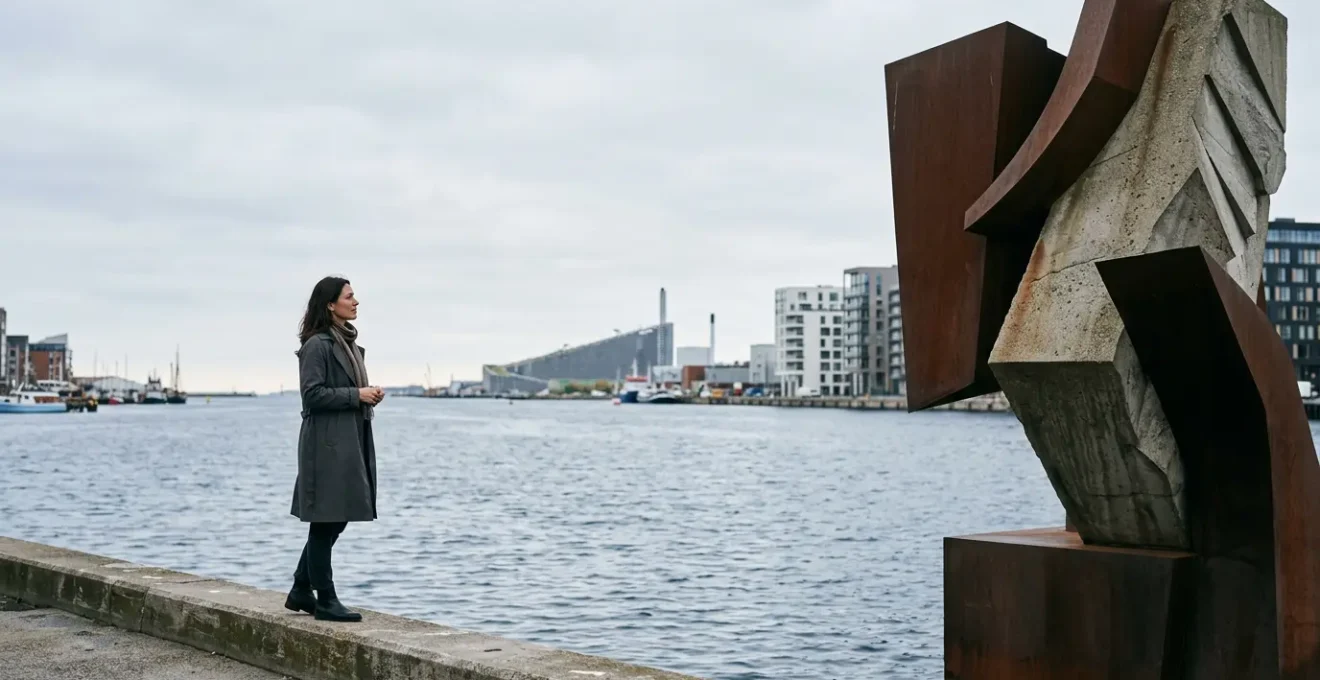
Experiencing Copenhagen’s art scene is not about a checklist of sights; it’s about understanding the city’s philosophy of ‘poetic pragmatism,’ where art is woven into the very fabric of daily life.
- World-class art isn’t confined to museums; it’s found in public infrastructure, metro stations, and the design of everyday objects.
- The city’s most exciting contemporary work comes from emerging artists in accessible districts like Vesterbro, not just established institutions.
Recommendation: Approach the city with a curator’s eye—seek the connections between art, design, and urbanism to uncover a creative ecosystem far richer than any tourist guide suggests.
For the discerning traveler, Copenhagen presents a paradox. Its global image is one of charming canals, colorful facades, and a certain fairy-tale monarchism. Yet, beneath this placid surface churns one of the world’s most dynamic and integrated contemporary art scenes. Many visitors arrive with a simple checklist: see the major museums, snap a photo of The Little Mermaid, and perhaps buy a piece of iconic Danish design. This approach, while pleasant, misses the city’s essential genius entirely.
The common advice to simply “visit the Louisiana” or “go gallery hopping” treats art as a series of destinations. But what if the true key to understanding Copenhagen’s creative soul lies not in what you see, but in *how* you see it? The city operates on a unique principle of poetic pragmatism, a philosophy where elegant, artistic solutions are applied to real-world, communal problems. This is a place where a bicycle bridge is a sculpture and a museum visit is a pilgrimage that begins with a train ride through the Danish landscape.
This guide moves beyond the classics to offer a curated perspective. It is designed for the art lover and creative seeker who wants to navigate the scene like an insider. We will explore how to strategically approach its most revered institutions, where to discover and acquire work from the next generation of artists, and how to decipher the code that makes Copenhagen a living, breathing work of art. This journey will reveal an ecosystem where contemporary art, mid-century design, and visionary urban planning are not separate disciplines, but facets of a single, coherent cultural identity.
To fully appreciate this integrated landscape, we will examine the pillars of Copenhagen’s creative world. This article breaks down the essential experiences, from its most famous modern art museum to the secrets of its vintage design shops, providing a framework for a truly inspiring visit.
Contents: A Curated Itinerary of Copenhagen’s Art Scene
- Is the Trip to Louisiana Museum Worth the 45-Minute Train Ride?
- Vesterbro Galleries: Where to Buy Affordable Art from Rising Stars?
- Why Is Copenhagen Investing Millions in Public Art Installations?
- When is Copenhagen Art Week and Should You Plan Your Trip Around It?
- The Monday Trap: Which Art Museums Are Actually Open to Start the Week?
- Designmuseum Danmark: Is the Chair Tunnel the Only Highlight?
- The Bicycle Snake: How Infrastructure Became Art in the Harbor?
- How to Identify Authentic Mid-Century Chairs in Vintage Shops?
Is the Trip to Louisiana Museum Worth the 45-Minute Train Ride?
The question is not whether the Louisiana Museum of Modern Art is a world-class institution—it unequivocally is. The real question is whether the journey itself is an imposition or an integral part of the experience. For the strategic art lover, the 45-minute train ride north from Copenhagen is not a commute; it is a necessary transition. It shifts the mindset from the urban hustle to the contemplative state required to fully absorb what Louisiana offers: a sublime synthesis of art, architecture, and nature.
Its status as Scandinavia’s most visited museum, with over 700,000 visitors annually, is not just due to its collection, but its unique atmosphere. Unlike a traditional city museum, Louisiana unfolds across a landscape. Glass corridors connect pavilions, framing views of the Øresund strait and the ancient trees of the surrounding park. The architecture by Vilhelm Wohlert and Jørgen Bo was designed to be secondary to the art and the environment, creating a seamless dialogue between indoors and outdoors. The journey prepares you for this dialogue.
To treat Louisiana as just another stop on a packed itinerary is to miss its point. The value of the trip is realized not by rushing through, but by embracing its pace. Arriving with a plan to experience its distinct elements—the Giacometti Hall, Yayoi Kusama’s immersive infinity room, and the monumental sculptures by Calder and Serra in the park—transforms the visit from a task into a pilgrimage. The train ride, then, becomes the first act of this curated experience, a purposeful moment of decompression before the immersion begins.
Vesterbro Galleries: Where to Buy Affordable Art from Rising Stars?
While museums house the established canon, the pulse of Copenhagen’s contemporary art scene beats strongest in its commercial galleries, particularly in the Vesterbro district. This is where you graduate from observer to participant, where you can discover—and even acquire—work from the artists who will define the next generation. The key is knowing where to look and how to approach this dynamic ecosystem.
The Meatpacking District (Kødbyen) in Vesterbro is the city’s gallery epicenter. What began in the mid-2000s as a gritty industrial area has transformed into a polished hub for contemporary art, yet it retains an accessible, eclectic energy. Stalwart galleries like V1 Gallery and its various offshoots anchor a scene that is dense with opportunities for discovery. Here, you’ll find a mix of painting, sculpture, and new media from both Danish and international artists. The environment encourages exploration; it’s a place to see museum-quality shows in an intimate, commercial setting, often with the gallerist on hand to discuss the artist’s practice.
For the aspiring collector, Vesterbro is the ideal hunting ground. The question of affordability is answered by focusing on emerging artists and accessible mediums. Photography and limited-edition prints offer a common entry point, allowing you to own a piece of the scene without the price tag of a unique painting. The most crucial step, however, is preparation. Understanding gallery etiquette and research are paramount to a successful and rewarding experience.
Your Action Plan: The First-Time Art Buyer’s Checklist for Copenhagen
- Research Emerging Artists: Look for recent graduates of the Royal Danish Academy of Fine Arts, local art prize winners, or artists featured in group shows at Kunsthal Charlottenborg.
- Master Gallery Etiquette: It’s okay to just look. Engage gallerists by asking, “Tell me about the artist’s practice,” rather than leading with price inquiries to open a meaningful dialogue.
- Start with Affordable Mediums: Consider photography and prints as entry points. They are typically more accessible than original paintings or sculptures from the same artist.
- Understand Price Structures: Learn the difference between limited edition prints, artist proofs (APs), and unique works. A gallerist can explain these pricing tiers.
- Plan International Shipping: Before purchasing, inquire about the gallery’s experience with international shipping, customs documentation, and insurance for transport to ensure your new artwork arrives safely.
Why Is Copenhagen Investing Millions in Public Art Installations?
The proliferation of high-quality public art throughout Copenhagen is not a decorative afterthought; it is a deliberate and deeply philosophical policy. The city’s significant investment in art for its shared spaces—from metro stations to harbor fronts—is rooted in a core tenet of Danish society: cultural democracy. This is the social-democratic principle that access to high-quality culture is a right for all citizens, not a privilege reserved for a museum-going elite.
This philosophy is institutionalized through bodies like the Danish Arts Foundation, which funds over 6,400 art projects annually. Established in 1964, its mission is to ensure that art is an active and visible part of public life. By commissioning works for spaces people transit through daily, the city transforms routine into an opportunity for aesthetic encounter. The Metro, for instance, is treated as an underground museum, with a recent initiative unveiling five new major art pieces in the spring of 2024. This turns a daily commute into an act of cultural participation.
This investment yields a city that feels curated. It fosters a population that is visually literate and accustomed to interacting with contemporary artistic ideas. Furthermore, it enhances the quality of life and strengthens the city’s identity as a global center for creativity. For the visitor, this means the art experience doesn’t end when you leave a gallery. It continues on the street, on your way to dinner, or while waiting for a train. The investment is, therefore, not just in objects, but in the civic and cultural fabric of Copenhagen itself, making the entire city a canvas.
When is Copenhagen Art Week and Should You Plan Your Trip Around It?
For the deeply engaged art enthusiast, timing a visit to coincide with Copenhagen’s annual art festival can be a powerful strategy. Historically known as Copenhagen Art Week and relaunched in 2024 as the Art Matter Festival, this city-wide event (typically held in late May to early June) represents the densest concentration of contemporary art programming in the Nordic region. But the decision to plan a trip around it requires a nuanced understanding of its benefits and drawbacks.
The primary advantage is unparalleled access and energy. During the festival, the city’s entire art ecosystem is activated. Over a single week, you can experience close to 200 exhibitions and events spanning major institutions like Kunsthal Charlottenborg and Louisiana, the commercial galleries of Vesterbro, and experimental, artist-run project spaces. The program is packed with artist talks, performances, studio visits, and vernissages, creating an electric atmosphere and countless opportunities for discovery and networking. It is the moment the city’s art scene is most visible, vocal, and interconnected.
However, this intensity comes at a cost. The sheer volume of events can be overwhelming, and the crowds at popular venues can detract from the viewing experience. Accommodation prices surge, and securing a reservation at top restaurants becomes a competitive sport. More importantly, the focused attention of gallerists is divided. For a first-time buyer seeking a deep conversation, the frenetic pace of a festival opening might be less productive than a quiet Tuesday afternoon. A strategic alternative is to visit the week just before or after the festival. This allows you to see the same exceptional exhibitions without the crowds and with greater access to the people behind the art.
The Monday Trap: Which Art Museums Are Actually Open to Start the Week?
The “Monday Trap” is a classic pitfall for culture-trippers worldwide, and Copenhagen is no exception. After a weekend of exploration, many visitors plan to dedicate Monday to a major museum, only to be met with locked doors. Most of the city’s state-funded institutions, including the National Gallery of Denmark (SMK), Ny Carlsberg Glyptotek, and Designmuseum Danmark, are closed on Mondays for maintenance and exhibition changeovers. However, a closed museum door is not a dead end; it’s an opportunity to experience the city’s art scene from a different, and often more intimate, perspective.
A savvy art lover’s Monday should be built around the parts of the ecosystem that remain open. This is the perfect day to dive deep into the commercial gallery scene. Galleries in districts like Vesterbro and the more classical Bredgade often maintain Monday hours, offering a chance for quiet contemplation and one-on-one conversations with gallerists that are impossible on a bustling Saturday. It’s always wise to call ahead or check websites, but this can be the most rewarding day for gallery hopping.
Alternatively, Monday is the ideal time to create your own public art walking tour. The city itself is your gallery, and its most significant works are always accessible. From the superkilen park in Nørrebro to the sculptures dotted around the harbor, a self-guided tour reveals the deep integration of art into the urban landscape. For those still craving an institutional experience, consider institutions with different schedules, such as the Danish Architecture Center (DAC), or take a short train ride to the ARKEN Museum of Modern Art in Ishøj (check its schedule) or across the bridge to the Moderna Museet in Malmö, Sweden, which is often open on Mondays.
Designmuseum Danmark: Is the Chair Tunnel the Only Highlight?
To ask if the iconic “Chair Tunnel” is the only highlight of Designmuseum Danmark is like asking if the “Mona Lisa” is the only reason to visit the Louvre. The tunnel, an immersive passage lined with decades of Danish chair design, is a brilliant and accessible entry point, but it is not the destination. Its true purpose is to serve as a prologue, introducing the central theme that runs through the entire museum and, indeed, through Danish culture: the elevation of the everyday object through thoughtful, human-centered design.
The museum, housed in a magnificent 18th-century Rococo building, uses this architectural contrast to highlight the radical simplicity and functionality of modern Danish design. Beyond the chairs, the collections offer a deep dive into the philosophy that shaped them. You’ll find exhibitions dedicated to textiles, graphic design, industrial products, and fashion, all governed by the same principles of craftsmanship, honest materials, and democratic accessibility. The museum tells the story of how designers like Arne Jacobsen, Hans J. Wegner, and Poul Henningsen sought to create beautiful, functional items not as luxury goods, but as solutions to improve daily life for everyone.
The real highlight of the Designmuseum is this narrative. It’s the understanding that the perfect curvature of a chair back is not just an aesthetic choice, but the result of rigorous studies in ergonomics. It’s realizing the clean lines of a teapot are about efficient production and ease of use. The Chair Tunnel is the hook, but the lasting takeaway is a profound appreciation for the intellectual and social project behind Danish modernism. It equips you to see the rest of the city not just as a collection of buildings and objects, but as a living repository of this enduring design philosophy.
The Bicycle Snake: How Infrastructure Became Art in the Harbor?
Cykelslangen, or the Bicycle Snake, is more than just an elevated, bright orange cycle track winding its way over Copenhagen’s harbor. It is perhaps the most elegant and public manifestation of the city’s guiding philosophy of poetic pragmatism. In any other city, a bridge connecting two points for cyclists would be a purely utilitarian structure. In Copenhagen, it becomes a graceful, sculptural intervention in the urban landscape—an object of beauty that also solves a practical problem with remarkable efficiency.
This approach, where infrastructure transcends its function to become art, is a hallmark of Copenhagen’s modern identity. The city’s planners and architects do not see a false dichotomy between beauty and utility. As explored in analyses of the city’s design culture, there is a deep-seated belief in creating shared spaces that are both communal and aesthetically pleasing. Another prime example is the Olafur Eliasson-engineered Circle Bridge (Cirkelbroen), composed of five intersecting circular platforms that encourage pedestrians and cyclists to pause and interact rather than just cross.
This philosophy transforms how one experiences the city. Riding the Bicycle Snake is not just a commute; it’s a kinetic experience, offering shifting perspectives of the water and the skyline. It’s an invitation to engage with the city’s form. By treating essential infrastructure as a canvas for high-level design and artistic expression, Copenhagen creates a public realm that is constantly engaging and inspiring. It proves that the most impactful art isn’t always on a pedestal in a gallery; sometimes, you can ride your bike across it.
Key Takeaways
- Look Beyond the Museum: Copenhagen’s most profound art experiences often happen in public spaces, where design, architecture, and infrastructure intersect.
- Embrace the “Why”: Understanding the philosophy of “cultural democracy” and “poetic pragmatism” transforms a simple visit into a deep cultural analysis.
- Collect Strategically: The emerging art scene in Vesterbro offers accessible entry points for new collectors, but requires research and a confident approach.
How to Identify Authentic Mid-Century Chairs in Vintage Shops?
After immersing yourself in the philosophy of Danish design at the museum, the final, most tangible step is to engage with it in the marketplace. Copenhagen’s vintage shops are treasure troves of mid-century modern furniture, but they are also filled with reproductions and lesser-quality pieces. For the discerning buyer, knowing how to distinguish an authentic masterpiece from a clever copy is a crucial skill. The key lies in a forensic examination of materials, craftsmanship, and the subtle signs of age.
Authenticity begins with the materials. True Danish mid-century pieces were crafted from high-quality hardwoods like teak, oak, and rosewood, chosen for their durability and beautiful grain. Run your hand over the surface; it should feel solid, with a visible, organic pattern. Be wary of laminates or veneers that hide cheaper particleboard beneath. As detailed in expert guides, the joinery is another critical tell. Look for masterful techniques like dovetail or finger joints, especially in drawers and frames. The presence of crude screws, staples, or visible glue is a red flag for a reproduction.
Finally, look for the maker’s mark and the patina of time. Many authentic pieces bear a manufacturer’s burn stamp (like Carl Hansen & Søn or Fritz Hansen) or a “Danish Furnituremakers’ Quality Control” medallion on the underside. Most importantly, a genuine vintage chair should show its age with grace. A slight, even wear on the armrests, a soft patina on the leather, or a gentle fading of the wood are not flaws—they are testaments to its history and authenticity. An overly pristine piece can sometimes be more suspicious than one with an honest story to tell. By training your eye for these details, you can confidently navigate the market and find a true piece of Danish design history.
To aid in your search, it’s helpful to know the city’s distinct shopping districts. The following table breaks down where to look based on your goals and budget, with data sourced from curated guides to the city’s design scene.
| District | Characteristic | Price Point | Recommended For |
|---|---|---|---|
| Bredgade (Centrum) | Classical Copenhagen architecture, polished galleries | High-end investment pieces | Authenticated iconic designers (Finn Juhl, Arne Jacobsen), museum-quality condition |
| Ravnsborggade (Nørrebro) | Flea market atmosphere, eclectic neighborhood | Affordable bargains | First-time buyers, hidden gems, DIY restoration projects |
| Vesterbro Meatpacking | Converted industrial warehouses, contemporary mix | Mid-range to high | Contemporary design alongside vintage, gallery-quality curation |
Armed with this new perspective—an understanding of the city’s guiding philosophies and a practical eye for quality—you are ready. It’s time to explore Copenhagen’s streets, galleries, and shops not as a tourist ticking off a list, but as a connoisseur decoding a rich and integrated creative world.