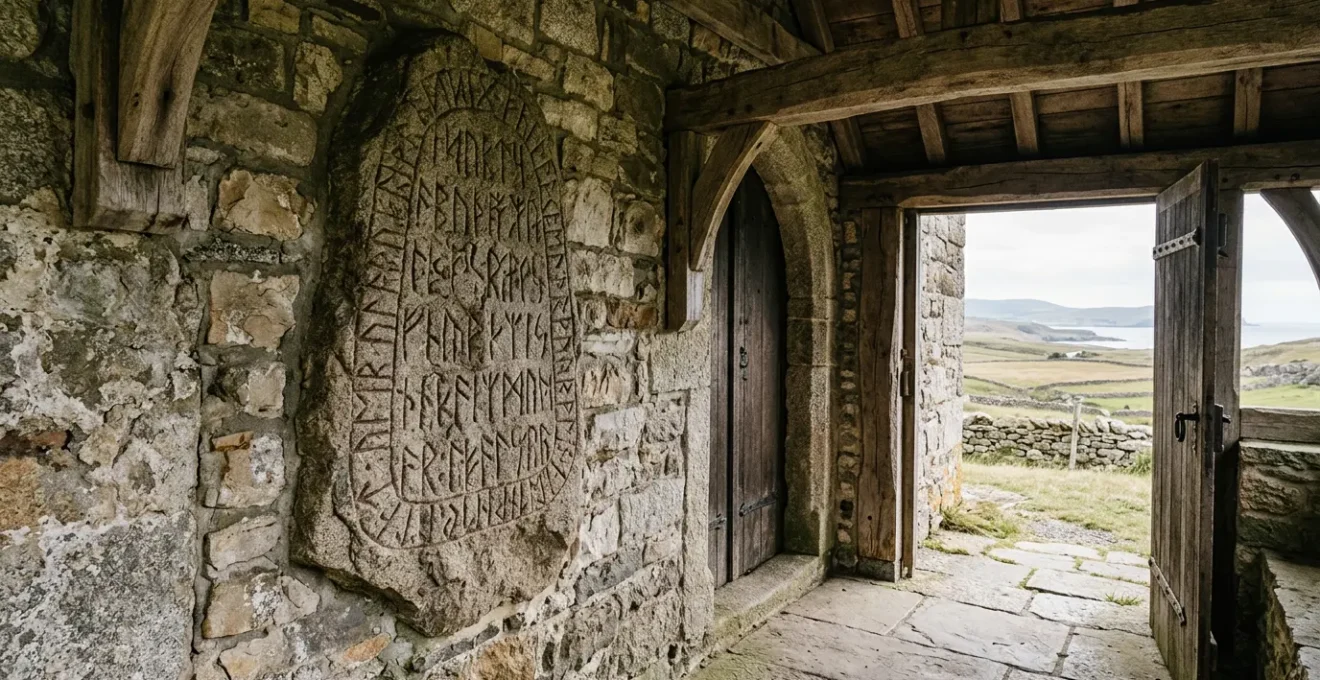
The grand monuments at Jelling tell one story, but the true, complex narrative of the Viking Age is scattered across thousands of lesser-known runestones.
- Most runestones are not royal proclamations but local “social documents” marking inheritance, status, and memory.
- Authenticity can be verified by analyzing carving-edge weathering, lichen growth, and runic grammar—a skill this guide provides.
Recommendation: Move beyond the famous sites and learn to read the epigraphic footprints of individuals to uncover a more personal history of the Norse world.
Imagine stumbling upon a lichen-covered slab of granite, built into the wall of a medieval Danish church. Carved into its surface is a winding serpent, its body filled with strange, angular letters. For the unprepared, this is merely a curiosity. For the history hunter, this is a direct message from the Viking Age, an epigraphic footprint waiting to be deciphered. The common path leads directly to the monumental stones at Jelling, spectacular but singular in their royal boast. This focus, however, overlooks a fundamental truth known to every runologist: the Jelling stones are the exception, not the rule.
The real history is not a monolithic narrative but a complex mosaic of thousands of stones raised by farmers, priests, and widows across Scandinavia. These were not just memorials; they were social documents, property deeds, and political statements, each with a local voice. To understand them requires moving beyond a tourist’s gaze and adopting a runologist’s eye—learning the script, questioning the context, and distinguishing the hand of an ancient carver from a modern forger. The secrets of the Viking Age are not locked away in a single location; they are hidden in plain sight, carved into the very fabric of the Scandinavian landscape.
This guide provides the framework for that deeper understanding. We will decipher the runic alphabet, investigate the motivations behind these monuments, and journey to a stone even longer than those at Jelling. Ultimately, you will be equipped with the tools to not just find these stones, but to hear the voices of the ancestors who carved them.
Summary: Beyond Jelling: Deciphering the Runestones Hidden in Plain Sight
- Futhark 101: How to Recognize Your First Runic Letter?
- Memorials or Property Deeds: Why Did Vikings Raise Stones?
- The Longest Inscription: Is the Glavendrup Stone Worth the Drive to Fyn?
- Indoor vs Outdoor: Why Are Some Runestones Moving Inside Museums?
- Replica vs Original: How to Tell if the Stone is Authentic?
- Harald Bluetooth’s Boast: What Does the Big Jelling Stone Actually Say?
- Why Is the Viking Age Shorter Than Most People Think?
- How to Understand the Birth of Denmark at the Jelling Monuments?
Futhark 101: How to Recognize Your First Runic Letter?
Before one can read a message, one must learn the alphabet. The Viking Age script, known as the Younger Futhark, is a deceptively simple system of 16 characters. Unlike modern alphabets, these runes were primarily composed of vertical and diagonal strokes, a practical design for carving into the grain of wood or stone. The name “Futhark” itself is derived from its first six letters: f-u-þ-a-r-k. To begin your journey into runic literacy, you must first abandon the notion of a single, uniform script. Regional variations abounded, and the hand of the individual carver often introduced unique quirks.
The scale of this runic world is vast and extends far beyond Denmark’s borders. In fact, comprehensive surveys show there are between 1,700 and 2,500 runestones in Sweden alone, with the region of Uppland hosting a staggering 1,196 inscriptions. Each one is a piece of a massive puzzle. Recognizing your first letter is an exercise in pattern recognition. Start with the most distinct shapes: the ‘s’-rune (ᛋ), a lightning bolt; the ‘i’-rune (ᛁ), a simple vertical staff; or the ‘m’-rune (ᛘ), resembling a stylized tree. The challenge, and the thrill, lies in deciphering these forms on weathered, damaged, or creatively carved surfaces.
To the untrained eye, inscriptions can appear as a jumble of scratches. However, a few techniques can bring clarity to the carver’s hand:
- Look for ligatures. Runemasters often saved space by combining runes. A common example is the s-rune (ᛋ) and k-rune (ᚴ) in the word ‘skipari’ (sailor), where the strokes might merge into a single, complex character.
- Use side-lighting. An essential field technique is to hold a light source, like a phone’s flashlight, at a very low angle to the stone. This rakes light across the surface, casting shadows in the grooves and making even heavily eroded carvings legible.
- Forget standard direction. Runic inscriptions had no fixed rules for direction. They could be carved left to right, right to left, or in a winding pattern known as boustrophedon, following the shape of the stone or a carved serpent.
- Note the lack of separation. Authentic inscriptions rarely have spaces between words and use no punctuation. This is why translation is a specialist’s art, requiring knowledge of Old Norse grammar to parse the continuous stream of letters.
Mastering these initial steps transforms a passive viewer into an active investigator, ready to engage with the stone as a text. The first recognized letter is a key turning a lock.
Memorials or Property Deeds: Why Did Vikings Raise Stones?
A runestone is never just a rock with writing. It is a public declaration, a permanent fixture in the social and legal landscape of its time. While many served as memorials, reducing them to mere gravestones would be a grave misinterpretation. Each stone was a stone as social document, erected to solidify a family’s status, claim inheritance, or commemorate a political alliance. The act of raising a stone was an expensive and public affair, a clear signal of wealth and influence within the community. The content of the inscription often reveals these underlying motives, broadcasting a message to all who passed by.
The formula is often “X raised this stone in memory of Y,” but the crucial details lie in the titles and relationships described. A prime example is the Glavendrup stone, which states:
Ragnhildr placed this stone in memory of Alli the Pale, priest of the sanctuary, honourable þegn of the retinue.
– Glavendrup Stone inscription, National Museum of Denmark, DR 209 runestone documentation
Here, Ragnhildr is not just mourning her husband; she is cementing his—and by extension, her family’s—high status in society by listing his prestigious roles as a priest (goði) and a chieftain’s retainer (þegn). The stone functions as a permanent record of their social standing, visible to all.
Case Study: Queen Thyra, the Most Commemorated Woman in Viking Age Denmark
Runestones can even rewrite history, revealing the hidden influence of figures previously thought to be minor. Queen Thyra, wife of Gorm the Old, is mentioned on at least four different runestones—more than any other individual in Viking Age Denmark. This is double the mentions received by her famous husband and son, Harald Bluetooth. Recent 3D scanning has revealed that several of these stones were carved by the same master, Ravnunge-Tue. This suggests a coordinated campaign to honor her, and runological analysis indicates she came from a more powerful and established noble family than Gorm. The stones are primary evidence that Thyra was a far more significant political figure than written sources had led historians to believe, demonstrating how these monuments served to broadcast and legitimize power structures.
Therefore, when approaching a runestone, the first question should not be “Who died?” but “What is being declared?” Is it a son’s legal claim to his father’s land? A widow consolidating her family’s prestige? Or a chieftain honoring a fallen warrior to inspire loyalty in others? The stone speaks of the living as much as it does of the dead.
The Longest Inscription: Is the Glavendrup Stone Worth the Drive to Fyn?
For the history hunter seeking stories beyond Jelling, the island of Fyn holds a monument of profound importance: the Glavendrup stone. While Harald Bluetooth’s stone is famed for its imagery and historical claim, the Glavendrup stone (DR 209) holds the title for Denmark’s longest runic inscription. This is not a boast of a king, but the intricate legacy of a powerful woman, Ragnhildr. The journey to this site is a pilgrimage to one of the most complete and foreboding runic texts ever discovered.
The stone is part of a larger ship-setting monument and features an inscription with an astonishing 210 runic letters, wrapping around its surface. As we’ve seen, it details the status of Ragnhildr’s husband, Alli the Pale. But the text does not end with a memorial. It concludes with a grim and powerful curse, a feature found on several runestones, meant to protect the monument from being damaged or repurposed—a common practice in a landscape where large, shaped stones were a valuable building resource. This section reveals the raw, pre-Christian worldview where words held tangible power.
The carver, using the full force of runic magic, laid down a chilling warning for any who would dare to desecrate the memorial. The curse is a direct address to the future, a voice echoing across a millennium:
A warlock be he who damages this stone or drags it to stand in memory of another.
– Glavendrup Stone curse inscription, Glavendrup Stone (DR 209), early 10th century
This final passage transforms the stone from a historical document into an object of apotropaic power. It is a testament to the belief that the runes themselves, and the act of carving them, could enforce a contract between the living, the dead, and the supernatural. The drive to Fyn is therefore not just a trip to see a long text; it’s an encounter with the fierce protective magic of the Viking Age, a raw and potent force that the later, Christianized stones lack.
Indoor vs Outdoor: Why Are Some Runestones Moving Inside Museums?
A contentious debate in the world of runology is the fate of the stones themselves. Should they remain in their original locations, exposed to the elements as they have been for a thousand years, or be moved into the sterile, climate-controlled environment of a museum? The answer is a difficult balance between preserving the object and preserving its context. The primary driver for moving stones indoors is the undeniable threat of deterioration. Acid rain, frost, and biological growth are slowly erasing these epigraphic footprints from existence.
What we see today is a pale ghost of the stones’ original appearance. It is a well-established fact, as noted in runestone preservation research, that “Runestones were usually brightly coloured when erected, though this is no longer evident as the colour has worn off.” The intricate carvings were once filled with vibrant pigments—red, black, white, and blue—making the text and imagery leap out from the stone. This brilliant spectacle is now almost entirely lost to weathering, and protecting the faint traces of remaining paint is a high priority for conservators.
Case Study: The Jelling Stones’ High-Tech Preservation
The famous Jelling stones provide the most high-profile example of this dilemma. After a millennium of exposure, experts noticed cracks forming on their surfaces. In 2008, following an examination, UNESCO requested the stones be moved indoors or otherwise protected in situ. The decision was made to keep the original stones at the Jelling site, but they are now encased in state-of-the-art glass enclosures. These cases meticulously control the internal climate, protecting the stones from rain, frost, and pollution while allowing them to remain at their historic location. Meanwhile, to convey their original splendor, full-sized and painted replicas have been created and are displayed at museums in Copenhagen and Stockholm, and even as far as London and Normandy. This hybrid approach allows the public to experience the stones’ intended vibrant appearance while ensuring the priceless originals are preserved for future generations.
The decision to move a stone is never taken lightly. Removing it from its original landscape—the farm it marked, the burial mound it stood by, the river crossing it overlooked—strips it of its geographical and social context. Yet, leaving it to crumble may mean losing it forever. The compromise, often seen in local churches where smaller stones are brought inside and mounted on a wall, is a pragmatic solution to an impossible problem. It is an acknowledgment that these messages from the past are fragile, and our duty as their inheritors is, first and foremost, to ensure they survive.
Replica vs Original: How to Tell if the Stone is Authentic?
For the dedicated history hunter, there is no greater thrill than finding an authentic artifact, and no deeper disappointment than discovering it is a fake. The world of runestones is not immune to hoaxes, some driven by local pride and others by simple mischief. Distinguishing a 10th-century carving from a 19th-century one requires a runologist’s skeptical eye and a toolkit of diagnostic techniques. The most infamous example serves as a potent cautionary tale for any aspiring field researcher.
Case Study: The Kensington Runestone Hoax
Discovered in Minnesota in 1898, the Kensington Runestone claims to be a record left by Scandinavian explorers in the year 1362. If authentic, it would rewrite the history of European presence in North America. However, since the very first scientific analysis in 1910, the overwhelming scholarly consensus has been that the stone is a 19th-century forgery. The evidence is damning: the language and grammar are inconsistent with 14th-century Old Norse, and several of the runic characters are not found in any known medieval Futhark. Despite being debunked by linguists and runologists, the stone remains a popular tourist attraction, a testament to the power of a good story over hard evidence.
The Kensington stone is an extreme case, but it underscores the need for critical evaluation. An authentic Viking Age runestone is an artifact that has weathered a thousand Scandinavian winters. A modern replica, even a well-made one, lacks this deep history etched into its very surface. With careful observation, you can learn to spot the tell-tale signs of age and authenticity.
Runestone Detective’s Checklist: Spotting a Modern Replica
- Examine Lichen Growth: Authentic stones display complex, slow-growing lichen colonies with varied, asymmetrical patterns that can take centuries to form. A modern fake will have no lichen, or perhaps a uniform, artificially applied growth that looks like a smear of paint.
- Check Carving Edges with Side-Lighting: Use a flashlight at a low angle. The carved grooves on a genuine artifact will have softened, rounded edges from centuries of wind and rain erosion. Modern tool marks are sharp, crisp, and angular. This reveals the difference in The Carver’s Hand versus a modern chisel.
- Study the Stone’s Geology and Context: Viking Age runemasters used locally-sourced stone. Is the stone’s material (e.g., granite, sandstone) consistent with the local geology? Does its weathering match other ancient rocks in the area? A stone that looks out of place is a red flag.
- Look for Official Registration: Virtually all legitimate Scandinavian runestones are cataloged in academic databases, such as the Rundata project. They are assigned an official designation code (e.g., “DR” for Denmark, “U” for Uppland, Sweden). The absence of such a registration is highly suspicious for any significant find.
By applying this methodical approach, the history hunter can move from hopeful belief to confident assessment, ensuring the stories they uncover are those of the Vikings, not of a more recent trickster.
Harald Bluetooth’s Boast: What Does the Big Jelling Stone Actually Say?
Having explored the wider world of runestones, we can return to Jelling with a more critical eye. The larger of the two Jelling stones (DR 42) is often called “Denmark’s Baptismal Certificate.” It is the ultimate example of a monumental narrative, a political and religious declaration by a powerful king meant to be seen by all and to define his reign for eternity. Unlike the local, personal stones, this was an act of state-building, carved in stone. Its three-sided surface is a masterclass in political propaganda.
One side features the earliest depiction of Christ in Scandinavia, intertwined with Nordic-style patterns. Another shows a great beast fighting a serpent, a motif open to both pagan and Christian interpretation. The third and most important side carries the text itself. The inscription is a bold, unambiguous statement of power and accomplishment. It is Harald’s resume, carved for all time:
King Harald bade this monument be made in memory of Gorm his father and Thyra his mother, that Harald who won for himself all of Denmark and Norway and made the Danes Christian.
– Harald Bluetooth’s Jelling Stone inscription, The Jelling Stone (DR 42), circa 965 CE
The text is masterful in its construction. It begins with the traditional memorial formula, honoring his parents and establishing his legitimate succession. It then pivots to his own achievements, making three audacious claims: he unified Denmark, he conquered Norway, and he converted the Danes to Christianity. By erecting this stone around 965 CE, Harald was not just creating a memorial; he was marking a definitive break with the past and proclaiming the birth of a new, Christian kingdom under his absolute rule. It is a singular and powerful statement, but it is crucial to remember that it is one king’s voice, deliberately trying to shape the historical record.
Why Is the Viking Age Shorter Than Most People Think?
Conventional history often marks the end of the Viking Age with a neat, tidy date: 1066, the year of the Battle of Stamford Bridge and the Norman Conquest of England. From a runologist’s perspective, this is an arbitrary and misleading endpoint. The cultural, religious, and social phenomena that defined the era did not simply cease on a single day. If we define the age by its most unique and enduring cultural practice—the raising of runestones—then the “Viking Age” extends significantly later, well into the 12th century. The stones tell a different story than the chronicles of kings and battles.
The practice of erecting runestones exploded in the late 10th century and continued unabated through the 11th. In fact, archaeological and runological research confirms that most runestones were erected during the period 950-1100 CE, with a significant number in the area around Lake Mälaren in Sweden being raised as late as 1130. This was a time of immense change, as Scandinavia slowly converted to Christianity and integrated into the broader European world. The stones are our most direct record of this transition, with Christian crosses appearing alongside runic serpents.
This “runological” dating is supported by academic consensus. As experts from the Historical Museum of Norway articulate, the timeline is defined by the script itself:
From a runological point of view, the Viking Age begins with the transition to the younger runes in the early 700s and lasts until just after 1100 when runestones apparently ceased to be raised.
– Historical Museum of Norway, Viking runes (750-1100) exhibition research
This perspective re-frames the Viking Age not as a period of raiding and conquest alone, but as the “Runestone Period.” It was an age defined by a unique form of public literacy and memorialization that flourished for nearly two centuries after the last longship sailed home from England. To a history hunter, this is a crucial insight: the most fertile ground for finding these messages from the past lies in this later, transitional period, long after popular history has closed the book on the Vikings.
Key Takeaways
- Runestones are primarily social and legal documents that declare status and inheritance, not just simple memorials.
- Authenticity can be determined through field analysis of weathering, carving techniques, and lichen patterns, separating ancient artifacts from modern forgeries.
- The peak of the runestone-raising tradition (c. 950-1100 CE) extends far beyond the traditional 1066 end date of the Viking Age.
How to Understand the Birth of Denmark at the Jelling Monuments?
We end where many begin: Jelling. But armed with a runologist’s perspective, we no longer see just two famous stones. We see a complex, multi-layered power center that documents the very birth of the Danish nation-state. Granted UNESCO World Heritage status in 1994, the Jelling monuments are not a static display but an archaeological landscape that reveals the pivotal transition from a pagan Nordic chiefdom to a Christian European kingdom. Understanding this site means reading the entire complex, not just its most famous inscriptions.
Case Study: The Jelling Power Complex
The site is far more than its stones. It comprises two colossal burial mounds, each 70 meters in diameter. Between them stand the runestones of Gorm the Old and Harald Bluetooth. Beneath the stone church on the site lie the foundations of a 10th-century wooden longhouse, presumed to be Harald’s royal hall. Most impressively, recent excavations have revealed the footprint of a massive, 356-meter-long, diamond-shaped palisade that once fortified the entire area. The northern mound held a burial chamber for King Gorm, who was later exhumed and reburied in the first Christian church on the site. This sequence of acts—pagan mound burial followed by Christian re-interment—is the physical manifestation of the cultural shift Harald boasts about on his stone. The entire complex tells a story: the pagan power of the mounds giving way to the Christian authority of the church, all consolidated by Harald’s runic declaration.
The evolution of the site during the 10th century CE, under the reigns of Gorm and Harald, is the story of Denmark’s foundation. It is a move from one form of power, rooted in ancestry and pagan tradition (Gorm’s mound and small stone), to a new, centralized, and divinely-sanctioned authority (Harald’s church and large stone). Jelling is not the whole story of the Viking Age, but it is the dramatic climax of one of its most important chapters: the creation of a nation.
The monumental narrative of Jelling is powerful, but it is a single, royal voice. The hundreds of other stones scattered across the land provide the chorus, the local voices, the family sagas, and the personal testaments that complete the story. The true history hunter knows that Jelling is the beginning of the inquiry, not its end.
Now equipped with the fundamentals of runic literacy and context, the next step is to leave the well-trodden path. Seek out the local museums, the village churches, and the quiet groves where these ancient stones still stand. Go and read the messages they hold.