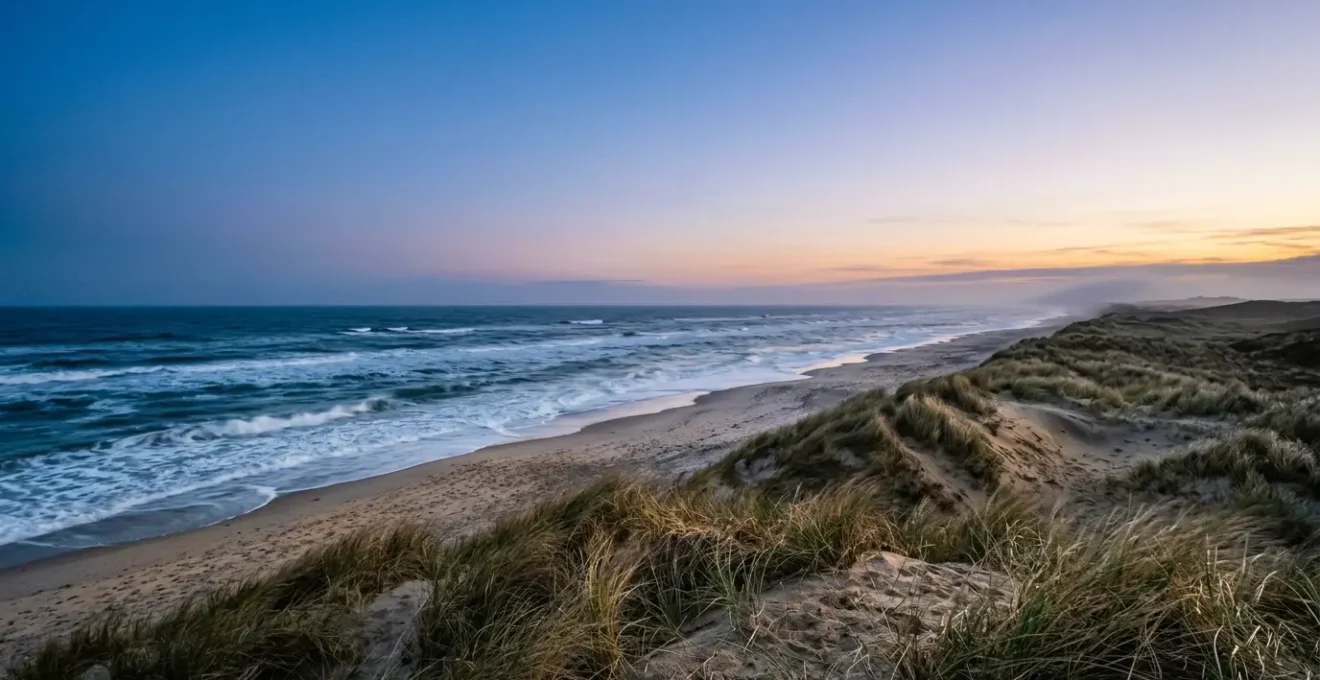
The secret to exceptional Danish coastal photography isn’t just visiting the famous spots; it’s mastering the interplay of unique Nordic light, dynamic weather, and coastal geology.
- The raw, powerful North Sea demands wide-angle lenses and storm-chasing tactics, while the serene Baltic Sea is a canvas for minimalist long exposures.
- The legendary ‘blue hour’ in Skagen is a real, extended twilight phenomenon caused by its high latitude, offering a unique window for atmospheric shots.
Recommendation: Plan your photography trips around specific light conditions and coastal characteristics, not just a checklist of locations.
For any landscape photographer, Denmark presents a tantalizing promise: endless coastlines, iconic lighthouses, and a certain ‘hygge’ charm. The internet is filled with postcard-perfect shots of Møns Klint’s chalk cliffs or the iconic Rubjerg Knude Fyr. But capturing the true soul of the Danish coast—the profound drama, the painterly light, the raw, wind-swept energy—requires more than a GPS coordinate and a wide-angle lens. Many guides will tell you where to go, but they seldom explain *why* these places are magical from a photographer’s perspective.
They might mention the Skagen Painters but not deconstruct the specific quality of light they were chasing. They’ll suggest renting a traditional *sommerhus*, but not how to choose one as a strategic photographic base camp. The common advice to “visit at sunset” is a platitude that ignores the complex atmospheric convergence of sea, sky, and land that defines Danish seascapes. This guide moves beyond the what and into the how. It’s a technical and visual deep dive into the elements that create photographic drama.
We won’t just list locations; we will dissect the light, analyze the conditions, and provide a framework for you to create compelling, evocative images. This is about treating the light as the subject and the coastline as its dynamic stage. From the violent waves of the North Sea to the ethereal calm of the Baltic, we’ll explore the dual personalities of the Danish coast. You will learn not just where to point your camera, but how to see, feel, and capture the authentic story of Denmark’s edge.
To navigate this visual journey, this article breaks down the essential knowledge every landscape photographer needs. We will cover the distinct personalities of Denmark’s two seas, the secrets of the Skagen light, practical gear choices, and strategies for tackling the most iconic and challenging locations.
Contents: A Photographer’s Itinerary for the Danish Coast
- North Sea vs Baltic: Which Coast Offers the Most Dramatic Waves?
- Sommerhus Culture: How to Rent a Traditional Cottage by the Sea?
- Why Did Painters Flock to Skagen for the ‘Blue Hour’?
- Windproof or Waterproof: What Jacket Do You Really Need on the Coast?
- The Margueriteruten: Is Following the Flower Signs Worth the Detour?
- How to Tackle the Stairs of Møns Klint Without Exhaustion?
- Dragør or Hornbæk: Which Seaside Vibe Fits Your Personality?
- How to Visit the Meeting Point of Two Seas at Grenen?
North Sea vs Baltic: Which Coast Offers the Most Dramatic Waves?
The first decision in planning a Danish coastal shoot is choosing a sea. Denmark is defined by this coastal duality, and each side offers a completely different photographic canvas. It’s not a question of which is “better,” but which matches the visual story you want to tell. The west coast, facing the North Sea (Vesterhavet), is a theatre of raw power. It’s where you go for untamed energy, towering waves during autumn storms, and vast, windswept dunes. The light here is often harsh and dramatic, cutting through storm clouds to create high-contrast scenes.
To capture this scale, a wide-angle lens (14-35mm) is your primary tool. Your technique will be reactive, capturing the decisive moment a wave crashes. Long exposures are possible, but they will be about capturing motion blur and kinetic energy rather than creating a serene effect. Be prepared for constant salt spray; a high-quality lens cloth and protective rain covers are not optional here, they are essential for survival.
Conversely, the Baltic Sea (Østersøen) coast, including the islands of Møn and Bornholm, offers a completely different aesthetic. The water is often calmer, creating opportunities for minimalist and contemplative compositions. This is the domain of the neutral density filter. Using a 3-stop to 10-stop ND filter allows you to smooth the water’s surface into a glassy, ethereal plane, isolating piers, rocks, or a distant shoreline. The light feels softer, and the colour palette leans towards subtle pastels, especially during the long twilight hours. Here, your compositions are more deliberate, focusing on leading lines, negative space, and the quiet dialogue between water and sky.
Sommerhus Culture: How to Rent a Traditional Cottage by the Sea?
To truly immerse yourself in the Danish coastal landscape, you must embrace the concept of the *sommerhus* (summer house). This isn’t just accommodation; it’s a cultural institution and a photographer’s greatest strategic asset. Renting a cottage by the sea provides a base camp for capturing the fleeting magic of golden and blue hours without long pre-dawn drives. The goal is what can be termed “operational hygge”—using this cozy cultural icon as a practical tool for your craft. With over 40,000 holiday homes available for rent across the country, the options are vast, but a photographer’s criteria are specific.
When searching on Danish rental portals, use keywords that prioritize the view: ‘panoramaudsigt’ (panoramic view), ‘havkig’ (sea glimpse), or, the holy grail, ‘første række’ (first row/beachfront). Don’t just look at the view *from* the cottage; analyze its architecture. A traditional thatched roof on Fanø or a modern, glass-fronted home nestled in the West Coast dunes can become a powerful subject in itself, especially when framed against a dramatic sky. Ensure your chosen cottage is within a 500-meter walk of a wild, unpopulated beach to make those early morning and late evening shoots effortless.
Consider an off-season strategy. Booking in autumn (September-November) not only means rental prices can be 30-50% lower, but it also places you on the coast during the storm season—the prime time for dramatic wave photography on the North Sea. Inside, look for amenities that support your work: west or north-facing windows for beautiful, soft interior light, and ideally, a safe, weatherproof space to store and clean your gear after a session in the salt and sand.
Why Did Painters Flock to Skagen for the ‘Blue Hour’?
The legend of the Skagen Painters is deeply woven into the fabric of Danish art history. Artists like P.S. Krøyer and Michael Ancher were drawn to Denmark’s northernmost tip in the late 19th century, not just for the picturesque fishing villages, but for something far more elemental: the light. The famed ‘blue hour’ of Skagen is not a myth; it’s a tangible, photographically exploitable atmospheric phenomenon. Its uniqueness stems from Skagen’s high-latitude location and the convergence of two seas, which creates an extended period of twilight where the sky and water seem to dissolve into a single, luminous entity.
The celebrated painter Peder Severin Krøyer articulated this obsession perfectly, as documented in a catalog from Bruun Rasmussen Auctioneers. He stated:
There is a time of day I cannot resist in Skagen. It is when the moonlight quietly lingers above the beach. You will find me there immediately with my sketchbook.
– Peder Severin Krøyer, Bruun Rasmussen Auctioneers Exhibition Catalog
This wasn’t just poetic sentiment; it was a technical observation of light. For a modern photographer, this ‘blue hour’ typically occurs 20-40 minutes after sunset, providing a generous window of soft, cool, and beautifully diffused omnidirectional light. This is the moment to create images with a painterly quality, where harsh shadows vanish and the world is rendered in a palette of blues, lavenders, and soft greys.
Case Study: Deconstructing Krøyer’s ‘Summer Evening on Skagen’s Southern Beach’
Krøyer’s iconic 1893 masterpiece is a masterclass in capturing the blue hour. The painting’s composition places its two figures according to the rule of thirds, using them as an anchor against the vast, atmospheric backdrop where the horizon line is almost completely lost in mist. The genius of the work lies in its ability to capture the merging of sea and sky into unified blue tones. To replicate this effect photographically, you must shoot during that transitional period when the primary light source is the sky itself, not the sun. Use a longer lens (85mm or more) to compress the scene, and slightly underexpose to deepen the blues and create a sense of contemplative melancholy.
Windproof or Waterproof: What Jacket Do You Really Need on the Coast?
On the Danish coast, your outerwear is as critical as your camera gear. The weather is not an inconvenience; it’s a defining feature of the landscape and a constant challenge. Choosing the right jacket isn’t a matter of fashion, but of function and survival. The primary debate is between windproof and waterproof, but the reality is that the best choice depends entirely on which coast you are shooting. The two environments present vastly different challenges, demanding different technical specifications from your gear.
The West Coast (Vesterhavet) is dominated by one single, relentless force: wind. A jacket that is merely “wind-resistant” will fail. You need a shell that is 100% windproof to prevent convective heat loss, which can chill you to the bone even on a sunny day. Here, waterproofing is a secondary, albeit important, feature. On the other hand, the Baltic coast is known for more variable conditions with sudden, unpredictable rain showers. A balanced, breathable jacket with a good waterproof membrane is more practical. The following table breaks down the requirements for a photographer.
| Coast Region | Primary Weather Challenge | Essential Jacket Feature | Recommended Water Resistance | Critical Additional Gear |
|---|---|---|---|---|
| West Coast (Vesterhavet / North Sea) | Constant wind (15-30 km/h average) | Windproof (100% windproof rating mandatory) | 10,000mm+ water column | Sand-proof zippers, reinforced cuffs |
| Baltic Coast (Bornholm, Møn) | Variable conditions, sudden rain | Balanced wind/waterproof (breathable membrane) | 5,000-10,000mm water column | Packable design for weather changes |
| Skagen / Grenen (Two Seas) | Extreme exposure, salt spray | Both windproof AND waterproof | 15,000mm+ water column | Hood with visor, extended back hem |
| Danish Riviera (North Zealand) | Mild but breezy | Light windbreaker sufficient | 3,000mm water column | Layering system more critical |
Protecting yourself is only half the battle; protecting your camera is equally vital. Sand, salt, and moisture are the enemies of delicate electronics and optics. A disciplined protection protocol is non-negotiable for any serious coastal photographer.
Your Coastal Gear Protection Audit
- Seal All Entry Points: Before every beach session, confirm that a dedicated rain cover is fitted over your camera and that all seams and ports are sealed with painter’s tape to prevent sand infiltration.
- Inventory Your Cleaning Kit: Verify that you have a clean, dry microfiber cloth stored in a sealed plastic bag, ready for immediate use against salt spray on your lens elements.
- Assess Your Stability Rig: For windy conditions, ensure your tripod is weighted down with a sandbag or your camera bag is hooked to the center column to prevent catastrophic tip-overs.
- Define Your Lens Strategy: Prioritize the use of weather-sealed lenses. Have you mounted a UV filter on each lens as a sacrificial barrier against abrasive sand and corrosive spray?
- Establish a Post-Shoot Protocol: Have a damp, freshwater cloth ready to wipe down all metal surfaces and lens barrels immediately after returning from the coast, before salt deposits can dry and cause damage.
The Margueriteruten: Is Following the Flower Signs Worth the Detour?
The Margueriteruten (Marguerite Route) is a 4,218 km scenic tourist route that winds through Denmark’s most beautiful landscapes, marked by distinctive brown signs with a daisy flower. For a road-tripping photographer, it seems like the perfect ready-made itinerary. However, following it blindly can be a mistake. While the route does connect many of Denmark’s gems, it also meanders through less photogenic inland agricultural areas. The key is to use the Margueriteruten strategically as a backbone, not as a rigid set of directions.
Your goal is to identify the specific segments that offer the most dramatic coastal access. For instance, the section that follows the Wadden Sea National Park in Western Jutland is unmissable. It guides you through vast, horizontal landscapes perfect for capturing the graphic beauty of tidal flats at low tide. Similarly, the coastal loop in North Zealand around the fishing villages of Gilleleje and Hornbæk offers a perfect blend of charming architecture and accessible beach viewpoints, ideal for lifestyle-oriented coastal photography.
Equally important is knowing when to ignore the daisy signs. Between Ringkøbing and Skive, for example, the route moves inland. A photographer chasing storm clouds over the North Sea would be better off bypassing this section and taking the more direct Highway 11 to reach the wild beaches near Thy National Park faster. Think of it as creating your own “Storm Chaser’s Route,” linking exposed headlands like Bovbjerg Fyr and Rubjerg Knude—places that aren’t always on the official path but offer maximum photographic drama. Use the route for inspiration, but let satellite imagery on Google Earth be your ultimate guide, revealing the small, unmarked ‘stikvej’ (access roads) that lead to hidden coves and deserted stretches of sand.
How to Tackle the Stairs of Møns Klint Without Exhaustion?
Møns Klint is one of Denmark’s most breathtaking natural wonders. The brilliant white chalk cliffs plunging into the turquoise Baltic Sea are a photographer’s dream. But accessing the prime shooting location—the beach at the base of the cliffs—requires conquering a formidable obstacle: the main staircase at GeoCenter Møns Klint. This descent involves a staggering 497 steps down to the beach, and, more importantly, 497 steps back up. For a photographer laden with a heavy camera bag and tripod, this is a serious physical challenge that demands a strategy.
The key is not to avoid the stairs, but to use them to your advantage. The most rewarding light on the east-facing cliffs is at sunrise. This means beginning your descent in the pre-dawn darkness, using a headlamp to navigate. Aim to be on the beach at least 30 minutes before sunrise to set up and compose your shots as the first light kisses the white chalk. The stairs themselves offer unique compositional opportunities. Don’t rush. Stop at the viewing platforms located approximately 150 and 300 steps down. These spots provide elevated perspectives of the coastline that most visitors miss, perfect for using a telephoto lens (70-200mm) to compress the layers of cliffs.
If the main staircase seems too daunting, employ the “two-point visit” hack. First, capture the classic clifftop overview from the area near the GeoCenter. Then, drive 15 minutes to a different access point, such as the beach near Liselund Park, where you can photograph chalk formations at ground level with minimal walking. Once at the beach, your work isn’t over. During the golden hour, the pebble-strewn shore is a fantastic place to hunt for belemnite fossils. These small, dark, bullet-shaped remains of ancient cephalopods make for compelling macro foreground elements against the bright cliffs. Finally, budget your energy for the ascent. Allow a full 45-60 minutes, stopping every 100 steps to rest and shoot upward-looking compositions of the wooden staircase disappearing into the dense beech forest above.
Dragør or Hornbæk: Which Seaside Vibe Fits Your Personality?
For photographers based in Copenhagen, the question of a quick coastal escape often comes down to two classic destinations: Dragør and Hornbæk. While both are charming seaside towns, they offer vastly different photographic “vibes” and cater to different creative personalities. Choosing between them depends on the type of story you want your images to tell. Dragør is a journey back in time; Hornbæk is a celebration of contemporary coastal life.
Dragør, just a 20-minute drive south of the city, is a perfectly preserved 18th-century fishing village. Its photogenic drama lies in its historical narrative and timeless architecture. The signature shots here are intimate and moody: cobblestone streets slick with rain, the warm glow of light from yellow-thatched houses at dusk, and lone fishing boats shrouded in morning fog. Being east-facing, Dragør is a prime location for dramatic sunrise photography over the Øresund strait. A 35mm or 50mm prime lens is perfect for capturing its architectural details and quiet, narrow street perspectives.
Hornbæk, on the other hand, is part of the “Danish Riviera” on North Zealand’s coast. It’s about an hour’s drive away and exudes a completely different energy. Its drama is one of social vibrancy and expansive shoreline. This is where you go to capture the Danish beach lifestyle: long shadows of people walking on the dunes at sunset, wide panoramic shots of the Hamptons-like beach, and the clean architectural lines of modern beach huts. Its north-facing position grants it a beautiful, extended golden hour during the summer evenings, making it ideal for lifestyle portraits and silhouettes. An ultra-wide zoom like a 16-35mm is essential for capturing the sheer scale of the beach.
Your choice ultimately depends on your artistic intent. Do you seek quiet, historical melancholy or bright, energetic coastal scenes? This comparison can help you decide.
| Photography Aspect | Dragør (Historic Harbor) | Hornbæk (North Coast Beach) |
|---|---|---|
| Photogenic Drama Type | Historical narrative & timeless architecture | Social energy & expansive coastal lifestyle |
| Signature Shot List | Thatched roofs against grey skies, lone boats in harbor fog, cobblestone reflections at dusk | Long shadows on dunes at sunset, silhouettes against vibrant beach life, wide Hamptons-like shoreline panoramas |
| Optimal Light Direction | East-facing across Øresund—prime for dramatic sunrise photography (6:00-7:30 AM) | North coast position offers extended golden hour in summer evenings (8:00-10:00 PM) |
| Best Season for Drama | Autumn/winter for moody fog and minimalist compositions | Summer for active beach lifestyle scenes; late spring for pristine empty dunes |
| Lens Recommendations | 35mm or 50mm for intimate architectural details, 24mm for narrow street perspectives | 16-35mm ultra-wide for expansive beach panoramas, 85mm for lifestyle portraits with compression |
| Distance from Copenhagen | 12 km (20 min drive)—ideal for sunrise missions | 50 km (50 min drive)—requires dedicated half-day minimum |
Key takeaways
- Master the Duality: The key to Danish coastal photography is understanding the two “canvases”: the raw, powerful North Sea for storm drama and the serene, calm Baltic for minimalist compositions.
- Light is the Subject: Don’t just visit famous places; plan your shoots around specific light phenomena like the extended ‘blue hour’ in Skagen or the low-angle winter sun on the West Coast.
- Gear for the Elements: A 100% windproof jacket is non-negotiable for the West Coast, and a disciplined gear protection protocol against sand and salt is essential for all coastal work.
How to Visit the Meeting Point of Two Seas at Grenen?
Grenen, the sandy spit at Denmark’s absolute northernmost point, is a place of immense geographical and photographic significance. It is here that the Skagerrak (part of the North Sea) and the Kattegat (part of the Baltic Sea) visibly collide, creating a unique line of turbulence in the water. For a photographer, the appeal is obvious: to capture the elemental power of two seas meeting. However, this iconic status comes with a significant challenge: crowds. Grenen attracts approximately 2 million visitors per year, making it one of the country’s busiest tourist spots.
To capture a clean, powerful, and uncrowded shot of this natural spectacle, timing is everything. The vast majority of visitors arrive between 10 AM and 4 PM, often taking the ‘Sandormen’ (The Sand Worm) tractor bus from the parking lot to the tip. Your strategy must be to avoid this peak window at all costs. The best photographic opportunities are at the extremes of the day: sunrise and sunset. A pre-dawn visit will reward you with solitude, soft morning light, and the chance to photograph the dramatic wave patterns without a single footprint in the sand. Similarly, staying late after the last tractor bus has departed allows you to experience the landscape in the golden and blue hours, creating far more atmospheric and memorable images.
From a compositional standpoint, don’t just focus on the thin line of sand. Look for the contrast in the character of the waves on either side. Use a polarizing filter to manage reflections and enhance the colour difference in the water. A telephoto lens can be surprisingly effective here, allowing you to compress the distant waves and emphasize the turbulence at their meeting point. Most importantly, be patient. The magic of Grenen isn’t just a static point on a map; it’s a dynamic, ever-changing interaction of water, light, and weather. Capturing its essence requires observing these changes and being ready when the perfect moment of convergence occurs.
Now that you are equipped with the technical knowledge and location insights, the next step is to synthesize this information into a cohesive plan for your own photographic journey along the Danish coast.